
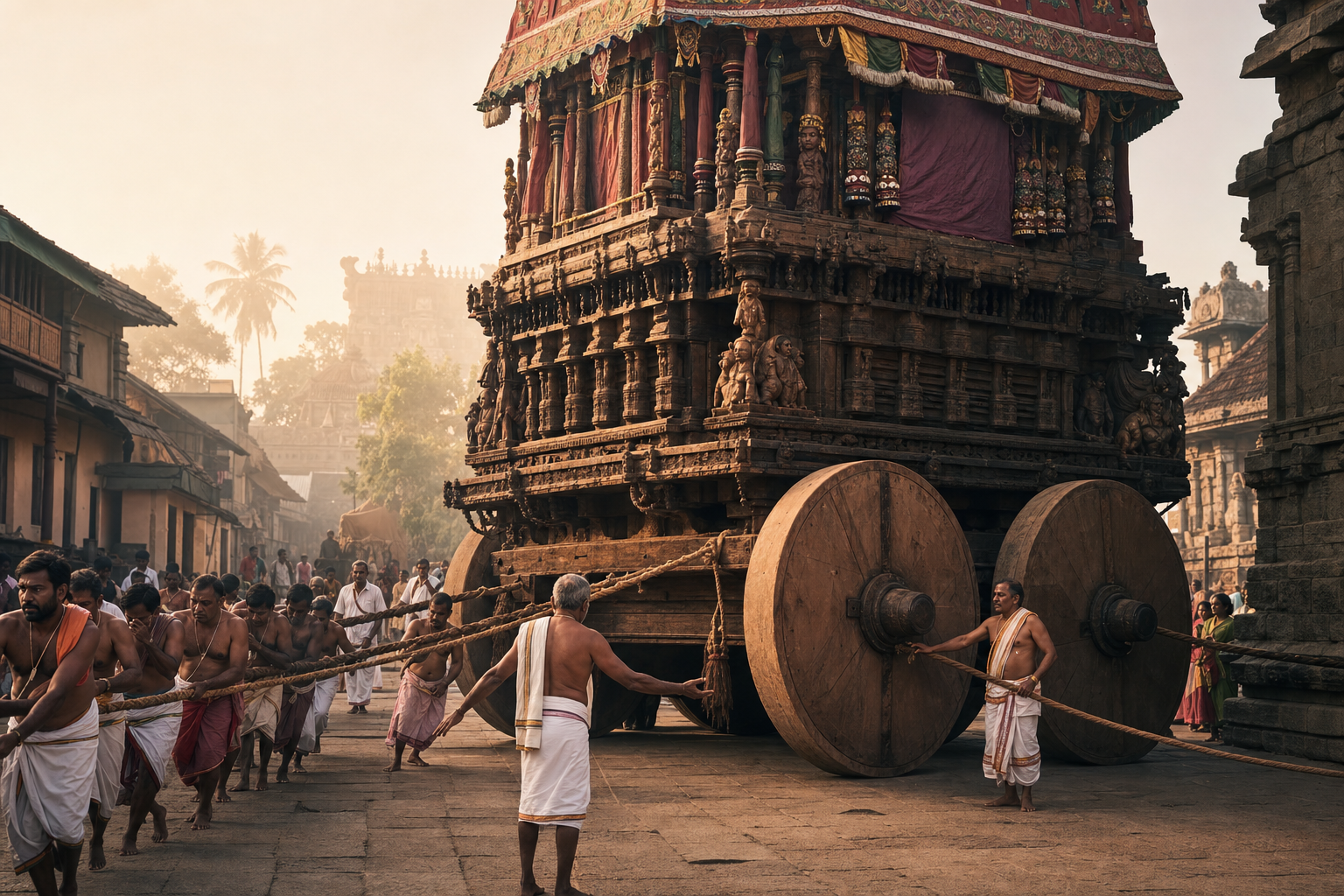
You are standing beside a towering temple chariot, looking at carved timber, immense wheels, long ropes, priests, volunteers, and a street filling with devotees. Is this architecture, sculpture, transport, or worship? The most useful answer is that it is all four, coordinated for one sacred movement.
To understand a ratha, don’t begin by asking how old or large it is. Ask what must remain ritually correct while a heavy, decorated structure carries the deity through a real town. That question reveals why the wheel, joint, rope, route, command, and act of seva belong to one system.
The procession sets the engineering brief
A temple chariot is not ordinary transport with sacred decoration added afterward. Its first requirement is ritual: the utsava-murti travels beyond the temple walls so devotees can receive public darshan. The deity’s journey extends the temple’s presence into streets, neighborhoods, and marketplaces. The route therefore carries theological meaning before anyone calculates its gradient or turning radius.
That purpose produces a demanding design brief. The ratha must bear the festival image and its ritual setting, present recognizable iconography, allow prescribed ceremonies to occur, move through the available streets, and accept the coordinated effort of a large community. A solution that moves efficiently but disrupts the ritual is incomplete. So is a visually impressive structure that cannot negotiate its route safely.
- Ritual identity: The canopy, colors, guardians, sculpted panels, and other motifs must express the deity and the temple’s regional tradition.
- Structural integrity: Wheels, axles, platform, joints, lashings, and upper structure must work as one load-bearing assembly.
- Route compatibility: Overall height, gradients, street width, turning space, crowds, electrical lines, and urban fixtures shape what can move and where.
- Collective control: Ropes make broad participation possible, but calls, spotters, chocks, wedges, and disciplined timing turn many individual efforts into controlled motion.
The Katha Upanishad offers a philosophical lens for this controlled movement. The body is the chariot, the Self its passenger, buddhi the charioteer, manas the reins, the senses the horses, and sense-objects the roads. This is not a construction manual, but it prevents a shallow reading of the ratha as spectacle. Power must be directed. Movement without discrimination is not progress.
You can apply that insight at a festival. Notice not only when the chariot moves, but what governs its movement. Who authorizes departure? Which ritual acts require a halt? How do pullers receive a start, slow, or stop call? Where does the procession turn, and why? The answers show how theology becomes an operating requirement.
Read the ratha from the route upward
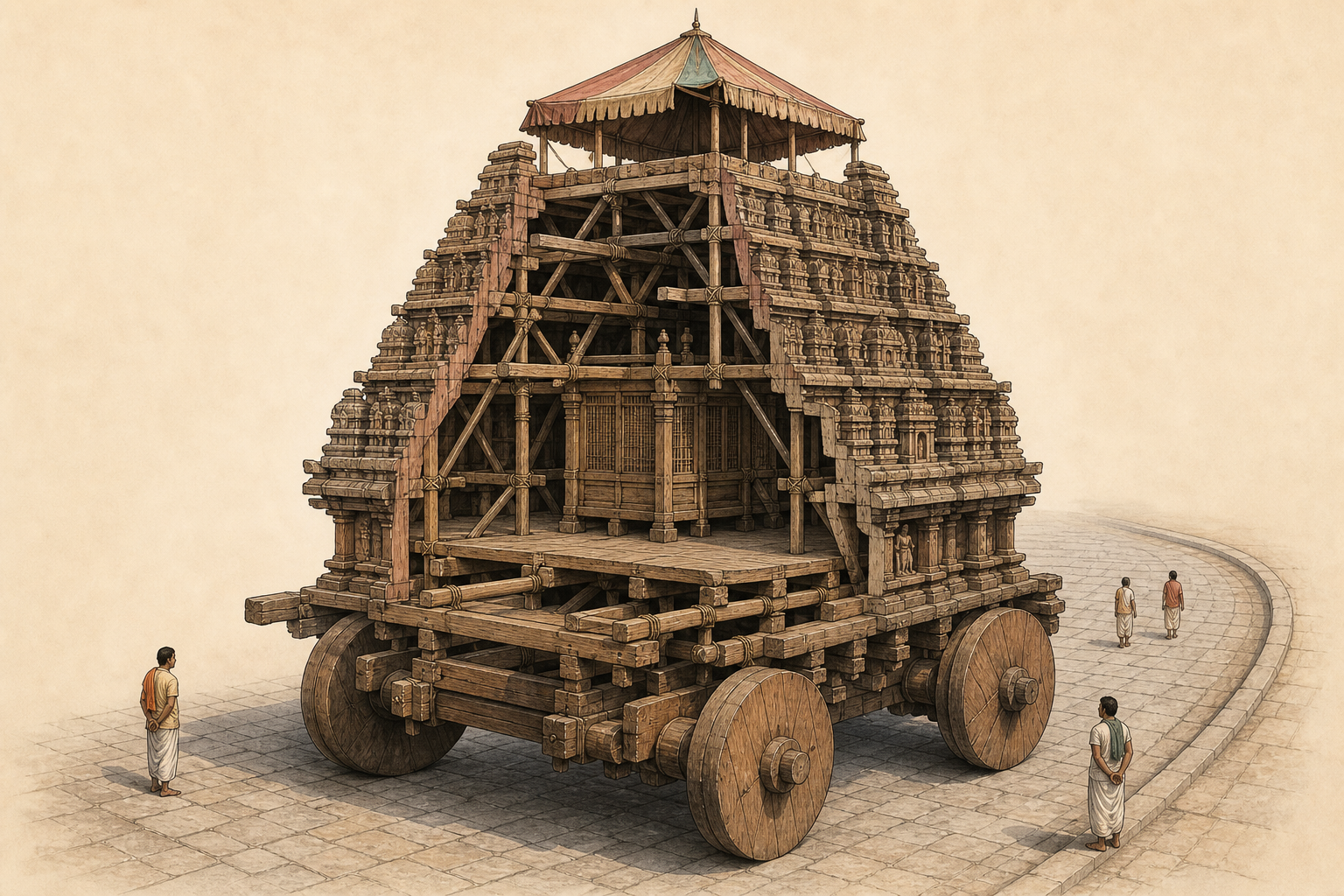
Ornament attracts the eye first, but the ratha becomes easier to understand when you read it in engineering order. Begin with the conditions in which it must move, then trace how each physical layer answers them.
- Begin with the route. A traditional procession still occupies a present-day street. Gradients, bends, turning radii, crowd space, overhead lines, and roadside fixtures are functionally part of the vehicle’s design problem. If any of these conditions change, last year’s successful passage is useful experience, not automatic proof that this year’s passage is safe.
- Examine the wheels and axles. Wheel diameter, axle placement, and platform stability are related decisions. They determine how the lower structure carries its burden and how the ratha behaves at starts, turns, slopes, and halts. A large wheel is not merely a visual statement; it belongs to the running geometry of the car.
- Look for the structural frame. Traditional builders use robust hardwoods, mortise-and-tenon joints, rope lashings, and repairable assemblies. The important quality is not the romantic appearance of wood. It is the coherence of the joined system and the ability of knowledgeable craftspeople to inspect, renew, assemble, and repair it.
- Separate the platform from the upper works. Monumental canopies and carved superstructures give the ratha its vertical presence, while modular construction can make inspection, repair, or periodic assembly possible. Ask which parts carry structural loads and which establish sacred identity; a single element may do both.
- Follow the traction and control system. Long ropes distribute pulling effort among many participants. Chocks, wedges, stabilizers, and spotter-calls help crews manage pauses, slopes, or constrained turns. The rope supplies connection and force, but control comes from agreed roles and signals.
This bottom-up reading corrects two common misjudgments. The first is to treat engineering as an invisible, secular support for the meaningful ritual above it. In fact, the ritual can occur only because material, route, and labor have been ordered around it. The second is to treat traditional construction as the opposite of technical thinking. Joinery, modularity, repair cycles, route geometry, and coordinated traction are technical knowledge, even when that knowledge is transmitted through a hereditary craft lineage rather than a modern factory drawing.
Don’t infer the entire construction method from what is visible during the procession. Cloth, paint, and carved panels can conceal structural members. If you are documenting a ratha, distinguish direct observation from information supplied by its builders. Record the local name for each component rather than forcing every regional form into one generic diagram.
A crowd supplies force; discipline supplies control
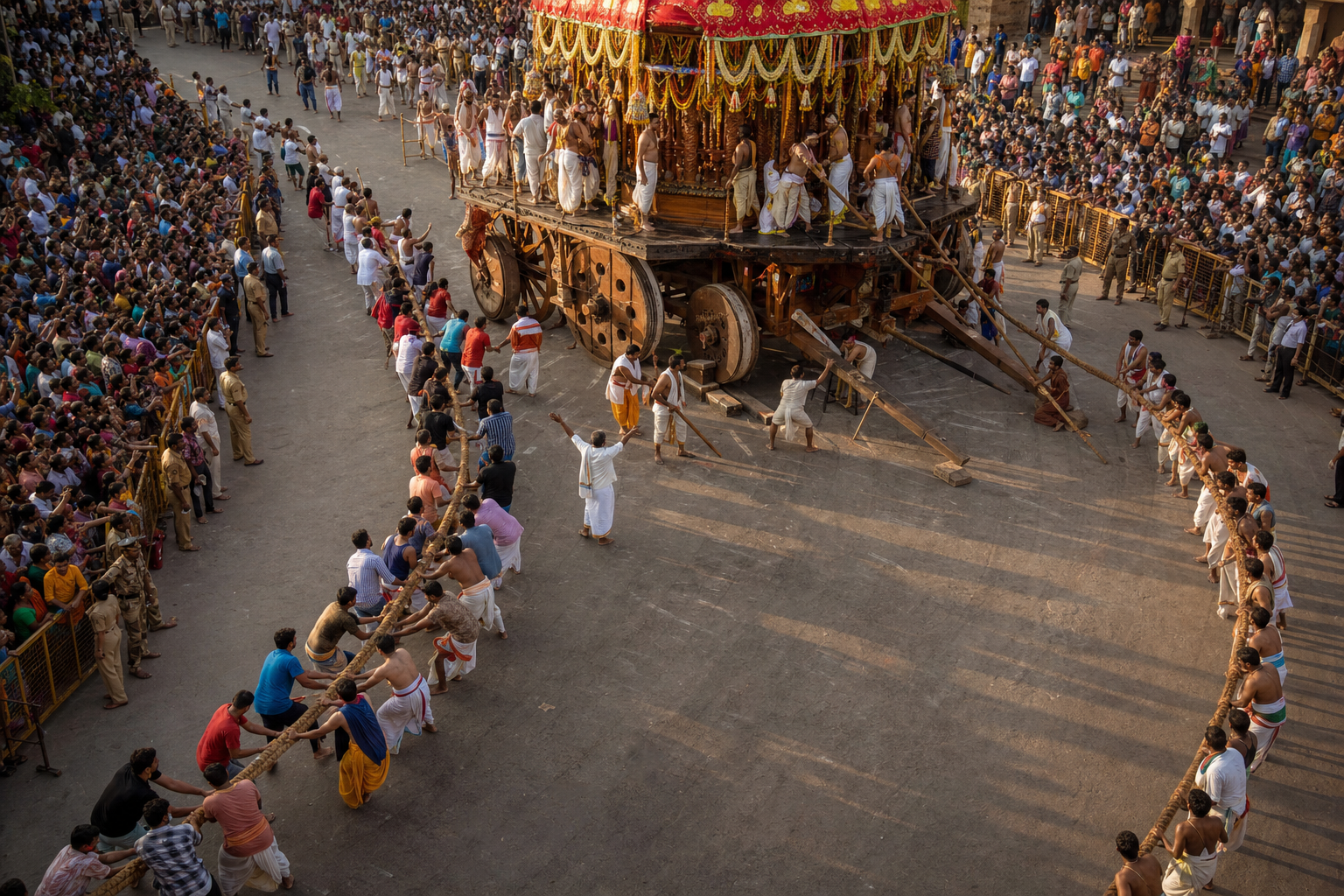
The public pull is one of the ratha’s most powerful acts of inclusion. It also creates the central operational challenge: many people must act together around a large moving structure. More hands do not automatically produce better control. Shared commands, defined working zones, and restraint are what make collective strength usable.
Think of the procession as a distributed control system. Priests govern ritual timing. Carpenters and other craftspeople understand the structure. Rope teams provide traction. Spotters watch wheels, clearances, and constrained points. Musicians and callers help sustain a common rhythm. Temple organizers and municipal teams manage the route, crowd, and civic infrastructure. The categories can overlap locally, but the responsibilities cannot simply disappear.
If you are helping to organize a rathotsava, test the interfaces between those responsibilities. A component inspection is of limited value if its findings never reach the movement team. A route plan is incomplete if the people calling the pull do not know its tightest turn. A ceremonial schedule becomes a safety problem if the structural crew does not know when devotees will be invited near the stationary ratha.
- Before movement: Confirm who has authority to start, slow, halt, and resume. Walk the actual route, check height and turning constraints, inspect the working components, and make sure volunteers understand their assigned positions.
- At the first pull: Use the designated call rather than allowing scattered pulling. The beginning of motion is a controlled transition, not a contest to show enthusiasm.
- At turns and slopes: Give spotters, chock teams, and other control crews the space to work. Clear instructions must reach pullers before the ratha enters the constrained point.
- At a halt: Secure the ratha through the locally approved procedure before opening its working area. Ritual urgency should never be used to bypass physical control.
- After the procession: Record wear, repairs, component changes, route obstructions, and communication failures while the details are still clear. That record strengthens the next inspection rather than replacing it.
For organizers, inherited expertise should be joined to a current structural, electrical-clearance, route, and crowd-safety review. Modern streets can introduce overhead lines and urban fixtures that older routes were never designed around. When the structure, route, or expected crowd changes materially, qualified engineering and public-safety review is safer than assuming a previous festival settles the question.
As a visitor, treat the marshals’ boundary as part of the ritual order. Do not enter the wheel path, cross an active rope zone, seize a rope before the authorized call, or approach a halted chariot until the working area has been opened. The sacred pull is collective seva, not an individual entitlement. Restraint can serve the procession as meaningfully as physical effort.
Renewal and preservation are two forms of continuity
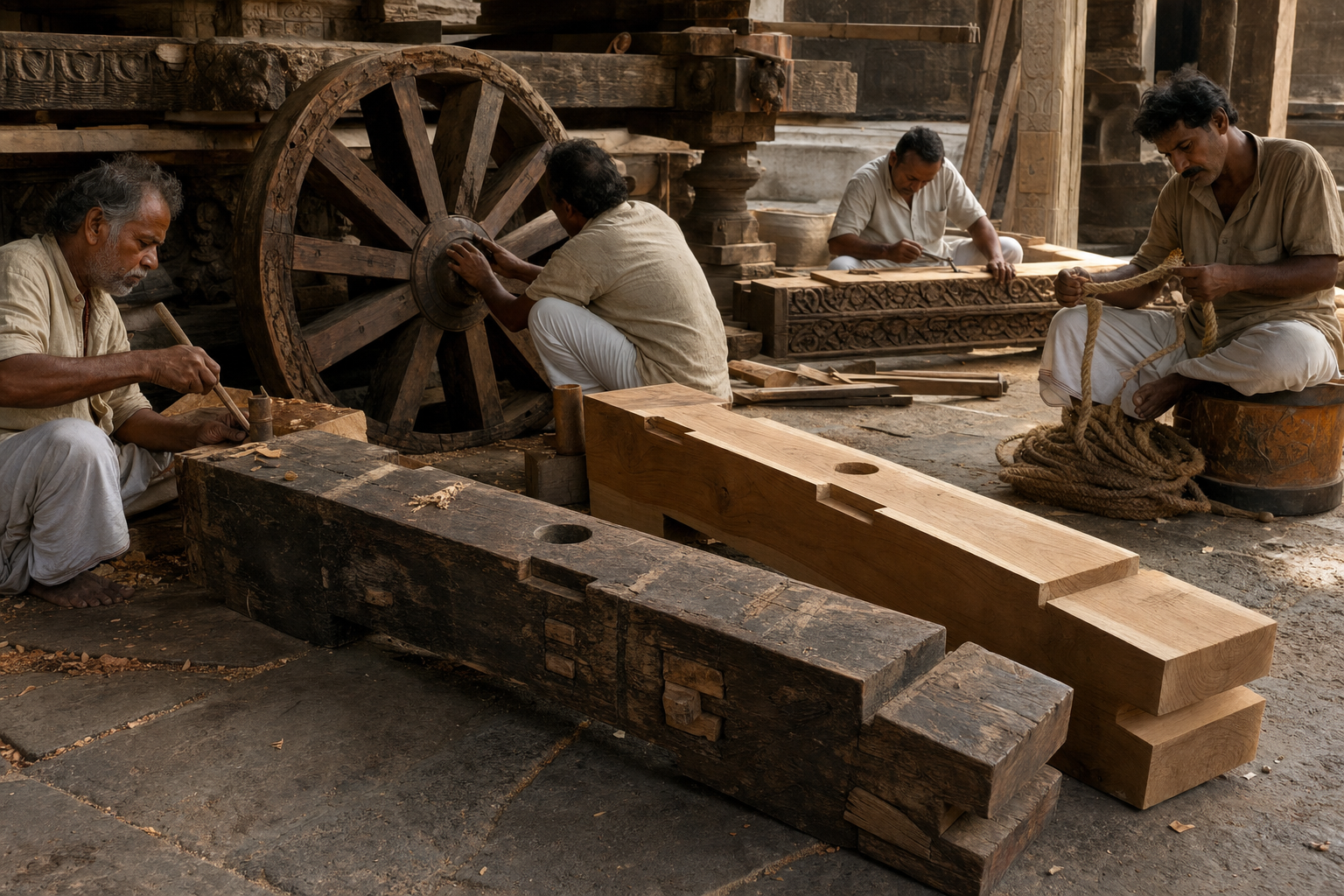
A living ratha tradition does not preserve every material object in the same way. At Puri, distinct chariots for Jagannath, Balabhadra, and Subhadra are newly constructed each year by hereditary artisans for the journey along the Badadanda to the Gundicha Temple and back. In other traditions, major chariots remain in service for decades through cycles of inspection, repair, and refurbishment.
These are not opposing choices between authenticity and change. They locate continuity in different places. Annual reconstruction places unusual weight on transmitted measurements, joinery, work sequence, iconographic rules, and a functioning community of makers. Long-term maintenance places more weight on stewardship of an existing structure, timely repair, replaceable modules, and access to craftspeople capable of judging what can remain in service.
| Renewal pattern | What carries continuity | What a heritage record should clarify |
|---|---|---|
| Reconstruction for each festival cycle | Craft lineage, proportions, joinery, ritual sequence, and iconographic rules | Who holds the knowledge, which materials and components are prescribed, and how skills pass to the next generation |
| Long-lived chariot with periodic refurbishment | The maintained structure together with established repair knowledge | Inspection and repair history, component replacements, current condition, and the craftspeople responsible |
This distinction matters when you evaluate conservation. Calling every replacement a loss can weaken a tradition in which authorized renewal is essential. Calling every old component expendable can erase historic workmanship in a tradition built around long stewardship. Before choosing a preservation policy, establish where that temple locates the ratha’s ritual identity and which decisions belong to its authorized custodians and craft lineage.
The same care applies to sustainability. Some rathas conserve material through repeated repair; some traditions renew selected components and repurpose material under temple rules. A dharmic resource ethic is not simply a demand to reuse everything. It joins restraint in consumption to respect for sanctity, fitness for use, and the proper treatment of retired material.
What the community preserves is larger than the vehicle. The ratha’s structure and imagery communicate knowledge, or jnana. Darshan, music, and the deity’s presence cultivate bhakti. Building, painting, cleaning, pulling, directing, and repairing become karma expressed as seva. If a festival protects the spectacle but loses its makers, or celebrates participation while neglecting disciplined control, part of that integrated inheritance has been weakened.
A field guide for your next rathotsava
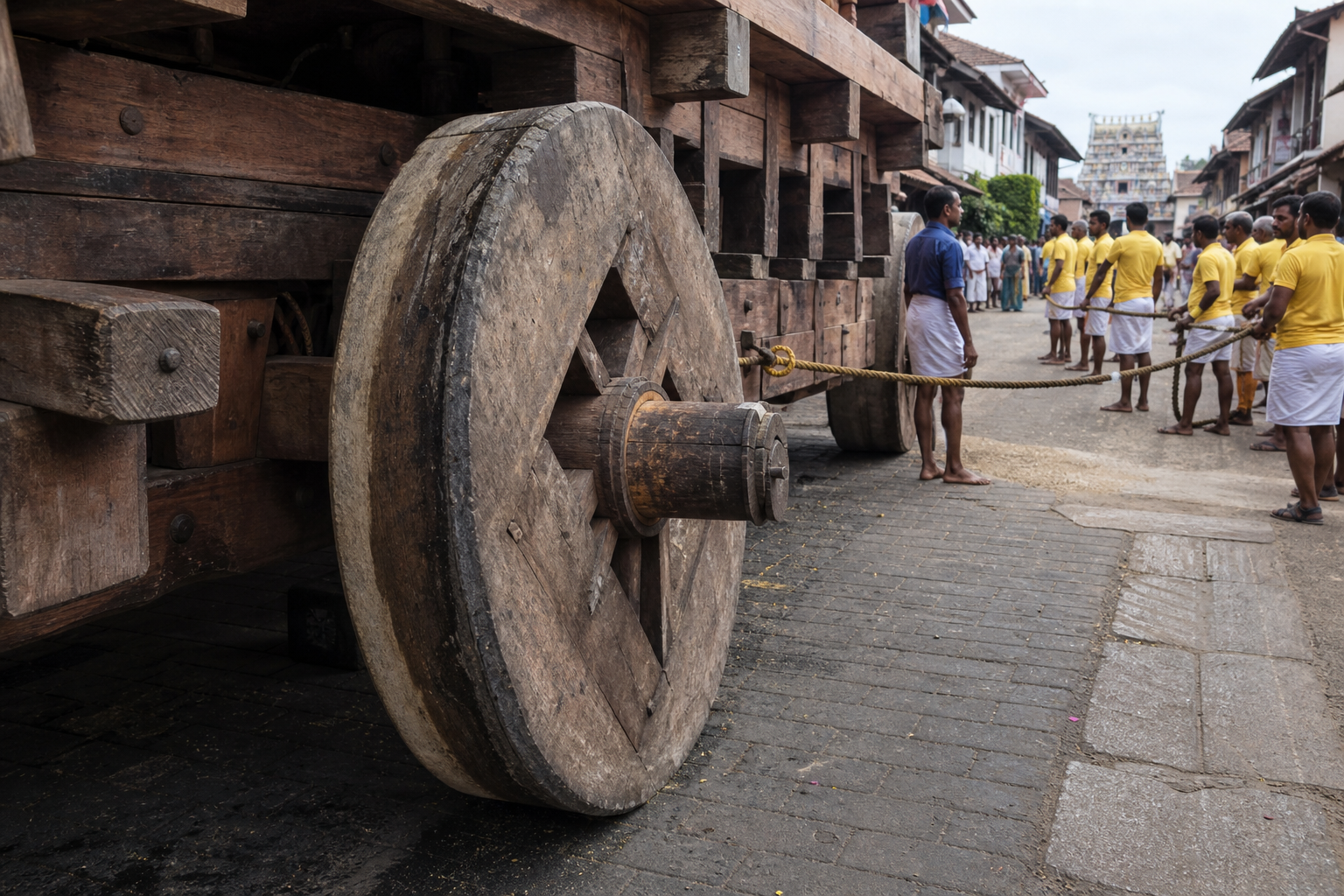
You do not need to be an engineer or ritual specialist to see this system clearly. At your next temple-car festival, choose a few observations and follow them carefully instead of trying to absorb the whole procession at once.
- See the ratha while it is stationary. If local access rules permit, arrive before movement. Trace the visible relationship from wheel and axle to platform, frame, and superstructure. Note which structural parts are exposed and which are concealed by festival decoration.
- Watch the change from temple to street. Notice how ritual authority, music, volunteers, and crowd organization gather around the utsava-murti’s outward journey. This transition explains why the ratha cannot be reduced to a vehicle.
- Follow one movement problem. Choose the initial pull, a turn, a slope, a clearance point, or a halt. Watch who looks, who calls, who acts, and who waits. The sequence will tell you more about the quality of control than the size of the crowd.
- Notice work that receives little attention. Look for the people checking ropes, watching wheels, clearing the route, placing controls, cleaning, painting, repairing, and managing spectators. Public pulling is only the most visible layer of seva.
- Ask one precise question. Useful questions include: Which components were renewed this year? Who inspects the wheels, axles, joints, and ropes? How were the turning points and overhead clearances checked? Which colors or carvings identify this deity? Who gives the movement calls?
Listen carefully to the answer, but interpret silence fairly. A volunteer’s inability to explain the joinery is not evidence that the builders lack knowledge. By contrast, a movement volunteer who does not know the stop call points to a real operational gap. Direct each question to the people responsible for that part of the system.
Do not rank rathas mainly by height, age, ornament, or attendance. A better test is coherence: does the form express the deity, does the structure suit the route, do controls match the physical risks, can the craft knowledge be transmitted, and does public participation remain ordered around darshan and seva?
Key takeaways
- A ratha’s engineering brief begins with the deity’s ritual journey, not with transportation alone.
- Read the system from route to wheels, frame, superstructure, ropes, and control calls.
- Collective pulling works only when authority, signals, spotters, and physical controls are clear.
- Continuity may be carried through annual reconstruction or long-term refurbishment; neither model should be judged without its local ritual context.
- Craft knowledge, disciplined participation, and responsible restraint are all forms of seva.
At the next rathotsava, watch one transition closely: the threshold crossing, first pull, difficult turn, or secure halt. There you will see the ratha’s deepest achievement. Wood, geometry, inherited knowledge, devotion, and thousands of human decisions become one measured sacred movement.
References
