

You cannot guarantee that your last hour will be quiet, painless, or medically uncomplicated. You can make sure it is not the first hour in which you try to remember the Divine, release your roles, or trust something deeper than the body.
That is the practical meaning of preparing for a conscious death. It is not an attempt to choreograph one perfect final thought. It is the patient work of making dharma, remembrance, reconciliation, and surrender familiar enough that they remain available when ordinary control begins to disappear.
Your final thought is a habit, not a last-minute choice
In the Yaksha Prashna, Yudhisthira identifies the great contradiction of human life: we witness beings die continually while living as though we will somehow remain. The point is not to frighten you. It is to expose the assumption that allows preparation to be postponed.
The Bhagavad Gita gives that preparation a clear direction. Verses 2.13 and 2.22 place bodily change, old age, and death within a continuity larger than the present body. Verses 8.5-6 connect the state remembered at death with what consciousness has repeatedly inhabited during life. The final remembrance is therefore not presented as a spiritual password that cancels years of contrary habits. It is the ripening of sustained orientation.
This is why samskara matters. Repeated actions leave tendencies in the mind. Under pressure, you are more likely to fall back on a familiar response than invent a new one. If anxiety normally sends you toward distraction, accusation, or desperate control, serious illness will not automatically reverse that movement. If you have practised returning to mantra, truthful awareness, prayer, or witnessing, that return has already become more familiar.
Begin by completing one sentence in plain language: When my body can no longer support my usual identity, I want my attention to return to ______. Your answer might be Krishna, Shiva, Rama, the Guru, Akal Purakh, the Namokar Mantra, mindful awareness, compassion, or another anchor given by your lineage. Choose one primary anchor. A mind under strain benefits from familiarity, not a collection assembled for spiritual variety.
Do not turn this teaching into perfectionism. Pain, medication, breathlessness, neurological illness, or delirium can affect speech and attention. A person who cannot chant audibly has not thereby failed. In bhakti traditions especially, grace cannot be reduced to a bedside test of cognitive performance. Your responsibility is sincere lifelong preparation; the final result is not an object for the ego to control.
Build a daily practice that can survive a difficult day
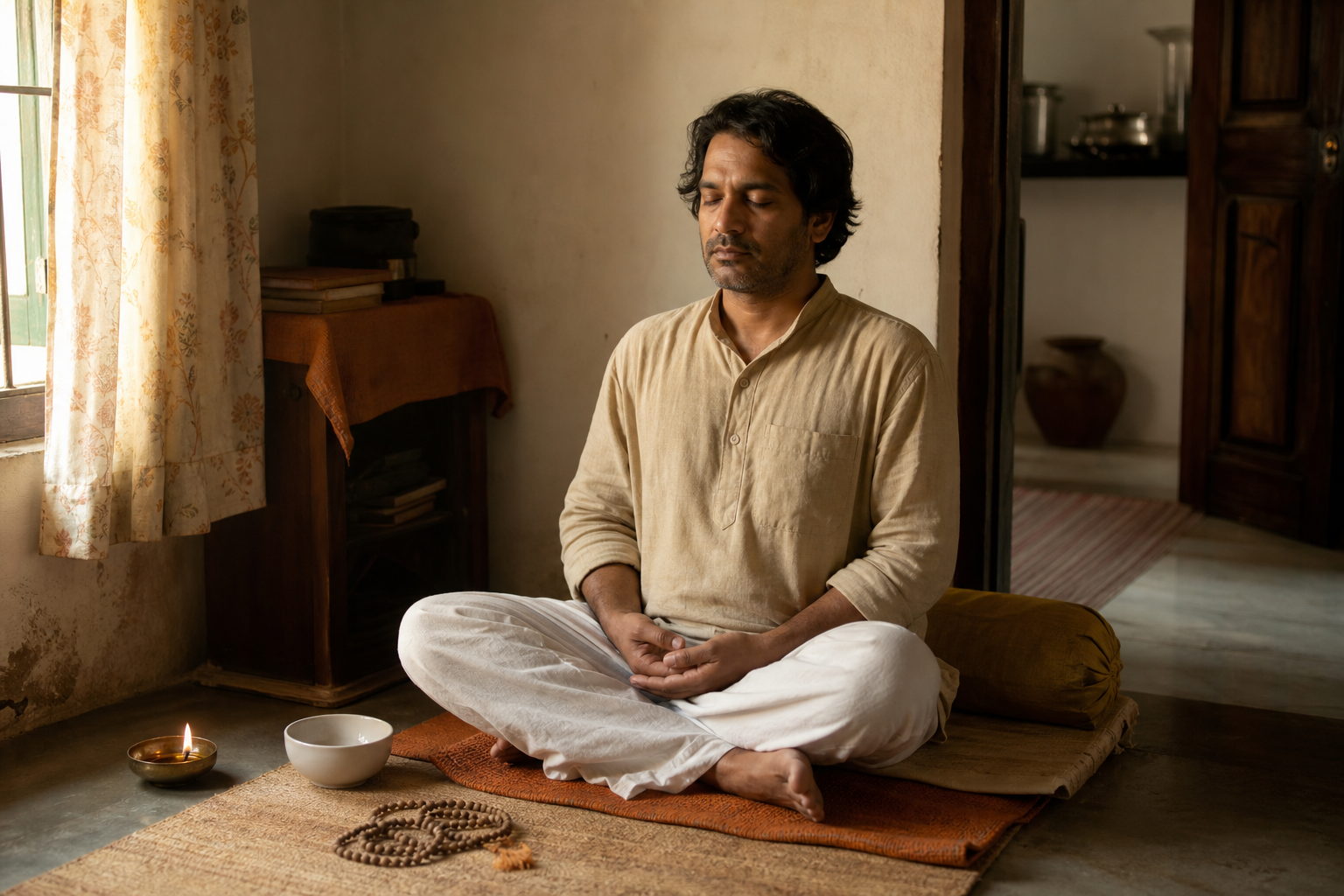
A death practice that works only when the room is quiet and your mind is agreeable is too fragile. Train under ordinary conditions: while tired, disappointed, busy, or mildly uncomfortable. The aim is not intensity. It is dependable return.
- Return to the same sacred anchor at dawn and dusk. Use the mantra or remembrance proper to your path: the Hare Krishna maha-mantra, a Shaiva panchakshari, Buddhist mindfulness or remembrance, the Jain Namokar Mantra, or Sikh Naam Simran. Select a form you can sustain without bargaining with yourself each day.
- Keep one teaching ready for moments of fear. You might learn the meaning of Bhagavad Gita 2.13, 2.22, 8.5, or 8.6 rather than trying to remember an entire library. Ask what the passage requires you to notice when the body changes or the mind begins to grasp.
- Practise steady attention while the body is well enough to learn. Dhyana and gentle pranayama can help you become less reactive to changing sensations. Breath retention or forceful techniques are not appropriate for everyone. If you have a medical condition, learn from a qualified teacher in coordination with a clinician rather than improvising.
- End the day with an ethical inventory. Ask where you caused harm, avoided truth, clung unnecessarily, or failed a duty. Name one correction. Reflection without repair easily becomes another form of self-absorption.
- Make seva regular. Serve without arranging for recognition. Help someone who is ill, elderly, bereaved, isolated, or materially burdened. Service weakens the assumption that your time, comfort, and identity exist only for you.
The elements reinforce one another. Hearing, chanting, scriptural reflection, seva, satsanga, and sanctified nourishment repeatedly redirect attention from self-enclosure toward sacred relationship. Quiet service is especially valuable because it exposes impatience, pride, and the need for visible reward while there is still time to work on them.
Dharmic traditions do not give identical accounts of the self or liberation. A Hindu practitioner may orient toward atman, moksha, or loving service to a personal Divine. Buddhist maranasati develops clear awareness of impermanence and loosens identification with the changing aggregates; anatta should not be quietly rewritten as an eternal-self doctrine. Jain anitya-anupreksha, samayik, ahimsa, tapas, and pratikramana address attachment and karmic residue within a distinct Jain framework. Sikh Naam Simran joins remembrance with hukam, duty, and the Guru’s grace. Their shared practical ground is ethical clarity, trained attention, and reduced grasping, not theological sameness.
Stay within your actual path deeply enough for its language to become instinctive. Borrowing five practices can feel inclusive while preventing any one of them from taking root. Respect between traditions does not require mixing their final aims or treating their disciplines as interchangeable.
Contemplating death should make you more attentive to life, not less able to live it. If the practice repeatedly triggers panic, worsens an existing mental-health condition, or becomes compulsive, pause the contemplation and speak with a qualified mental-health professional. Mantra and meditation can accompany appropriate care; they are not substitutes for it.
Settle what would otherwise pull your attention backward

It is difficult to release the body while fighting unfinished battles about duty, injury, property, status, or family approval. Ethical preparation does not mean becoming flawless before death. It means reducing avoidable agitation while you still have the ability to act.
- Repair harm where repair is possible. Offer a specific apology, return what is not yours, fulfil a neglected obligation, or change the conduct that made the apology necessary. Do not use reconciliation as a reason to re-enter an abusive or unsafe situation; seek appropriate professional or community support instead.
- Distinguish forgiveness from renewed access. You can work on releasing corrosive resentment without denying what occurred or restoring a relationship that remains dangerous.
- Reduce identity dependence. Notice which title, possession, routine, or family role feels indispensable to your existence. Delegate a task, give something useful away, or let another person lead. Small acts of relinquishment reveal where attachment is still governing you.
- Complete expressions of gratitude. Say what someone has meant to you while both of you can receive the exchange. Gratitude left entirely for a funeral does not help the living relationship.
- Serve people near the realities of aging and death. Seva to the ill, elderly, and bereaved develops empathy and makes mortality less foreign. Go to be useful, not to turn another person’s vulnerability into your spiritual exercise.
Then have one direct family conversation before a crisis forces it. Tell the people most likely to be present which spiritual anchor you want, whom they should contact, which recitation or music is welcome, whether you prefer silence, and which practices you do not want. Ask the same questions of them. Do not assume that sharing a religion means sharing a bedside preference.
A one-page spiritual bedside note can prevent confusion. Include your preferred name or mantra, one short text or recording, the contact details of a trusted spiritual guide, your preference for silence or recitation, and any lineage-specific observances important to you. Keep it where family members can find it.
That note is not a medical advance directive. Decisions about resuscitation, symptom control, life-sustaining treatment, organ donation, and legal authority require the appropriate clinical and legal process where you live. Discuss them with your treating clinicians and a qualified local professional. Spiritual clarity is helped, not diminished, when the people around you know who is authorised to make decisions.
Natural grief does not contradict this preparation. Love will still register absence as loss. The work is to keep grief from hardening into denial, blame, or a demand that the departed remain available to our attachment. Grief can be carried through duty, gratitude, the Holy Name, and service without being either theatrical or suppressed.
At the bedside, protect simplicity rather than performance

When death appears close, the person who is dying should not have to manage everyone else’s fear. Fewer voices, fewer arguments, and fewer competing rituals usually make spiritual attention easier. The bedside is not the place to negotiate theology or prove the intensity of a family’s devotion.
- Ask the person what they want while they can answer. Their present wish takes priority over the atmosphere others find impressive.
- Make the space orderly and calm. Reduce unnecessary noise, conflict, harsh light, and casual conversation. Cleanliness can support dignity without turning the room into a stage.
- Use the previously chosen anchor. Recite the familiar mantra or passage gently. Do not cycle through chants from several traditions because relatives have different preferences. If the person asks for silence, honour silence.
- Speak in short, releasing sentences. Reassure them that they are loved, that others will carry the duties they must leave, and that they may rest their attention in the Divine Name or contemplative anchor they chose.
- Allow breathing to remain natural. Formal pranayama belongs to prior training, not forced instruction during active dying. Do not pressure a breathless or unresponsive person to control the breath.
- Coordinate spiritual care with clinical care. Pain relief, nursing, palliative care, and treatment of distress are not failures of faith. Sudden agitation or confusion can have medical causes and should be reported promptly to the care team.
- Follow stated wishes if the person cannot respond. Do not assume that louder chanting produces deeper remembrance. Continue only what is respectful, permitted in the setting, and consistent with the person’s known preferences.
The family’s inner posture matters as much as the sound in the room. Try not to demand a final message, a sign of recognition, or a spiritually satisfying facial expression. These demands quietly ask the dying person to complete the survivors’ emotional work. Offer presence and remembrance without requiring a performance in return.
If different Dharmic traditions are represented in the family, settle the sequence in advance. The dying person’s own lineage and stated wishes provide the clearest centre. Other relatives can practise inwardly without surrounding the bed with competing claims. Mutual respect at that moment is itself a form of seva.
Key takeaways
- Conscious death is prepared through repeated orientation, not secured by one improvised final thought.
- Choose one primary mantra, Divine Name, teaching, or contemplative anchor from your actual lineage and return to it consistently.
- Combine remembrance with ethical repair, service, and gradual relinquishment; unresolved conduct can become a source of agitation.
- Tell your family what spiritual support you want before illness removes your ability to explain it.
- Keep the bedside quiet, familiar, and person-centred. Never force breathing, chanting, conversation, or ritual.
- Use clinical, palliative, mental-health, and legal support where appropriate. Dharmic practice accompanies responsible care rather than replacing it.
Start today with three modest acts: choose your anchor, tell one trusted person what you would want at the bedside, and complete one repair you have been postponing. Preparation for death becomes real at the moment it changes how truthfully and attentively you live.
References
- Dandavats — Defying Death Through Mercy: The Transformative Power of Silent Book Seva in Krsna Bhakti
- Dandavats — Facing the Greatest Wonder: Yaksha Prashna, Yudhisthira’s Insight, and Preparing for a Conscious Death
