

You may have reached Mimamsa with a simple puzzle: if Vedic action is decisive, is the soul merely a ritual performer trapped in an endless ledger of deeds? No. But Mimamsa also refuses the easier answer that freedom comes from feeling spiritual, holding the right belief, or waiting for divine intervention.
The system becomes coherent once you keep four things separate: the enduring self that acts, the body and mind through which it acts, the unseen potency produced by action, and liberation from the conditions that make suffering possible. Confuse any two of these and Mimamsa looks like mechanical ritualism. Distinguish them and you find a demanding philosophy of responsibility.
The soul owns experience without being a passing experience

Mimamsa begins with a plurality of eternal selves, not one universal self temporarily appearing as many individuals. Each atman is a knower, agent, and experiencer: jnata, karta, and bhokta. These three roles belong together. The one who performs an action must persist long enough to receive its result, including a result that arrives after the present body has disappeared.
This is why the self cannot simply be the body. A body changes, the senses supply different kinds of information, and mental states appear and vanish. Yet you remember earlier experiences as yours, recognize obligations as applying to you, and receive the consequences of what you have done. Mimamsa treats that continuity as evidence of an enduring subject rather than as a convenient fiction.
Many Mimamsakas describe the self as vibhu, or all-pervading. That does not mean an individual knows everything occurring everywhere. Cognition manifests through a particular connection among self, manas, senses, and body. The internal organ called manas is treated as atomic and as connecting with one sense at a time. This helps explain why your cognitions arrive in a sequence even if the self itself is not confined to the dimensions of the body.
Deep sleep supplies an important test case. The absence of an active cognition does not establish the absence of the self. Mimamsa explains the gap through the interruption of the relevant connections involving manas and the senses. The self persists while a conscious episode does not. You should therefore avoid translating the Mimamsa atman as a continuous stream of thoughts, sensations, or self-awareness. It is the owner of such episodes, not their aggregate.
The school also places this account inside a broader discipline of knowledge. Prabhakara accepts perception, inference, comparison, postulation, and verbal testimony as means of knowledge, while treating knowledge of absence within that framework. The Bhatta school associated with Kumarila identifies non-cognition, anupalabdhi, as an additional means by which an absence is known. The disagreement matters because Mimamsa does not ask you to accept the self as a vague article of faith. It analyzes how agency, memory, first-person experience, and knowledge claims become intelligible.
When you encounter a claim about the Mimamsa soul, run three checks:
- Is the claim about the atman itself, or about a cognition produced through manas and the senses?
- Does it preserve the same subject as knower, doer, and recipient of consequences?
- Does it mistake the loss of bodily or mental activity for the destruction of the self?
Those checks prevent the two most common errors: reducing atman to the personality of the present body, or importing a Vedantic account of self-luminous consciousness into a school making a different argument.
Apurva closes the gap between an action and its distant fruit

Karma presents a timing problem. A rite can be completed now while its promised fruit belongs to a later time, another world, or a future embodiment. If nothing connects those moments, the result would appear arbitrary. Mimamsa answers with apurva, the previously nonexistent potency generated by a properly performed act. It is also discussed through the language of adrishta, the unseen factor.
Apurva is not a feeling experienced at the conclusion of a ceremony. Nor is it merely a record kept in somebody’s memory. It is the causal link that allows an act to remain morally effective after its visible movements have ended. The basic sequence is:
- An eligible agent performs an action governed by a Vedic injunction.
- The completed action produces an unseen potency, apurva.
- That potency persists beyond the visible event and can accompany the self across embodiments.
- When the appropriate conditions arise, the fruit belongs to the same enduring self that performed the action.
This mechanism explains why Mimamsa needs a durable soul. A karmic potency cannot ensure responsibility if the later experiencer is wholly unrelated to the earlier agent. Atman supplies personal continuity; apurva supplies causal continuity. Rebirth is where those two continuities meet.
Classical Purva-Mimamsa does not need a creator Ishvara to assign every fruit. The authority of the Veda and the operation of apurva are sufficient to make karmic fruition orderly rather than dependent on a discretionary divine distributor. That position should not be carelessly translated as hostility toward every form of deity or devotion. Deities have defined places as mantra-devatas within the sacrificial order, and later Hindu syntheses can combine ritual with theism. The narrower philosophical point is that karmic law does not require divine preference or caprice.
Nor does karma amount to fatalism. If earlier acts help shape present circumstances, present action is also generating what follows. A doctrine that eliminated agency would destroy the karta needed for karma in the first place. Mimamsa instead makes agency consequential: what you deliberately do matters because its efficacy is not exhausted by what can be seen immediately.
There is also an ethical limit on how you should use this idea. An unseen causal order is not an observable biography of someone else’s suffering. You cannot inspect another person’s karmic history, identify a particular past act, and convert a metaphysical doctrine into permission to blame them. The responsible conclusion is about your own conduct: no action becomes harmless merely because its result is delayed or hidden.
Ritual matters because dharma is an instruction, not a mood
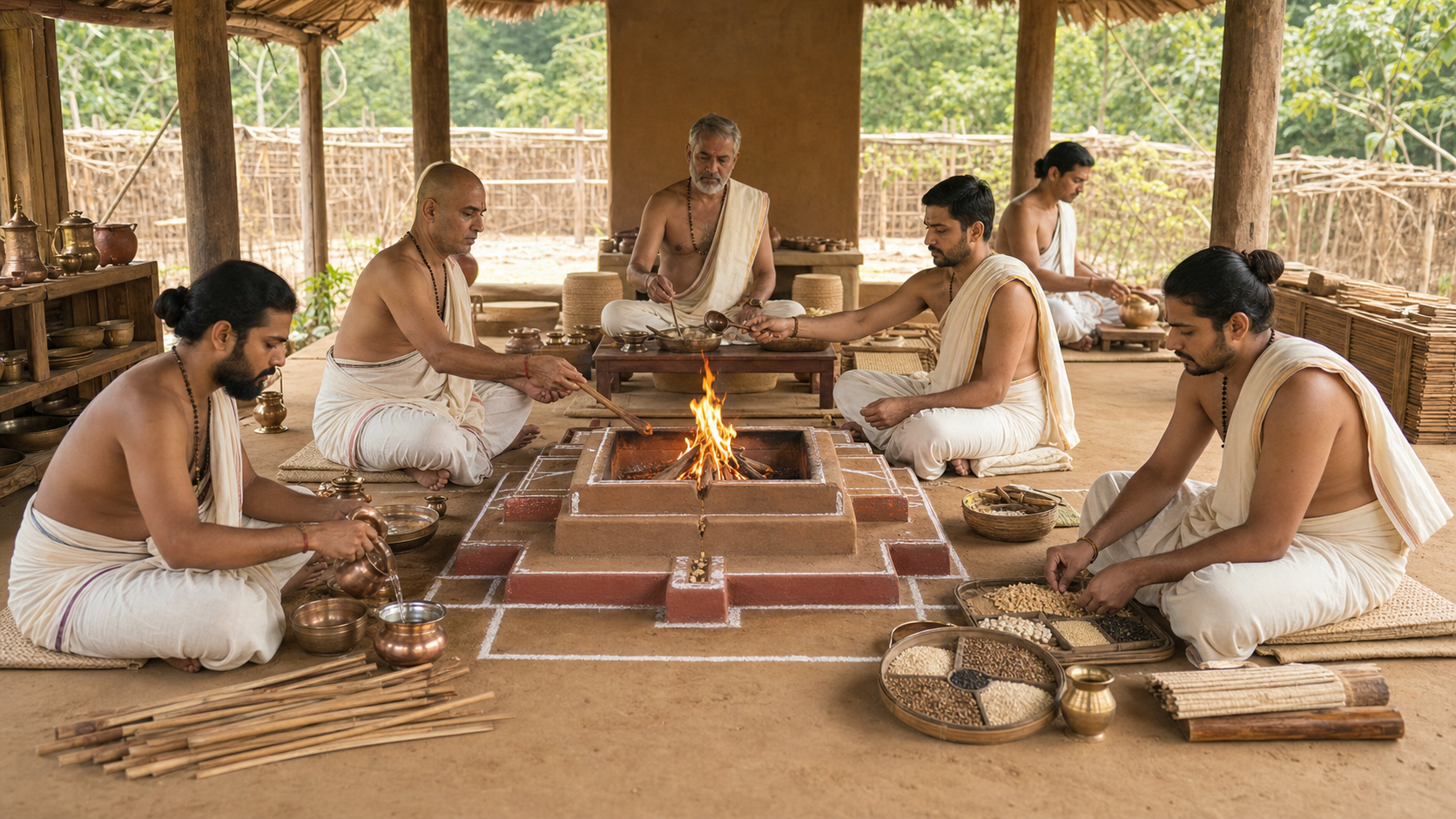
Jaimini’s inquiry opens with athato dharma-jijnasa, the undertaking to inquire into dharma, and identifies dharma through Vedic injunction: codana-lakshano dharmah. This starting point limits what unaided perception and inference can establish. You can observe fire, ingredients, movements, and immediate physical results. You cannot perceive by ordinary means that a particular act produces a remote, posthumous fruit. For that, Mimamsa relies on the Veda as authorless, apaurusheya, and on verbal testimony as the decisive means of knowing dharma.
Vedic language therefore does more than describe a religious world. A vidhi directs an act and creates an obligation. An arthavada praises, explains, or supports what is enjoined without automatically functioning as an independent command. Restrictive and permissive expressions determine scope. Context, sentence relation, indicative signs, and the agreement between a passage’s opening and conclusion help establish what is actually being required.
This is where the stereotype of empty ritual misses the point. Intention matters, but intention alone does not replace the act. Physical performance matters, but movements detached from the governing injunction do not amount to the same dharmic deed. Mimamsa asks whether resolve, words, materials, sequence, and purpose form the action specified by the Veda.
Three kinds of ritual motivation lead in different directions
- Nitya duties are obligatory. Their regular performance prevents demerit and trains action that is not dependent on securing a special personal reward.
- Naimittika duties arise on an appropriate occasion. They are not optional wishes merely because they are not performed every day.
- Kamya acts are undertaken for desired results. They are permitted within the ritual order, but their reward-seeking structure continues investment in worldly or heavenly fruits.
This classification gives you a practical diagnostic. When approaching a religious act, ask whether you are fulfilling an obligation, responding to a defined occasion, or bargaining for a wanted outcome. The outward form may be sacred in all three cases, but the action’s relation to karmic continuation is not identical.
Agnihotra and Darsa-Paurnamasa illustrate how the outer and inner dimensions fit together. Sankalpa establishes deliberate resolve. Mantras order attention and articulate the act. Offering changes possession into participation in a larger sacrificial order. Shanti recitations place the completed performance within an aspiration toward peace. Apurva explains why the rite’s efficacy can extend beyond its visible conclusion.
How to read a ritual passage without flattening it
If you are studying a Vedic or Mimamsa passage, do not extract one attractive sentence and treat it as a complete instruction. Mark the passage using this sequence:
- Identify the proposed action rather than beginning with its praise or symbolism.
- Locate the vidhi, if present, and determine what it actually enjoins.
- Separate supporting arthavada from the command itself.
- Check sentence relation, nearby context, restrictive language, and the agreement of the opening and conclusion.
- Only then ask what agent, occasion, intention, and result belong to the act.
This method is also a reason not to improvise a technical Vedic rite from an isolated translation. If you mean to practise rather than merely study, learn the inherited procedure from a competent tradition. In Mimamsa terms, sincerity cannot repair a failure to determine what action the injunction specifies.
Liberation is not the largest reward in the karmic ledger

If ritual generates future fruits, including heavenly ones, how can ritual action lead toward freedom from rebirth? The answer begins by distinguishing a desirable result from moksha. A pleasant but produced experience still belongs to the causal order of action and fruition. Liberation cannot simply mean obtaining the most enjoyable entry in that order.
The major Mimamsa formulations are austere, and their differences should not be erased:
| School | Formulation of liberation | What you should not infer |
|---|---|---|
| Bhatta | Atyanta-duhkha-nivritti, the complete cessation of suffering when bodily conditions and painful contacts have fallen away. | It is not the annihilation of atman, which remains eternal, and it is not ordinary sensory pleasure magnified without limit. |
| Prabhakara | Atma-svarupavasthana, the self abiding in its own nature without adventitious affliction. | It is not a temporary mental state or the merger of the many selves into one undifferentiated self. |
Both accounts resist treating moksha as a hedonic climax. Pleasure, pain, and ordinary cognition arise through conditions involving body, senses, and manas. The Bhatta caution is especially sharp: if liberation were another pleasurable experience dependent on psychophysical instruments, it would remain entangled with the very apparatus from which freedom is sought.
This also clarifies the place of duty. Nitya and naimittika action prevents the accumulation of demerit associated with neglected obligation. Restraining kamya action weakens the deliberate production of new reward-seeking trajectories. Some later interpreters add dispassion and right knowledge of the self, with liberation becoming possible when residual karmas are exhausted. That later development should not be presented as one unanimously stated ladder shared by every Mimamsaka.
You can now see why Mimamsa is neither a doctrine of ritual forever nor a shortcut around action. As long as you are an embodied agent under obligation, dismissing action produces consequences rather than transcendence. Yet endlessly multiplying desire-driven rites also multiplies sought-after fruits. The movement toward freedom lies in doing what is owed without turning every sacred act into a transaction for another experience.
A useful way to examine your own understanding is to ask three different questions. What must be done because it is dharma? What am I doing only because I want a particular fruit? What knowledge and dispassion would keep that fruit from becoming my definition of spiritual success? Mimamsa does not permit those questions to collapse into one.
Key takeaways for reading Mimamsa correctly
- Atman is the continuing subject. It knows, acts, and experiences consequences while remaining distinct from body, senses, manas, and passing cognitions.
- Consciousness can cease to manifest without the self ceasing to exist. Deep sleep is explained through interrupted psychophysical connections, not the destruction of atman.
- Apurva makes delayed karmic fruition intelligible. It connects a completed act with a result that may arise after the visible event or in another embodiment.
- Karmic order does not require divine arbitrariness. Classical Purva-Mimamsa can acknowledge ritual deities while explaining fruition without a creator who individually assigns every result.
- Not every sacred act has the same karmic orientation. Nitya and naimittika duties answer obligation; kamya acts intentionally pursue rewards.
- Moksha is not heaven or intensified pleasure. It is described either as the total ending of suffering or as the self abiding free of adventitious affliction.
The next time you read a Mimamsa argument, mark five terms in the margin: atman, manas, injunction, apurva, and fruit. Ask which one is doing the explanatory work in each sentence. If you are approaching a rite as a practitioner, add one more question before acting: is this inherited duty, an occasional obligation, or a desire-driven bargain? That small discipline will keep ritual, karma, and liberation in their proper places.
References
