
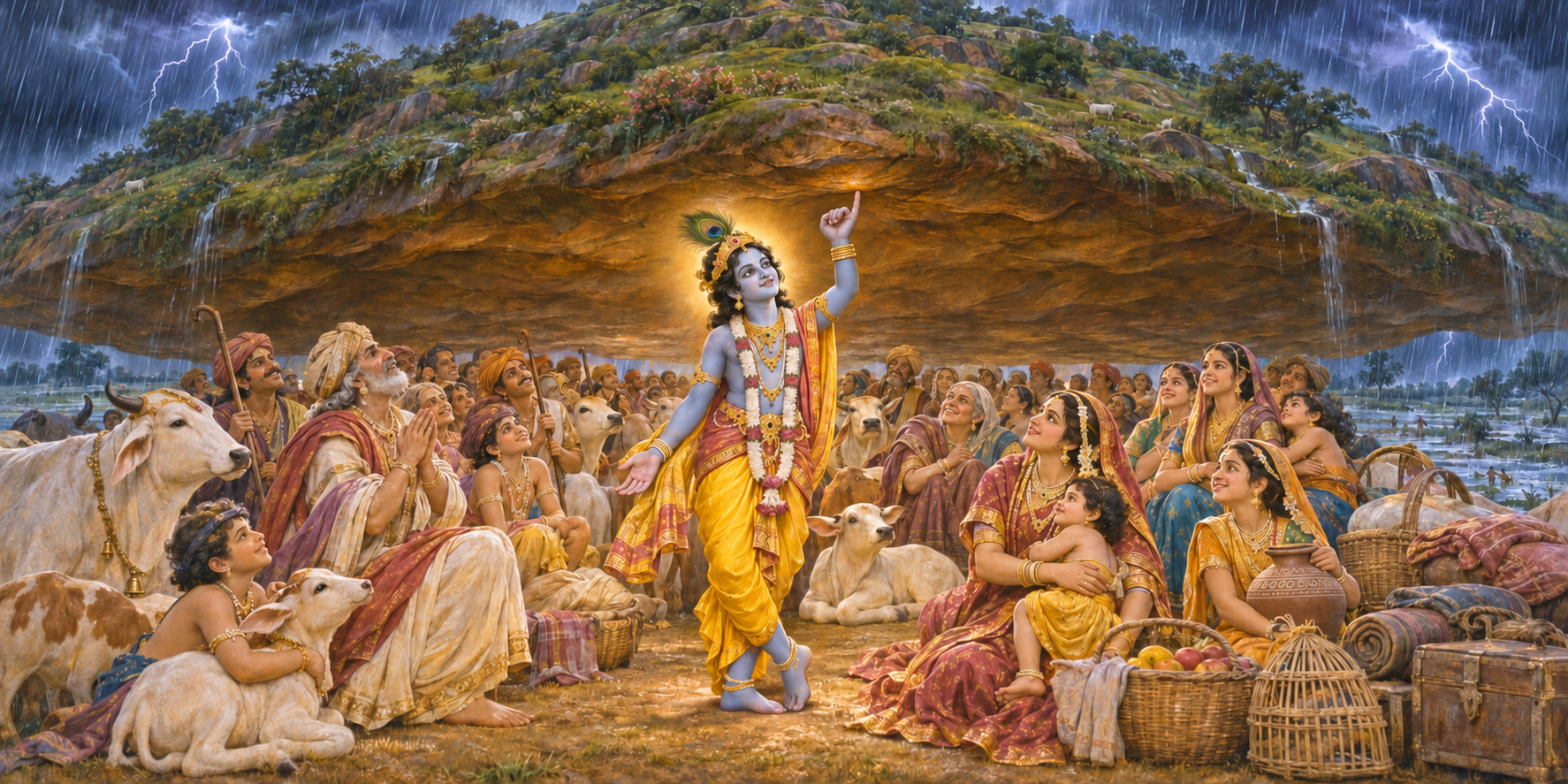
If Govardhan Puja has become a familiar annual observance for you, the danger is not disbelief. It is familiarity without examination. You may admire the image of Krishna lifting the hill, receive prasada, and still miss the uncomfortable question at the heart of the lila: what happens when legitimate responsibility becomes wounded entitlement?
Srimad Bhagavatam 2.7.32 gives you a practical way to examine pride, protection, worship, and dependence. Carry that framework into the Govardhan Puja discourse on Srimad Bhagavatam 2.7.32, and the pastime becomes more than an extraordinary event from Vraja. It becomes a test of how you use whatever authority, recognition, and resources have been placed in your hands.
Read the whole sequence, not only the lifted hill
The most memorable image is also the easiest place to stop: young Krishna holds Govardhan aloft with one hand while the people and cows of Vraja take shelter beneath it. Yet the meaning of that shelter becomes clear only when you follow the decisions that precede it.
- The people of Vraja are preparing their customary offering to Indra.
- Krishna redirects their attention toward Govardhan, the cows, their actual duties, and the community that sustains their life.
- Indra treats the loss of worship as an injury to his status and unleashes destructive rain.
- Krishna answers coercive power by turning Govardhan into a common shelter for Vraja.
This sequence matters. The rain is not merely bad weather, and lifting the hill is not a display performed for applause. A powerful being uses his entrusted capacity to punish people for withholding recognition. Krishna then protects the very beings whom that abuse of authority endangers.
Do not turn the episode into a general excuse for insulting devas or discarding inherited worship carelessly. Krishna is personally present in Vraja and gives the direction. The lesson for an ordinary devotee is not, “My judgement is equal to Krishna’s.” It is, “No delegated power, office, or honour makes anyone independent of Bhagavan.” Respect for a deva and recognition of Krishna’s supremacy are not contradictory in the Bhagavata vision.
Indra’s failure begins where service becomes ownership
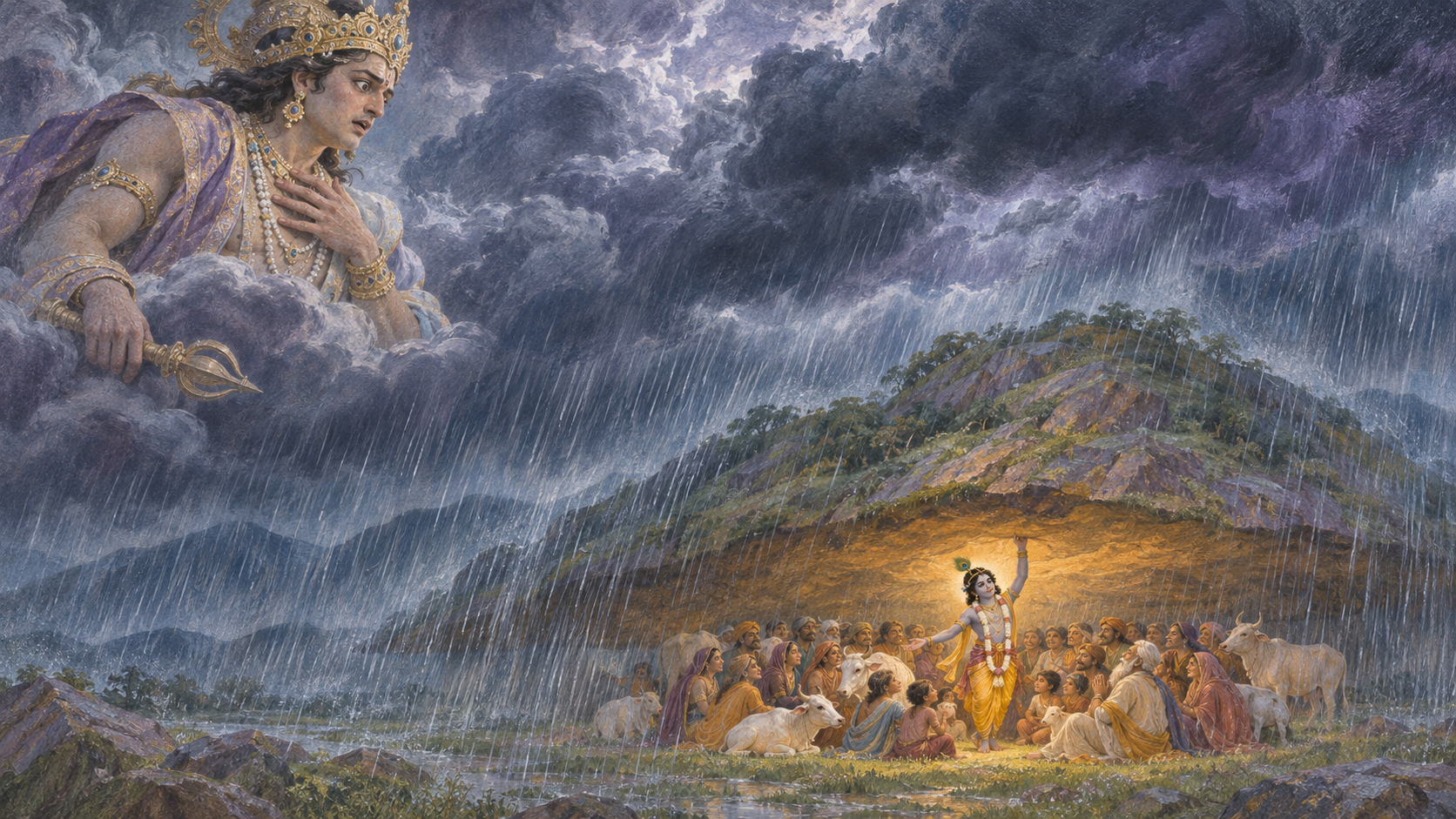
Indra is not presented here as someone without responsibility. Rain is connected with a genuine cosmic function, and Vraja’s life depends on rain. His failure begins when he confuses stewardship with proprietorship. Instead of seeing power as something entrusted for the welfare of others, he treats it as proof that others owe him honour.
That makes the lila especially relevant when you hold any position from which your mood affects other people: parent, teacher, employer, organiser, donor, priest, community elder, or volunteer coordinator. Your role may be legitimate. Your work may be necessary. Neither fact makes resentment righteous when someone does not acknowledge you as expected.
Use three questions to locate the Indra tendency before it becomes a storm:
- When a plan changes, do you evaluate the change on its merits, or experience it first as a challenge to your standing?
- When someone else receives credit, does your willingness to serve diminish?
- When you feel overlooked, do people with less power absorb your displeasure?
The third question is the sharpest. Pride becomes socially dangerous when dependants pay for a superior’s injured self-image. In Vraja, the cows, families, and land are exposed to a deluge they did not cause. In your life, the equivalent may be a child, junior colleague, spouse, volunteer, or other person who cannot answer your anger freely.
A fitting Govardhan Puja practice is therefore to perform one useful act without arranging to be noticed. Do not announce that you are conquering pride. Quietly complete the neglected task, give credit accurately, or remove a burden from someone under your care. That turns reflection into seva.
Krishna’s shelter gathers a community, not an audience
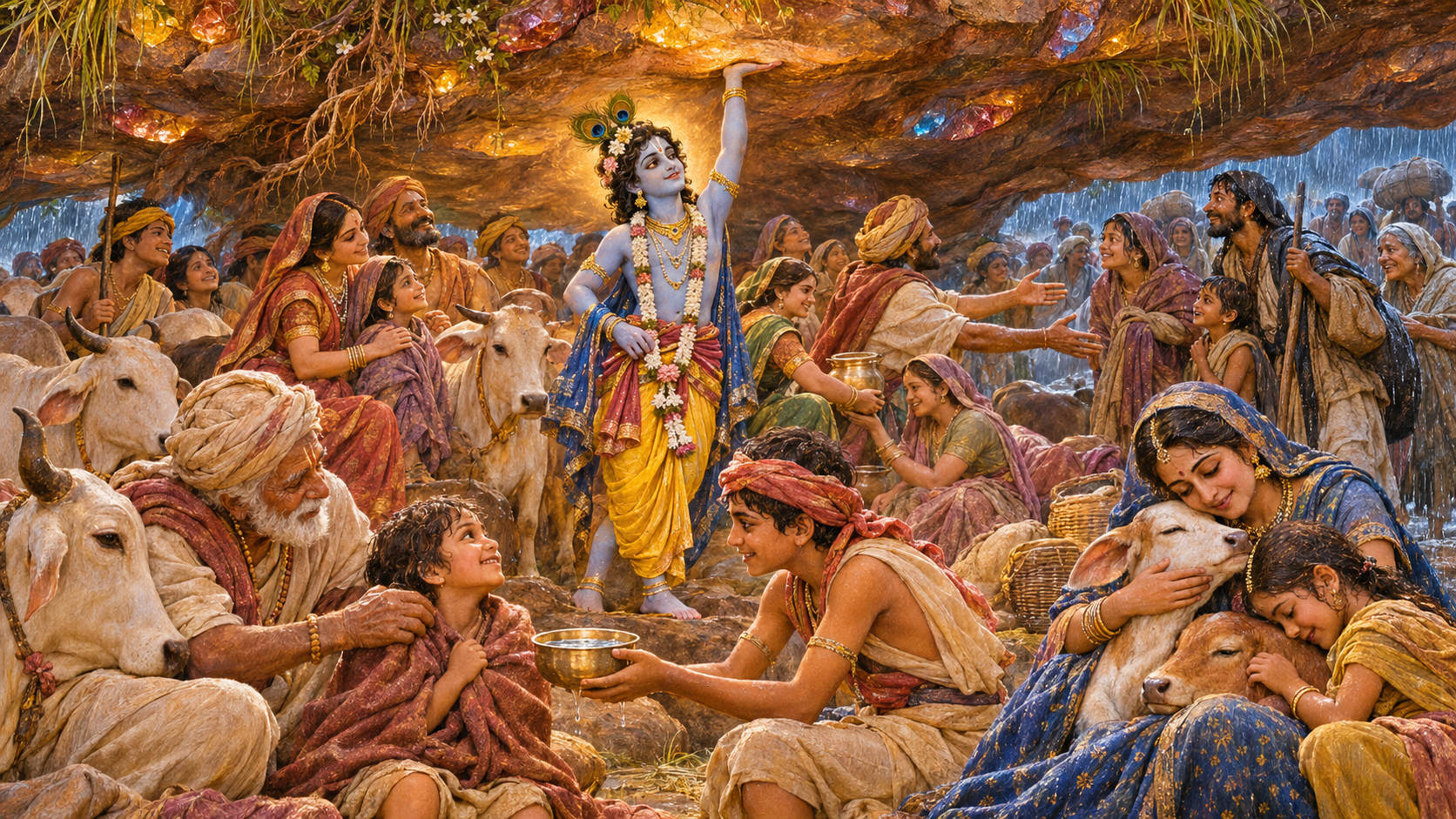
Govardhan does not become a private refuge for a spiritually impressive few. The people of Vraja enter together with their cows and their shared life. Krishna’s protection is personal, but it is not individualistic. The strong, the frightened, the dependent, and the economically essential all stand beneath the same shelter.
This gives you a concrete test for festival devotion: who is safer, better fed, less isolated, or more securely cared for because you observed Govardhan Puja? A large offering may express devotion, but abundance reaches its proper purpose when it is offered to Krishna and received as prasada rather than used to display the host’s importance.
If your home or temple prepares an Annakuta offering, connect the visible celebration with at least one verifiable duty:
- Share prasada with someone who would otherwise be excluded by distance, age, illness, poverty, or lack of transport.
- If you support cow protection, ask what the animals actually need. Feed, water, shelter, veterinary attention, and lifelong care matter more than a photograph or slogan.
- Care for the place where worship occurs. Clean it, prevent avoidable waste, and leave the surrounding land in better condition than you found it.
- Notice the people whose quiet labour made the celebration possible. Thank them directly and distribute the remaining work fairly.
Govardhan should not be reduced to “nature” in the abstract. In the lila, the hill belongs to Krishna’s intimate world and serves Krishna, the cows, and Vraja. Still, the relationship reveals something important for daily dharma: land, animals, food, livelihood, and worship are not sealed into separate compartments. Gratitude becomes credible when it changes how you treat what sustains life.
Taking shelter is neither passivity nor a bargain
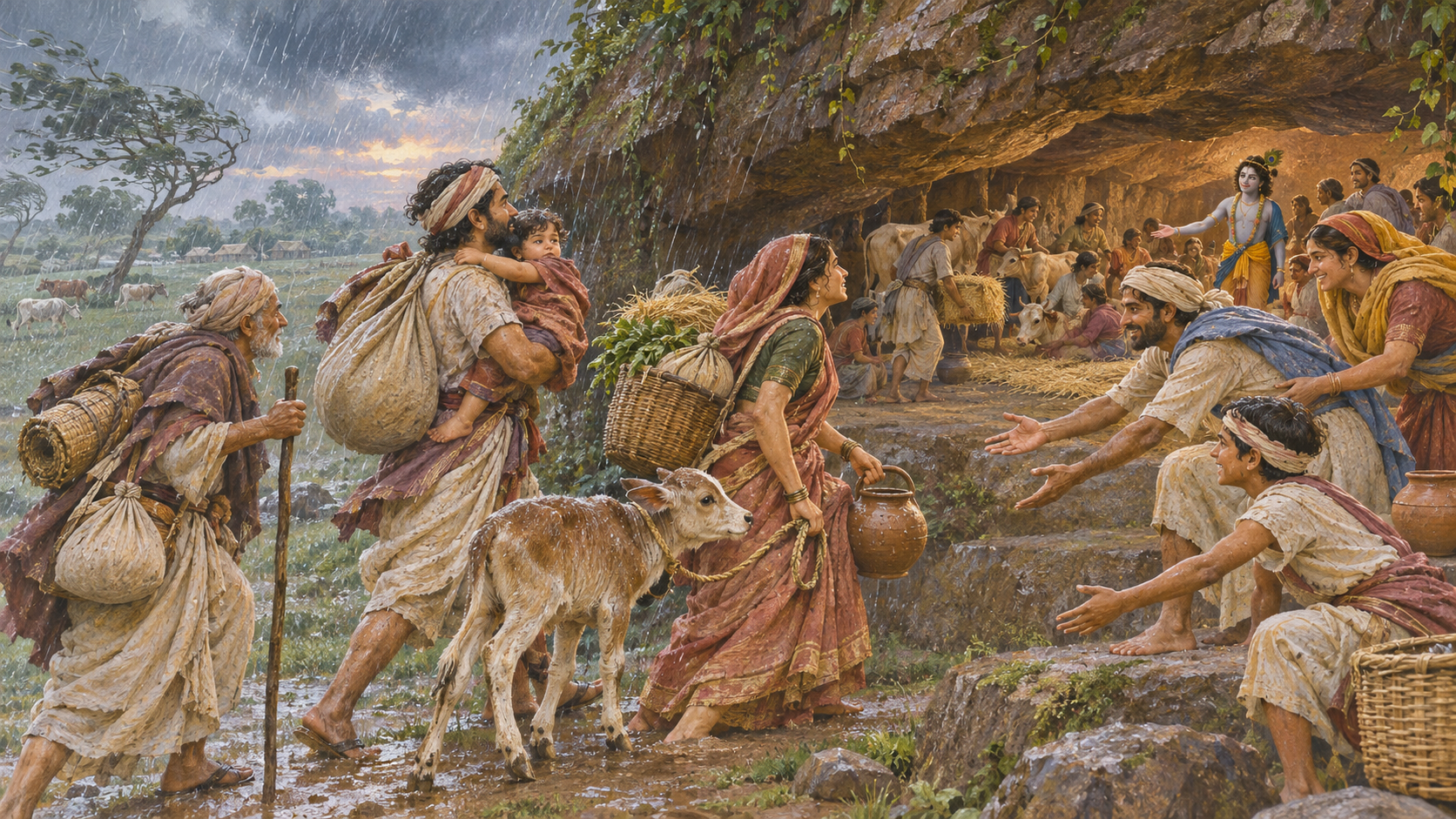
It is tempting to read divine protection as a promise that a devotee will never encounter a storm. The Govardhan lila does not support that simplification. Vraja experiences danger, fear, and dislocation before the community stands beneath Krishna’s protection. The presence of adversity does not prove the absence of Bhagavan.
Shelter also does not mean refusing ordinary responsibility while waiting for a miracle. The residents of Vraja move toward the refuge Krishna provides. They remain together. They bring the cows. Dependence on Krishna orders their response; it does not erase the need to respond.
Nor is bhakti a commercial exchange in which an offering purchases favourable weather. That transactional assumption is precisely what the episode unsettles. Krishna’s protection is not controlled by ritual payment, and divine authority cannot be reduced to the management of material outcomes.
You can apply this without pretending that every difficulty has a simple religious explanation. Before or after hearing the discourse, work through the following practice:
- Name the “storm” plainly. Describe what is happening without exaggerating it and without forcing it into an allegory.
- Separate what you can govern from what you cannot. Your speech, duty, honesty, and treatment of dependants remain yours even when the outcome does not.
- Identify your actual shelter: remembrance of Krishna, sadhu-sanga, scripture, prayer, responsible action, and trustworthy community. Do not substitute vague optimism for these practices.
- Choose one being or responsibility that needs protection from your own agitation. Make that person, animal, duty, or place part of your response.
- Offer the result without demanding that Krishna validate your preferred timetable.
This keeps the application disciplined. You are not claiming to be Krishna, diagnosing every hardship as someone’s pride, or promising a miraculous outcome. You are allowing the lila to correct how you behave under pressure.
Key takeaways
- Govardhan Puja is not only about Krishna’s strength; it also reveals what happens when entrusted power is corrupted by wounded status.
- Indra’s mistake is not having responsibility. It is treating responsibility as ownership and worship as a debt owed to him.
- Krishna’s shelter includes the whole life of Vraja: people, cows, land, livelihood, and community.
- Taking shelter does not guarantee the absence of difficulty, excuse passivity, or turn devotion into a bargain for favourable results.
- Your observance becomes practical when it produces quieter service, better care for dependants, honest gratitude, and less need for recognition.
When you next stand before Govardhan or hear this lila recited, do not ask only whether you believe Krishna lifted the hill. Ask what you are doing with the small share of power entrusted to you, who stands exposed when your pride is hurt, and what concrete shelter your devotion can help provide today.
References

Leave a Reply
You must be logged in to post a comment.