

The Taj Mahal dispute is often presented as a contest between two historical narratives. The immediate issue before the court, however, is narrower: whether a judicially supervised inspection should be ordered to investigate the petitioners’ claim that the protected monument was originally a Shiva temple called Tejomahalaya.
Understanding the case requires separating four questions that public debate frequently blends together: what the petition alleges, what the court has decided, what evidence could establish, and whether any resulting religious claim could change the management of a protected heritage site.
The proceeding concerns access and evidence, not a historical verdict
According to the supplied report, the petition was filed on behalf of the deity Lord Sri Agreshwar Mahadev Nagnatheswar Virajman through a legal representative described as the deity’s next friend, together with devotees. The petitioners seek a declaration that the Taj Mahal is a Hindu temple and permission for darshan and prayer inside the complex.
The immediate procedural dispute arose after the petitioners sought an advocate commissioner in an Agra court to inspect, photograph and record video of the monument. The report says that application was rejected and that a subsequent revision was dismissed as not maintainable. The petition before the Allahabad High Court at Prayagraj challenges those outcomes, arguing that an official inspection is needed because the applicants cannot freely access every part of the Archaeological Survey of India-administered monument.
In the procedural snapshot provided by the source, the High Court had directed the Union government and the ASI to submit counter-affidavits. That direction records no conclusion about Tejomahalaya. It gives the responsible institutions an opportunity to answer the petition before the court considers the disputed legal and evidentiary questions.
Key takeaways
- The reported request for a survey is not itself proof that the Tejomahalaya claim is true, and an order inviting counter-affidavits is not a finding in the petitioners’ favour.
- The petitioners reportedly identify 109 features, but the strength of the case depends on whether those observations can be connected to datable, contextual and independently corroborated evidence.
- Even if an earlier structure or reused element were demonstrated, further evidence would still be required to establish its identity, history and legal significance.
- Any inspection must be assessed alongside conservation duties because the Taj Mahal is administered as a protected monument, not as ordinary disputed property.
Why 109 claimed features do not all carry the same weight
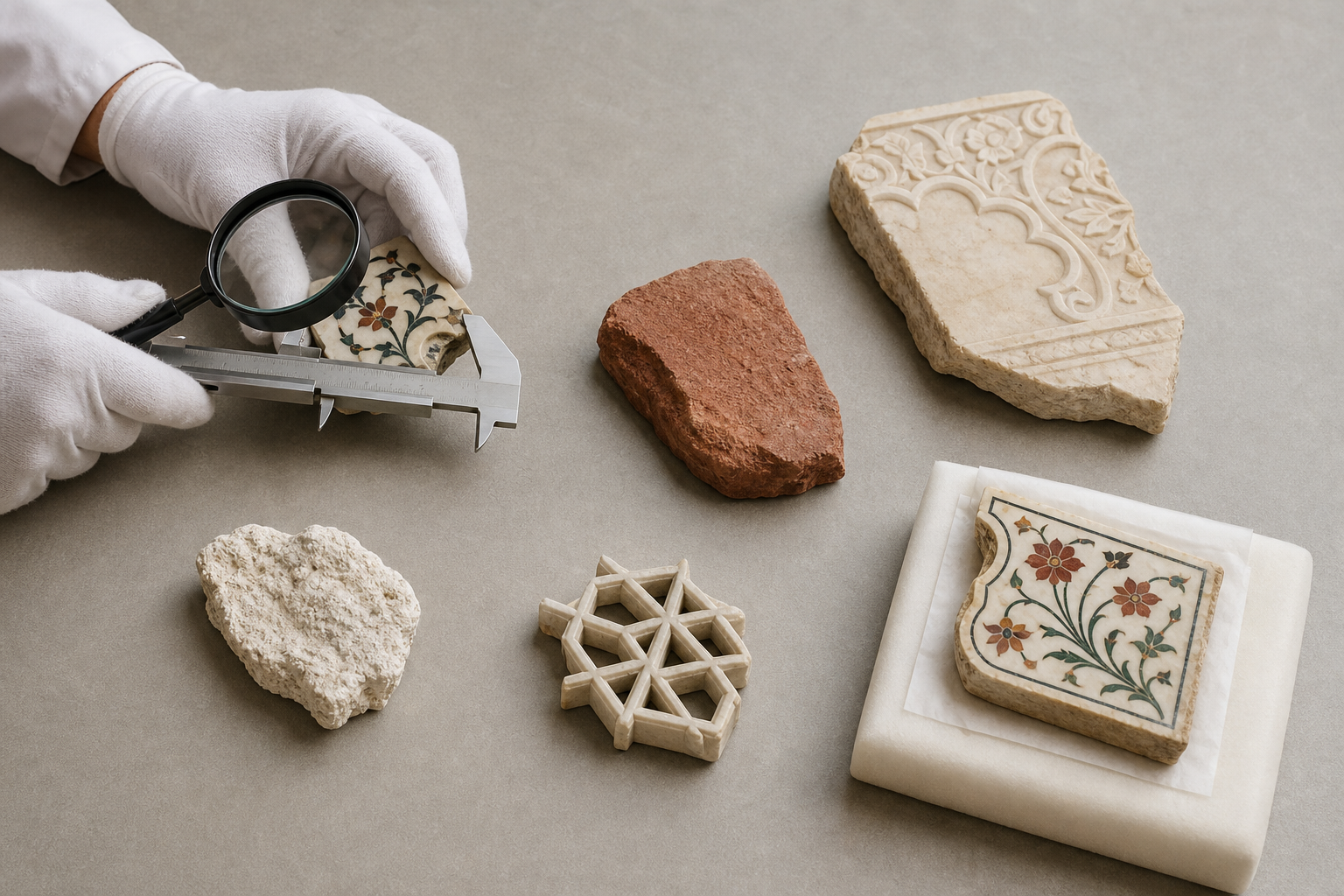
The supplied article reports that the petitioners cite 109 archaeological and historical features. Publicly described examples include a kalash-like finial, lotus imagery, a structure characterised as a gaushala, inaccessible portions of the complex, and an asserted history involving Raja Paramardi Dev, Raja Man Singh and Raja Jai Singh before the site came under Shah Jahan. These are allegations presented for examination, not facts established by a court or by the material supplied here.
Such claims also belong to different evidentiary categories. A visual resemblance is an architectural observation. A story about former ownership is a historical proposition. A locked room is an access condition. None automatically proves the others. A credible inquiry would have to test each proposition using the kind of evidence suited to it rather than treating the number of allegations as a substitute for their individual quality.
Decorative forms are especially vulnerable to overinterpretation. Lotus designs, floral ornament, finials and domical forms can move between regions, patrons and religious traditions. Their presence may justify comparison, but resemblance alone cannot reliably identify a building’s original function. Archaeological reasoning becomes stronger when form is supported by construction sequences, inscriptions, archival records, material analysis, conservation documentation and securely dated context.
The report contrasts the petitioners’ account with the established official description. As summarised there, UNESCO identifies the Taj Mahal as the marble mausoleum commissioned by Mughal emperor Shah Jahan in memory of Mumtaz Mahal and describes the wider ensemble through its tomb, garden, gateway, mosque, guest house, symmetry and inlay work. The article provides no expert report or completed survey overturning that official account. The petition therefore raises a proposition to be tested against the existing heritage record rather than replacing that record merely by being filed.
A survey would need a defined question and a conservation-safe method
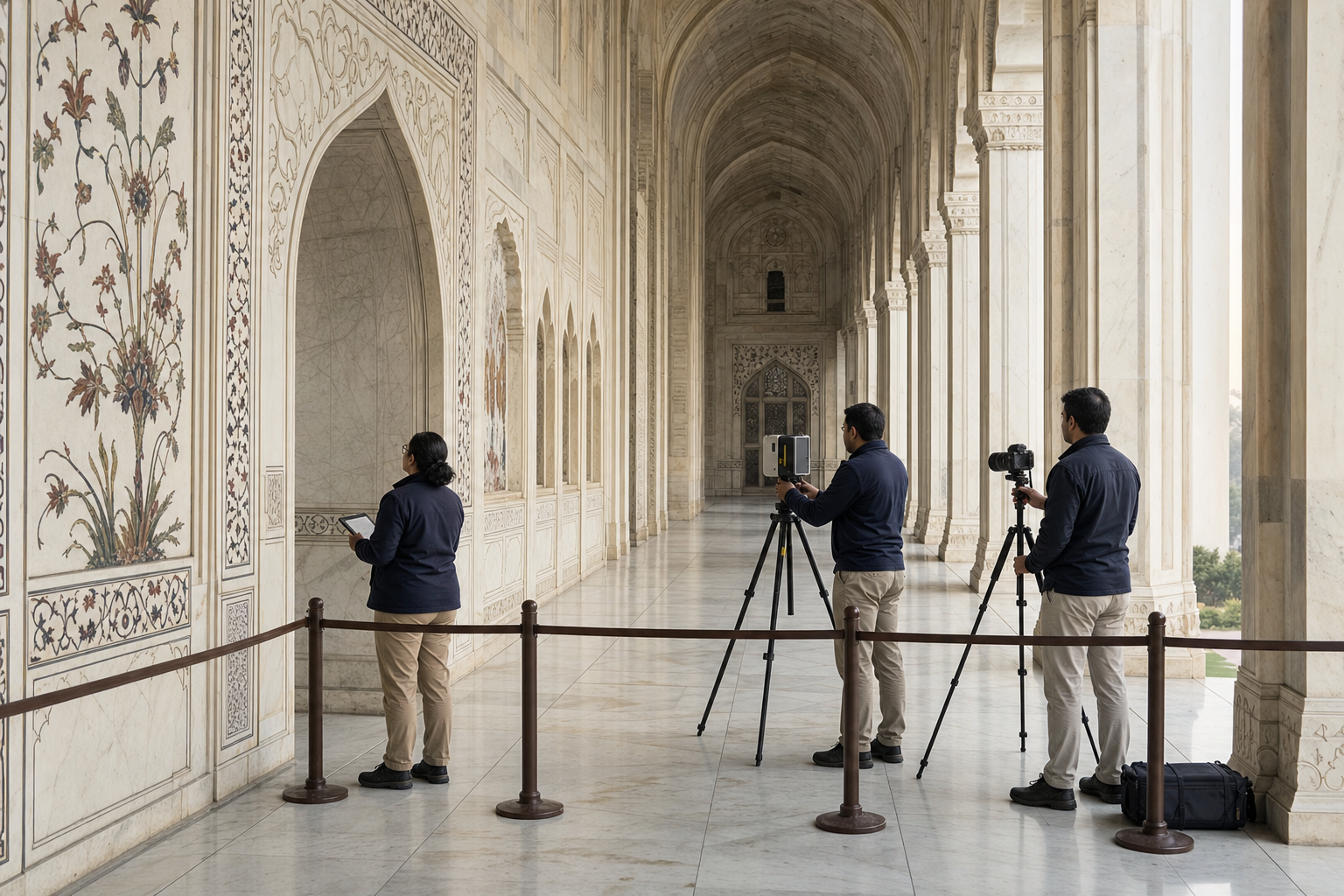
The word survey can conceal several very different activities. Visual documentation, archival comparison, non-invasive scanning, material sampling, opening an inaccessible space and excavation do not produce the same evidence or impose the same physical risk. A useful order would therefore need to identify the disputed question, the method capable of answering it, the qualified body responsible for the work and the limits placed on intervention.
This distinction matters because discovering an earlier construction phase would not, on its own, prove every element of the petition. Evidence of reused material would not necessarily identify the source structure. Evidence of an earlier building would not automatically establish that it was the temple named by the petitioners. Establishing religious identity, continuity of worship, title and a present entitlement to conduct rituals would involve separate historical and legal steps.
The source also emphasises the ASI’s conservation role. It describes the complex as facing continuing pressures associated with pollution, weathering, groundwater, tourism and the preservation of marble and sandstone. Those concerns do not determine whether the historical claim is valid, but they do affect which investigative methods could responsibly be authorised. The likely evidentiary gain from each intervention must be weighed against irreversible harm to the monument.
Religious freedom does not settle monument management by itself
The petitioners reportedly invoke Article 25 of the Constitution in support of darshan and puja. Article 25 protects freedom of conscience and religious profession, practice and propagation, while remaining subject to public order, morality, health and other constitutional provisions. The existence of a sincerely asserted belief is therefore relevant, but it does not by itself decide how an ASI-administered site must be used.
The legal analysis has at least two stages. A court would first have to assess whether the asserted historical and religious basis is legally cognisable and adequately supported. It would then have to consider whether the requested worship is compatible with the monument’s protected status, its existing administrative regime, conservation requirements and its public character. A ruling on inspection, historical origin and present worship rights need not answer all three questions in the same way.
The form of the petition adds another important legal dimension. As the source explains, Indian temple litigation can recognise a deity as a juristic person represented by a next friend. That procedural capacity permits a claim to be brought; it should not be confused with proof of the claimed site’s identity or with an automatic entitlement to the remedy sought.
What a responsible next phase should clarify
The dispute carries emotional weight because it touches memories of temple destruction, appropriation and reuse during periods of political conflict. That broader history warrants serious study, but it cannot decide the origin of a particular monument without site-specific evidence. Nor should an unresolved historical claim be converted into hostility toward present-day religious communities.
The most informative next phase would place the petitioners’ full evidentiary case, the government’s response, the ASI’s records and any proposed inspection method into a common framework. The court could then distinguish testable claims from symbolic interpretations and determine whether further investigation would add reliable knowledge without endangering the structure. Until that process produces findings, the Tejomahalaya proposition remains a litigated claim and the official heritage description remains the operative account.