

If you have seen claims that gold or other valuables may be missing from Shri Padmanabhaswamy Temple, the first question is not whether the most alarming headline is true. It is whether the evidence has been protected well enough to find out. Intelligence inputs have reportedly raised possible discrepancies in valuables, security controls and record-keeping, but those concerns remain allegations until a disciplined audit establishes what happened.
You do not have to choose between reverence and accountability. A sound process can preserve worship, protect sensitive security information and still give devotees a meaningful account of the temple’s stewardship. The test is simple: can every conclusion be traced from an identified object, through a documented chain of custody, to independently verified evidence?
Do not let the word ‘missing’ decide the case
‘Missing’ is too imprecise for an audit finding. It can describe an accounting problem, a cataloguing problem, a custody problem or an established loss. Treating those conditions as interchangeable can damage trust before the evidence has been examined.
- Unreconciled: Two records do not agree, or a recorded item has not yet been physically verified. The discrepancy is open; its cause is not known.
- Misdescribed: The object is present, but a legacy entry uses an incomplete, duplicated or inconsistent description. Old measurements, repairs or naming conventions may need to be reconciled with the physical object.
- Misplaced: The object is not where the record says it should be, but tracing across ritual-use, cleaning, repair and temporary-custody records is still underway.
- Confirmed loss: A completed reconciliation supports the conclusion that the object is absent. Whether theft, negligence or another cause is responsible belongs to a properly constituted investigation.
A credible public update should report these categories separately. It should also show how many discrepancies were resolved, how many remain open and how many were escalated for investigation. A changing count is not automatically evidence of manipulation: verification can move an entry from one category to another. What matters is whether the reason for every change is logged and independently reviewable.
You should therefore be cautious with both extremes. A claim of theft before verification outruns the evidence. A blanket assurance that everything is safe, without explaining the scope and method of verification, does not establish anything either. The responsible position is neither accusation nor dismissal; it is insistence on a process capable of producing an auditable answer.
A defensible audit begins by freezing the evidence
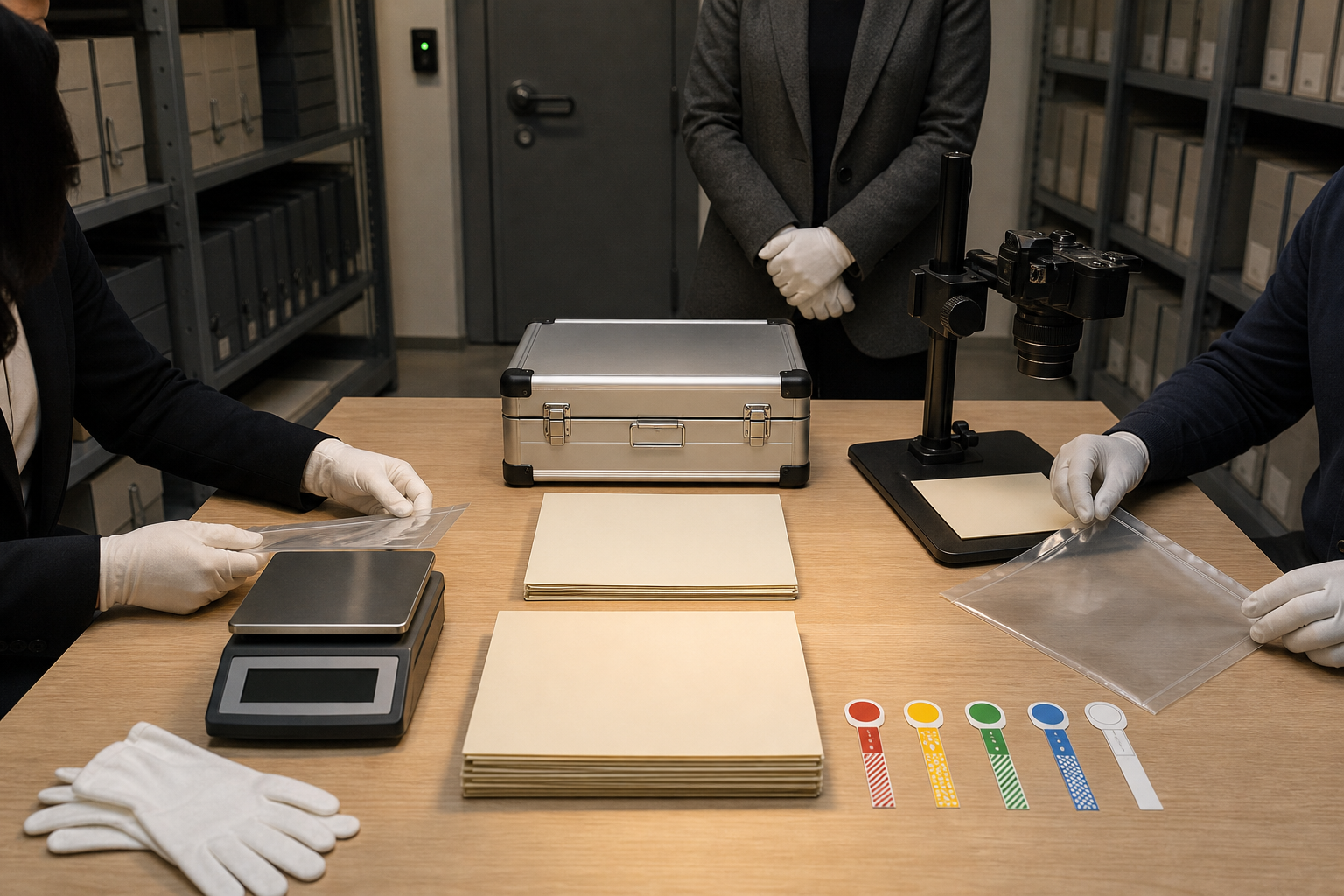
The first task is not valuation. It is evidence preservation. Opening vaults repeatedly, correcting old entries without retaining their history or allowing routine movements to continue undocumented can contaminate the very record an audit is meant to test. The audit itself must not become another unlogged custody event.
- Freeze affected movements. Suspend non-essential movement for the item families under review. If an object is indispensable to a scheduled ritual, record the exception, the authorising officers, the purpose and the complete custody trail.
- Preserve the records before reconciling them. Mirror access logs, inventory histories, video records, seal registers and repair or cleaning records to a secure off-network repository. Preserve the original sequence rather than silently correcting it.
- Constitute an independent team. The auditors should be independent of the people whose daily work they are examining, and the team should have court-acknowledged authority appropriate to the temple’s governance framework.
- Define the audit universe. State which vaults, item families, dates, custody locations and record systems are in scope. Without a declared scope, a statement such as ‘all valuables verified’ cannot be tested.
- Reconcile under videography. Record the opening of storage, seal checks, identification, measurement and return. Every person who handles an object should appear in the custody record.
- Classify before escalating. Assign each discrepancy a status and supporting evidence. If a material loss is confirmed, transfer the matter to a specialised investigation team without disturbing the preserved chain of custody.
The audit report should disclose its method, scope, exceptions and aggregate results. It should not publish item-level values, detailed vault arrangements, routes, camera positions or images that could create a target list. Transparency is not the indiscriminate release of security-sensitive information; it is the release of enough verifiable information to show that the controls were tested and the exceptions were resolved lawfully.
Religious services should continue with the least disruption compatible with evidence protection. That requires planning ritual exceptions in advance instead of treating worship as an obstacle to the audit. Ritual authorities must identify what can be paused, what cannot be paused and how essential movements can be witnessed without violating sacred practice.
Give every sacred object an identity that survives ritual use
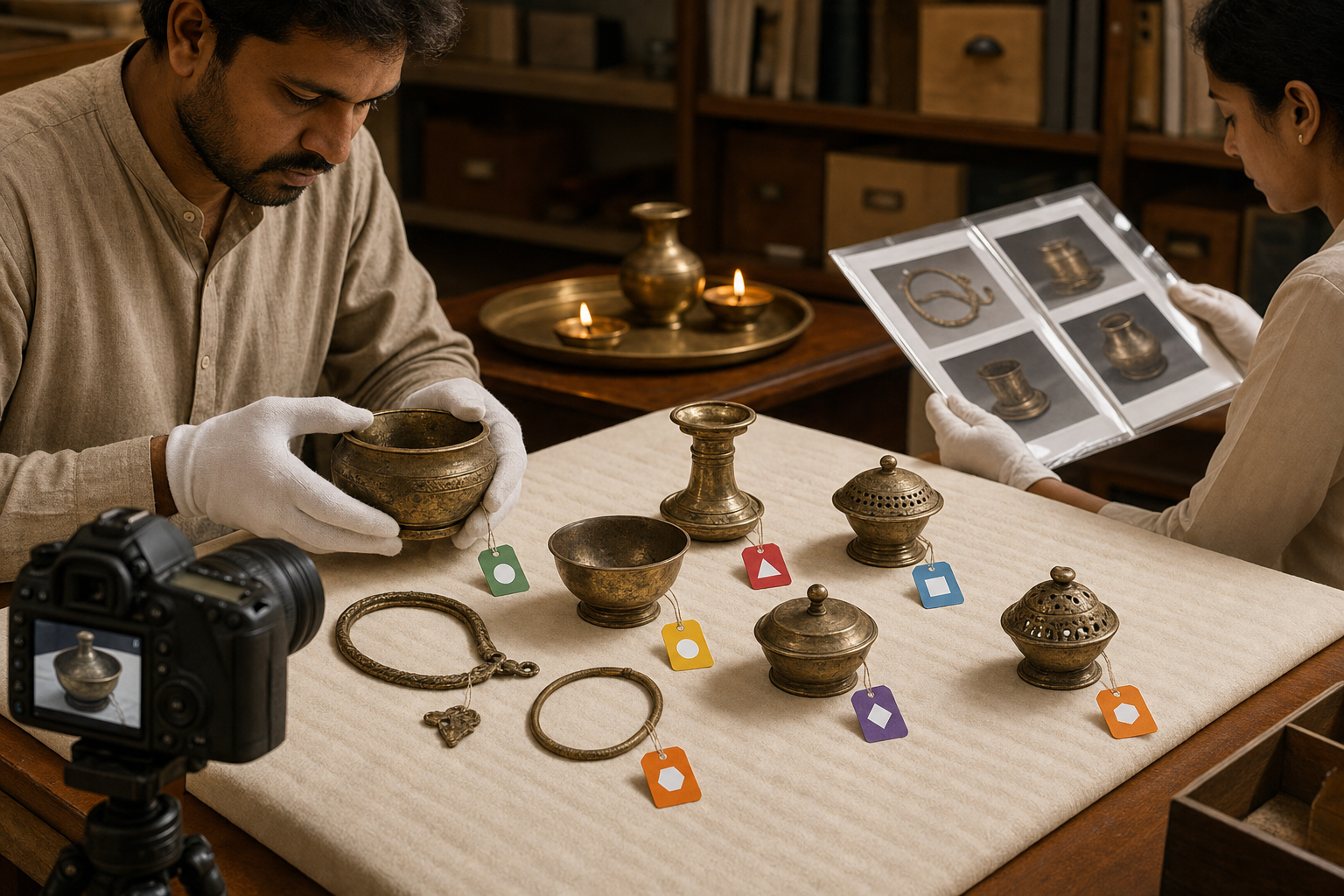
An ornament cannot be protected by an entry that merely says ‘gold necklace’ or relies on one old photograph. Similar objects, legacy descriptions and repeated ritual movements make ambiguity dangerous. Each object needs a persistent identifier connected to a master record that remains useful even when the object moves between a vault, preparation area and sanctum.
- Visual identity: Macro photographs from multiple angles, including distinctive workmanship, marks and condition features.
- Measured identity: Precise weight and dimensions, together with stated tolerance bands so that a legitimate measurement variation is not confused with a material discrepancy.
- Material identity: Non-destructive X-ray fluorescence analysis where composition testing is appropriate. This can support identification without treating every sacred object as raw bullion.
- Custodial identity: Provenance, ritual use, authorised storage location and links to repair, cleaning or conservation histories.
The persistent identifier belongs in the record, but the method of associating it with the object must respect both conservation and ritual requirements. A tag that could damage an ornament or violate its permitted handling is not an improvement. Where direct tagging is unsuitable, a tamper-evident pouch, container or seal can carry the identifier. Radio-frequency identification may assist tracking, but it must complement physical identification, weighing and witness checks rather than replace them.
Every addition, issue, movement and return should use a maker-checker process with at least three witnesses. The witnesses should verify the identifier, condition, weight where appropriate, container and seal number. Their signatures should attach to one transaction record, not to separate paper trails that must later be guessed into alignment.
Ritual use is the point at which custody controls face their most demanding test. A workable sequence is concrete:
- Verify the identifier, photographs, condition and recorded weight before issue.
- Place the object in a tamper-evident container with a unique seal number when the ritual permits containerised movement.
- Record the purpose code, such as adornment, abhishekam preparation, cleaning or repair.
- Move it with authorised escorts along the approved route, with entry and exit events recorded.
- Reconcile the identifier, seal, condition and weight immediately after use.
- Flag any unexplained variance before the object or associated records enter another transaction.
This sequence protects more than monetary value. A sacred ornament carries ritual associations and historical evidence that cannot be restored merely by replacing an equivalent quantity of metal. Preservation records and custody records must therefore describe the same object, not operate as unrelated systems.
Make the physical and digital controls prove each other

No single lock, camera, password or ledger can secure a treasury of this significance. The controls must overlap so that one system leaves evidence in another. A door opening should correspond to an authenticated person, an approved purpose and, when an object moves, an inventory transaction in the same time window.
| Control layer | What it should prevent or detect | Evidence an auditor should test |
|---|---|---|
| Vault and key control | Single-person access, unrecorded opening and covert physical attack | Dual-custody authorisations, time-lock events, split-key records, vibration or seismic alerts |
| Identity and entry control | Impersonation, tailgating and entry without a valid purpose | Multi-factor authentication, secure reader logs, anti-tailgating events, entry and exit purpose codes |
| CCTV and video management | Blind movement, disputed handling and unauthorised review of footage | Coverage tests, image quality, clock alignment, retention, uptime, angle-drift checks and logged reviewer access |
| Inventory ledger | Silent editing, back-dated entries and unexplained custody gaps | Append-only transactions, cryptographic hashes, time-stamped electronic signatures and external attestations |
| Environmental protection | Corrosion or deterioration that alters condition and complicates identification | Humidity and temperature records, alarms, conservation exceptions and documented corrective action |
CCTV must be designed for identification, not merely for showing that a person-shaped figure entered a room. Approach routes and high-risk interiors need adequate image density, overlapping fields of view, dependable lighting and aligned timestamps. In the highest-risk areas, the proposed control standard calls for secure, encrypted retention of at least 180 days. Retention is useful only if camera uptime, focus, illumination and angle drift are checked by someone independent of day-to-day operators.
Access to video is itself a security event. A role-based video management system should record who viewed, exported or administered footage. Otherwise, an insider may learn coverage patterns or remove evidence without producing a second trail. Personal phones should be prohibited in vault zones, with any authorised recording performed through controlled equipment that enters the evidence register.
The inventory ledger needs the same discipline. Each transaction should be append-only, cryptographically hashed and signed with the time and identity of the authorised custodians. Write-once-read-many storage can preserve logs against later alteration. A fashionable label is not the goal: blockchain is unnecessary if a simpler system provides immutability, traceable access, reliable backup and periodic independent attestation.
Physical protection should use graded safes, dual-custody time locks, segregated key management and vibration or seismic detection appropriate to the risk. Environmental monitoring belongs in the same security design. Uncontrolled humidity, temperature or corrosion can damage heritage objects and create uncertainty when current condition is compared with old records.
Split responsibility, then report enough to earn trust
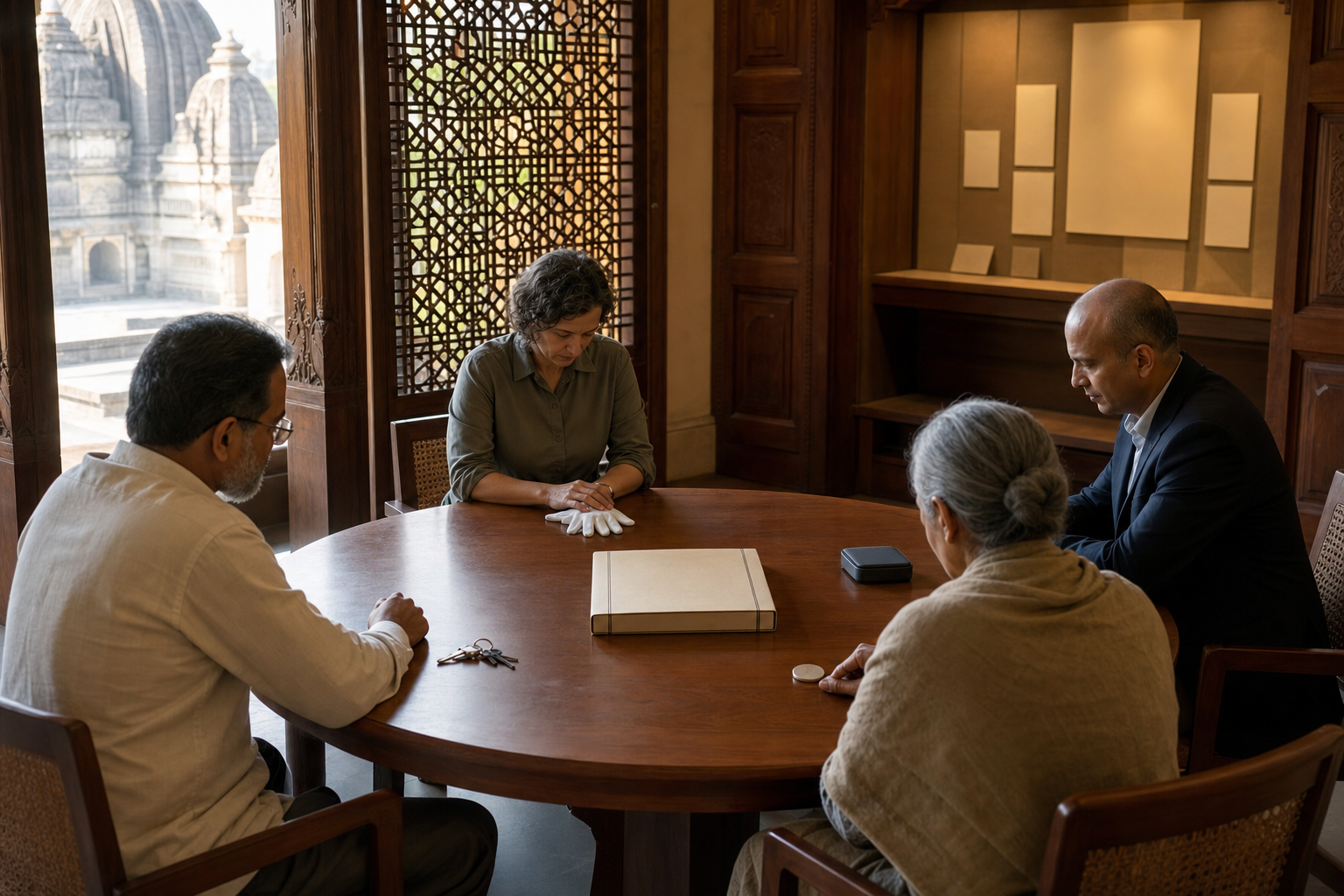
Governance fails when everyone is ‘responsible’ in general but no one owns a particular control. Shri Padmanabhaswamy Temple needs three distinct lines of responsibility:
- Operational custodians handle authorised storage, issue, return and ritual support. They own accurate execution and immediate exception reporting.
- Internal risk and compliance test whether controls operate, review exceptions, monitor remediation and report beyond the operational chain.
- Independent auditors attest the inventory and control results without managing the processes they examine.
Independence has a practical meaning. The people who hold keys should not certify the adequacy of key controls. The team that administers the ledger should not be the sole judge of whether its history is tamper-evident. The people who select a remediation should not close their own unresolved exception without review.
An oversight committee should operate under a publicly known charter and include ritual authorities, heritage-preservation expertise and external audit competence. Its authority must fit the court-directed framework intended to balance religious autonomy with administrative integrity. This is essential: technical specialists should not redesign ritual practice by administrative convenience, while ritual authority should not be used to exempt financial or custodial conduct from verification.
Training is part of governance, not an optional staff benefit. Custodians need repeated practice in seal inspection, evidence handling, witness discipline, exception escalation and accurate data entry. A sophisticated system operated through shared passwords, informal handovers or unsigned corrections will merely produce more convincing-looking uncertainty.
Public reporting should be regular and aggregated. Devotees can reasonably be told how many items were within scope, how many were verified, how many discrepancies fell into each status, how many were resolved, what control failures were found and whether corrective actions were completed. They do not need a catalogue of exact values, storage locations, movement routes or security architecture.
Key takeaways for devotees and trustees
- Ask whether officials distinguish unreconciled, misdescribed, misplaced and confirmed-loss cases instead of calling all of them ‘missing.’
- Look for a declared audit scope, preserved original records, independent verification and reconciliation under videography.
- Expect every object to have a persistent identity supported by photographs, measurements, provenance and custody history.
- Check whether vault entry, purpose codes, video and inventory movements can be reconciled to the same event.
- Demand aggregate progress and control-health reporting, but reject calls to publish line-item values or security-sensitive details.
- Confirm that ritual authorities, heritage specialists and independent auditors have defined roles rather than overlapping, untestable responsibility.
The next time a claim circulates, apply this checklist to the official response. If it gives precise discrepancy categories, protects the evidence, separates operational and audit authority, and reports measurable resolution without exposing the treasury, the governance system is doing work you can test. If it offers only a sweeping denial or an unverified accusation, ask for the missing process. Sacred stewardship deserves neither spectacle nor opaque reassurance; it deserves evidence strong enough to protect both the temple and the trust placed in it.
References
