
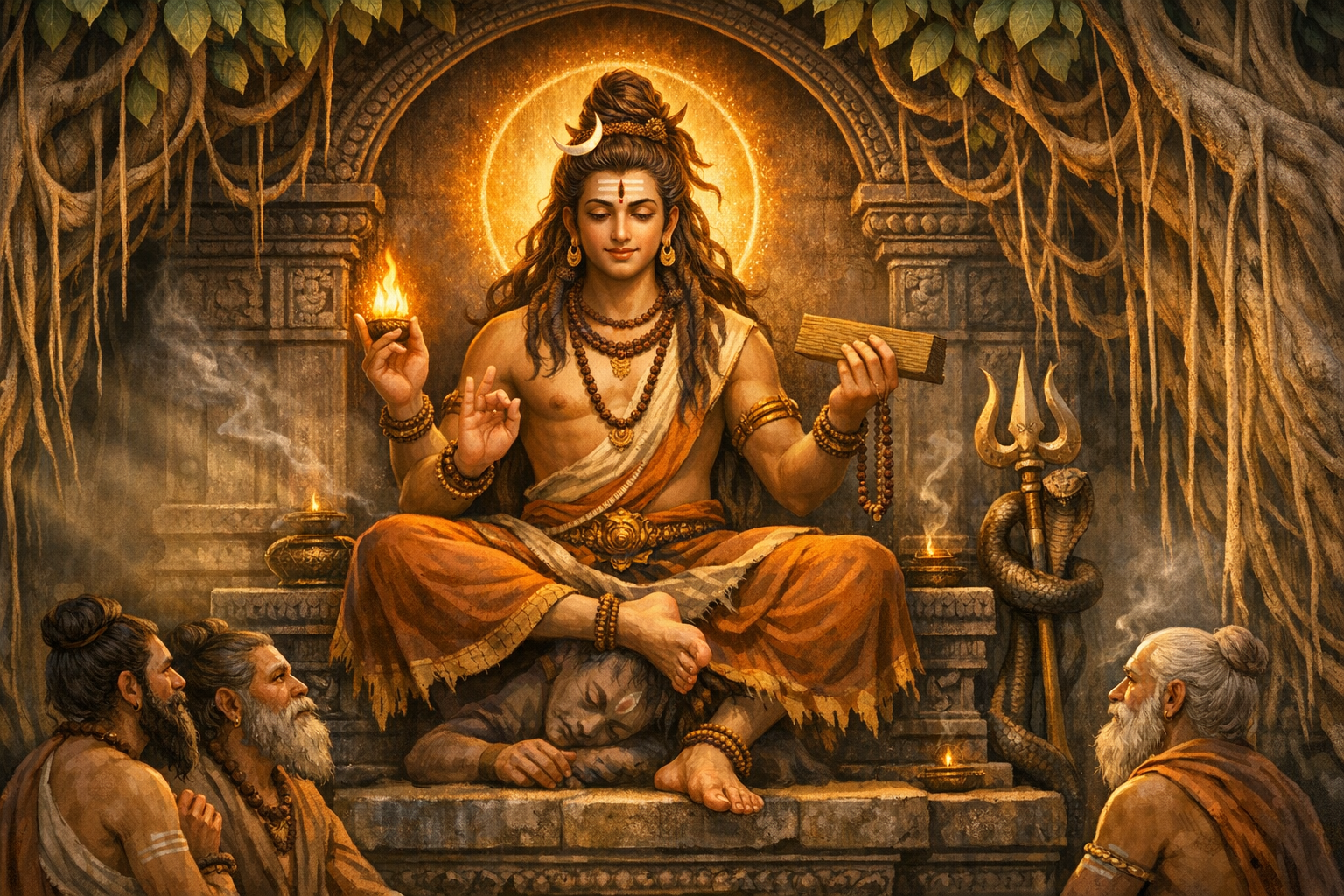
Within the expansive Shaiva tradition, Dakshinamurti is revered as the south-facing guru who teaches through silence. The Samhara form of Dakshinamurti brings into focus the power of dissolutionsamharanot as wanton destruction, but as the precise withdrawal of ignorance, limitation, and bondage. This iconographic variant stands in creative tension with the more familiar Vyakhyana (teaching) form: where Vyakhyana gestures toward exposition, Samhara emphasizes the fiery clearing of obstacles so that knowledge can shine unobstructed.
Etymologically, “Dakshinamurti” refers to the deity who faces the south (dakshina), the direction associated with inner knowledge and ancestral wisdom. In the Panca-kritya cyclesrishti (emanation), sthiti (maintenance), samhara (dissolution), tirodhana (concealment), and anugraha (grace)Dakshinamurti is often linked with anugraha. The Samhara Dakshinamurti integrates these acts by dissolving avidya (ignorance) and its subtle residues. The result is not nihilism but a return to clarity, a theological and experiential alignment with non-dual insight.
Art-historically, Dakshinamurti typically occupies the southern niche (dakshina-koshta) on the outer wall of many South Indian Shiva temples. Stone panels from the early medieval period and Chola bronzes reveal a stable iconographic grammarbanyan canopy, seated posture, youthful countenance, and the subjugation of Apasmara (the personification of delusion). The Samhara emphasis adds a palpable, contained intensity to this grammar, visible in attributes such as fire, dynamic locks, or a sharpened gaze that signals inner transformation rather than outward wrath.
Core iconographic features remain constant across forms. Dakshinamurti is seated beneath a banyan tree, a living emblem of transmission, longevity, and layered knowledge. The right foot typically rests upon Apasmara, establishing the primacy of insight over forgetfulness. The body radiates youthful stillness, adorned with the sacred thread and minimal ornaments that cue the viewer to the primacy of knowledge over opulence. Rishis may be shown in attendance, their faces turned upward in contemplative receptivity.
Hand attributes and mudras provide the clearest signals of theological emphasis. In the teaching template, the lower right hand shows jnana or vyakhyana mudra, communicating non-dual knowledge, while other hands may hold the akshamala (rosary), palm-leaf manuscript, deer, or damaru. In Samhara Dakshinamurti, regional Shilpa Shastra traditions frequently privilege agni (fire) as a primary attribute. Agni concentrates and purifies; in tantric hermeneutics, it “burns” vasanas (latent impressions) so that knowledge can take firm root. Some traditions substitute or add a trident (trisula) or serpent (naga), each marking a controlled, transformative energy rather than unbounded ferocity.
Mudra logic likewise tilts toward inner transformation. The pedagogical chinmudrathumb and forefinger joined, other fingers extendedoften remains, affirming that dissolution culminates in recognition of the indivisible Self. In some depictions the gesture of protection (abhaya) yields to a more incisive teaching mudra, visually stating that the surest safety lies in the dissolution of error. Samhara, in this register, is a rigorous pedagogywhat is removed is precisely what veils.
Facial expression and coiffure are carefully moderated to differentiate Samhara Dakshinamurti from overtly wrathful Shaiva forms such as Bhairava. Where Bhairava can display fang-like teeth and skull garlands, Samhara Dakshinamurti usually retains the serene guru affect, with subtle intensifications: slightly arched brows, more animated jata (matted locks), or an aureole that hints at thermal radiance. The effect is of heat without harm, a sign of tapasthe disciplined fire of insight.
The banyan canopy and the subdued dwarf Apasmara are not mere background. In Shaiva semiotics, the tree shelters transmission across time, just as the guru shelters the lineage of knowledge. Apasmara, subdued but not annihilated, acknowledges that forgetfulness is a perennial human possibility; practice must remain vigilant. Samhara Dakshinamurti signals that dissolution is a continuous, compassionate act: ignorance is pressed down each time it arises until its energies are transmuted into insight.
Tantric readings expand this logic into a full psychology of liberation. Dissolution can be read along the 36 tattvas as a movement from gross to subtle back to source. As attention steadies in sushumna, the “knots” (granthis) of habit unbind; rajasic agitation and tamasic inertia give way to sattvic clarity and then to a stillness beyond the gunas. In this sense, Samhara is not an end-state but a processual refinement: a practitioner repeatedly “burns” misperception, allowing direct knowledge to stand revealed.
Mantra-sadhana mirrors this interior architecture. Japa of the Panchakshari, “Om Namah Shivaya,” functions as a steady purifier when synchronized with breath. The well-known line mauna-vyakhya-prakatita-para-brahma-tattvam, traditionally associated with the Daksinamurti Stotra, encapsulates the pedagogy: the highest truth of Brahman is disclosed in silent teaching. In Samhara contemplation, the “silence” is not the absence of sound but the subsiding of conceptual noise.
Ritual practice around Dakshinamurti is broadly agamic, with regional accents. Abhisheka with vibhuti (sacred ash), bilva leaves, and clear water underscores purification and cooling after the heat of insight. On days sacred to Shivaespecially monthly pradosha and the Arudra/Thiruvadhirai constellationtemples may highlight the guru aspect of Shiva, and some traditions spotlight the Samhara nuance through alankara (iconic decoration) that accentuates agni or the dynamic jata.
From an art-historical perspective, Samhara Dakshinamurti serves as a useful analytical lens across regional idioms. In Tamil Nadu, Kerala, and parts of Karnataka, sculptors achieve “contained dynamism” through slight torsion in the torso or more active locks without departing from the seated pose (usually lalitasana or virasana). North Indian representations of Dakshinamurti are rarer, but where they appear, the Samhara accent may be inferred through attribute selection rather than facial ferocity, maintaining the guru’s compassionate core.
Symbolic layers converge in the attribute set. Fire (agni) signifies reduction to essentials; the rosary (akshamala) signals methodical contemplation; the scripture leaf points to transmission; the deer (mriga) alludes to the mind’s quicksilver restlessness, calmed under steady gaze. When present, the trident compresses the triad of knower, known, and knowing into a single, non-dual cognition. Each element, read tantrically, is a worked metaphor for lived practice.
Devotees frequently report a distinctive atmosphere before a Dakshinamurti shrine: a hush that is more than quiet, a sense that thought has been gently bracketed. In the Samhara idiom, that hush acquires a heat of discernmentdistractions fall away, priorities reorder, and the inner posture becomes lucid. Such testimonies are not merely emotive; they map onto the icon’s instructional intent, substantiating how carefully composed form catalyzes contemplative function.
Unity within the wider dharmic family becomes visible through this lens. The pedagogy of silence resonates with the Buddhist emphasis on direct seeing beyond discursivity; the Jain ideal of shedding karmic obscurations parallels the “burning” of vasanas; the Sikh insight that the Shabad Guru dissolves haumai (ego) aligns with the removal of avidya. Samhara Dakshinamurti thus communicates a shared civilizational intuition: liberation ripens as obstructions are compassionately and steadily dissolved.
For contemporary practice, a simple contemplative sequence harmonizes with the iconography. First, orient southward if possible, acknowledging the lineage of knowledge. Second, visualize the banyan canopy and place attention upon the foot subduing Apasmara, intentionally naming a specific distraction. Third, dwell on agni as the gentle fire of claritywarmed, not scorched. Fourth, rest the right hand mentally in chinmudra, allowing seer and seen to soften into one bright field. Over time, such visualization becomes less a technique than a natural remembrance.
Scholarly caution remains appropriate. Agamic and Shilpa Shastra prescriptions vary by lineage, region, and era, and the label “Samhara Dakshinamurti” is not uniformly standardized across all textual corpora. Nonetheless, the thematic through-line is consistent: when the Dakshinamurti template is inflected toward dissolution, attributes, expression, and ritual accent work together to foreground the precise removal of veiling forces.
Ultimately, Samhara Dakshinamurti is not a contradiction of the guru’s grace but its necessary complement. Teaching without the clearing of obstacles cannot take hold; clearing without compassionate guidance risks aridity. In this form, Shiva as the supreme teacher gathers both movements into a single, elegant iconone that embodies, in stillness and subtle heat, the path by which knowledge becomes freedom.
Inspired by this post on Hindu Blog.
