,

Sacred Homecoming: Australia Returns Ancient Murugan, Nandi and Bhadrakali Artefacts

16 min read
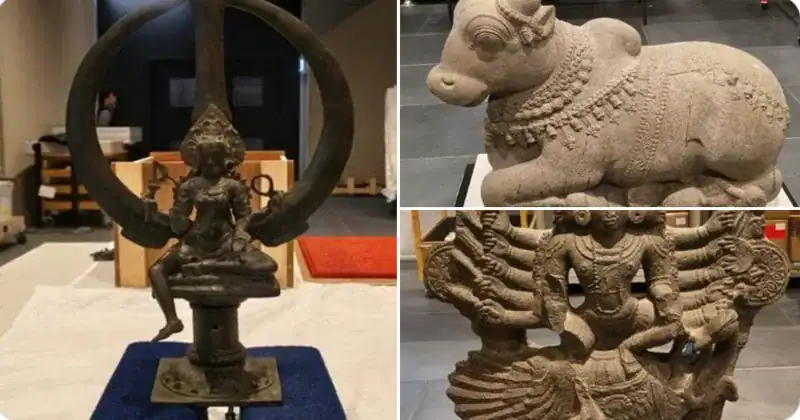
Collage of repatriated Hindu temple artefacts: a Bhadrakali-topped metal trident, stone Nandi bull and six-faced Murugan sculpture from Tamil Nadu.

Australia’s decision to return three sacred antiquities from Tamil Nadu to India—also known civilisationally as Bharat—was one of the most culturally significant outcomes of Prime Minister Narendra Modi’s July 2026 visit to Melbourne. Announced during the Third Australia–India Annual Summit on 9 July, the repatriation brings together diplomacy, criminal investigation, museum ethics, art history and the concerns of living temple communities. The objects are not merely examples of medieval craftsmanship: they embody traditions of worship that have remained meaningful for generations.

The official Government of India list of summit outcomes identifies the three antiquities with unusual precision: an 11th–12th-century granite Nandi, an 11th-century bronze trident bearing an image of Bhadrakali, and a 12th-century basalt image of six-headed Skanda, or Karttikeya. Australia described the action as a voluntary return, while the summit documents recorded it as an outcome that would bring the antiquities back to India.

This wording is important. The diplomatic commitment was completed at the summit, but the physical movement, conservation assessment, transfer of custody and possible restoration to the associated temples can require additional administrative steps. The event should therefore be understood as an authoritative decision to repatriate the objects rather than an assumption that all three had already been ritually reinstalled when the announcement was made.

Three objects, three interconnected sacred traditions

The returned group is remarkable because it reflects the close relationship among Shaiva, Shakta and Murugan traditions in Tamil religious culture. Nandi is inseparable from the worship of Shiva; the ceremonial trishula bearing Bhadrakali expresses the power of the Divine Feminine; and Shanmukha is among Tamil Nadu’s most beloved manifestations of Murugan. Rather than representing isolated sectarian categories, the three objects demonstrate how multiple forms of devotion coexist within a shared Dharmic landscape.

The largest and most visually complex object is the six-headed Skanda. The original report in Organiser describes it as approximately 130 centimetres tall and attributes an investigative valuation of about ₹4 crore to the Tamil Nadu Idol Wing-CID. That monetary estimate may help communicate its rarity, but it cannot capture the sculpture’s historical, ritual or emotional value.

Official documentation classifies the sculpture as 12th-century basalt from Tamil Nadu. It presents Karttikeya in his six-headed form, Shanmukha. The deity is known by several names—including Murugan, Skanda, Karttikeya and Subramanya—reflecting the breadth of his worship across regional and textual traditions. The six faces are interpreted in different theological and devotional ways, while the form as a whole conveys divine awareness, courage, wisdom and protective power.

The reported place of origin is the Naganathaswamy Temple at Manambadi, near Kumbakonam in the Thanjavur region. The temple is associated with the age of Rajendra Chola I and the extraordinary expansion of Chola political, architectural and artistic influence during the 11th century. The sculpture’s return consequently reconnects an individual sacred image with a broader landscape of inscriptions, temple patronage, ritual practice and Chola-period stone carving.

Reports that the Naganathaswamy Temple has experienced serious physical deterioration add urgency to the homecoming. A repatriated sculpture cannot by itself restore a damaged monument, but it can direct scholarly and public attention toward the site. In this sense, the return of Murugan may become a catalyst for architectural documentation, structural conservation, inscriptional research and responsible revival of the temple’s cultural life.

Nandi and the sacred orientation of a Shiva temple

The second antiquity is an 11th–12th-century granite representation of Nandi, the sacred bull and vahana of Shiva. The reported temple of origin is the Sri Kasiviswanathaswamy Temple at Kollumangudi in Tiruvarur district, a place rendered as Kullumangudi in some reports. Nandi images are conventionally positioned on the axial line facing a Shiva sanctum, creating a visual and ritual relationship between the devotee, Nandi and the deity within the garbhagriha.

Nandi is therefore more than an ornamental animal sculpture. Within Shaiva practice, he signifies disciplined devotion, steadiness, strength and attentive service. His fixed orientation toward Shiva is itself a theological statement. Removing such an image from its temple setting breaks an intentionally constructed relationship among image, architecture, direction, ritual movement and community memory.

A museum display can preserve Nandi’s material form and make its artistry accessible to a global audience, but it cannot fully reproduce this spatial function. In a temple, the sculpture participates in an active sacred environment shaped by bells, lamps, circumambulation, recitation and darshan. The difference between viewing a sculpture in a gallery and encountering a murti in its ritual setting explains why repatriation can possess significance far beyond a transfer of legal title.

The Bhadrakali trident as ritual metalwork

The third object is an 11th-century bronze ceremonial trident surmounted by an image of Bhadrakali. It is also associated in reporting with the Sri Kasiviswanathaswamy Temple at Kollumangudi. Its form combines the trishula, closely associated with Shiva and divine power, with an image of the Goddess in a protective and formidable manifestation. This union expresses the theological proximity of Shaiva and Shakta traditions rather than a rigid separation between them.

Bhadrakali’s iconography communicates protection, the overcoming of destructive forces and the power of Shakti. The term “auspicious Kali,” used in the National Gallery of Australia’s catalogue title, captures an essential feature of the deity: fierce appearance and benevolent protection are not contradictory within the tradition. Divine force is presented as purposeful, restoring order and safeguarding devotees.

As ceremonial metalwork, the trident should also be studied as an instrument of worship rather than only as freestanding sculpture. Its metal composition, casting technique, wear patterns, attachment points and ritual residues may reveal how it was handled or displayed. Conservators must balance scientific examination with the sensitivities appropriate to an object created for sacred use.

The official dating of the Nandi and trident to the 11th and 12th centuries should be kept distinct from estimates assigned to later architectural phases of the temple complex. South Indian temples frequently underwent rebuilding, expansion and reconsecration under successive dynasties and patrons. An object can predate surviving architectural fabric, and stylistic dating alone does not establish the precise date on which it entered or left a particular shrine.

How provenance research changed the case

Provenance is the documented history of an object’s ownership, custody, movement and sale. For an antiquity, a credible provenance should answer several questions: where the object was originally located, when it left its country of origin, whether export was lawful, who possessed it at each stage and whether the evidence is independent of the seller’s assurances. Missing decades, vague references to unnamed collections and documents created only at the moment of sale are serious warning signs.

The National Gallery of Australia had publicly examined all three objects through its Asian Art Provenance Project. In April 2017, an NGA media release confirmed that the Tamil Nadu Idol Wing had reported the Nandi and Bhadrakali trident, along with two other sculptures, as stolen. The gallery stated that these works already had suspect or insufficiently documented provenance and remained under discussion with the Indian High Commission.

The institutional acquisition history is revealing. The NGA said that it purchased the granite Nandi from New York dealer Carlton Rochell in 2009 and acquired the Bhadrakali trident from the same dealer in 2006. The gallery’s earlier investigation found the Nandi’s provenance problematic because it could not establish when the sculpture left India. For the trident, ownership could be traced only to 1993, not to the benchmark year of 1970 or to a demonstrated lawful export from India.

The Skanda case illustrates why provenance conclusions must remain open to new evidence. An earlier independent review of the NGA’s Asian Art Provenance Project considered the sculpture comparatively unlikely to be problematic. Documents supplied by its Paris vendor placed it in the collection of dealer C. T. Loo before his death in 1957. Yet the review also acknowledged that ownership before Loo had not been established and that no temple or archaeological origin was known at that time.

Subsequent reporting attributes the identification of the Skanda with the Manambadi temple to the Tamil Nadu Idol Wing-CID. This does not make earlier research worthless; it demonstrates that provenance is an evolving evidentiary field. A chain of private ownership may appear internally consistent while still failing to explain how an object first left its original sacred setting. Newly located photographs, temple records or witness testimony can transform the assessment years later.

The strongest temple-art investigations are multidisciplinary. Police records can establish reported thefts; archival photographs can match damage, measurements and iconographic details; inscriptions can identify donors or ritual functions; geological analysis can compare stone sources; metallurgical testing can examine alloy composition; and customs or dealer records can reconstruct international movement. Even small features—an old fracture, a repaired limb or a distinctive weathering pattern—may connect a museum object to a photograph taken in a temple decades earlier.

Digital comparison has made this work more powerful. Investigators can align historic photographs with three-dimensional scans, compare ornament and surface loss, and search dispersed archival collections far more efficiently than in the past. Nevertheless, technology does not eliminate the need for contextual scholarship. Temple names change, villages have alternative spellings, objects may be moved between shrines, and old photographic captions can themselves contain errors.

The legal machinery behind a cultural homecoming

Organiser reports that the Tamil Nadu Idol Wing-CID invoked the Mutual Legal Assistance Treaty mechanism during the recovery effort. Australia and India signed their Treaty on Mutual Legal Assistance in Criminal Matters in Canberra on 23 June 2008. Its scope includes obtaining evidence and records, locating and identifying objects, executing search or seizure requests, and assisting with property connected to criminal investigations.

An MLAT does not automatically determine ownership or compel every disputed antiquity to be returned. It provides a government-to-government channel through which evidence can be requested and handled according to the laws of both countries. That distinction matters because museum acquisition, unlawful export, theft, good-faith purchase and criminal trafficking can involve different legal questions even when they concern the same object.

The summit’s language of voluntary return is consequently significant. It indicates that Australia chose an ethical and diplomatic resolution without requiring every historical uncertainty to be litigated to final judgment. Voluntary repatriation can be especially effective when an object’s early history is poorly documented, the alleged removal occurred decades ago, or strict procedural barriers would make courtroom recovery slow and uncertain.

The wider international framework is shaped by the 1970 UNESCO Convention, which recognises illicit import, export and transfer of cultural property as causes of heritage impoverishment and identifies international cooperation as an essential remedy. However, treaty rules may not resolve removals that predate their entry into force. Bilateral negotiation, provenance research and voluntary institutional action therefore remain indispensable.

Repatriation, restitution and return are sometimes used interchangeably, but they can carry different emphases. Restitution often highlights the correction of a wrongful taking; repatriation stresses restoration to a country, people or community; and voluntary return describes the mechanism chosen by the current custodian. In this case, “repatriation” most clearly conveys the movement of Tamil sacred heritage back to India while leaving room for the different legal histories of the three objects.

A changing standard for museums

The case reflects a major change in museum practice. Older acquisition systems sometimes accepted thin documentation, dealer-supplied histories or the absence of a theft report as sufficient reassurance. Contemporary due diligence demands a more searching question: not merely whether illegality can be conclusively proven, but whether the institution possesses enough reliable evidence to justify retaining an antiquity of uncertain origin.

This shift does not deny the educational value of international museums. Museums preserve fragile material, support research and allow art to be studied across cultures. Those benefits are strongest, however, when collections are ethically assembled and transparently documented. An institution’s credibility increases when it publishes provenance gaps, invites external evidence and returns an object after a persuasive claim emerges.

The National Gallery of Australia’s public provenance programme is therefore part of the story as well as an object of scrutiny. Its records preserved acquisition dates, vendor names and prior assessments that could be reassessed when Indian authorities supplied additional information. Transparency cannot undo a questionable acquisition, but it creates the evidentiary conditions necessary for accountability and informed return.

The history of Australia–India cultural-property cooperation predates the 2026 summit. The Archaeological Survey of India records Australia’s 2014 return of a Chola Nataraja and Ardhanarishvara, while the NGA has documented further Indian returns through its Right of Return research. The latest homecoming should therefore be seen as part of an institutional learning process rather than an isolated diplomatic gesture.

Reciprocity and the dignity of ancestral heritage

The July 2026 announcement also carried a reciprocal dimension. The Australian Government’s cultural-cooperation statement welcomed India’s decision to return an Australian First Nations ancestor held at the Government Museum in Chennai to the appropriate Traditional Custodians. Australia, in turn, announced the return of culturally significant Indian objects previously held in Australian collecting institutions.

Human ancestral remains and temple murtis are not identical categories and should not be treated as equivalent. Each requires its own legal, cultural and ethical protocols. Yet both returns recognise a shared principle: institutions should listen to source communities when material in their custody possesses continuing sacred, ancestral or identity-forming significance.

The joint summit statement placed these decisions within the protection and preservation of cultural heritage. This framing moves cultural cooperation beyond ceremonial symbolism. It acknowledges that respectful custody, provenance research and the healing of historical dislocation can form a substantive part of modern bilateral relations.

For members of temple communities, the emotional meaning is readily understandable. An empty pedestal or an absent ritual object can preserve the memory of loss long after a police file has gone quiet. The return of a murti does not erase the theft, but it can repair a visible rupture between a community and the sacred form remembered by earlier generations.

India’s expanding heritage-recovery system

The three antiquities belong to a much larger recovery effort involving the Ministry of Culture, Archaeological Survey of India, Indian diplomatic missions, state police units, customs agencies and foreign museums. In May 2026, the Government of India reported that 653 antiquities had been retrieved since 2014. Because official counts may be updated only after physical transfer or administrative accession, the three Australian objects should not simply be added to that figure without a later government update.

Numbers demonstrate scale, but they can conceal differences among cases. A single repatriation may involve years of research, multiple jurisdictions, contested documentation and expensive conservation. Some objects are returned through criminal forfeiture, some through negotiated agreements, some after museum-led provenance investigations and others through private surrender. The quality of the evidence and the suitability of post-return care matter as much as the total.

The homecoming is therefore only one stage in a longer stewardship process. Each object should undergo a detailed condition assessment before transport, including high-resolution photography, structural examination and documentation of earlier repairs. Stone and bronze respond differently to humidity, vibration and handling. Packing systems, environmental controls and insurance arrangements must be designed around the individual object rather than applied generically.

After arrival, authorities must determine lawful custody, conservation needs and the appropriate location for display or worship. Reinstallation in a temple may require consultation among the Archaeological Survey of India, state heritage and religious-endowment authorities, police investigators, conservators, temple administrators, priests and local devotees. If the original structure is unstable, temporary secure custody may be necessary before a culturally appropriate return to the site can occur.

Security must also improve alongside repatriation. Detailed photography, measurements, three-dimensional scans, inscriptions, distinctive damage and conservation history should be entered into interoperable databases. India’s National Mission on Monuments and Antiquities had documented more than 1.24 million antiquities by July 2025, according to government figures. Comprehensive inventories make stolen objects easier to identify and make undocumented artefacts harder to sell.

Documentation should be paired with practical protection: trained temple staff, secure doors and display systems, discreet surveillance, controlled key access, periodic audits and rapid reporting protocols. Smaller temples often hold historically important objects without the financial or technical resources available to major museums. A sustainable heritage policy must support these local custodians before theft occurs.

Local knowledge is equally valuable. Priests, hereditary trustees, residents, photographers and regional historians may remember an object that never entered a formal catalogue. Their recollections should be recorded carefully and tested against photographs, measurements and documentary evidence. Community participation is not a substitute for forensic investigation, but it often provides the lead from which a rigorous case can be built.

Why this homecoming matters

The return of Murugan, Nandi and the Bhadrakali trident demonstrates that sacred heritage is simultaneously material and relational. Stone and bronze carry measurable properties, stylistic features and market values, yet their deepest significance arises from relationships—with a temple, a deity, a landscape, a ritual tradition and a community of memory.

The three objects also offer a compelling image of unity within Hindu Dharma. Murugan devotion, Shaiva worship and reverence for Shakti meet within the same cultural geography without requiring uniformity. That pattern resonates with the wider Dharmic commitment to preserving distinct paths while recognising their capacity for coexistence, mutual respect and shared custodianship of sacred heritage.

For Australia, the voluntary return reinforces a commitment to ethical collection management and stronger relations with India. For India, it validates the patient work of investigators, diplomats, archaeologists and community researchers. For museums worldwide, it confirms that an apparently settled acquisition can require reconsideration when better evidence becomes available.

The most meaningful measure of success will not be the ceremony alone. It will be whether the antiquities are conserved responsibly, their histories are published transparently, the associated temples receive sustained protection and future trafficking is prevented. Repatriation should close one chapter of displacement while opening a more durable chapter of research, worship, education and cultural care.

Australia’s 2026 decision is ultimately a homecoming of context. Nandi can again be understood in relation to Shiva, the Bhadrakali trident in relation to ritual power, and Shanmukha in relation to the Chola sacred landscape of Manambadi. Their return affirms that cultural diplomacy is at its strongest when it restores not only possession, but also memory, dignity and living connection.


Inspired by this post on Hindu Post.


Graphic with an orange DONATE button and heart icons on a dark mandala background. Overlay text asks to support dharma-renaissance.org in reviving and sharing dharmic wisdom. Cultural Insights, Personal Reflections.

FAQs

Which three Tamil Nadu antiquities is Australia returning to India?

The return covers an 11th–12th-century granite Nandi, an 11th-century bronze ceremonial trident bearing Bhadrakali, and a 12th-century basalt image of six-headed Skanda, also known as Murugan or Karttikeya. Australia described the action as a voluntary return announced at the Third Australia–India Annual Summit on 9 July 2026.

Where did the three artefacts reportedly come from?

The six-headed Skanda is reported to come from the Naganathaswamy Temple at Manambadi near Kumbakonam. The Nandi and Bhadrakali trident are associated in reporting with the Sri Kasiviswanathaswamy Temple at Kollumangudi in Tiruvarur district.

Why are the Nandi, Bhadrakali trident and Skanda more than museum artworks?

They belong to living Shaiva, Shakta and Murugan traditions and were made for sacred settings and ritual use. Their meaning is tied not only to craftsmanship but also to temple architecture, worship, community memory and relationships such as Nandi’s orientation toward a Shiva sanctum.

How did provenance research help establish the case for return?

The National Gallery of Australia documented acquisition histories and gaps, while Tamil Nadu Idol Wing evidence linked objects to reported thefts or temple origins. The case shows that dealer records can be reassessed when archival photographs, police files, temple records or other evidence emerges.

What role did the Australia–India Mutual Legal Assistance Treaty play?

Reporting says the Tamil Nadu Idol Wing-CID used the treaty mechanism to support the recovery effort. The treaty provides a government-to-government channel for evidence, records, searches, seizures and property-related assistance, but it does not by itself determine ownership or compel return.

Does the summit announcement mean the artefacts were already back in their temples?

No. The summit established an authoritative commitment to repatriate them, but physical transport, conservation assessment, transfer of custody and any possible temple restoration can require additional steps.

What needs to happen after the antiquities return to India?

Their long-term benefit will depend on careful conservation, secure custody, transparent documentation and protection of the associated temples. Decisions about ritual reinstallation should also account for structural safety, security and the needs of living temple communities.

Leave a Reply