
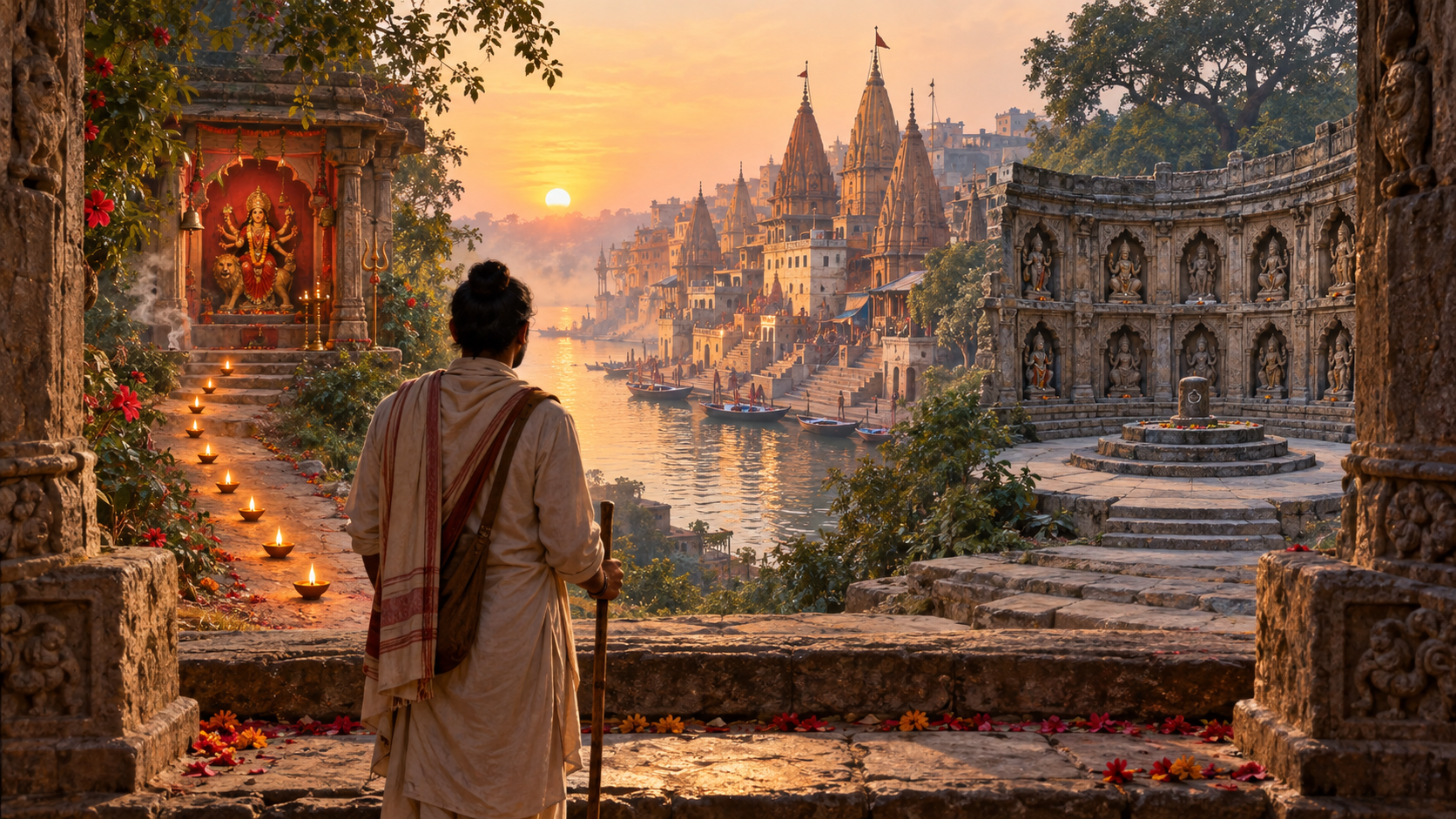
You may be preparing for Navaratri, planning a pilgrimage to Kashi, or wondering how a 64-Yogini shrine belongs in the same broad sacred world as the nine forms of Durga. The useful answer begins with a distinction: these traditions approach Shakti through different sacred maps. They belong together, but they are not interchangeable.
Once you know whether a temple is organized by a festival sequence, a network of shrines, or a collective of divine forms, you stop seeing an unexplained crowd of names. You begin to notice what the tradition is asking you to remember, practise, and experience.
Navadurga is a sequence, not merely a list of names
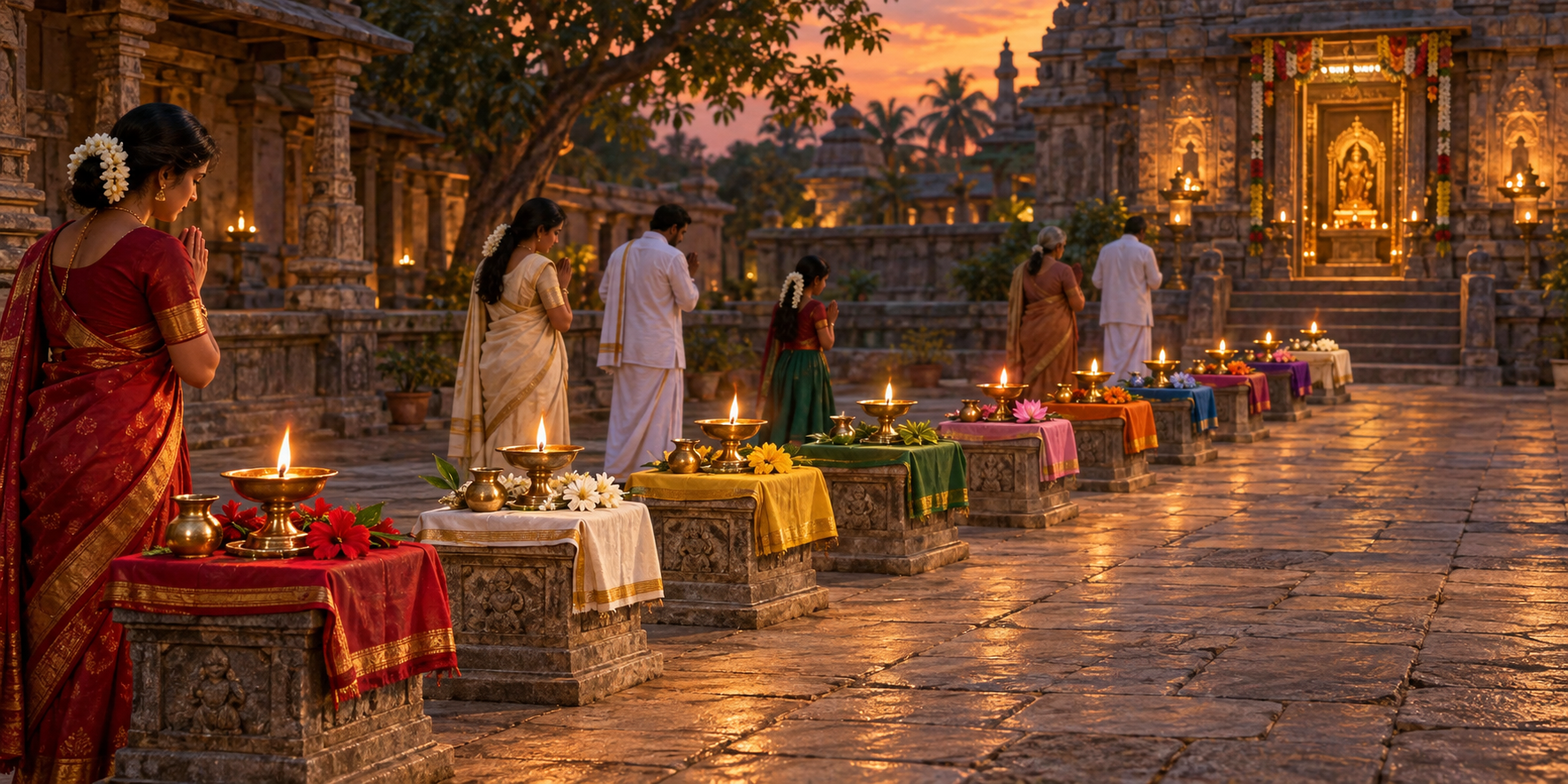
Navadurga presents Durga through nine forms associated with the successive days of Navaratri: Shailaputri, Brahmacharini, Chandraghanta, Kushmanda, Skandamata, Katyayini, Kaalratri, Mahagauri, and Siddhidhatri. Remembering the order matters because the sequence gives the tradition its devotional rhythm. If you remove the order, you retain nine names but lose part of the practice.
A useful way to approach the sequence is to ask three questions each day: Which form is being honoured? Where does she stand in the ninefold order? What quality does her name place before your attention? This keeps Navaratri worship from becoming a hurried change of images without a corresponding change in awareness.
Brahmacharini makes the method clear. She is the second manifestation of Navadurga and is honoured on the second day of Navaratri. Her name joins Brahma, understood here in the sense of supreme reality, with charini, one who walks or follows a path. The emphasis is not simply on possessing knowledge. It is on walking toward the highest through steadiness.
If you want to turn that meaning into practice, choose one modest discipline for the day: keep the time you set aside for prayer, complete the recitation you have undertaken, or remove one avoidable distraction from your worship. This is a personal application, not a replacement for the ritual instructions of your family, guru, or temple. Its purpose is to make the name memorable through conduct.
Do not reduce Brahmacharini, or any other form, to a motivational slogan. A deity is not a self-help theme. The practical quality is an entrance into contemplation, while the form remains an object of reverence. Hold both together: learn what the name discloses, and approach the Devi as more than an illustration of that idea.
Kashi turns the ninefold sequence into sacred geography
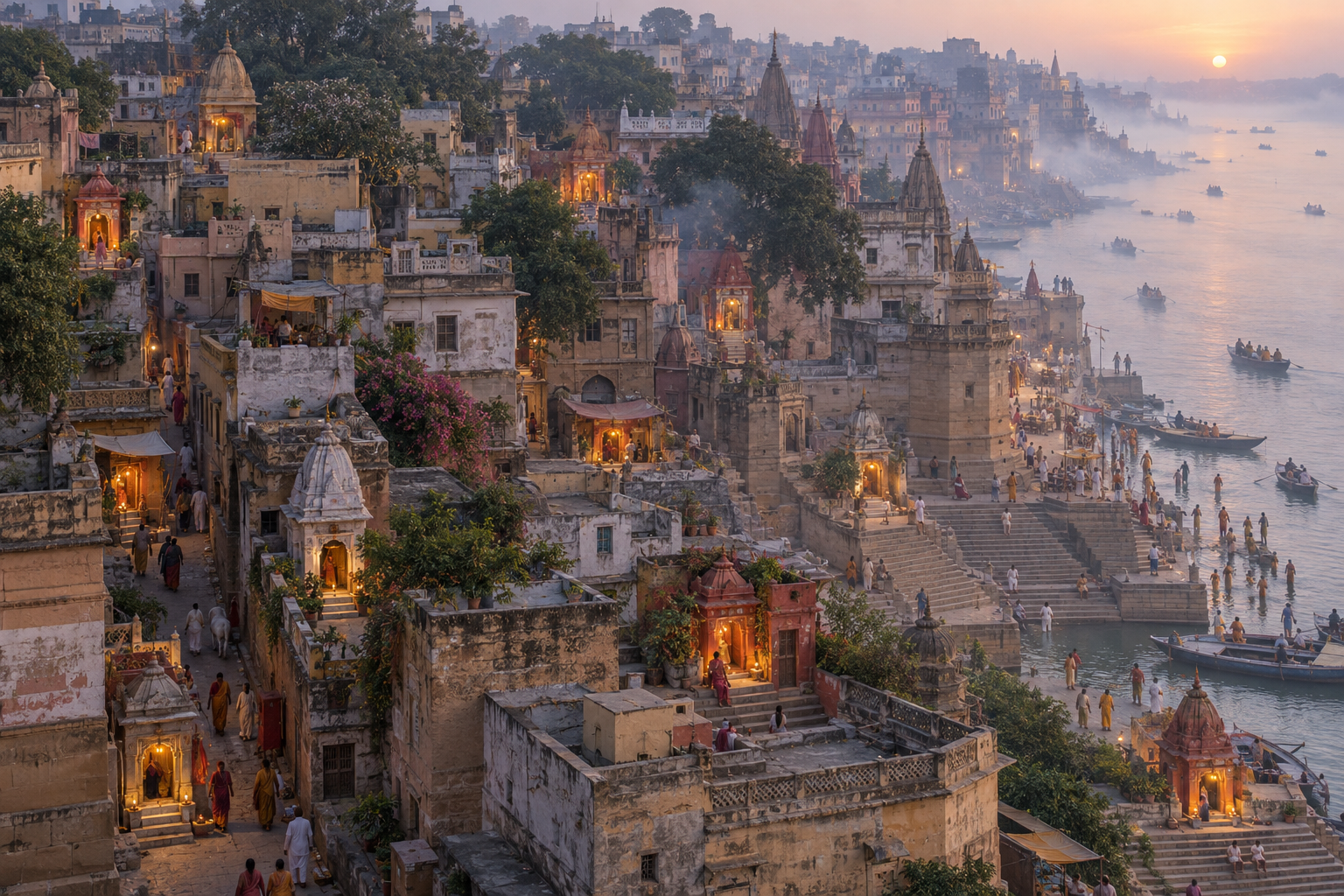
Navadurga is encountered through time during Navaratri, but Kashi also allows the ninefold tradition to be approached through place. Varanasi has temples associated with Shailaputri and the other eight forms: Brahmacharini, Chandraghanta, Kushmanda, Skandamata, Katyayini, Kaalratri, Siddhidhatri, and Mahagauri. The calendar can therefore become a pilgrimage across a sacred city.
If you intend to visit these shrines, plan for a network rather than a single Navadurga complex. Make a nine-row route sheet before you travel. For each form, record the shrine name, locality, current opening hours, travel time, and any temple-specific guidance you can verify. Check practical details close to the date of your visit; sacred identity may endure while access arrangements and timings change.
Begin with Shailaputri when you want your pilgrimage to follow the conventional Navadurga order. If distance, crowds, or opening times require a different physical route, keep the devotional order in your notes. Geography may force you to move differently without erasing the sequence you are studying.
At each shrine, resist the urge to collect photographs and leave. First identify the form being worshipped. Then notice the local name, the arrangement of the sanctum, and anything that distinguishes this temple’s observance from the abstract nine-name list you brought with you. If an appropriate opportunity arises, ask one precise question: What is distinctive about the worship of this form here during Navaratri? A focused question is more likely to teach you something than a request for the whole history of the shrine.
Kashi also teaches an important restraint. A tidy chart can help you prepare, but it cannot contain the full life of a temple. Local customs, inherited ritual responsibilities, neighbourhood memory, and the rhythms of daily worship give each shrine a character that a list cannot reproduce. Use the list to arrive informed, not to overrule what you encounter.
The 64 Yoginis belong to a different Shakti framework
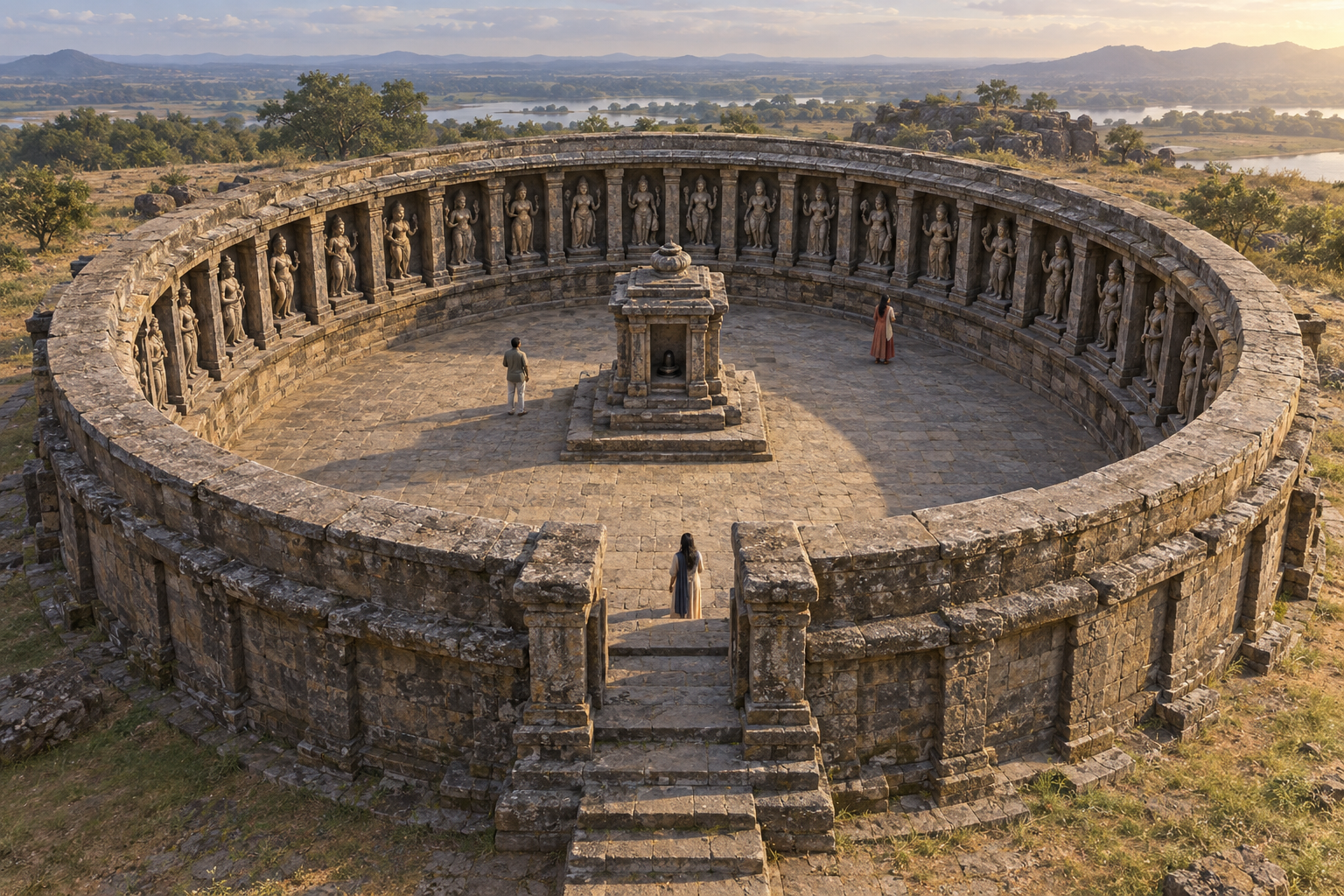
The 64 Yoginis widen the field of Shakti worship, but they should not be treated as an expanded version of Navadurga. The tradition understands the Yoginis as manifestations of Shakti, organized as their own collective. Navadurga gives you a ninefold sequence closely associated with Navaratri; a 64-Yogini temple presents another way of encountering divine plurality.
On the outskirts of Bhubaneswar in Odisha, approximately 15 kilometres southeast of the city, stands a small circular Yogini temple dated to the early ninth century. Its number, age, and circular form are not decorative facts. They tell you that you are entering a sacred arrangement with a structure different from the day-by-day progression of Navadurga.
The circular setting gives you a practical discipline of attention. Notice how multiple forms are related within one enclosure. Look for repetition and difference without rushing to select a single figure as the key to all the others. This is a way to observe the temple responsibly, not a claim that one modern interpretation exhausts the original intention of its builders or worshippers.
One confusion is especially worth correcting: the Yoginis should not be casually identified with the Saptamatrikas or Ashtamatrikas. The very terms point to different groupings – sixty-four Yoginis, seven Matrikas, or eight Matrikas. They can inhabit the wider world of Shakti traditions without becoming three names for the same collective.
- Navadurga identifies the nine forms of Durga in a devotional sequence associated with Navaratri.
- 64 Yoginis identifies a larger and distinct collective understood as manifestations of Shakti.
- Saptamatrikas and Ashtamatrikas identify groupings of seven or eight Matrikas, not alternative names for the 64 Yoginis.
- Shakti temple is a broad description. It tells you the sacred field, but not the temple’s precise ritual, theological, or architectural organization.
These distinctions protect the individuality of each tradition. Saying that several forms manifest Shakti can express their relationship. It does not authorize us to erase their names, numbers, ritual settings, or local identities.
Use a four-part method when you visit a Shakti temple
You do not need specialist training to visit attentively. You do need enough discipline to separate what the temple presents from what you assumed before arriving. The following method works whether you are approaching a Navadurga shrine in Kashi or a Yogini temple in Odisha.
- Name the tradition precisely before you go. Write Navadurga, 64 Yoginis, Saptamatrikas, Ashtamatrikas, or the particular form of Devi named by the temple. Do not let the general label Shakti temple replace the proper identity.
- Give darshan priority over documentation. On arrival, follow the temple’s norms, quiet your impulse to record everything, and attend to the presiding form. Ask before taking photographs, touching sacred objects, or entering an area whose access is unclear.
- Observe the organizing principle. Is the temple part of a nine-shrine geography? Does a festival day determine the form receiving attention? Are many figures arranged together in one enclosure? The answer tells you how the sacred plurality is being expressed.
- Separate observation from interpretation. After the visit, make three short notes: what you directly saw, what local practice or explanation identified, and what you inferred. This prevents a personal impression from hardening into a claim about every Shakti tradition.
There is also a simple test for anything you plan to repeat to someone else: could you say which form, which grouping, and which temple you mean? If not, your statement is probably too broad. Replace phrases such as all Goddess temples do this with the narrower description you can actually support.
This care does not weaken a sense of unity. It makes unity more meaningful. You can recognize the nine Durgas and the sixty-four Yoginis as expressions within the sacred world of Shakti while still allowing nine to remain nine, sixty-four to remain sixty-four, and every temple to speak in its own ritual language.
Key takeaways
- Approach Navadurga as an ordered nine-form practice associated with the days of Navaratri, not as an unordered catalogue of Goddess names.
- Brahmacharini is the second Navadurga. Her name directs attention to walking a disciplined path toward the highest reality.
- Kashi contains temples associated with all nine forms, so a Navadurga pilgrimage requires a multi-shrine plan and locally verified logistics.
- The early ninth-century circular 64-Yogini temple near Bhubaneswar represents a distinct Shakti framework, not a larger Navadurga list.
- Do not use 64 Yoginis, Saptamatrikas, and Ashtamatrikas as interchangeable terms. Their numbers identify different sacred groupings.
- During a temple visit, identify the tradition, observe its organizing structure, follow local boundaries, and distinguish what you saw from what you inferred.
If you are preparing for Navaratri, write the nine names in order and give each day one sincere point of attention. If you are travelling to Kashi or Odisha, carry the relevant distinctions, verify practical details locally, and let the temple correct your assumptions. That small discipline can turn a tour of sacred images into informed darshan.
References
- Hindu Pad – Aspects of Brahmacharini Navadurga
- Hindu Pad – Shailaputri Temple, Varanasi
- Hindu Pad – 64 Yogini Temple, Bhubaneswar in Odisha

Leave a Reply
You must be logged in to post a comment.