
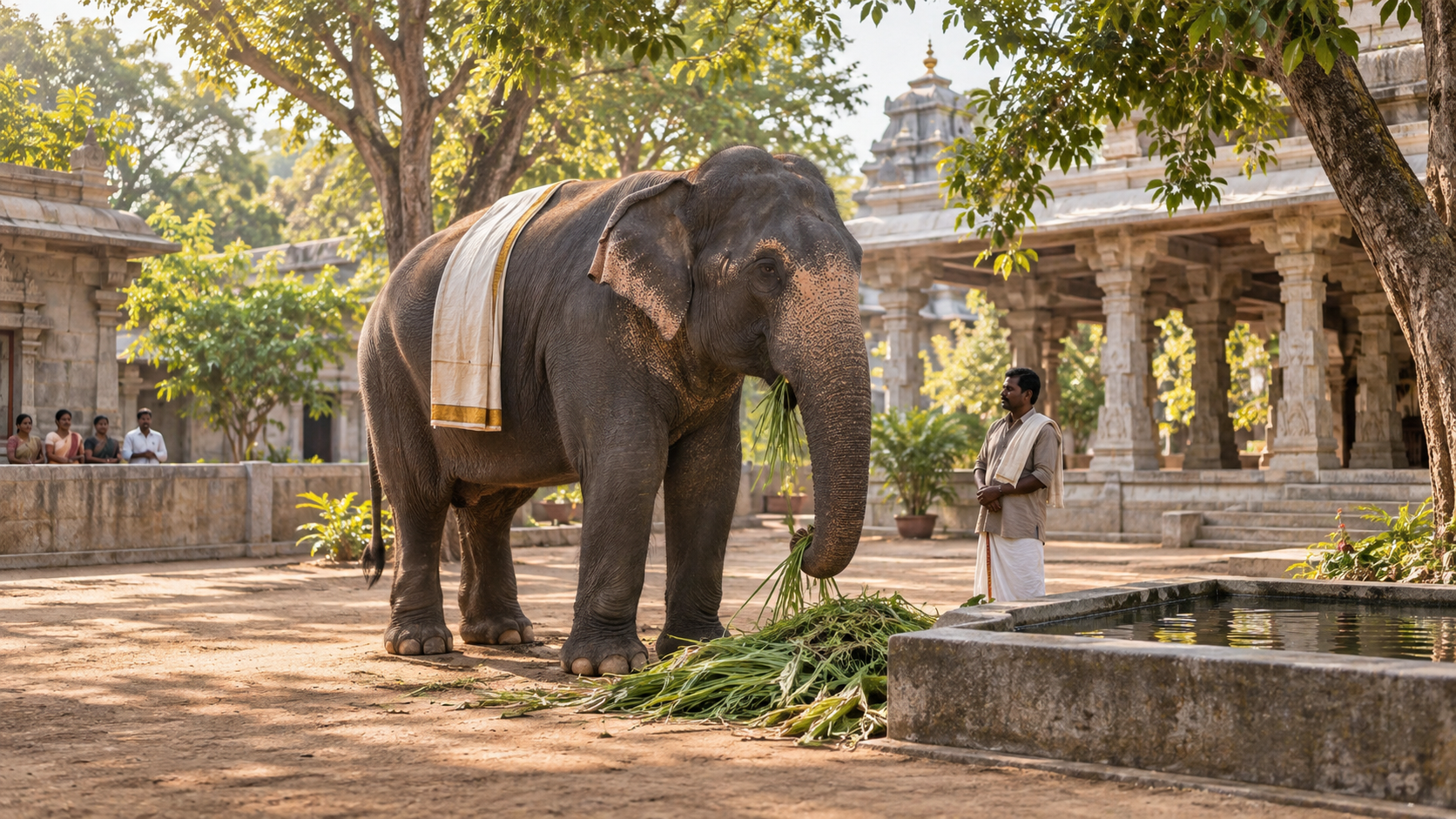
If your temple keeps or displays an elephant, you may feel caught between reverence for a tradition and concern for the animal in front of you. You don’t have to choose between Dharma and compassion. The practical question is whether a particular ceremony protects a living being from avoidable pain, exhaustion and fear.
You can raise that question without insulting the deity, the temple or fellow devotees. Begin with what you can observe, ask temple authorities for verifiable answers, and insist that worship continue without the elephant whenever illness, injury or unsafe handling is suspected.
Key takeaways
- A living elephant is not a ritual object. Sacred symbolism never removes the temple’s duty of care toward the animal.
- If illness, injury or severe exhaustion is credibly suspected, the procession should pause while a qualified veterinarian assesses the elephant.
- Ask for facts: veterinary fitness, travel conditions, restraint methods, rest arrangements, transfer history and a funded retirement plan.
- Do not feed, touch, crowd, release or attempt to handle the elephant yourself. Urgent intervention belongs with qualified professionals and the relevant authorities.
- Preserve the religious meaning through an image, emblem, palanquin or other animal-free representation, and redirect elephant-related donations toward care and retirement.
Sacred symbolism does not excuse harmful treatment
An elephant may carry profound religious meaning without a captive elephant being required at every celebration. Confusing the animal with the symbol creates a false choice: either accept the practice without question or reject the tradition itself. A devotee can honour Ganesha, respect the temple and still oppose conditions that cause an elephant to suffer.
Ahimsa is not merely an affectionate feeling toward animals. It asks what our actions do to a vulnerable being. When an elephant cannot leave, refuse a command or explain its pain, the people exercising control carry the heavier moral responsibility. A procession does not become compassionate because it is religious, and long use does not turn an avoidable burden into a necessity.
That responsibility becomes immediate when illness is reported. Shyamu, a 32-year-old elephant reportedly used in Ujjain’s Mahakal procession, was reported to have tested positive for EHEV-1 and still to have been made to stand for hours. Those claims should not be mistaken for an independent veterinary finding available to the reader. They are, however, serious enough to establish the correct order of action: pause the display, arrange qualified care and verify fitness before considering any further participation.
The same principle applies to transport and handling. Durga, described as a baby elephant, reportedly travelled for four to five days from Assam to Madurai and was led with a rope threaded through a hole in her left ear. Her transfer also prompted questions about separation from her mother, amid reports that four elephants were being moved to locations in Tamil Nadu. A concern about separation is not proof of what occurred. It is a reason to demand records and professional assessment rather than treating arrival at a temple as proof that everything was proper.
The threshold for precaution should be lower than the threshold for blame. You do not need to prove cruelty before asking that a visibly unwell or recently ill elephant be removed from public display. You do need reliable evidence before accusing a named person of an offence. That distinction protects the animal while keeping advocacy accurate.
Observe carefully, but do not try to diagnose the elephant
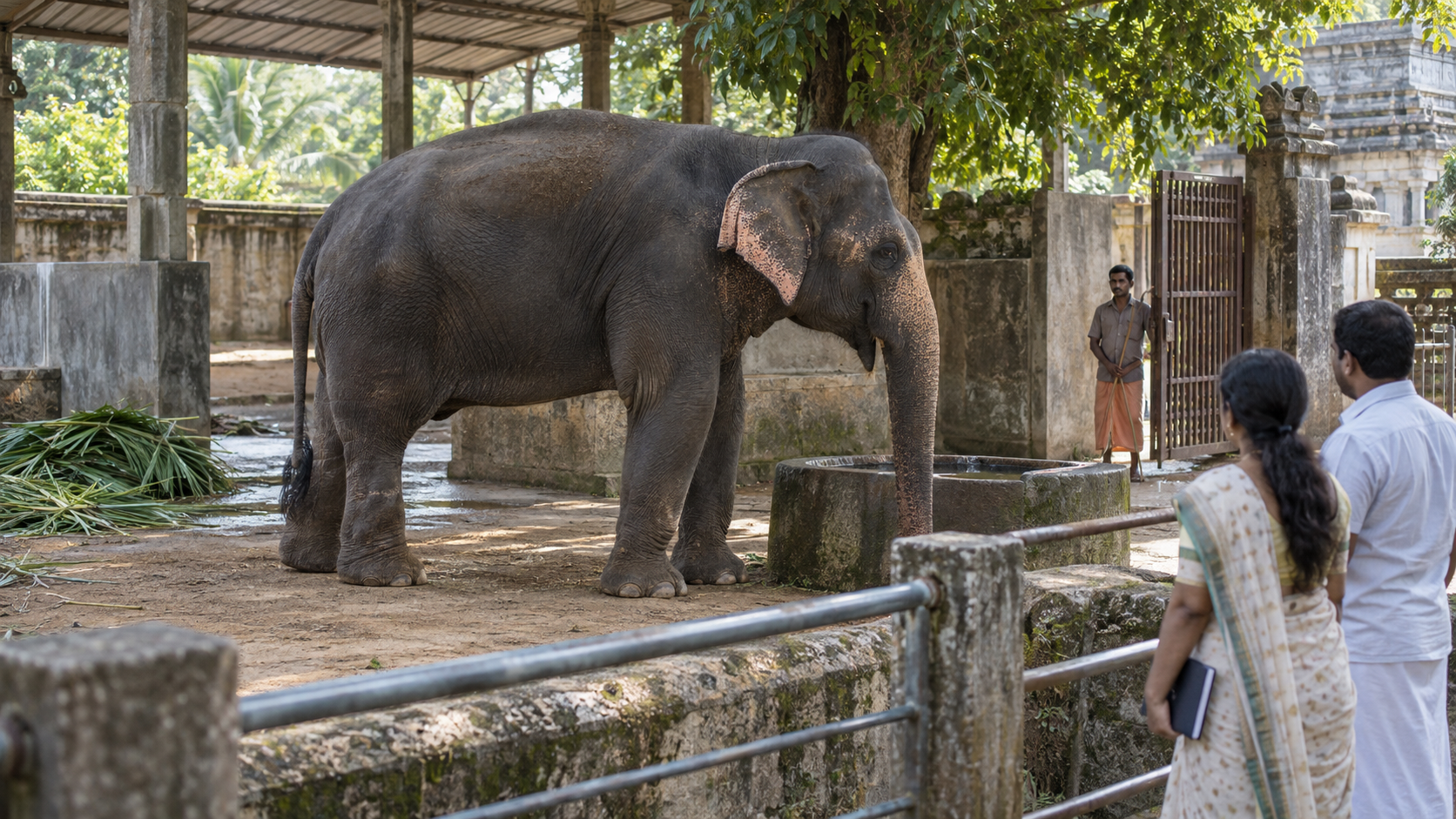
You are unlikely to have access to the elephant’s medical history, and a short observation cannot establish a diagnosis. It can still reveal conditions that justify stopping an interaction and asking urgent questions. Notice the whole setting, not just whether the elephant appears calm for a photograph.
- Visible injury: Look for open wounds, bleeding, damaged skin or restraints contacting an injured area. Record only what you can actually see; do not assign a cause you cannot verify.
- Difficulty moving or remaining upright: Limping, an unwillingness to move, repeated attempts to shift weight or obvious trouble standing warrants professional attention. It does not tell you the diagnosis.
- Prolonged display: Ask when the elephant arrived, how long it has been standing and when it will receive uninterrupted rest. If nobody responsible can answer, the schedule is not adequately transparent.
- Heat, water and retreat: Check whether clean water, shade and a place away from crowds are available. Access must be practical, not merely visible behind a barrier the elephant cannot reach.
- Restraint and control: Notice where ropes, chains or other equipment touch the body. Never pull, remove or alter them yourself; an uncontrolled intervention can endanger the elephant, its handler and the crowd.
- Recent transport: Ask how long the journey took, what care occurred during it and whether a veterinarian examined the elephant before public participation.
- A young elephant without its mother: Do not assume unlawful or permanent separation from a single sighting. Ask where the mother is, why separation occurred, who approved the movement and what specialist care the calf is receiving.
One sign may have more than one explanation. Your task as a devotee or visitor is not to settle the medical question. It is to notice when the question cannot safely be ignored and to bring in someone qualified to answer it.
Ask the temple committee for evidence, not assurances
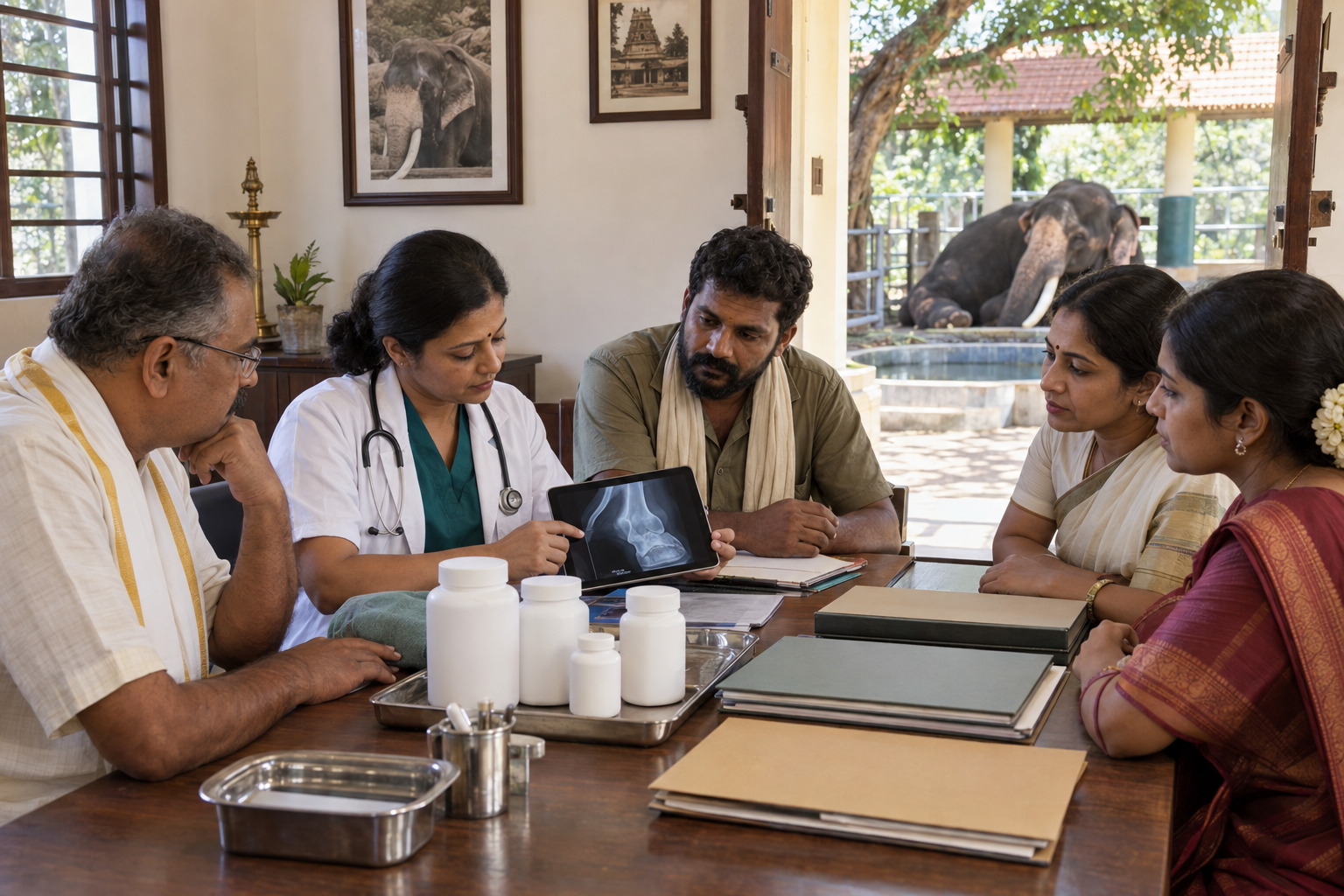
“The elephant is fine” is not a welfare system. A temple that chooses to involve an elephant should be able to show who is responsible, how decisions are made and what happens when an animal cannot participate. Put your questions in writing so that the committee can answer precisely and so the same concerns do not disappear after the festival.
- Who is the responsible veterinarian? Ask whether the person is qualified to assess elephants, when the latest examination occurred and whether the elephant was declared fit for this particular journey and event. A generic health statement is not the same as fitness for transport, crowds and prolonged standing.
- Is the elephant ill, injured, under treatment or awaiting test results? If the answer is yes or uncertain, request removal from the programme until a qualified veterinarian clears participation. Ceremony should not be used as a test of whether the animal can endure the ceremony.
- What does the day’s schedule require? Ask for travel time, display time, rest periods, access to water and shade, and the distance the elephant is expected to walk. Do not invent a universal safe limit; health, age, weather, terrain and veterinary findings matter.
- How is the elephant restrained and directed? Ask what equipment is used, why it is considered necessary and how injury is prevented. Any method involving damaged tissue, an open wound or a body piercing deserves immediate scrutiny and a safer alternative.
- What is the transfer and family history? For a young elephant, ask whether the mother is alive and accessible, why any separation occurred, who authorised the movement and what professional assessment supports it. Preserve uncertainty until records are produced.
- What happens when participation ends? Ask where the elephant lives, who pays for continuing care and whether a retirement plan already exists. Welfare cannot begin at the temple gate and end when the procession finishes.
Medical records may contain information that cannot simply be handed to every visitor. That does not prevent a temple from naming the responsible professional, confirming the date and outcome of a fitness assessment, explaining its decision process, and publishing a clear welfare policy. Transparency can respect legitimate confidentiality without reducing devotees to blind trust.
If there appears to be immediate danger, request that the elephant be moved away from the ceremony and assessed at once. Contact the relevant wildlife or animal-welfare authority for that jurisdiction when temple personnel do not respond. Do not enter an enclosure, confront a handler beside the elephant or attempt a release. Sudden movement in a crowded setting can create another emergency.
Raise the concern in a way that produces action
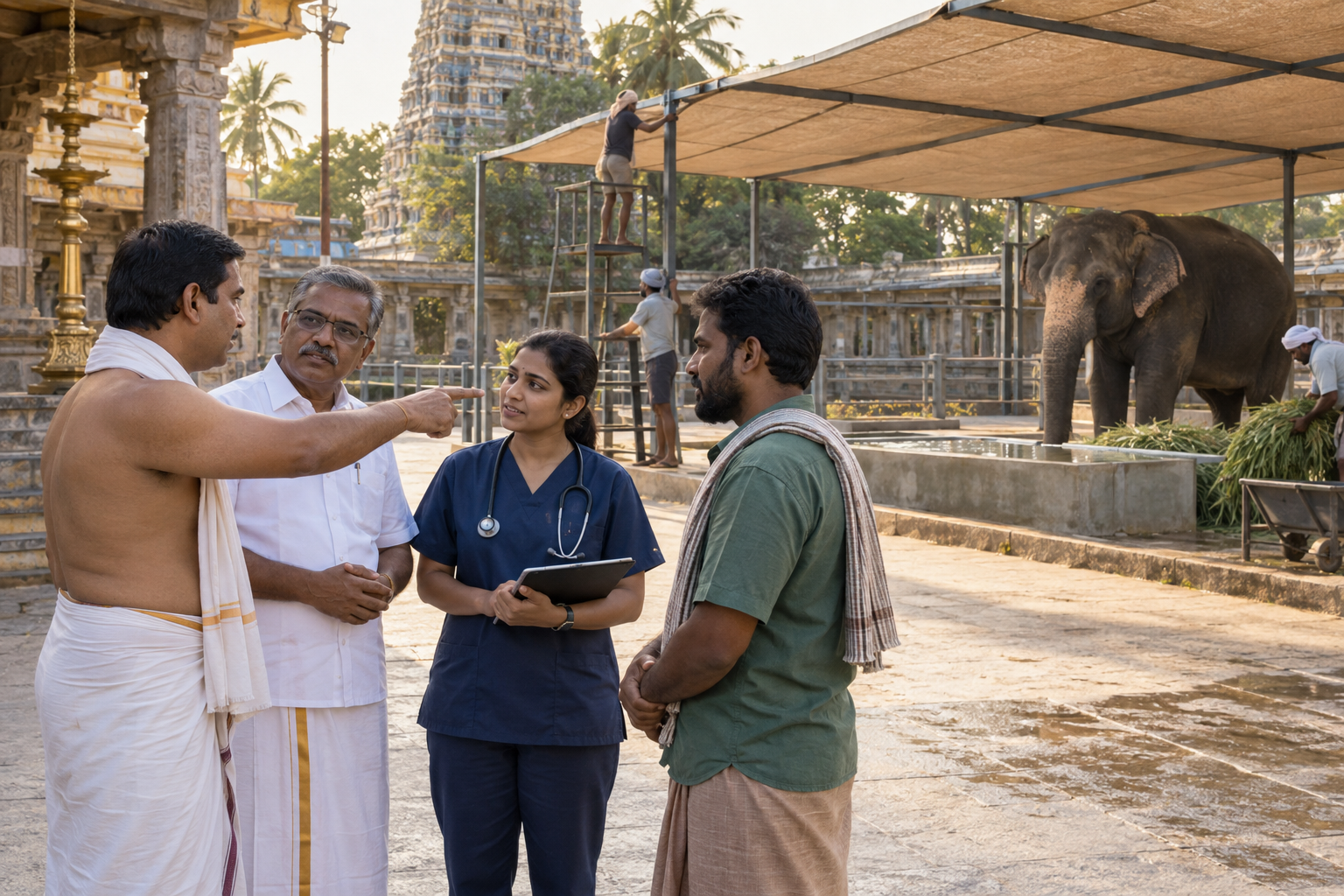
A sweeping accusation may attract attention while making it easier for decision-makers to dismiss the complaint as hostility toward Hindu practice. A precise request is harder to evade. Separate what you witnessed from what you suspect, and connect each concern to a remedy.
- Make a factual record. Note the temple, date, approximate time, ceremony, visible condition, restraint method and duration you personally observed. Use photographs or video only where permitted and safe. Keep the original files.
- Describe observations without diagnosing. Write “the rope appeared to pass through an opening in the left ear,” not “the handler caused this wound,” unless you have evidence for the second claim. Write “the elephant struggled to place weight on one leg,” not a guessed medical condition.
- State the immediate request. Ask for withdrawal from the event, water, shade, quiet rest and qualified veterinary assessment when those needs appear urgent. Avoid a vague demand to “do better.”
- Ask for a written answer before the next event. Request the fitness decision, welfare protocol and name of the accountable committee member. The practical deadline is before the elephant is transported or displayed again.
- Offer an animal-free replacement. A committee can reject a complaint as impractical if the festival programme depends on the elephant. Bring a workable ceremonial alternative at the same time.
- Escalate responsibly. If the response is absent or inadequate, share the documented facts with trustees, respected devotees and the relevant professional or public authority. Do not turn uncertainty into certainty merely to make a campaign more dramatic.
Keep the Dharmic claim simple: devotion cannot require us to disregard suffering. This is not an argument against darshan, temple festivals or the sacred place of elephants in Hindu imagination. It is an argument that religious meaning must be expressed through methods consistent with compassion.
Money is also a form of consent. If a temple sells feeding, touching, photography or other close interactions, you can decline them and explain why. If you donate, make the gift conditional on veterinary care, improved living conditions, independent oversight or retirement rather than on another public appearance. Ask for a written account of how restricted funds will be used.
Preserve the ritual meaning without using a live elephant
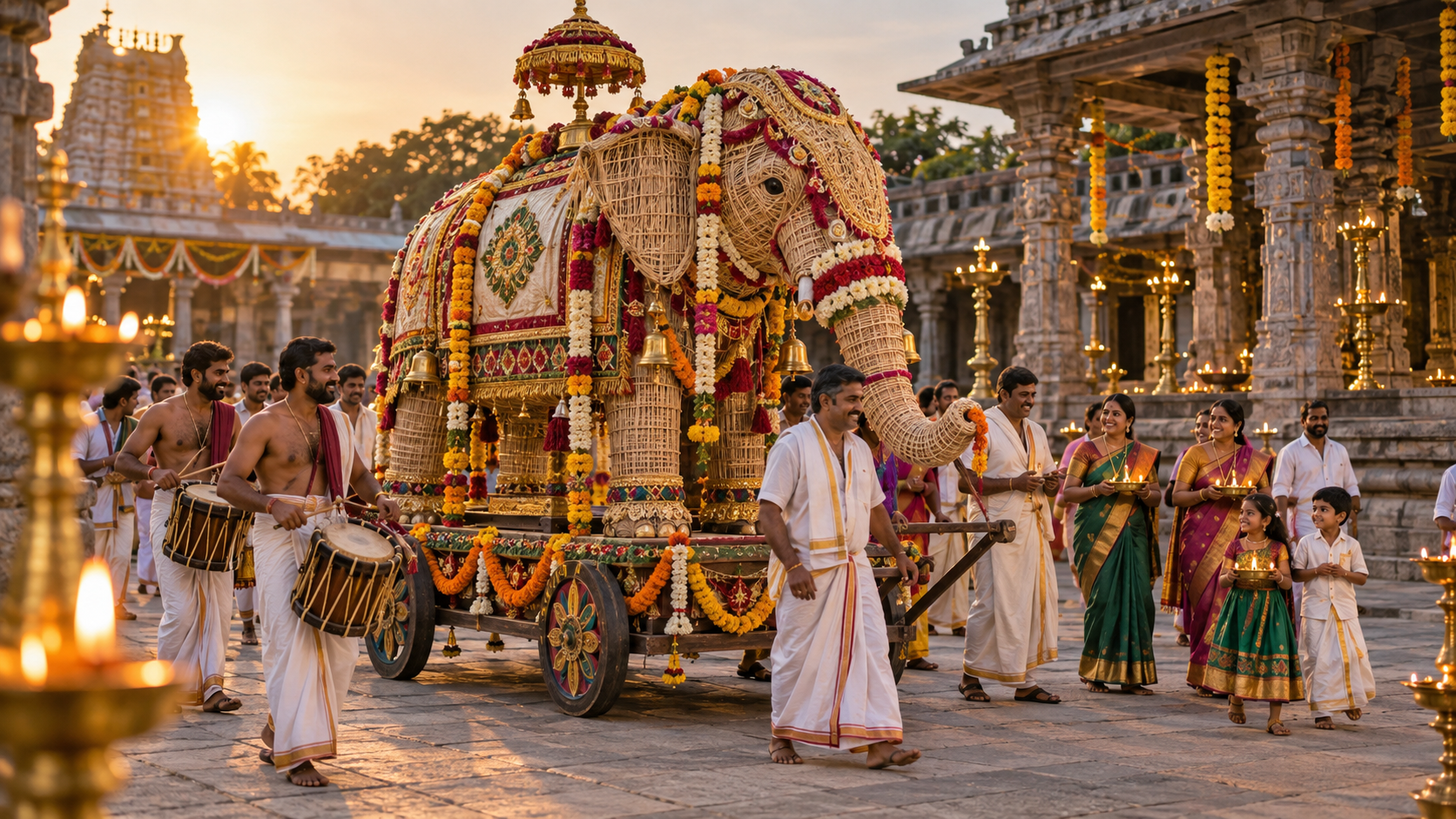
A live animal is not the only way to carry an elephant’s symbolism through a festival. The committee can use a decorated image, temple emblem, sculpture, processional standard or palanquin suited to the local tradition. The right form should be selected with the acharya, priests, artisans and devotees, but the welfare boundary should be settled first: no animal participates when its safety and care cannot be demonstrated.
A practical transition can happen in three stages. For the immediate event, remove any elephant whose fitness is uncertain and use the simplest available representation. Before the next festival, commission a dignified animal-free processional form and explain its Dharmic purpose to the community. For the long term, adopt a written rule that the celebration will not depend on captive-animal display.
Good communication matters. Tell devotees that the symbol remains honoured while the method changes. Invite offerings for food, treatment and retirement rather than for ornamentation or performance. Let children encounter the elephant through art, stories and education about compassionate care, not through the assumption that sacredness gives humans a right to touch or command a living animal.
If retirement or relocation is proposed, do not treat “free the elephant” as permission for an improvised release. A captive animal may require continuing veterinary care, experienced caregivers, suitable surroundings and carefully planned transport. Ask who will receive the elephant, what professional assessment supports the move, how lifetime care will be funded and how transfer to another spectacle will be prevented. A sanctuary label alone is not evidence; the care plan is what matters.
Before your next temple visit, send the committee three questions: Who certified the elephant fit, what restraints and schedule will be used, and what is the retirement plan? If the answers are vague, ask that the ceremony proceed with an animal-free symbol. That is a concrete offering you can make to both the temple and the being whose welfare depends on human decisions.
References

Leave a Reply
You must be logged in to post a comment.