
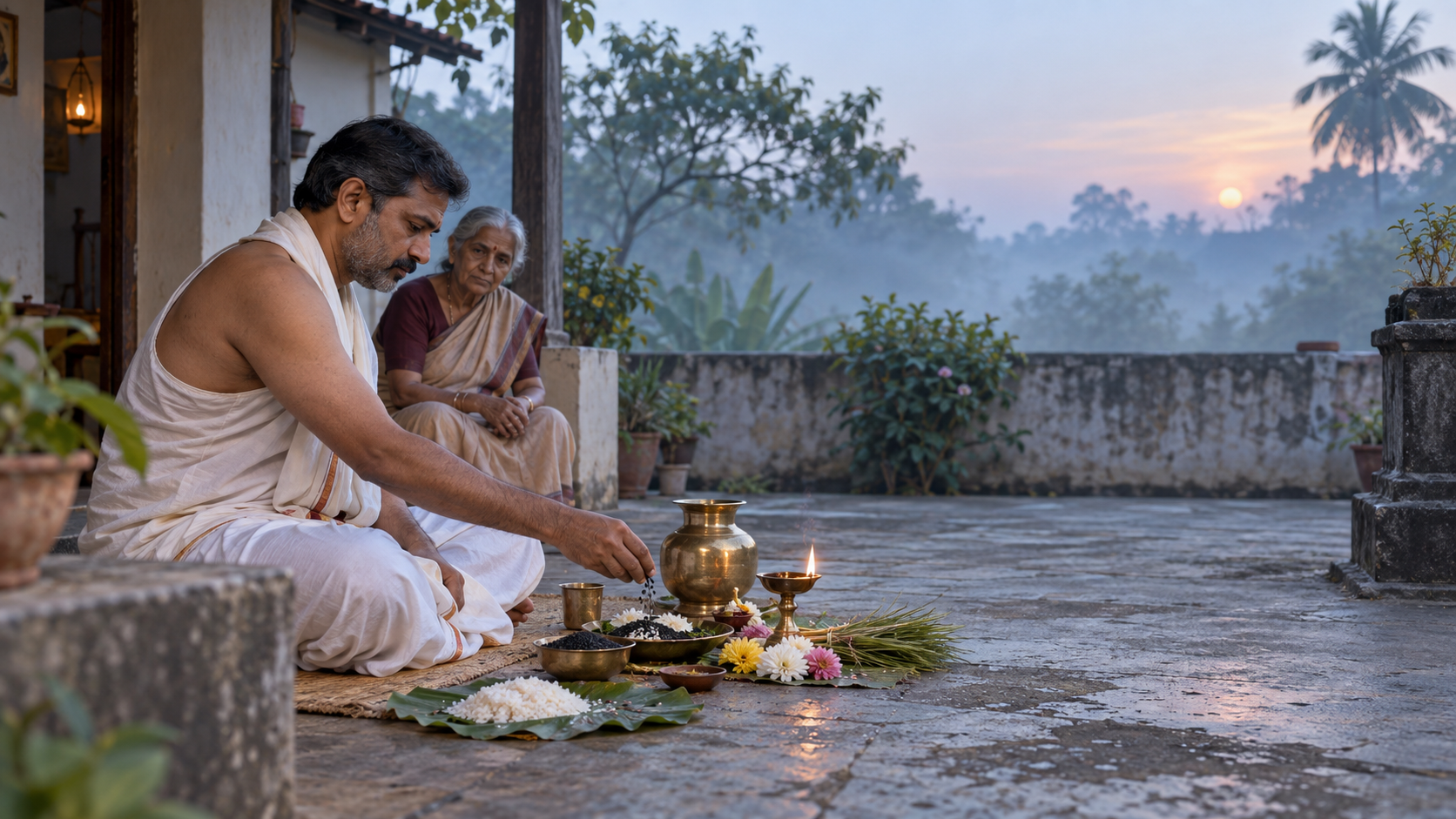
You want to honour your ancestors on Mahalaya Amavasya, but a date and a Sanskrit text aren’t enough to tell you what to do. The first task is to identify your family’s practice: which rite is performed, who performs it, whose names are invoked, and which local calendar governs the observance.
In 2026, Mahalaya Amavasya Shraddha is assigned to 10 October. Treat that as the starting point for preparation, then have the tithi, time and sankalpa confirmed for your location and tradition. That small act of verification prevents most avoidable ritual confusion.
First decide which ancestral observance you are performing
Mahalaya Amavasya falls within Pitru Paksha and is associated with Shraddha and tarpana for the departed. Those words are related, but they don’t necessarily describe one interchangeable procedure. Shraddha can refer to the wider ancestral rite, while tarpana commonly refers to offerings of water made with remembrance and invocation. The form, sequence and eligibility rules can differ among regions, sampradayas and family traditions.
Before collecting ritual materials, ask the person guiding you to name the ceremony precisely. Are you undertaking a complete Shraddha, performing tarpana, arranging a rite through a temple, or joining an observance conducted by your family? If your household already has a transmitted paddhati, or ritual procedure, use that as your working authority rather than assembling a new ceremony from unrelated online instructions.
This distinction matters especially after a recent bereavement. Do not assume that a Mahalaya observance automatically replaces the rites prescribed for a recent death or the annual observance of a particular ancestor. Give the date of death and the status of any completed rites to a knowledgeable purohita or family ritual practitioner, then ask what is appropriate in your lineage.
- Confirm the exact rite: Shraddha, tarpana, or another family observance.
- Confirm whether it will be performed at home, at a temple, or at another customary place.
- Ask who should participate and who will make the offerings under your family’s practice.
- Tell the officiant about any recent death or separately observed annual Shraddha.
- Use one coherent procedure from your tradition; do not combine mantras and steps from unrelated lineages.
Prepare the family record before the ritual materials
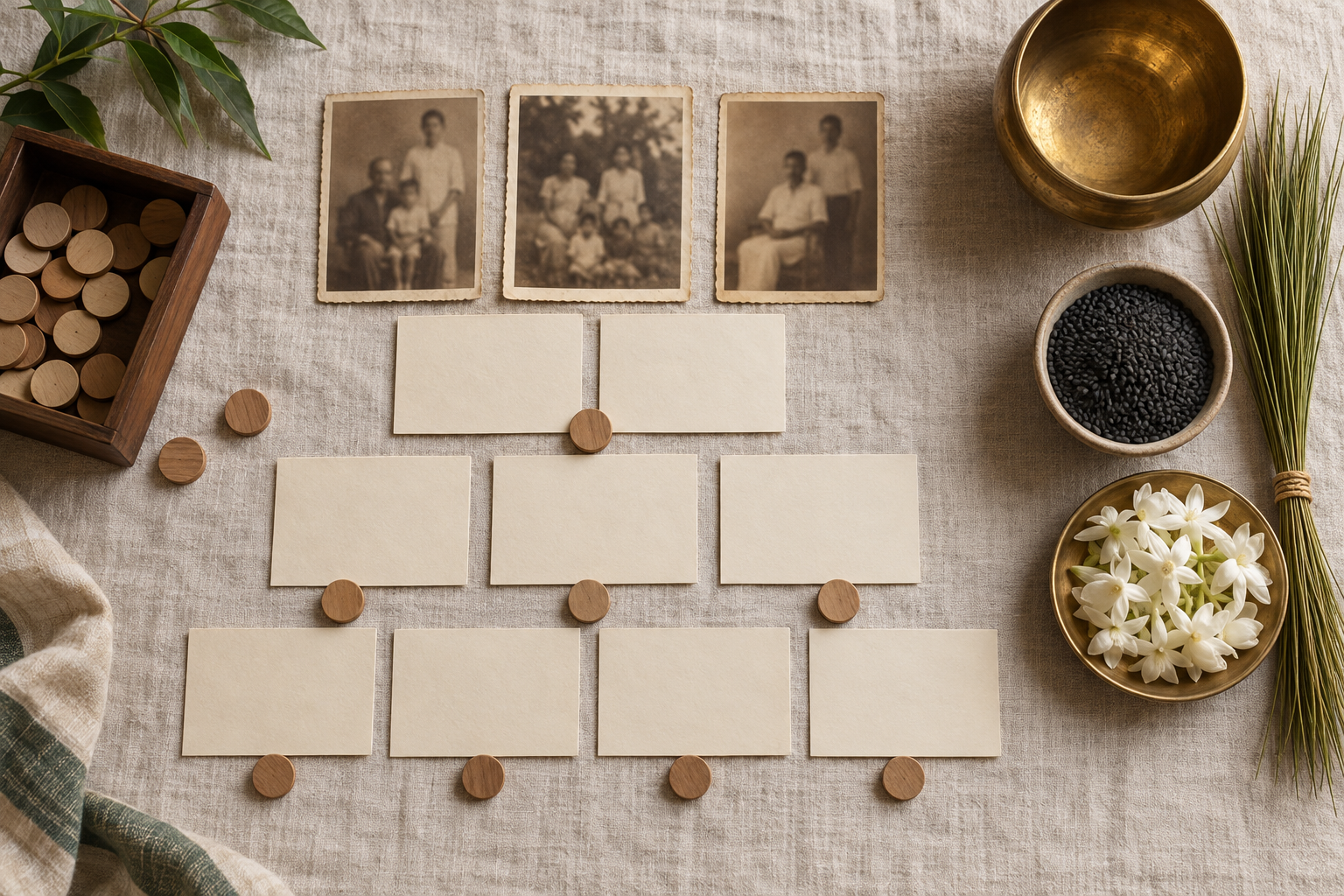
The most useful preparation is often a sheet of names, relationships and lineage information. Write each departed person’s name in the form your family uses during worship, not merely an informal nickname. Add the relationship to the performer and the gotra if it is known and required. Check spellings and pronunciation with an elder while there is still time to resolve uncertainty.
Do not invent a gotra, ancestral name or relationship to make a printed form look complete. Tell the purohita exactly what you know and what you do not know. Established traditions have ways of handling incomplete family information, but the correct convention should come from the tradition conducting the rite.
Ask explicitly whether your procedure invokes particular paternal ancestors, maternal ancestors, other departed relatives, or a wider body of known and unknown forebears. Families do not always follow the same scope. A clear answer here prevents the painful discovery, during the ceremony, that you and the officiant were preparing for different sets of names.
- Write the performer’s name, gotra and customary family identifiers.
- List the departed people to be remembered, with each person’s relationship to the performer.
- Mark every uncertain spelling, pronunciation or lineage detail instead of guessing.
- Send the list to the person guiding the rite and ask which names will actually be recited.
- Request that practitioner’s own materials list, including any food or offering instructions followed by your household.
- Clarify what must be prepared before the rite and what may be obtained at the place of worship.
This order saves effort. Buying a generic puja kit before confirming the procedure can leave you with the wrong materials and no answer to the questions that affect the rite itself.
A sankalpa must match the day, place and purpose
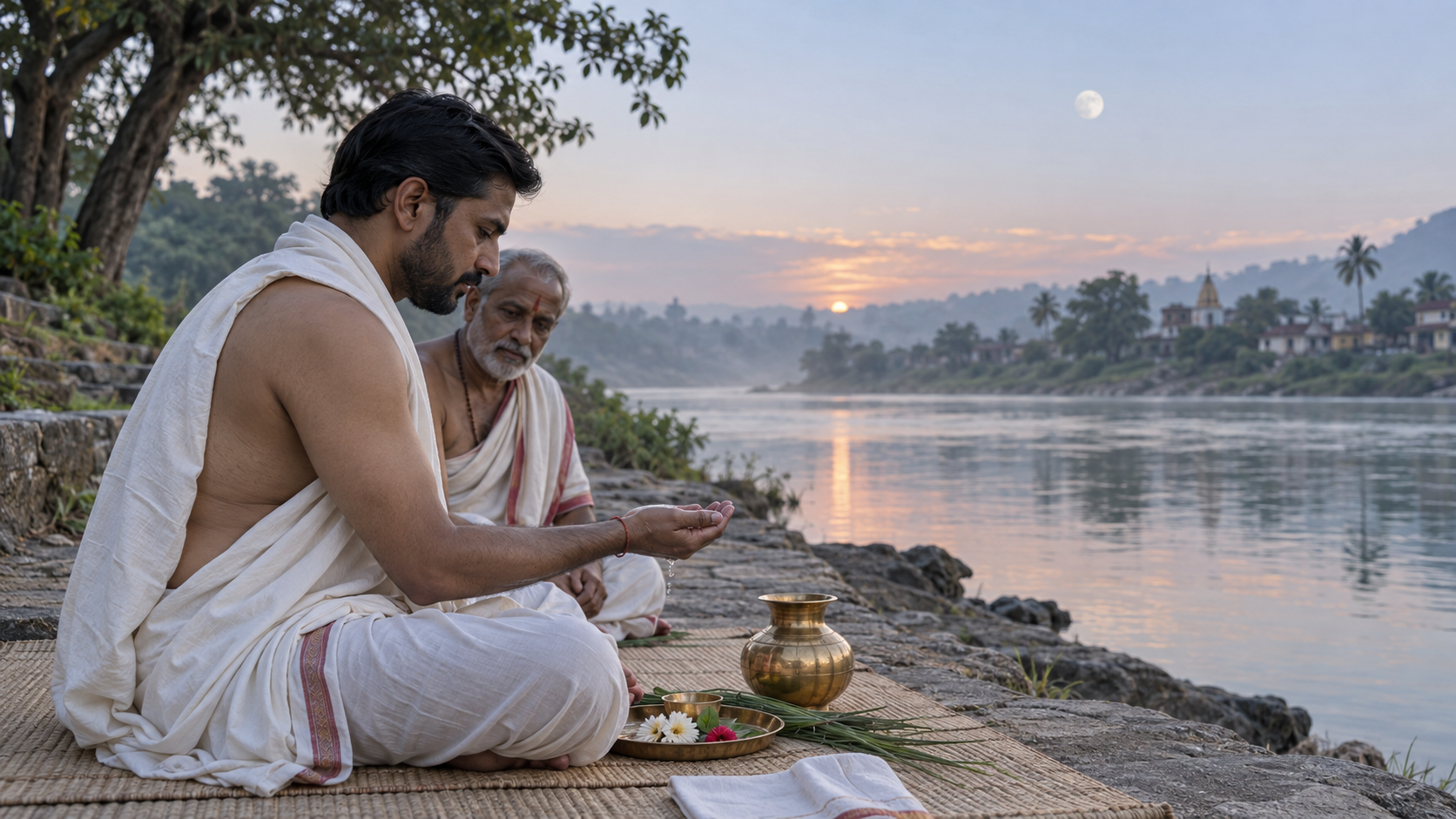
A sankalpa is not a free-standing spell. It declares the purpose of the rite and places the act within a calendrical and ritual setting. Its elements can identify the year, the movement of the sun, the season, the lunar month or solar context used by the tradition, the fortnight, the tithi and the day. Personal and geographical details may also be included according to the procedure.
For the cited 2026 observance, the supplied sequence includes Parabhava nama samvatsara, Dakshinayana, varsha ritu, Kanya masa, Krishna paksha and amavasya tithi. Transliteration and grammatical endings may differ when a practitioner recites the full formula. Do not silently alter unfamiliar words, but do not assume that a copied paragraph is complete for every place and lineage either.
A civil date begins at midnight; a Hindu tithi is a lunar division and does not have to follow that boundary. This is why two calendars can appear to disagree without either one necessarily describing the same locality or ritual rule. If you live outside Bharat, the need for local confirmation becomes even more important. Ask whether the stated date applies where you are and which local panchanga the officiant is using.
When requesting verification, send the officiant the full proposed sankalpa, your city, and the planned time of the rite. Asking only, “Is this mantra correct?” hides the very information needed to answer the question. A correct line for one place or moment can be incomplete or unsuitable in another.
Follow a preparation sequence that keeps the rite coherent
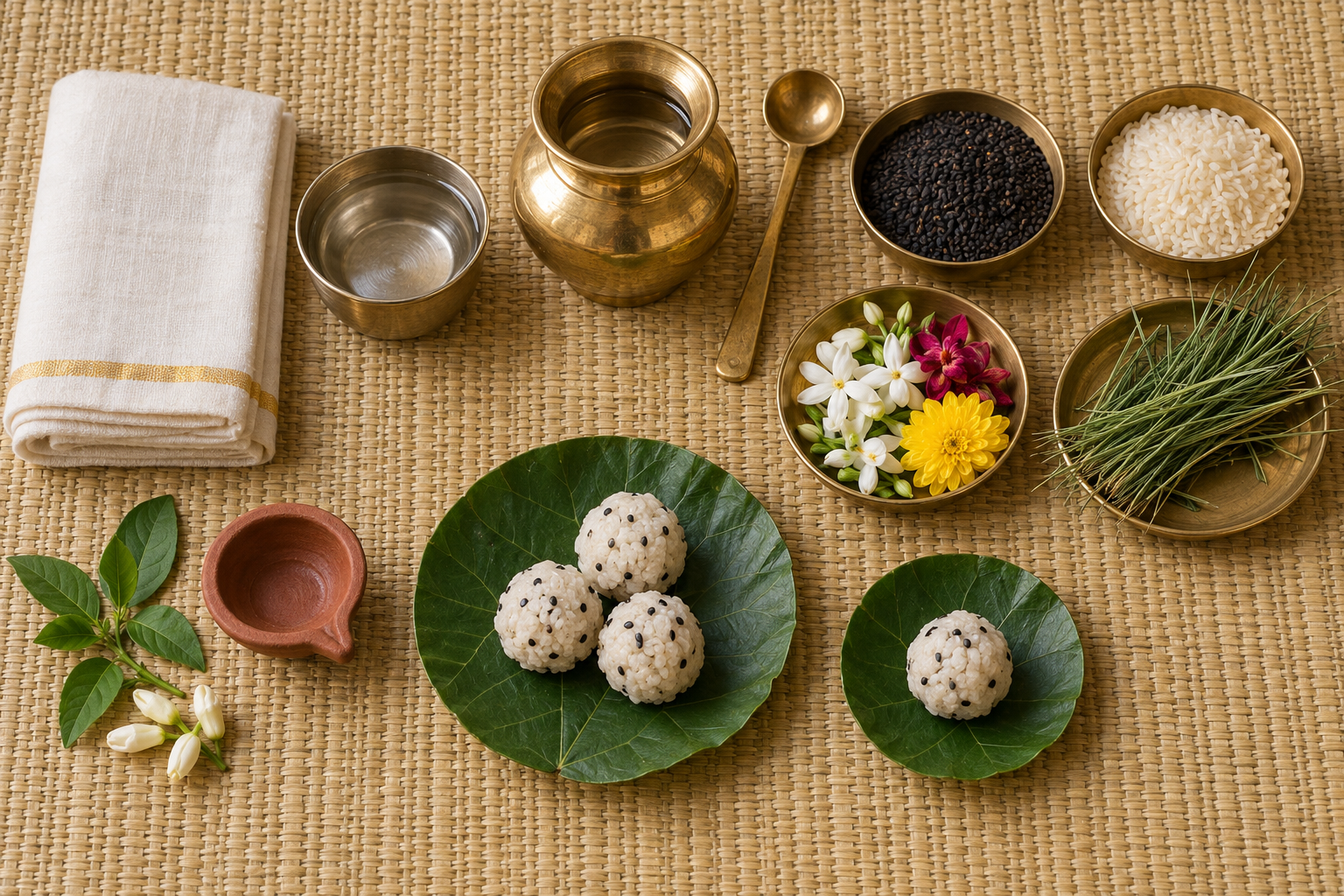
You do not need to turn ancestral remembrance into an exercise in ritual shopping. Accuracy, attention and continuity with your dharma matter more than display. Once the procedure has been confirmed, work through it in this order:
- Verify the observance. Confirm the local tithi, the usable time and the exact ancestral rite to be performed.
- Choose one ritual authority. Follow your family procedure or the instructions of the officiant conducting the rite. Resolve contradictions before the day rather than improvising during it.
- Prepare the lineage details. Check names, relationships, gotra information and pronunciation. Keep the final list legible and available.
- Obtain the specific materials list. Ask which water vessels, offerings, food preparations and other items your procedure requires. Regional substitutions should be approved rather than assumed.
- Clarify personal observances. Ask about bathing, clothing, food, fasting and conduct before and after the rite. These disciplines vary, so a generic checklist is not enough.
- Read through the sequence. Know when you will state the sankalpa, invoke the ancestors, make offerings and conclude. If you cannot recite Sanskrit confidently, arrange for guided repetition instead of racing through an unfamiliar text.
- Protect the time. Keep the ceremony free from routine calls, photography and avoidable interruptions. Place the final name sheet and required materials together before beginning.
If circumstances prevent a full rite, do not declare an improvised performance equivalent to a procedure you were unable to follow. Contact a trusted temple, purohita or knowledgeable practitioner and ask what form of prayer, remembrance, offering or dana is appropriate in your tradition. Honest simplicity is better than false certainty.
Frequently asked questions about Mahalaya rites
Can I recite a 2026 sankalpa exactly as I find it online?
Use it as a draft, not as an automatically universal formula. Have its calendar terms, location details, purpose and personal identifiers checked for the place and procedure in which you will perform the rite.
What should I do if I do not know an ancestor’s gotra or full name?
State the uncertainty clearly to the person directing the ritual. Do not invent the missing information. Ask which established convention your tradition uses when a name, gotra or relationship cannot be recovered.
Does Mahalaya Amavasya replace every other ancestral rite?
Do not presume that it does. A Mahalaya observance, rites following a recent death and an ancestor’s annual Shraddha can have distinct roles. Your family tradition should determine what is required in your circumstances.
What if I live far from my family’s temple or purohita?
Contact them before the observance and provide your present city, planned time, family details and level of ritual knowledge. Ask whether they can guide you remotely, recommend a local practitioner, or arrange an observance through a temple. Confirm the local tithi rather than automatically using the calendar of your ancestral hometown.
Your next step is concrete: put 10 October 2026 on your planning calendar, then send your family details and location to the person who will guide the rite. Once the local tithi, procedure and sankalpa agree, the day can remain focused on what matters—grateful remembrance and the fulfilment of your ancestral dharma.
References

Leave a Reply
You must be logged in to post a comment.