
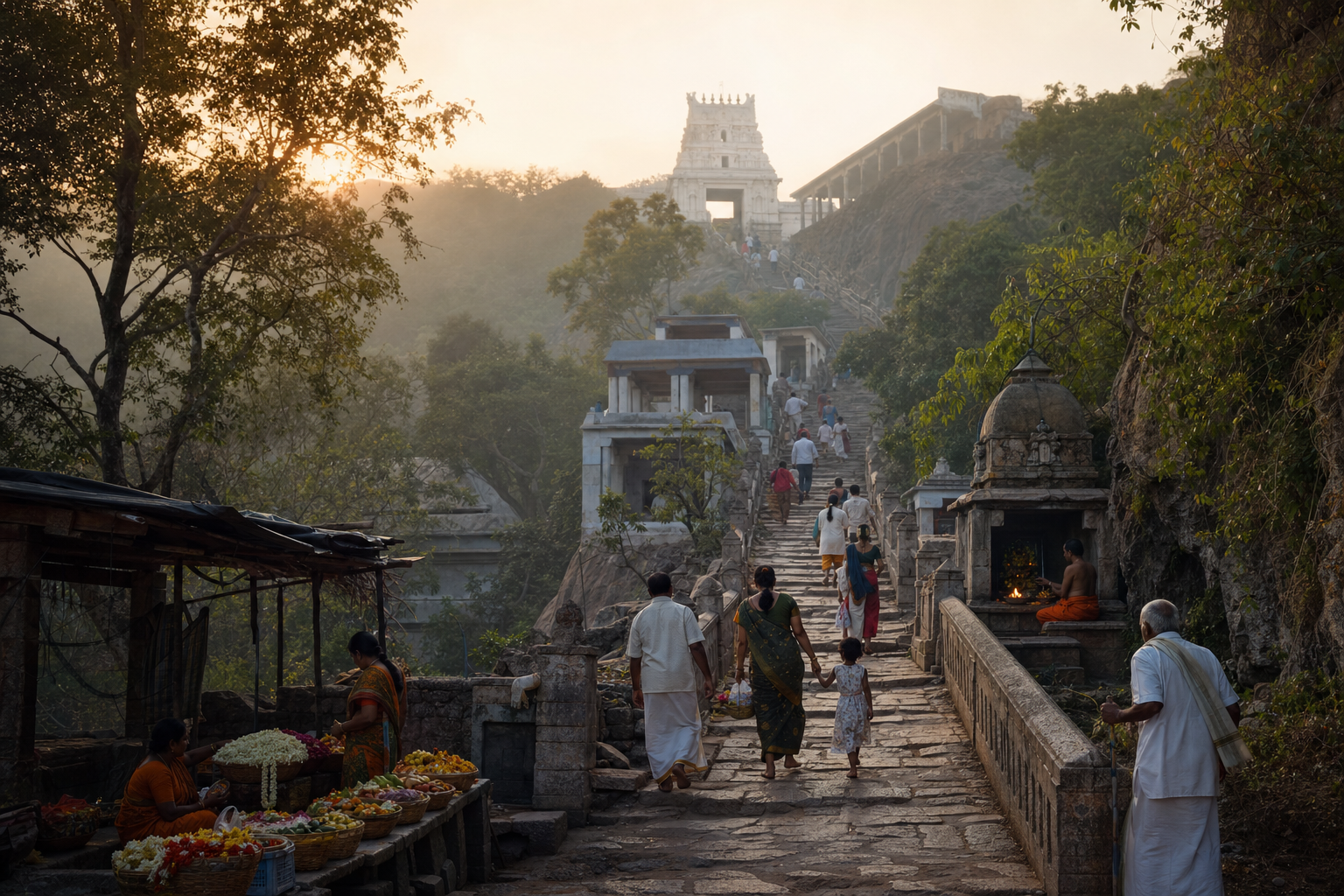
You may know which deity you want to worship and still feel unsure about how to approach a South Indian hill temple. Should you treat the climb as transport, visit only the principal sanctum, or try to see every shrine before leaving?
A living hill temple answers those questions through its terrain, ritual sequence and local community. If you learn to read those three together, your visit becomes more than a hurried ascent followed by darshan. You begin to participate in a sacred geography that is still being renewed.
Key takeaways for your next hill-temple visit
- Treat the ascent as the beginning of worship. Slow your pace, settle your intention and allow the change in terrain to prepare you for darshan.
- Look for a local sequence of shrines rather than assuming that only the largest sanctum matters. A Ganesha sannidhi or quieter companion temple may establish the ritual order of the hill.
- Read regular puja, vows, festival observances, prasada and community maintenance as signs of a living kshetra. Architectural age alone cannot tell you how a temple lives.
- Keep historical confidence proportional to the evidence. Oral memory can preserve genuine antiquity without proving an exact date or dynasty.
- Verify current timings locally, carry water, wear suitable footwear and avoid an exposed climb during intense summer midday heat.
- Carry all disposables back down, respect photography restrictions and support local services without treating the hill as a recreational facility.
The climb is part of the worship, not dead time
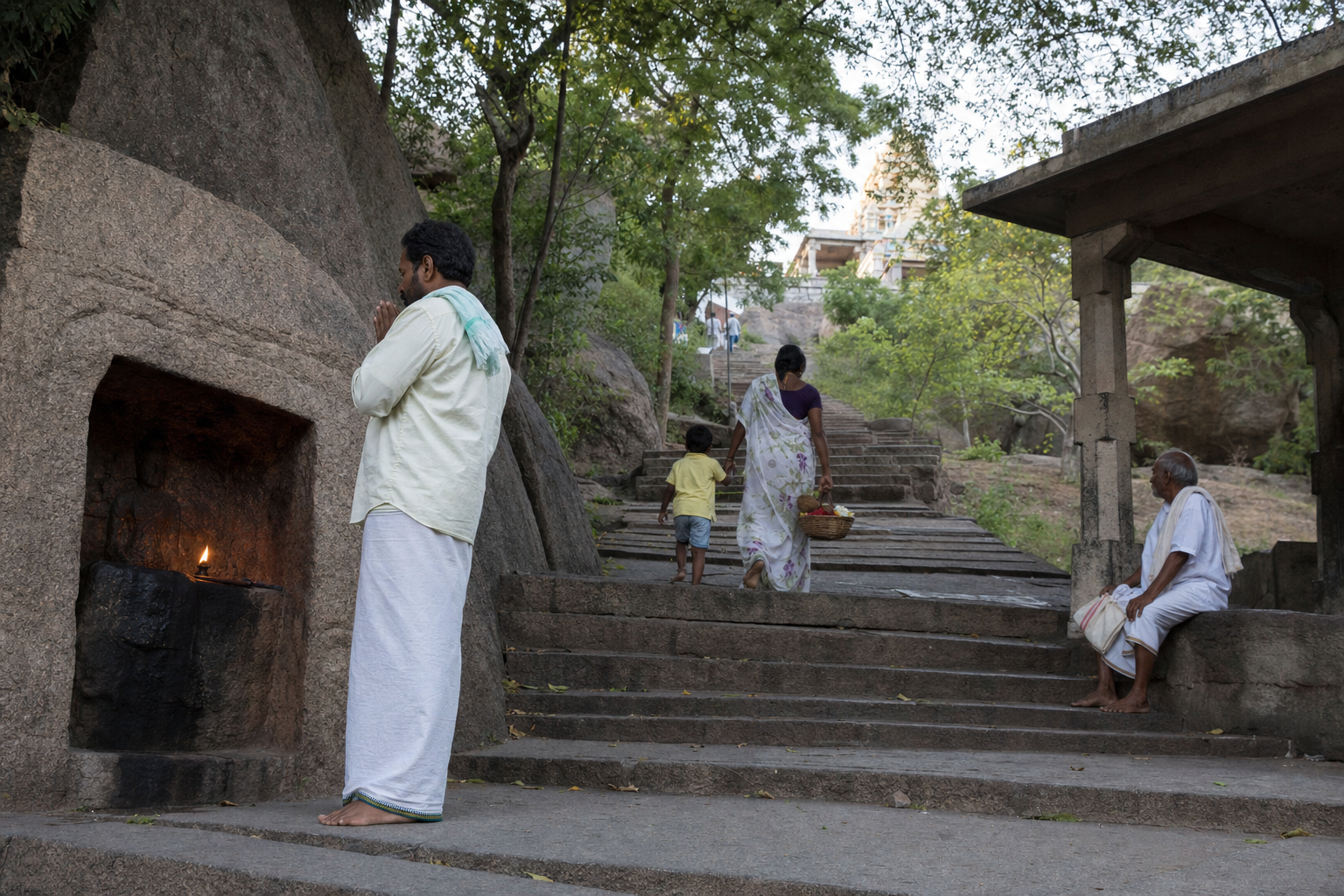
A hill-temple ascent changes the speed of the body before it asks anything of the mind. Footing becomes deliberate. Breathing becomes noticeable. Conversation thins out. The ordinary horizon opens, while the sanctum remains partly concealed. That interval is not an inconvenience placed between you and the deity. It is one of the tradition’s practical methods of preparation.
The relationship is particularly clear at Haddinakallu Hanumantharaya in Karnataka’s Mandya district. The kshetra crowns a rugged granite outcrop, and the surrounding rock, wind, open sky and circling raptors shape the experience before the pilgrim enters the shrine. The hill is not scenery attached to the temple. It provides the temple’s natural plinth, regulates the approach and gives physical form to the movement from distraction toward attention.
You can work with that movement deliberately. At the base, choose one intention that can survive the climb: gratitude, a vow, a prayer for courage, or a commitment to seva. Keep it simple. Walk at a pace that lets you remain attentive instead of turning the ascent into a contest. When you stop, use the pause to steady the breath and notice the land rather than reaching immediately for your phone.
This is especially fitting at a Hanuman shrine. Hanumantharaya, the devotional name widely used for Hanuman in Karnataka, brings together strength, humility, alertness and service. Regional images commonly communicate these qualities through the gada, the raised tail, an upright stance and the gesture of abhaya. The pilgrim therefore does not climb merely to ask for strength. The climb gives that request a discipline: courage is joined to steadiness, and power is directed toward dharma.
Elevation should not be romanticized into needless hardship. At Haddinakallu, comfortable footwear and water are practical necessities, while early morning or late afternoon is preferable to intense summer midday heat. Post-monsoon conditions can offer clearer skies and more comfortable temperatures. The devotional value lies in mindful effort, not in ignoring heat, fatigue or unsafe footing.
The same principle helps explain why elevated places recur across Dharmic landscapes without making every tradition identical. Hindu tapas, Buddhist and Jain associations between seclusion and contemplation, and the Sikh ethic of disciplined seva meet at the level of practice: attention must be embodied. A sacred hill slows you enough to discover whether your intention is sincere.
Read the sacred hill as a circuit, not a single sanctum
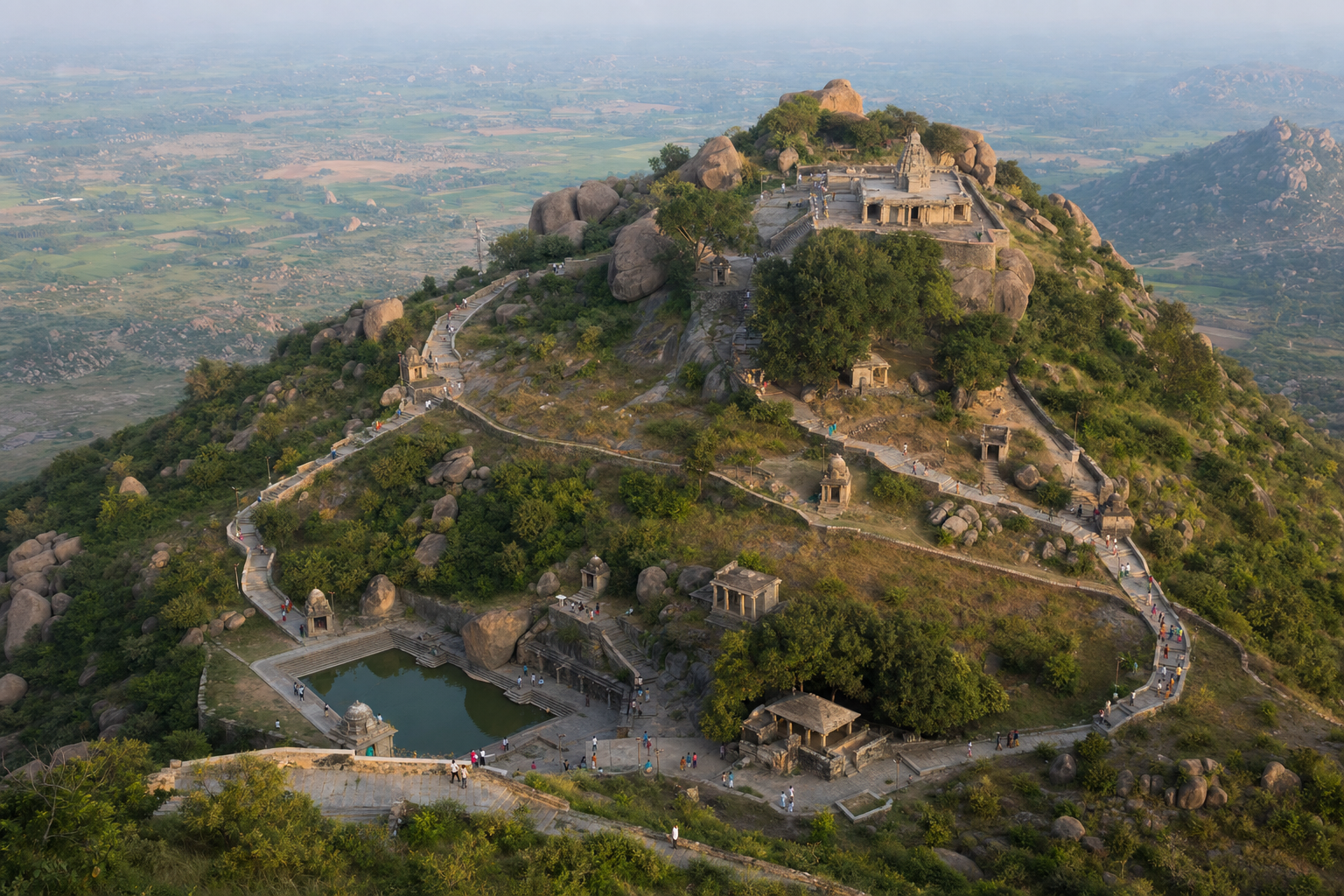
The largest shrine on a hill is not necessarily the whole pilgrimage. South Indian sacred sites often work as ordered landscapes in which a gateway deity, companion sannidhi, circumambulatory path and principal sanctum give different stages to the devotee’s movement. If you rush directly to the best-known queue, you may complete the headline darshan while missing the hill’s ritual grammar.
Thiruthani makes this visible. The celebrated Murugan hill is one of the Arupadai Veedu, the six sacred abodes associated with Murugan. Yet the Chengalvaraya Swami precinct on the quieter rear side of the hill, together with Sri Sengashuneer Vinayagar Sannidhi, allows worship to unfold in stages rather than as one crowded encounter.
A coherent circuit there can begin with Vinayagar, whose place at the start expresses the familiar Dharmic discipline of addressing obstacles before undertaking a vow. The Chengalvaraya Swami shrine then offers a smaller setting for focused worship, mantra japa or silent circumambulation. Darshan of Murugan can become the culmination rather than the only event. The sequence has an intelligible inner movement: preparation, concentration and fulfillment.
Do not turn that example into a universal formula. The proper order varies by kshetra, festival and local custom. On arrival, read the signs, observe how regular devotees move and ask temple personnel which sannidhi traditionally comes first. This small act protects you from imposing an itinerary designed around fame or convenience upon a landscape organized by worship.
A companion shrine should not be dismissed as a lesser attraction. Smaller precincts often preserve the reflective part of pilgrimage that becomes difficult in a major corridor on a crowded day. Their compact garbhagriha, close ardha-mandapa and slope-adapted circulation create physical intimacy. Ornament may be modest because the architecture is solving a different problem: how to hold concentrated worship on uneven terrain.
Give that intimacy time. After the principal darshan, resist the impulse to leave the hill immediately. Return to a quieter precinct if local circulation permits, sit without blocking the path and allow the experience to settle. Darshan is an encounter, not a collection of images, and a sacred circuit gives you somewhere to absorb it.
Ritual continuity is what makes the temple living
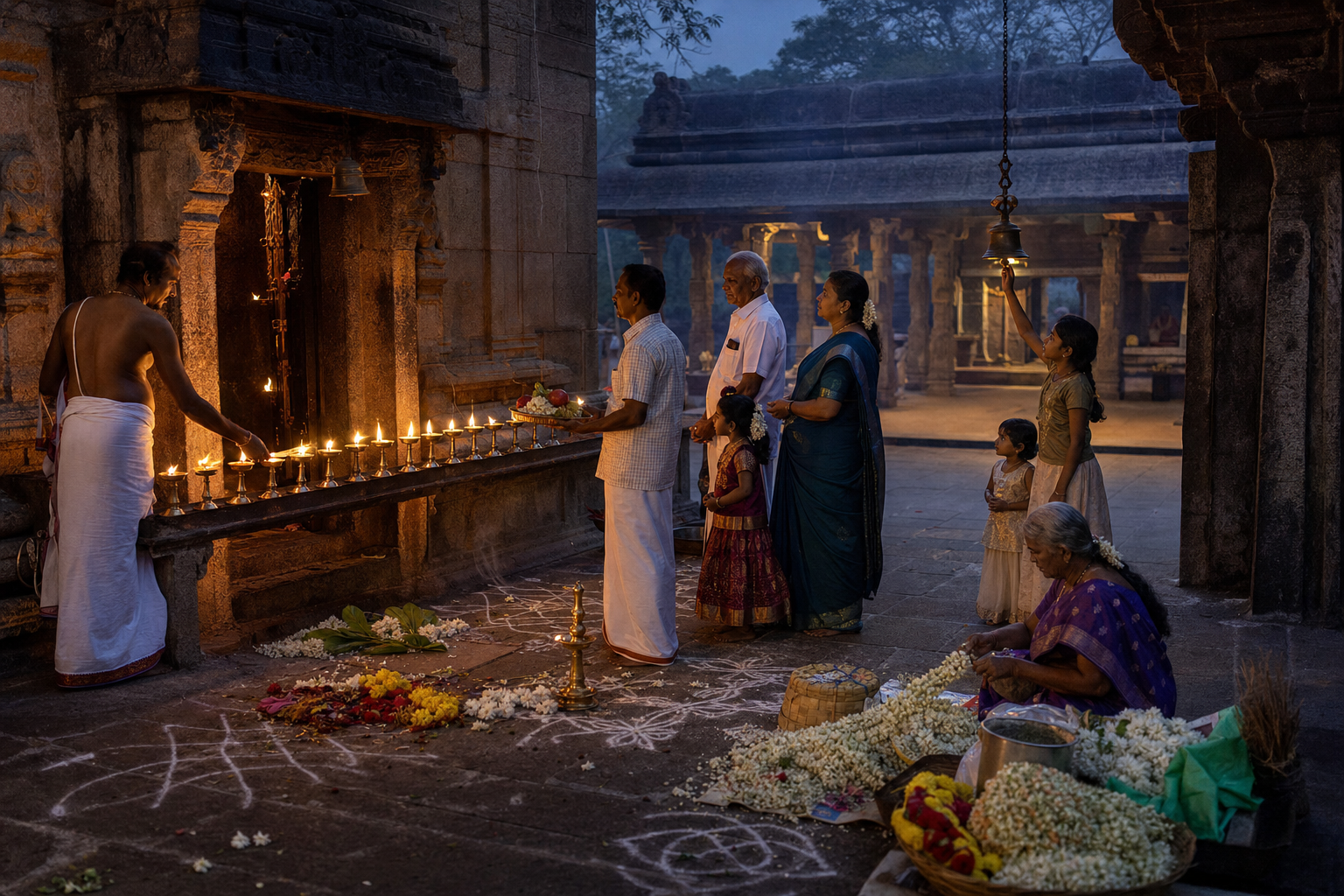
An old-looking structure is not automatically a living temple, and a repaired temple is not automatically less authentic. The decisive question is whether worship still orders time, relationships and responsibility around the deity. Daily puja, recurring festival days, family vows, prasada distribution and local stewardship reveal more about this continuity than weathered stone by itself.
At a Hanuman kshetra such as Haddinakallu, the recognizable ritual cadence includes abhisheka, alankara and archana, accompanied by devotional recitation such as the Hanuman Chalisa or portions of the Sundara Kanda. Tuesdays and Saturdays commonly draw more devotees, while Hanuman Jayanti brings extended recitation, special adornment and communal prasada. Karnataka’s observance date can vary regionally, so the local temple calendar matters more than an assumed date carried from elsewhere.
That rhythm should affect when you visit. Choose an ordinary morning if you want quiet attention and easier conversation with temple personnel. Choose an important observance if you want to participate in collective bhakti and can accept longer waits. Neither is inherently more authentic. They reveal different dimensions of the same kshetra: sustained daily care and intensified communal celebration.
At Thiruthani, the presence of Sengashuneer Vinayagar makes Sankatahara Chaturthi especially relevant to devotees seeking Ganesha’s grace in removing impediments. Krittika observances and the Karthigai season can draw attention toward Murugan. On such days, integrating the companion precinct into the wider hill pilgrimage preserves the sequence of worship even when the principal temple becomes the centre of activity.
Offerings also reveal how a temple joins personal devotion to collective life. Flowers, coconuts, fruit, oil or sindura are not souvenirs handed to the deity. They enter a ritual exchange governed by local practice. Ask before presenting anything unfamiliar, use the designated place for offerings and receive prasada without treating distribution as a transaction.
Vows make this relationship more explicit. A family that returns to climb, receive darshan or perform humble seva after a prayer has been fulfilled binds memory to place. The temple becomes part of a life history rather than a stop on a tour. If you undertake a vow, make it concrete enough to fulfill and modest enough to keep. A promise of one return visit, a prescribed offering accepted by the temple, or a specific act of service is more meaningful than a dramatic pledge you cannot responsibly complete.
Renovation belongs to the same living process. South Indian temples commonly acquire repairs, additions and regional styles across generations. Communities conserve them through continued ritual use as well as through work on stone, lime, roofs and paths. You should therefore learn to see a composite building: an older sacred core may coexist with later mandapas, finishes or practical repairs. Continuity need not mean architectural immobility.
Visit with historical care and practical responsibility
Respect oral memory without turning it into false certainty
Living temples often preserve history in several registers at once. Inscriptions, masonry, iconographic style, renovations and oral narratives may point to different periods. That is normal for a site sustained over centuries. The mistake is to force every layer into one confident founding story.
Local memory places Haddinakallu’s origin in the 8th century CE under regional patronage. That tradition deserves to be recorded and respected. It does not, by itself, settle an exact dynasty or prove that every visible feature belongs to the same century. Later repair and embellishment are plausible, while firmer dating would require careful documentation of inscriptions, surface remains and architectural style.
Thiruthani’s wider region likewise carries layers associated with Pallava, Chola, Vijayanagara and Nayaka patronage, but specific epigraphic claims for the Chengalvaraya Swami shrine are not widely established. The responsible conclusion is not that the temple lacks history. It is that the history of the wider sacred landscape is clearer than the precise chronology of this particular precinct.
When you encounter a date on a sign, in local speech or online, ask what kind of claim it is. Is it an inscriptional date, a stylistic estimate, a remembered founding tradition or the date of a renovation? These categories can coexist, but they should not be silently collapsed. Historical restraint honours the kshetra better than an impressive date repeated without qualification.
Plan around the hill you will actually encounter
Do not rely on a generic promise that a temple remains open from morning until evening. Smaller hill-side sannidhis may close during a midday recess, while festival schedules can extend or alter normal access. Verify the current hours on local information boards or with temple personnel when you arrive. If a companion shrine matters to your circuit, confirm its schedule separately from that of the principal temple.
For Haddinakallu, the final approach involves a foot climb, so water and footwear suited to exposed rock belong in your plan. For Thiruthani, road and rail connections bring pilgrims to the town and hill area, but you should still allow time to orient yourself and locate the rear precinct instead of assuming that every shrine lies on the main flow. Build your visit around terrain and ritual timing, not around the number of sanctums you hope to cover.
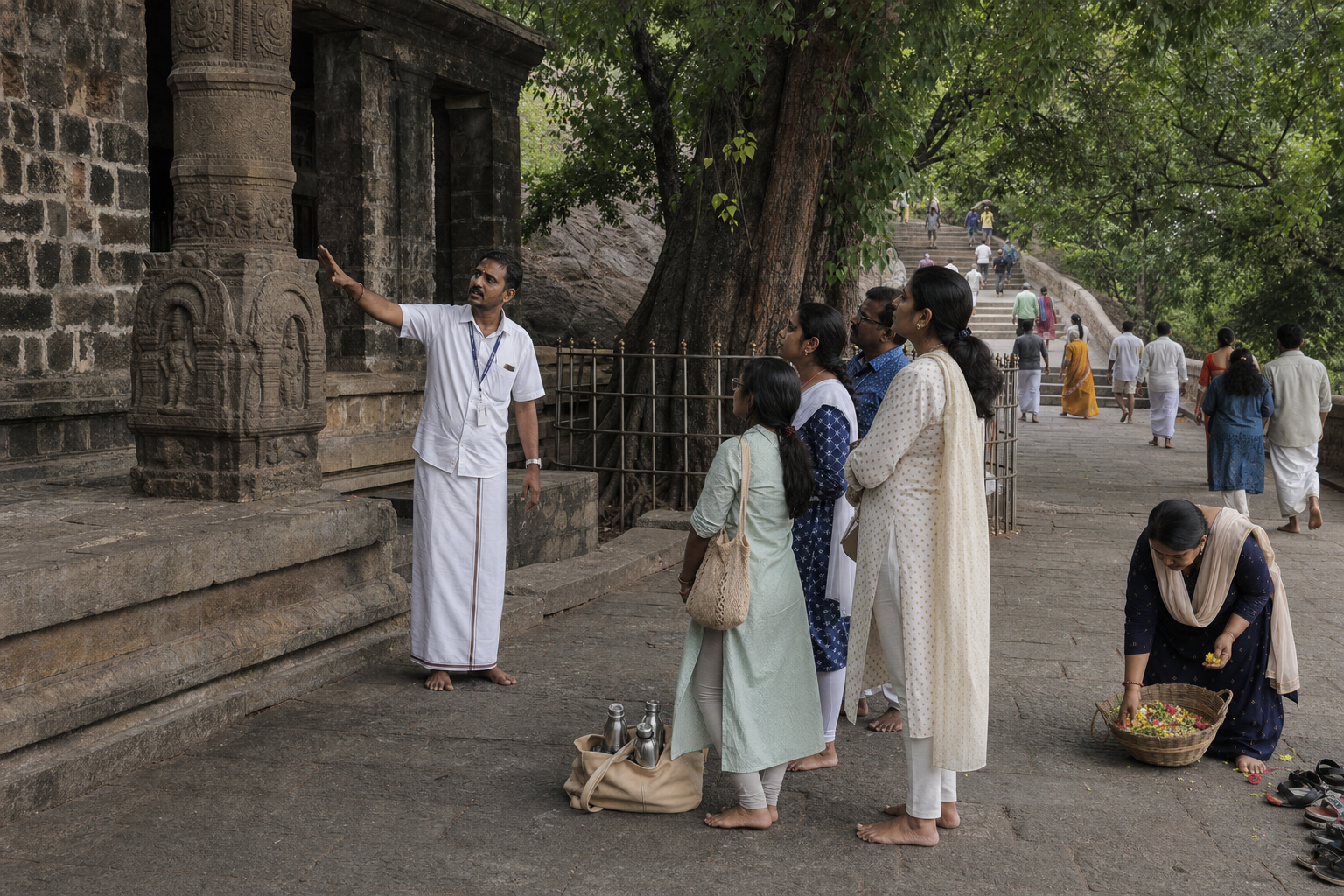
Modest clothing, observance of footwear areas, quiet near the garbhagriha and respect for queues are not decorative etiquette. They keep worship possible in a confined space. Photography restrictions deserve the same respect, especially near a sanctum. A phone should never delay a queue, intrude on another person’s prayer or turn an intimate ritual into content captured without permission.
Leave the ecology capable of carrying worship forward
A sacred hill has limited space, thin soil and exposed paths. Plastic, discarded packaging and unmanaged offerings do not disappear because they were carried there with devotional intent. Bring back everything that does not belong to the hill, use designated disposal points and follow local instructions for flowers, coconuts and other biodegradable offerings.
At Eagle Stone Hill, care also means avoiding disturbance to the birdlife for which the landscape is known. Do not pursue raptors for a closer photograph, leave food where wildlife can reach it or use noise to provoke movement. The same restraint applies to vegetation, rock surfaces and informal shortcuts. A pilgrim path is not permission to mark, chip or rearrange the hill.
Local vendors, guides and transport providers are part of the social world sustained by pilgrimage. Buy what you need fairly, follow temple rules rather than pressuring a local worker for special access, and avoid leaving waste that those same communities must remove. Responsible support joins livelihood to stewardship instead of making the village carry the hidden cost of your visit.
For your next pilgrimage, choose one hill rather than building an overfilled checklist. Confirm the local schedule, learn the order of its shrines, begin the ascent with one clear intention and complete one practical act of care before you leave. That is how a visitor stops merely consuming sacred heritage and begins, however modestly, to help a living tradition continue.
References
- Hindu Pad – Haddinakallu Hanumantharaya at Eagle Stone Hill: Awe-Inspiring 8th-Century Temple in Karnataka
- Hindu Pad – Chengalvaraya Swami Temple, Thiruthani: History, Architecture, and Darshan Guide