
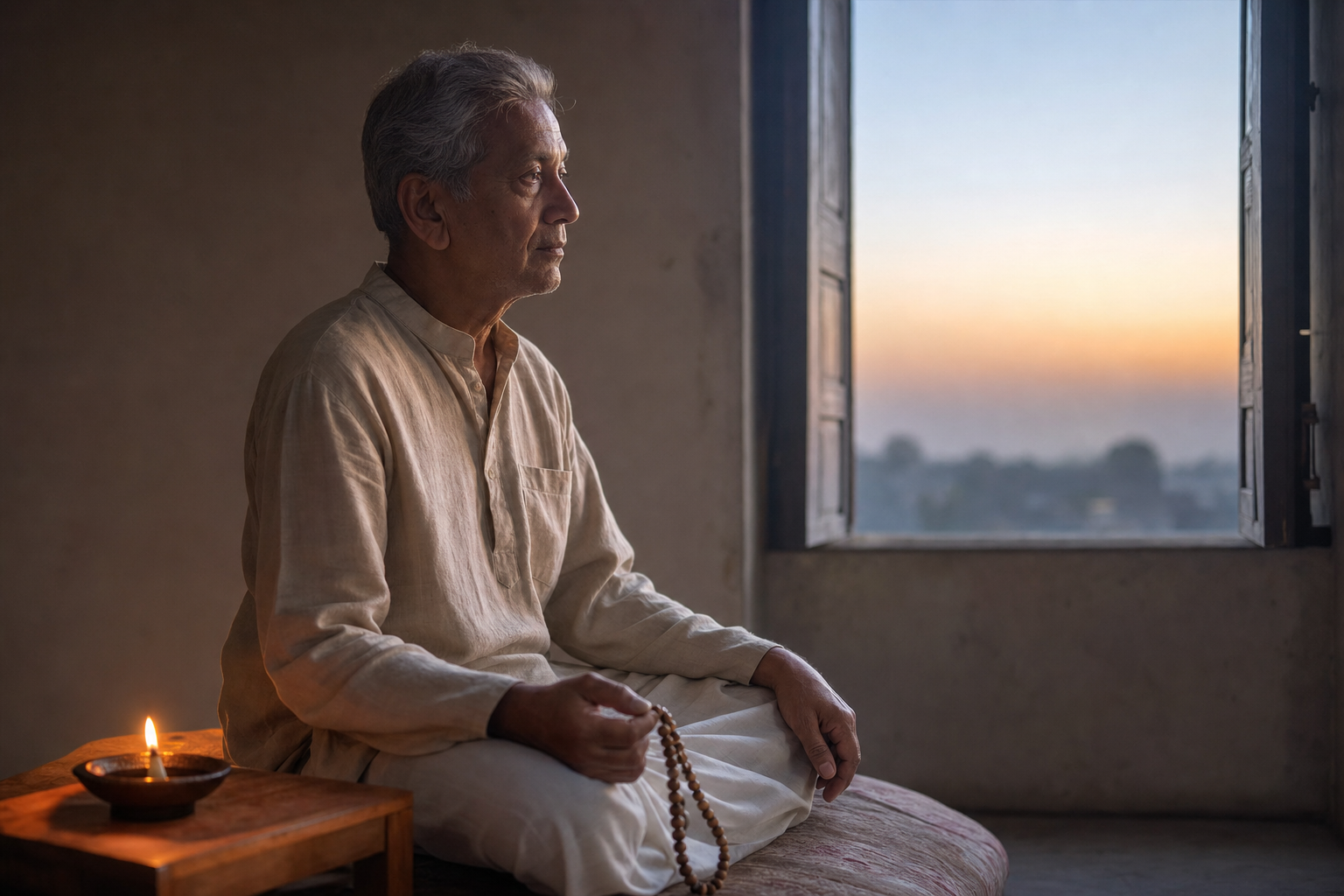
If you worry that a frightened, distracted, or medically clouded final moment could erase a lifetime of sadhana, you are treating death as a test of mental control. That is not the most helpful way to understand the Dharmic teaching.
Your practical task is not to manufacture a perfect last thought. It is to make remembrance so familiar that the mind knows where to return when control weakens. That preparation begins in ordinary life: in what you repeat, love, serve, consume, and choose under pressure.
The Gita is not describing a last-thought lottery
Bhagavad-gita 8.6 teaches that the bhava remembered as one leaves the body shapes what follows. Bhava here is more than a passing idea. It is a deeply formed orientation: the state of being produced by repeated attention, desire, identification, and action.
The Sanskrit is precise. Smaran indicates remembrance, while bhava carries feeling, understanding, and inward disposition. The closing expression, sada tad-bhava-bhavitah, points to what a person has continually cultivated. The decisive factor is therefore not an isolated mental accident. It is the pattern that has become most deeply one’s own.
The surrounding instruction prevents a fatalistic reading. Bhagavad-gita 8.5 speaks of remembering Krishna while leaving the body, and 8.7 immediately turns that teaching into a way of living: remember the Divine at all times and perform your duty. Arjuna is not told to abandon responsibility in order to think about death. He is told to act without allowing action to sever remembrance.
This changes the question you should ask. Instead of wondering, “What if I cannot think correctly in my final second?” ask, “What does my mind already return to when I am tired, hurt, tempted, or afraid?” Pressure usually exposes the grooves that repetition has made. Your reactions during an argument, illness, disappointment, or sleepless night can therefore show you where spiritual preparation is actually needed.
The familiar metaphor of death as life’s final examination is useful only if we understand what is being examined. It is not a quiz that rewards a last-minute answer. It reveals formation. Abhyasa, disciplined repetition, lays down samskaras in citta. Manas repeatedly presents objects to attention; buddhi learns what to endorse; ahankara identifies with what is chosen; and citta retains the resulting impressions. Over time, the whole antahkarana, or inner instrument, acquires a direction.
There is also no reason to turn this teaching into spiritual panic. Within the Gita’s own theology, sincere spiritual effort is not lost. Bhagavad-gita 6.37-45 describes progress continuing even when a practitioner does not reach perfection in one life. Sudden death, illness, confusion, or a lapse does not make years of devotion meaningless. Human effort matters, but it operates within grace rather than outside it.
Train the return of attention every day
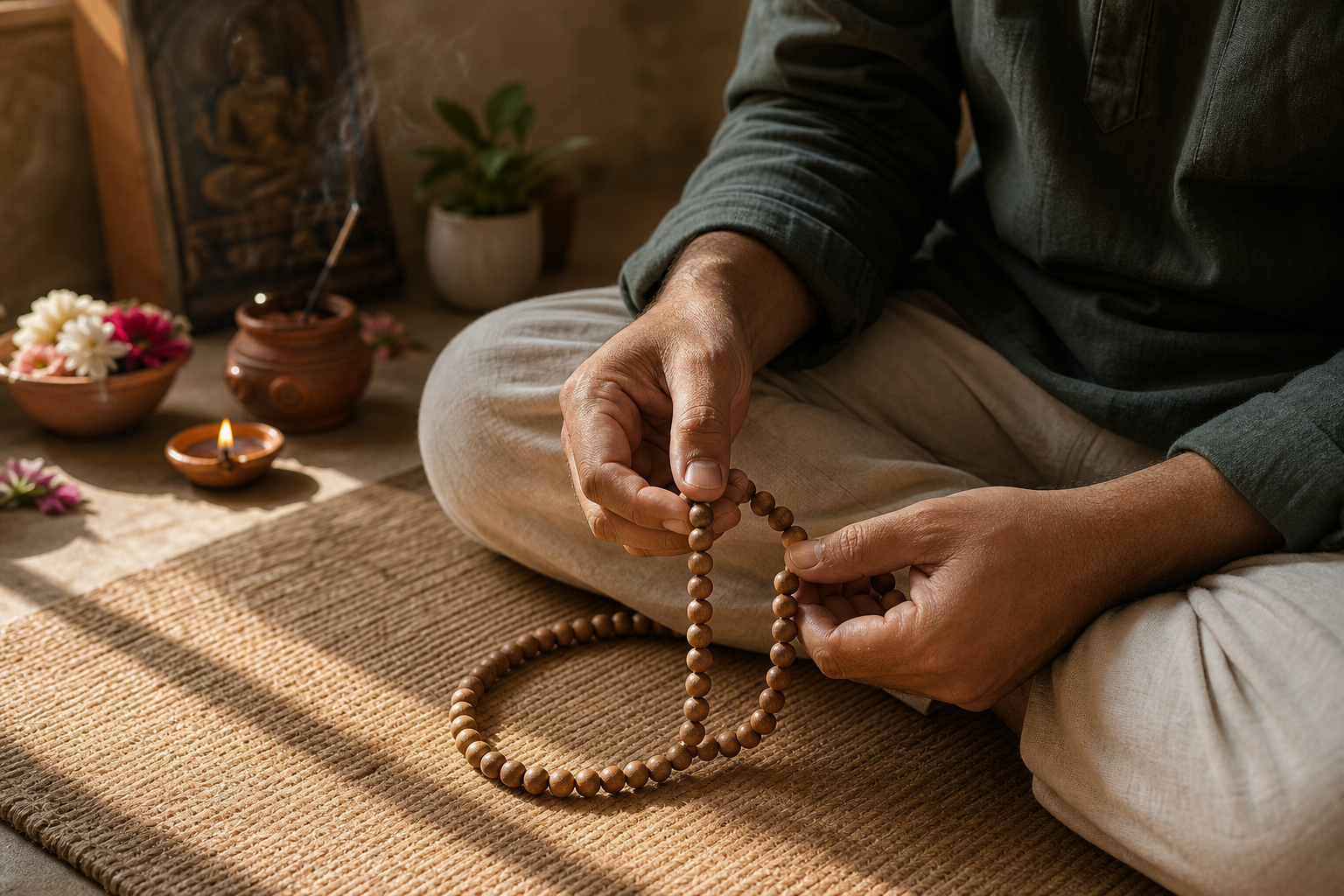
An unrealistic practice plan can make you feel devout for a short period and defeated soon afterward. A useful discipline survives work, family obligations, travel, low energy, and imperfect moods. Consistency matters because you are training a default response, not staging an occasional spiritual performance.
For a Krishna bhakta, nama-japa gives remembrance a portable form. The maha-mantra can accompany the body through changing circumstances: Hare Krishna, Hare Krishna, Krishna Krishna, Hare Hare; Hare Rama, Hare Rama, Rama Rama, Hare Hare. If you belong to another sampradaya, use the Divine Name, mantra, prayer, or contemplative discipline transmitted within that lineage. Depth usually grows through fidelity, not through constantly collecting new techniques.
- Begin before the day’s demands take possession of attention. Keep a fixed morning japa or meditation commitment. Make it realistic enough to maintain on a difficult day, and complete it before opening nonessential digital feeds.
- Install cues at predictable transitions. Use the beginning of a commute, the lighting of a lamp, the start of a meal, or the pause before work as a signal for nama-smarana. A dependable cue is more useful than waiting to feel inspired.
- Memorize sacred language gradually. Learn a scriptural sloka and revisit it during the week until its meaning is available without a screen or book. At a stressful moment, what has entered memory is easier to call upon than what remains merely bookmarked.
- Give remembrance a communal setting. Keep a regular family or community period for kirtan, recitation, or satsanga. Association strengthens a practice when private motivation weakens, and it prepares others to support you in illness.
- Choose the mind’s final deliberate input at night. Replace aimless scrolling with gratitude, prayer, the Divine Name, or a short passage of scripture. This does not guarantee a particular dream or thought; it simply teaches attention where to settle when the day’s control is being released.
Bhakti gives abhyasa its direction. Concentration alone can make attention steadier, but devotion gives attention a beloved object. Hearing, chanting, remembrance, service, worship, prayer, servitorship, friendship with the Divine, and self-surrender form the ninefold curriculum named in Srimad-Bhagavatam 7.5.23-24. You do not need to perform every form with equal intensity every day. Let hearing inform you, vocal remembrance gather the mind, and service prevent spirituality from becoming self-absorption.
Measure the practice by formation rather than by display. Notice whether the Divine Name arises more readily after bad news. Notice whether you recover perspective sooner during conflict. Notice whether service begins to feel like a natural response rather than an interruption. A growing preference for clarity over agitation, and for devotion over distraction, tells you more than an impressive practice streak that collapses under pressure.
Let conduct prepare what ritual alone cannot
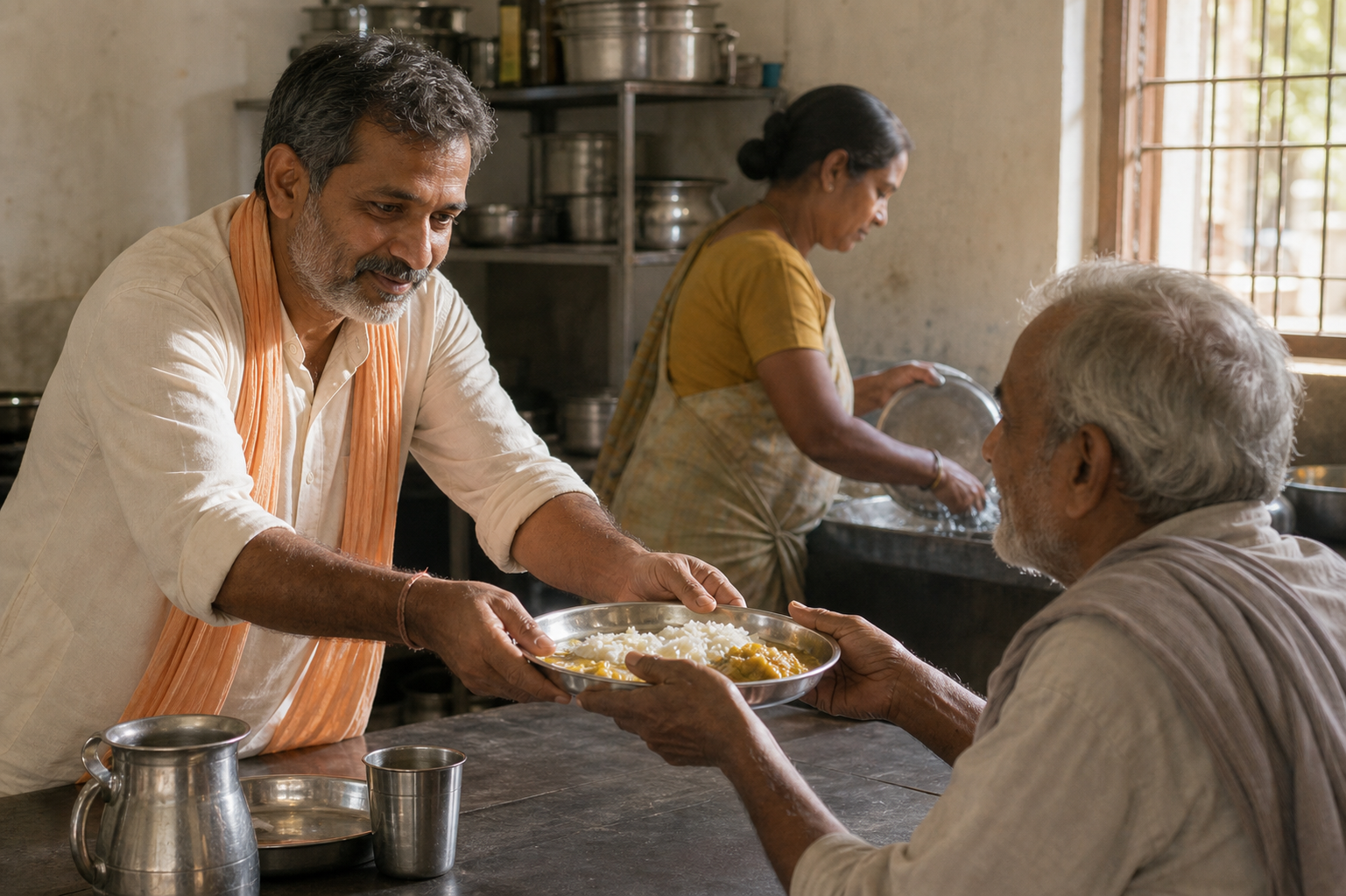
You cannot train remembrance only during formal worship and then spend the rest of the day feeding resentment, deception, indulgence, and agitation. Those choices also create samskaras. The mind brought to japa is the same mind shaped by speech, livelihood, entertainment, appetite, and relationships.
A sattvic life is therefore practical support for consciousness, not a badge of superiority. Sattvic food, adequate sleep, ethical livelihood, and elevating association reduce avoidable turbulence. They do not make illness or grief disappear. They give attention a clearer field in which to work.
Ethics serve the same preparation. Satya reduces the burden of maintaining falsehood. Ahimsa restrains the habits of hostility and domination. Dana loosens possessiveness. Seva trains identity away from the isolated ego. Karma-yoga places duty itself within remembrance by offering action and its fruits to the Divine.
A brief review before sleep can reveal what your formal practice has not yet transformed. Ask yourself:
- What repeatedly captured my attention today?
- Where did fear, anger, pride, or craving decide my conduct?
- Did I remember the Divine while performing duty, or only after duty was finished?
- Is there an apology, repayment, promise, or act of service I should complete?
- What should I stop feeding if I do not want it to become my reflex?
Then make the next concrete correction. Return what is owed. Tell the truth that has been avoided. Repair a relationship where repair is possible. Remove a recurring source of agitation. Death preparation becomes evasive when it concentrates on a future sacred moment while leaving present obligations unresolved.
Make a compassionate spiritual-care plan while you can

The conditions of dying may include exhaustion, pain, medication, reduced speech, or delirium. That is why a family should not depend on the dying person to explain every spiritual preference at the bedside. Prepare a brief spiritual-care note while you are able to communicate clearly, and share it with the people likely to be present.
- Name the mantra, Divine Name, prayer, or scriptural passage you would want heard gently.
- Record the teacher, sadhu, granthi, monk, community member, or temple contact your family should call.
- List the sacred items meaningful to you, such as Tulasi, prasada, mala, an image, or a scripture, and explain how they should be handled.
- State whether you prefer soft kirtan, spoken recitation, quiet japa, contemplative silence, or a combination.
- Ask those present to avoid arguments, ritual competition, loud instructions, and demands that you prove awareness by responding.
- Keep this spiritual note with your medical and end-of-life planning materials so that relatives do not have to search for it during a crisis.
If the person is conscious, ask what they want now. Their current wishes matter more than a relative’s preferred ritual or an earlier plan that no longer brings peace. If speech is difficult, keep the environment simple. A calm lead voice, familiar words, and pauses are usually more compassionate than several people giving competing instructions.
In a bhakti setting, soft kirtan, the maha-mantra, Tulasi, maha-prasada, and the presence of sadhus may provide familiar cues for remembrance. These supports should be offered with tenderness, not used to judge the departing person. An inability to chant aloud is not evidence of spiritual failure, and outward confusion does not give observers access to the person’s inner state.
Bhagavad-gita 8.10-13 includes advanced instructions concerning prana, concentrated attention, and Om. Do not turn those instructions into an improvised bedside test for someone who is already distressed. If such a discipline belongs to your established practice, learn it from a qualified teacher while healthy. At the end of life, familiar nama-japa or gentle kirtan may be more dependable than breath control attempted for the first time.
Spiritual care must complement medical care, not replace it. Questions about pain relief, medication, breathing difficulty, agitation, or delirium belong with the clinical team and the patient. Do not change prescribed treatment or withhold comfort measures in an attempt to force a particular state of consciousness. The spiritual task is to protect dignity, meaning, and remembrance within the person’s chosen care, not to make suffering into a ritual requirement.
Follow your lineage without erasing the Dharmic family

The Dharmic traditions do not offer an identical metaphysics of death, and their disciplines should not be blended as though their differences were cosmetic. They do, however, share a demanding insight: the final threshold is approached through habits formed before the crisis.
- Hindu bhakti traditions cultivate nama-japa, kirtan, smarana, worship, service, and surrender so that relationship with the Divine becomes the practitioner’s center.
- Buddhist traditions use marana-sati, mindfulness of death, to confront impermanence and reduce heedlessness. Tibetan phowa belongs to specific lineages and should be learned through proper instruction rather than improvised during an emergency.
- Jain tradition associates sallekhanā, or samadhi-marana, with equanimity and non-attachment under rigorous ethical safeguards. It is not a casual technique or a self-directed response to fear, illness, or emotional distress.
- Sikh tradition places constant simran, remembrance of the Divine Name, at the heart of life and the final breath. The preparation is continuous remembrance expressed through truthful living and devotion, not a last-minute formula.
Choose a primary discipline rather than sampling specialized death practices from several traditions. Ask a qualified teacher what you should maintain daily, what your family should do if you cannot speak, which rites are essential within your lineage, and which familiar prayer should take priority at the bedside. Resolve those questions before illness turns them into hurried family decisions.
Key takeaways
- Bhagavad-gita 8.6 concerns a deeply cultivated bhava, not a random final thought detached from the rest of life.
- Train attention to return through sustainable japa, prayer, scripture, satsanga, and service rather than demanding uninterrupted concentration.
- Treat sleep, food, livelihood, media, truthfulness, ahimsa, and unresolved duties as parts of spiritual preparation.
- Write down your spiritual-care preferences and share them before a crisis makes communication difficult.
- At the bedside, favor consent, familiar remembrance, calm presence, and coordinated medical care over ritual pressure.
- Let grace prevent vigilance from becoming fear: sincere formation matters even when the final conditions are beyond your control.
Begin with the next ordinary transition in your day. Decide which Divine Name or sacred remembrance you will return to, attach it to a reliable cue, and keep returning without drama. A peaceful death cannot be commanded in advance, but a life oriented toward the Divine can be practiced now.