
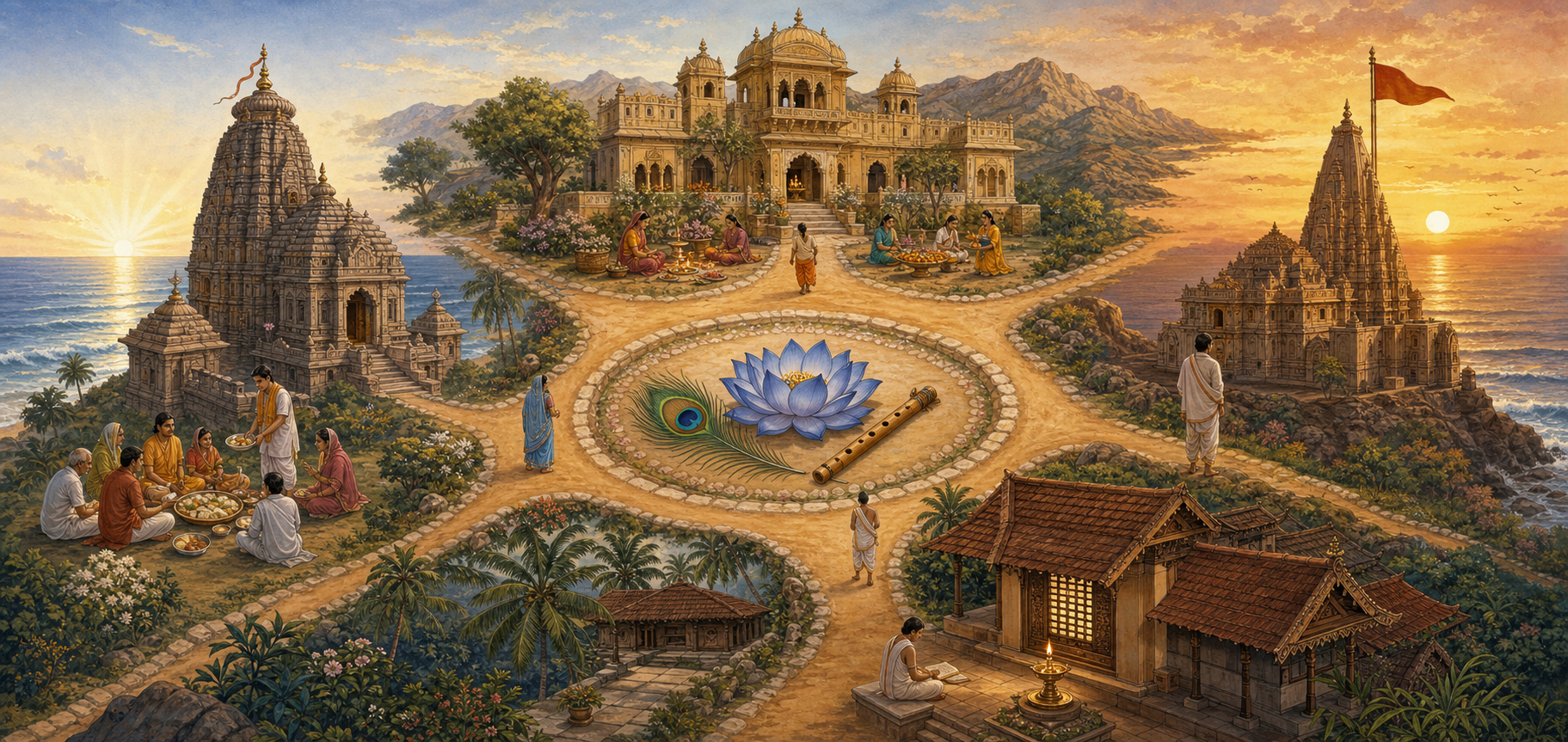
Perhaps you have one pilgrimage window, several famous Krishna temples in mind, and no clear reason to choose one beyond reputation. Or perhaps you are trying to understand why the same Krishna is approached through such different temple cultures across Bharat.
Use the four horizons as a diagnosis. Puri asks whether your bhakti has become too private. Dwarka tests whether devotion governs your difficult decisions. Nathdwara reveals whether you can turn ordinary care into seva. Udupi asks whether your feeling for Krishna is supported by disciplined thought. Once you know which question belongs to you, sacred geography stops being a collection of destinations and becomes a course of practice.
Read the four directions as sadhana, not as a ranking
A useful devotional compass places Jagannath at Puri in the East, Dwarkadhish at Dwarka in the West, Srinathji at Nathdwara in the North, and Sri Krishna at Udupi in the South. These are four complementary horizons of Krishna-bhakti, not the only Krishna temples that matter and not a mandatory circuit imposed by scripture.
That distinction protects the map from two common mistakes. The first is turning a helpful pattern into a claim of exclusive authority. The second is treating each shrine as an interchangeable branch of one standardized religion. Every temple has its own deity-form, lineage, ritual rhythm, regional memory and way of training the devotee. Unity does not require sameness.
Pāñcarātra theology supplies a suggestive grammar through the caturvyūha: Vāsudeva, Saṅkarṣaṇa, Pradyumna and Aniruddha. The sacred four can evoke directions, dimensions of order and complementary modes of spiritual life. It does not, however, establish a fixed one-to-one cartographic equation between those four emanations and these four cities. Treating the geography as a contemplative mandala is fruitful; presenting it as an uncontested scriptural command is not.
| Horizon | Krishna form and place | Discipline to notice | Question to carry |
|---|---|---|---|
| East | Jagannath, Puri | Nama-sankirtana, prasada and shared devotion | Have I made bhakti private when it should also nourish others? |
| West | Dwarkadhish, Dwarka | Dharma, responsible action and consecrated work | Am I using spirituality to avoid a decision that duty requires? |
| North | Srinathji, Nathdwara | Seva, grace, beauty and sacred household rhythms | Can I serve Krishna through the quality of an ordinary task? |
| South | Sri Krishna, Udupi | Japa, study, discernment and annadana | Is my devotion becoming clearer, steadier and more humble? |
The table is not a test for deciding which temple is superior. It helps you identify what your present life lacks. A person surrounded by abstractions may need Puri’s shared food and singing. A leader facing an unpopular but necessary decision may need Dwarka. A householder who has separated worship from daily care may need Nathdwara. A sincere devotee drifting between incompatible claims without studying any of them may need Udupi.
This approach also keeps Dharmic pluralism honest. Generosity, truthfulness, restraint, compassionate attention and disciplined service are intelligible across Hindu, Buddhist, Jain and Sikh lives, but the traditions do not therefore become doctrinally identical. You can recognize a shared ethical family while still learning what a particular Vaishnava sampradāya actually teaches.
East and West: let devotion enter community and duty
Puri: receive Krishna through sound, food and fellowship
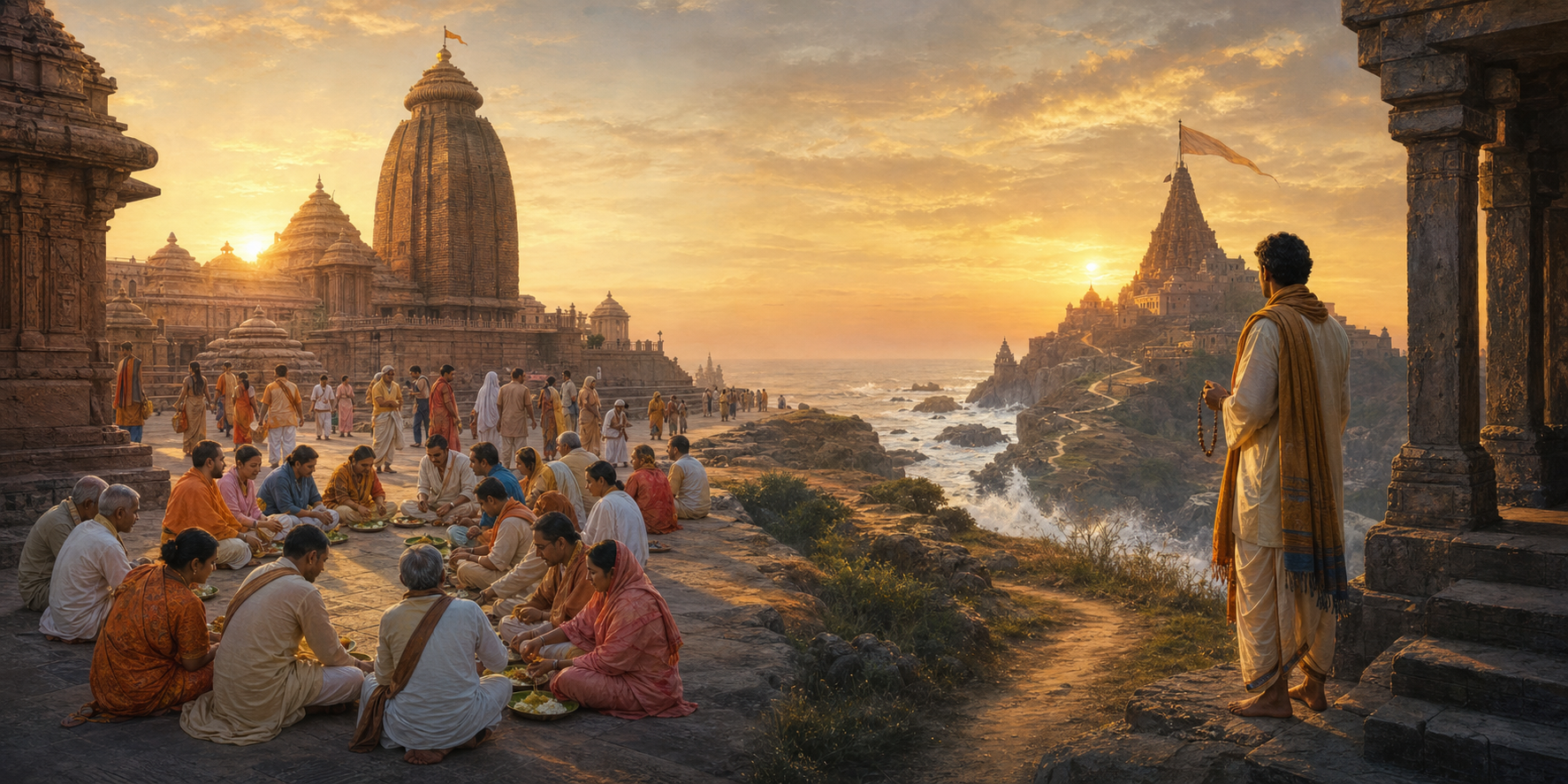
Jagannath does not wait for devotion to remain quiet and private. The forms of Jagannath, Balabhadra and Subhadra, worshipped as dāru-brahman, place sacred presence before the devotee in a striking wooden form. Nabakalebara makes renewal visible. Ratha Yatra brings the deity beyond the inner temple precinct and into a vast public act of movement, sight and chanting. Mahāprasāda at Ananda Bazar makes receiving and sharing food part of the theology rather than an incidental convenience.
Puri’s Sabara resonances and its association with the kirtana current of Sri Chaitanya Mahaprabhu also resist a narrow picture of Hindu civilization. A living tradition can preserve lineage and ritual particularity while drawing regional communities into a wider field of devotion. Inclusion here need not mean stripping the temple of its inherited form; it means recognizing how many strands have participated in sustaining that form.
The Bhāgavata Purāṇa, at 12.3.51, identifies the chanting of Krishna’s name as a direct remedy for the bondage of Kali Yuga. Puri shows what that remedy looks like when it becomes social. Name, food, service and shared remembrance reinforce one another. The distracted mind is given a sound to return to. The isolated devotee is placed among other devotees. Reverence is translated into nourishment.
If you go to Puri, do not measure the visit only by the duration or closeness of darshan. Join the devotional sound rather than treating it as atmosphere. Receive mahāprasāda with attention. Contribute to feeding or another form of service within your means. Then carry one practice home: establish a fixed period for Krishna-nama, share prasada rather than keeping worship entirely individual, or support annaseva regularly enough that it becomes part of your household dharma.
Puri is especially corrective when you know much about bhakti but rarely sing, serve or eat with other devotees. Its question is simple and uncomfortable: if remembrance of Krishna never changes how you gather with or feed people, what part of your life has the remembrance reached?
Dwarka: make competence answerable to conscience
At Dwarka, Krishna appears in the kingly register of Dwarkadhish and in the ethical register of Yogeshvara. The Jagat Mandir’s soaring śikhara and the western sea horizon suit a city remembered through sovereignty, diplomacy and movement. Okhamandal and Bet Dwarka add maritime memories of exchange and stewardship to that setting.
This is not a call to baptize ambition as dharma. Krishna’s counsel in the Mahābhārata’s Udyoga and Śānti Parvans joins restraint, negotiation, duty and decisive action. The Bhagavad Gita refuses the easier escape in which spiritual language becomes an excuse for withdrawing from responsibility. Karma-yoga asks you to act without claiming absolute ownership of the result, not to become indifferent to the quality or consequences of the action.
Carry a real decision to Dwarka. Before seeking a reassuring sign, write down three things: the duty attached to your role, the personal reward or fear that may be distorting your judgment, and the people who will bear the consequences. Then ask which action you could offer to Krishna without hiding any part of it. This is more demanding than asking which choice will make you feel peaceful.
For a professional, public servant, entrepreneur or family decision-maker, Dwarka’s discipline is ethical execution. Prepare well. Seek counsel. Do not confuse delay with compassion or aggression with courage. Act when dharma requires action, and release the fantasy that you control every result. If your daily japa does not affect contracts, hiring, speech, money, authority or promises, Dwarkadhish points directly to the gap.
North and South: train affection through seva and clarity
Nathdwara: let beauty become disciplined care
Nathdwara occupies the northern position in this devotional mandala even though the scheme should not be mistaken for a surveyor’s division of Bharat. Its place in the map follows Srinathji’s memory of Govardhan and the north Indian lineage carried into Rajasthan.
Srinathji is Krishna lifting Govardhan. The deity was originally worshipped at Govardhan and was moved in the early modern period so that worship could continue in safety. The community that grew around the Lord’s gate, nath-dvāra, became a major centre of Pushtimarg, the path articulated by Sri Vallabhacharya and enriched by the Aṣṭachāp poet-saints.
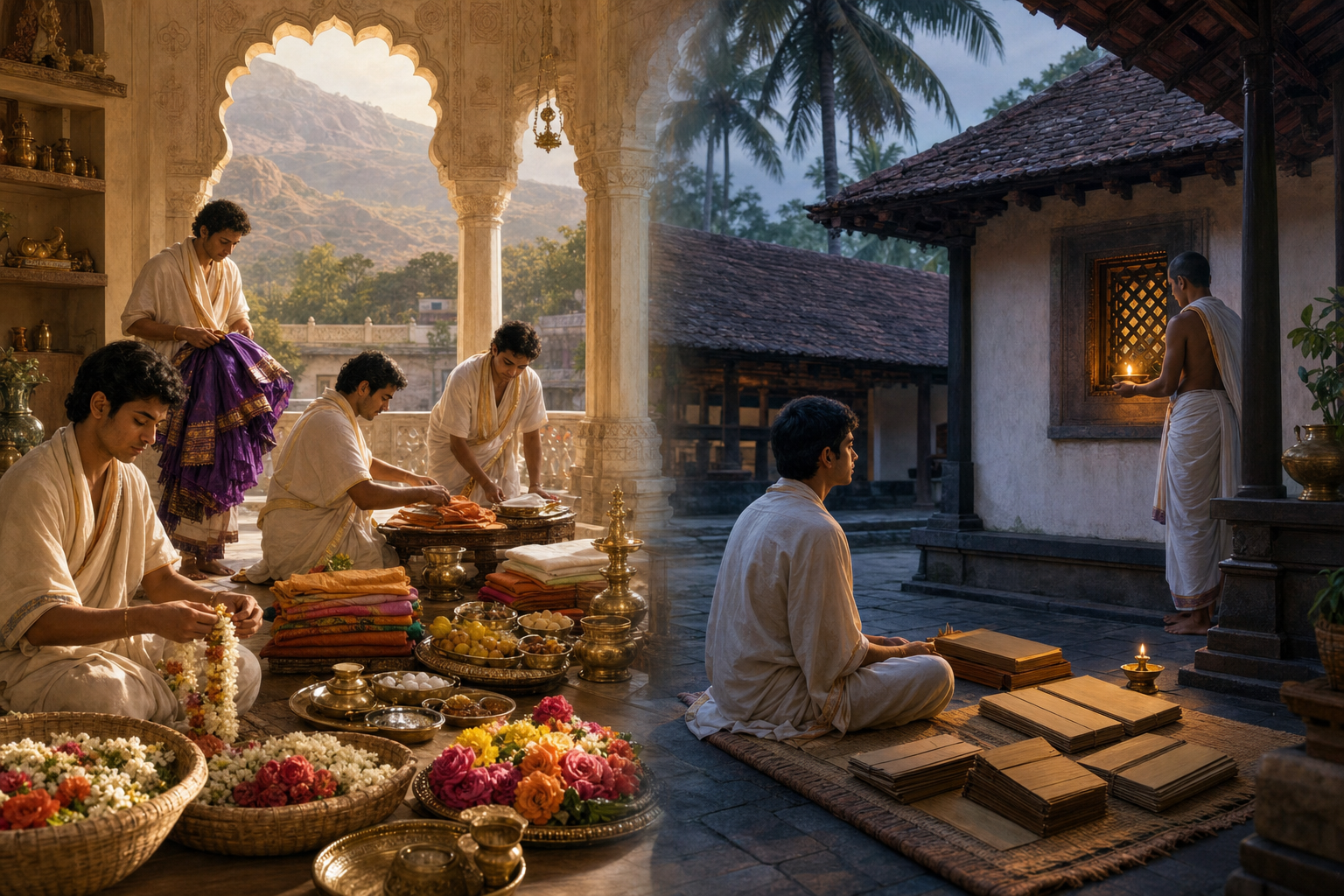
Here seva is not merely volunteering around a sacred institution. Daily worship unfolds through rāga, bhoga and śṛṅgāra: music appropriate to the moment, food offered to the Lord, and adornment fitted to season and occasion. Pichhvai painting, haveli-sangeet, textiles and cuisine show how trained attention can turn material culture toward devotion. Beauty is not valuable because it is expensive. It is valuable when proportion, timing, skill and affection make care visible.
This gives householders a precise correction. Do not wait for freedom from ordinary obligations before beginning serious sadhana. Choose one recurring task that already belongs to your day: preparing food, arranging the puja place, caring for a family member, maintaining an inherited object or supporting a skilled artisan. Perform it as seva by deciding in advance whom it serves, what quality it deserves and how you will prevent haste or resentment from governing it.
The test is not whether the task feels mystical. The test is whether attention becomes more faithful. Srinathji’s world exposes two opposite errors: careless simplicity that calls every lack of effort spiritual, and lavish display that centres the patron rather than the Lord. Good seva is beautiful because love has become exact.
Udupi: pair intimate bhakti with disciplined understanding
Udupi holds affection and argument close together. Sacred memory recounts that Madhvacharya recovered the Krishna murti from a mass of gopīcandana carried on a storm-tossed ship. That account belongs to hagiographic tradition. The institutional history of the eight Udupi Maṭhas and their rotating Paryāya stewardship shows how devotion was also given durable structures of worship, teaching and annadana.
Kanakana Kindi, associated with Kanakadasa, carries another lesson. Social position did not determine the reach of devotion; a window became the enduring sign of grace and access. The memory should not be reduced to a pleasing slogan. It asks whether a religious institution recognizes devotion and dignity when they appear outside the routes favoured by status.
Madhva’s Tattvavāda maintains the real distinction between jīva and Īśvara while grounding their relationship in bhakti. For practice, the important point is not to turn that doctrine into a label. Distinction protects humility: Krishna is not an enlargement of the individual ego, and the devotee does not become the object of devotion through strong feeling. Study disciplines love by teaching it whom it addresses.
If Udupi is your horizon, build a three-part practice. Keep japa regular enough that remembrance does not depend on mood. Study a defined passage of the Bhagavad Gita or a text taught within your lineage, asking what it actually claims before blending it with another school. Connect both practices to annadana or another dependable service. Feeling without study can become projection; study without devotion can become vanity; both without service can remain self-enclosed.
Where Guruvayur fits
Many Malayali Vaishnavas naturally experience Guruvayurappan as the southern anchor. There is no need to force Udupi and Guruvayur into a contest. Guruvayur’s four-armed form, Ekādaśī discipline and musical culture represented by the Chembai Sangeetholsavam emphasize vows, constancy, art and hospitality. Udupi gives the four-direction map a strong institutional and philosophical southern axis; Guruvayur supplies a complementary southern rhythm for devotees whose inherited practice turns there.
The right response to multiple sacred centres is not anxiety about choosing the only valid one. Ask which lineage you actually follow, which temple culture your family has inherited, and which discipline you are prepared to sustain after returning home. Sacred geography becomes superficial when the farthest destination is chosen only for prestige.
Turn four temple visits into one coherent yatra

Puri, Dwarka, Nathdwara and Udupi are distant from one another. You do not need to compress them into a single rushed journey for the map to work. A Krishna catur-dik yatra can unfold in stages. Continuity comes from one sankalpa, not from forcing every destination into the same ticket.
- Write the purpose before choosing the route. Complete this sentence plainly: I am going to Krishna with my difficulty in ________. Use community, duty, service or discernment if one of those is the real issue.
- Learn the local form before arrival. Know the deity’s name, the central lineage and the temple’s defining devotional practice. This prevents you from treating Jagannath, Dwarkadhish, Srinathji and Udupi Krishna as scenery surrounding the same generic ritual.
- At each place, pair darshan with participation. At Puri, attend to nama and prasada. At Dwarka, examine a duty. At Nathdwara, observe the care embodied in offering and adornment. At Udupi, join remembrance to study and service.
- Record one correction, not a catalogue of impressions. Write what the place exposed in you and name the practice that will answer it at home.
- Give the practice a devotional boundary. Continue it until a marker you recognize, such as the next Ekādaśī or a relevant festival observance, and then review it honestly. If it has become steady, renew it. If it failed, change the arrangement rather than disguising inconsistency as spontaneity.
Choose festival intensity deliberately
Festivals reveal the public character of each sacred centre. Puri’s Ratha Yatra, generally falling in June or July, makes collective movement and kirtana central. Dwarka’s Janmāṣṭamī observance, generally in August or September, gathers remembrance of Krishna’s birth, recitation and service. Nathdwara’s Annakūṭa during Deepavali brings the Govardhan form of abundance and offering to the foreground. Udupi’s Paryāya tradition highlights rotating stewardship among its eight Maṭhas.
Choose a festival visit if you need to encounter devotion at communal scale. Choose a quieter period if your present task is careful observation, study or an unhurried engagement with the local discipline. Festival dates follow the relevant religious calendar, so confirm the current temple calendar before fixing transport or accommodation; the month ranges above are orientation, not fixed annual dates.
If travel is not possible, practise the map at home
Physical yatra matters, but sacred geography need not become inaccessible when money, health, care obligations or distance prevent travel. Use one ordinary week as a small mandala. Give one day to shared nama and prasada in the spirit of Puri. On another, complete a difficult duty without grasping at praise, in the spirit of Dwarka. Offer one household task with deliberate beauty and care, in the spirit of Nathdwara. Pair japa with a defined period of scriptural study and an act of feeding or service, in the spirit of Udupi.
Do not pretend that this replaces darshan at the kṣetra. It does something different: it prepares you to arrive as a pilgrim rather than a consumer. When travel becomes possible, you will already know what you are going there to learn.
Key takeaways
- The four-direction map is a devotional interpretation, not an exclusive scriptural list or a ranking of Krishna temples.
- Puri trains communal bhakti through nama, prasada and shared service; Dwarka tests whether dharma governs work, leadership and difficult action.
- Nathdwara turns beauty and household care into exact seva; Udupi joins japa and devotion to philosophy, lineage and annadana.
- Choose your next horizon by the discipline your life lacks, not by the prestige of the destination.
- A complete pilgrimage carries one local practice home. Without that return movement, sacred geography remains travel rather than sadhana.
Start with the question in the table that you would most prefer to avoid. Let that question choose your horizon, then make one practice from that place part of your life before planning the next destination. Krishna’s geography becomes sacred for you when direction becomes discipline.