
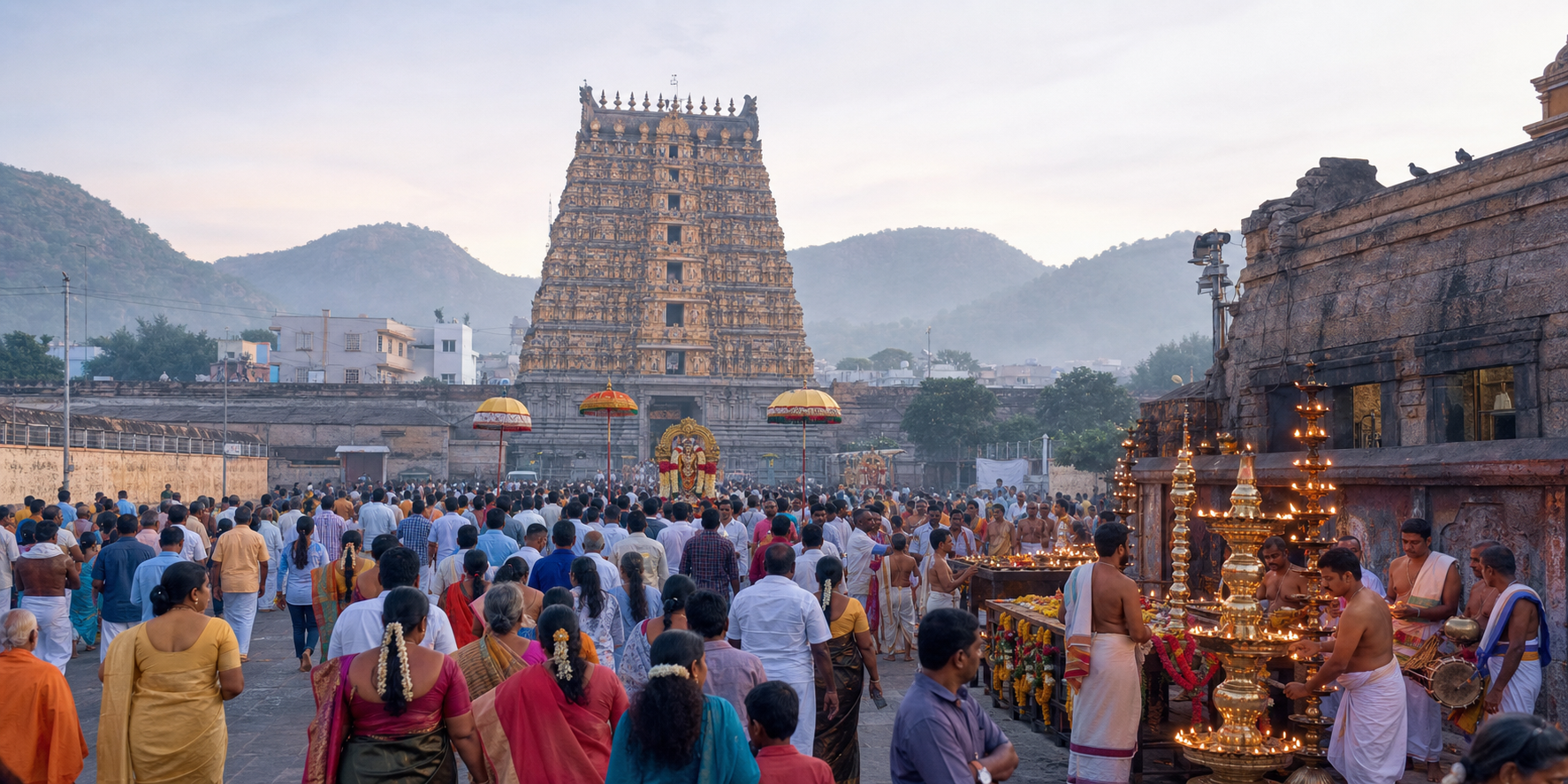
If your Tirupati journey has room for only one festival visit, do not choose by temple fame alone. First decide whether you want a focused procession within Tirupati or the unfolding ritual rhythm of a multi-day Brahmotsavam outside the city.
That distinction changes when you travel, how long you stay, and which sacred moment you can actually witness. The published 2026 celebrations offer a practical model for planning, provided you do not mistake one year’s dates for a permanent calendar.
Choose the festival shape before choosing the date
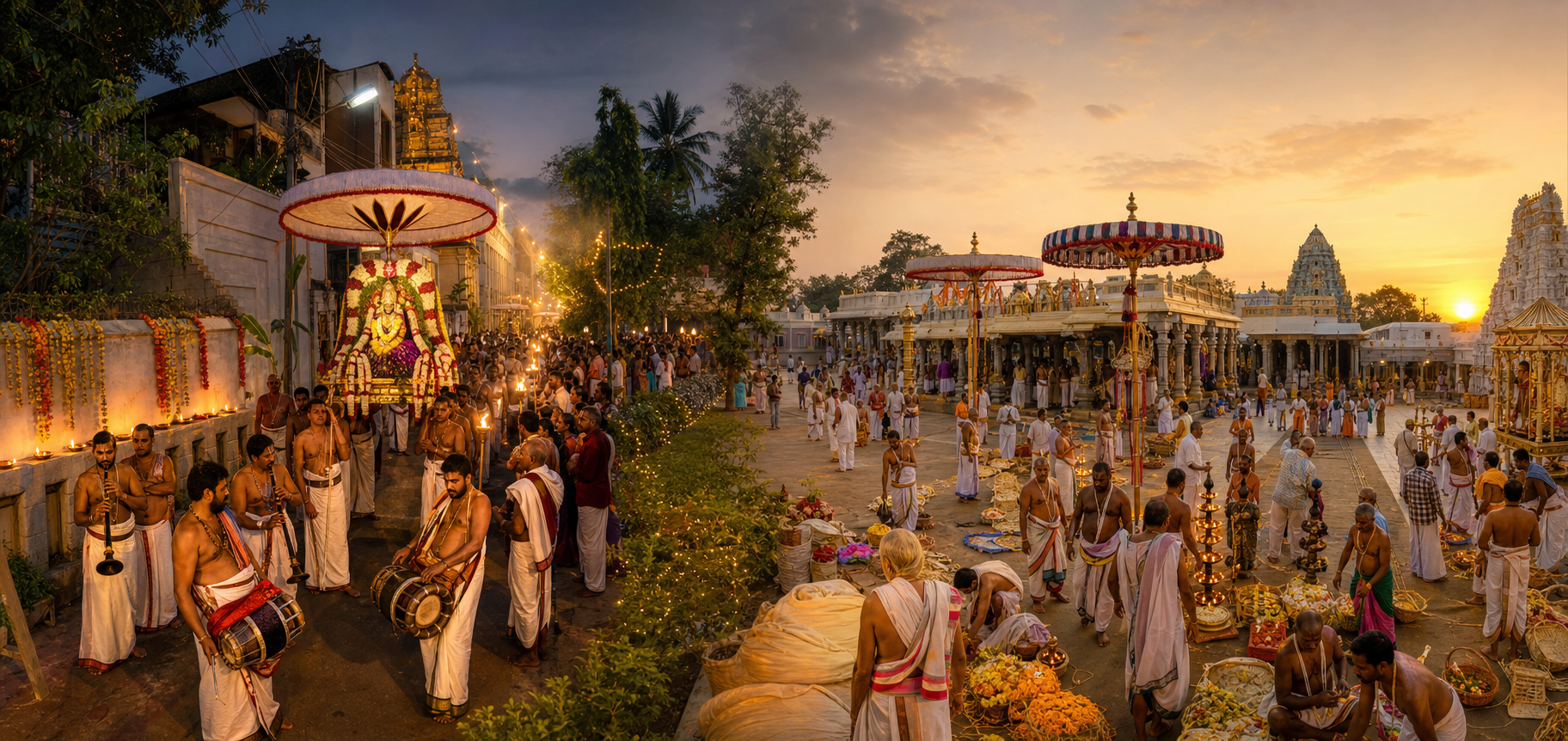
Repakula Subbamma Thota Utsavam is the more compact experience. At Sri Kodandarama Swamy Temple in Tirupati, the 2026 procession of Sri Sita, Rama, and Lakshmana began at 9:30 AM on Saturday, 4 April. The utsava-murtis moved into a garden setting where devotees could receive darshan, hear sacred recitation and auspicious music, and participate through prayer and offerings.
The Agastheeswara Swamy Brahmotsavam at Narayanavanam requires a different commitment. Its announced 2026 program placed Ganapati Puja and Ankurarpanam on 20 April from 6:00 PM to 8:30 PM, followed by festival days from 21 to 30 April. Instead of one principal procession, Brahmotsavam develops through preliminary rites, worship, alankaram, offerings, and successive public processions.
| Your priority | Stronger fit | Reason |
|---|---|---|
| A focused festival visit while staying in Tirupati | Repakula Subbamma Thota Utsavam | The principal 2026 procession began in the city at a stated morning time. |
| Several days of changing rites and processions | Agastheeswara Swamy Brahmotsavam | The preliminary observance was followed by a ten-day festival cycle. |
| Garden darshan of Sri Sita, Rama, and Lakshmana | Sri Kodandarama Swamy Temple | The thota itself forms part of the devotional setting. |
| Shaiva worship within Narayanavanam’s Shaiva-Vaishnava sacred landscape | Sri Agastheeswara Swamy Temple | Agastheeswara and Maragadavalli are worshipped near the traditions associated with Sri Kalyana Venkateswara and Sri Padmavathi. |
Use this distinction before looking at transport or accommodation. If you want one concentrated morning of Rama bhakti, the garden procession is the clearer fit. If you want to observe how a temple’s annual festival develops from sankalpa to ceremonial conclusion, reserve time for Brahmotsavam.
For any future year, verify the dates again. Festival names and ritual forms may recur, but the 2026 calendar does not establish the schedule for a later observance.
Read the ritual sequence so you arrive for the right moment
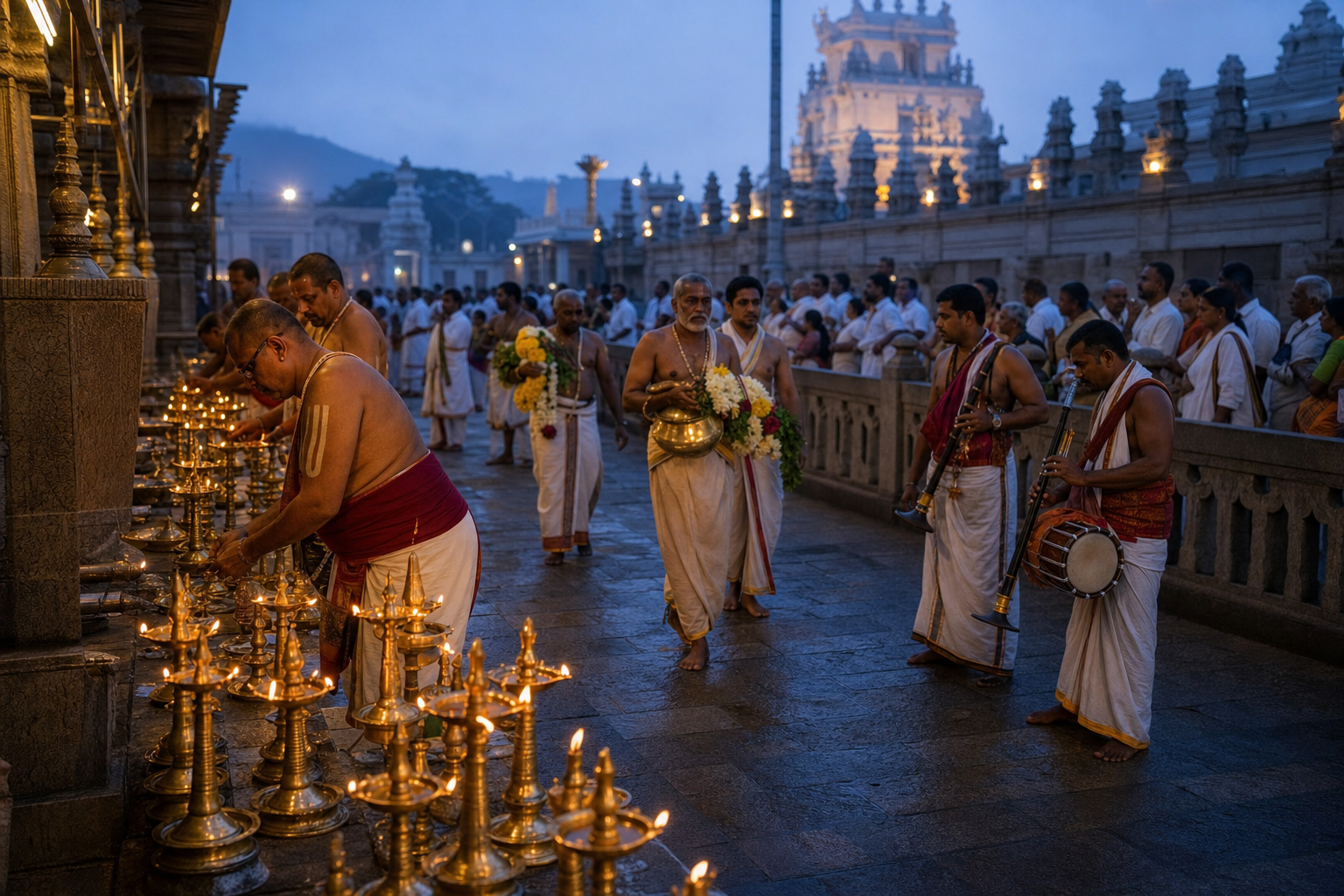
A temple festival is not a single interchangeable block of activity. Ankurarpanam, abhishekam, a vahana procession, and the final lowering of the festival flag do different ritual work. Asking only when the temple opens can therefore put you inside the complex but outside the moment you intended to witness.
At a Thota Utsavam, the movement of the utsava-murtis beyond the sanctum is central. The deity becomes accessible to a wider circle of worshippers, while flowers, shade, fragrance, music, recitation, harati, and naivedyam create a composed field of devotion. The garden is not merely a decorative venue. In the spring setting of Chaitra, coolness and repose are themselves part of the offering.
A Brahmotsavam has a longer ritual grammar. The usual landmarks help you decide which day matters most to you:
- Ganapati Puja and Ankurarpanam: obstacles are ritually addressed and auspicious seeds are sown as the intention for the festival takes form.
- Dhwajarohanam: the ceremonial raising of the flag marks the opening of the principal festival cycle.
- Daily worship: abhishekam, alankaram, archana, Vedic recitation, homa, naivedyam, and public processions establish the recurring cadence of worship.
- Vahana-sevas: the utsava-murti appears in procession on temple-specific vehicles. The exact day assigned to each seva must be checked locally.
- Dhwajavarohanam: lowering the festival flag brings the annual cycle to its formal ritual conclusion.
Do not assume that every item occurs at the same hour each day. For the Narayanavanam celebration, morning abhishekam and evening processions formed the expected rhythm, but the precise day-wise vahana program remained temple-specific. Before travelling, ask for the current day’s named seva and its reporting time, not merely the general festival dates.
Build your itinerary around geography, heat, and queues
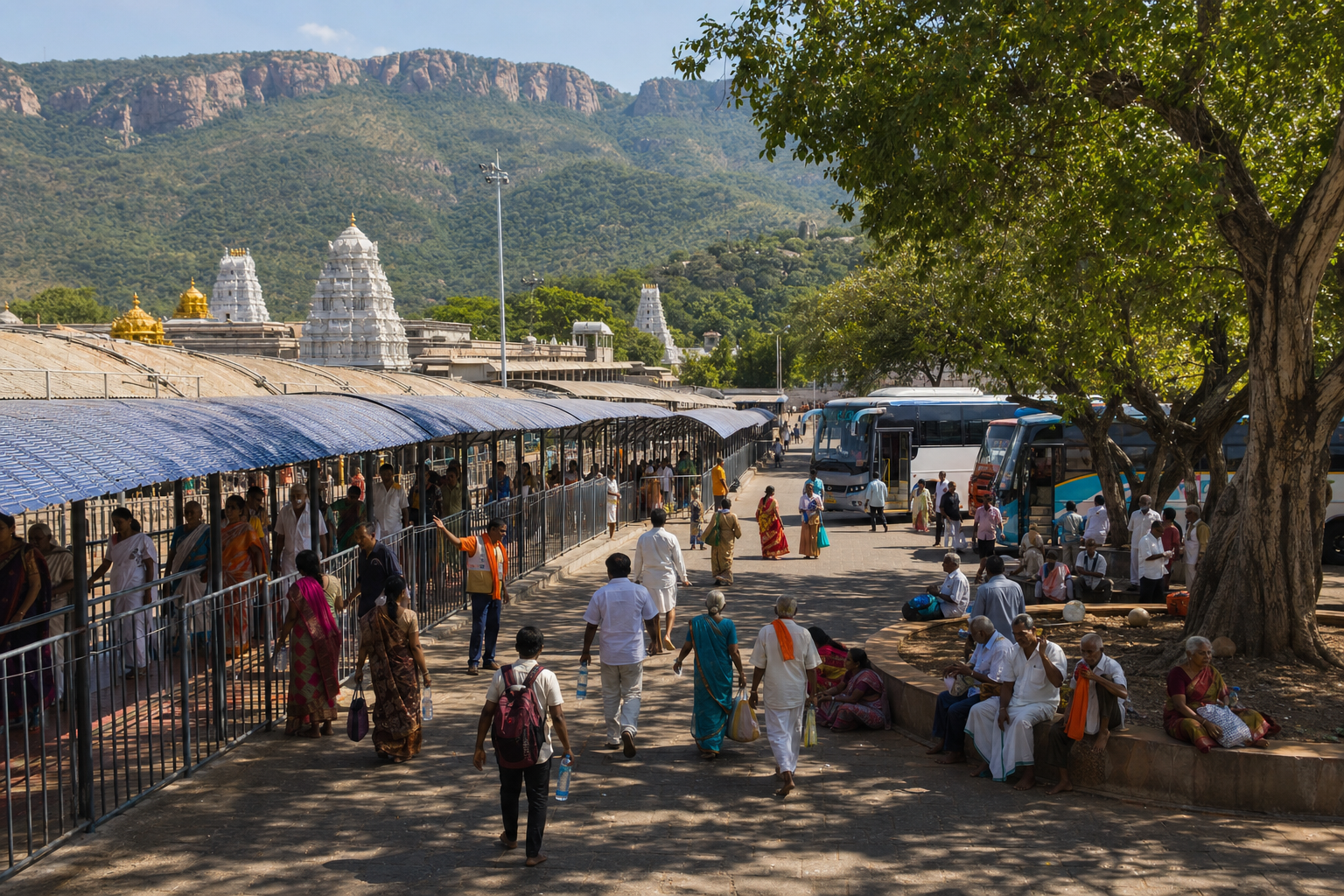
Sri Kodandarama Swamy Temple stands within Tirupati, making its garden festival suitable for a city-based itinerary. Even so, a stated procession time is not an arrival time. Reach the temple before the announced beginning so that footwear removal, security procedures, queue placement, and any local instructions do not consume the moment you came to witness.
Narayanavanam needs a separate travel plan. It lies approximately 35-40 km from Tirupati and close to Puttur. Puttur Railway Station provides nearby rail access, while Tirupati Airport at Renigunta is the regional airport. APSRTC and private buses serve the corridor; autos and taxis can cover the last leg. If you depend on public transport, verify both the onward connection and your return option before leaving Tirupati or Puttur. An evening procession and a tightly timed onward train are a poor combination.
April is peak summer in this part of Andhra Pradesh. Wear light, modest cotton clothing and carry sun protection. Keep drinking water available during the journey, using a reusable bottle where temple rules permit it. Hydration belongs in your transport plan, not as an afterthought once you join a queue.
Temple etiquette is straightforward but should be settled before you arrive:
- Wear clothing appropriate to a sacred space and remove footwear where directed.
- Ask before photographing a deity, ritual, procession, or inner precinct; do not infer permission from other visitors’ behavior.
- Carry only offerings accepted by the temple rather than assembling an elaborate offering independently.
- Keep conversation low during homa, mantra recitation, harati, and naivedyam.
- Follow the queue instead of pushing toward the utsava-murti when the procession pauses.
- Minimize disposable plastic and place waste only in designated receptacles.
We would also leave unscheduled time after the principal seva. A procession follows ritual order, not a tourist timetable. That margin lets you remain attentive instead of watching the clock through darshan.
Let your sankalpa decide what you attend
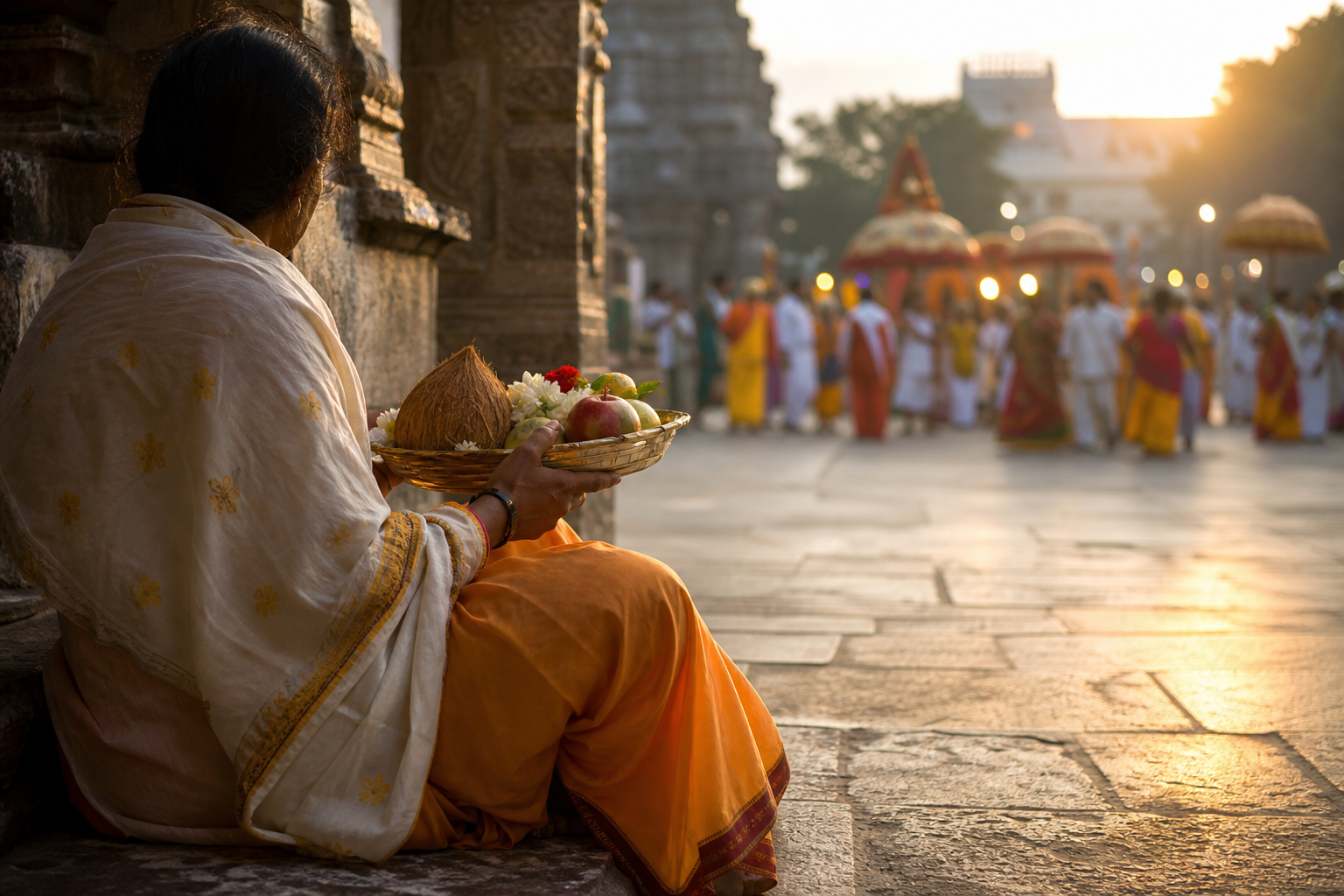
The two festivals illuminate different devotional emphases. At the garden festival, Sri Sita, Rama, and Lakshmana direct attention toward dharma, compassion, and steadfast seva. Flowers, shade, sacred sound, and measured movement show how sensory beauty can gather a distracted mind rather than merely entertain it.
You can participate more deliberately by choosing one point of attention before the procession begins. Listen closely to the transition from instrumental music to recitation, contemplate one virtue embodied by the deities, or keep silence while the procession passes. If you are bringing children, explain beforehand why the processional forms leave the sanctum. That simple explanation turns waiting in a crowd into intergenerational learning.
At Narayanavanam, Sri Agastheeswara is Shiva in the sacred association of Sage Agastya. Agastya’s Puranic role connects the southward movement of Vedic and temple traditions with the restoration of cosmic balance. Goddess Maragadavalli is traditionally invoked for prosperity, well-being, and inner steadiness. Nearby, the sacred marriage tradition of Sri Venkateswara and Sri Padmavathi gives the area a distinctly Vaishnava resonance as well.
This proximity is not a problem to be resolved by choosing one sect against another. It is part of the Tirupati region’s lived sacred geography. Shaiva and Vaishnava worship retain their own deities, rites, and theological accents while sharing a civilizational vocabulary of darshan, seva, discipline, hospitality, and collective merit.
Make that unity practical. Receive prasadam without waste, respect the recitation even when it is unfamiliar, and offer help through an authorized seva channel rather than interrupting temple workers. If annadanam is available, follow its serving and seating order. These small acts reveal more about dharma than treating the procession as a spectacle.
Key takeaways for your festival plan
- Choose by ritual form: a concentrated garden procession in Tirupati or a multi-day Brahmotsavam at Narayanavanam.
- Do not reuse 2026 dates for another year. Verify the current calendar, reporting time, named seva, and vahana schedule.
- For Narayanavanam, plan the 35-40 km journey separately and confirm last-mile and return transport.
- Prepare for April heat before joining a queue: modest cotton clothing, sun protection, and water for the journey.
- Arrive before the announced ritual, follow photography and offering rules, and leave time after the seva instead of scheduling a tight departure.
Your next step is to choose the sacred moment you most want to witness, then obtain that year’s temple schedule before booking around it. Build the day around that moment and leave it room to unfold; a temple festival should anchor the pilgrimage, not be squeezed between sightseeing stops.
References
- DharmaRenaissance Blog – Repakula Subbamma Thota Utsavam, Tirupati: Sacred Garden Procession at Sri Kodandarama Swamy Temple
- DharmaRenaissance Blog – Agastheeswara Swamy Brahmotsavam at Narayanavanam: Dates, Rituals, Significance & Guide