
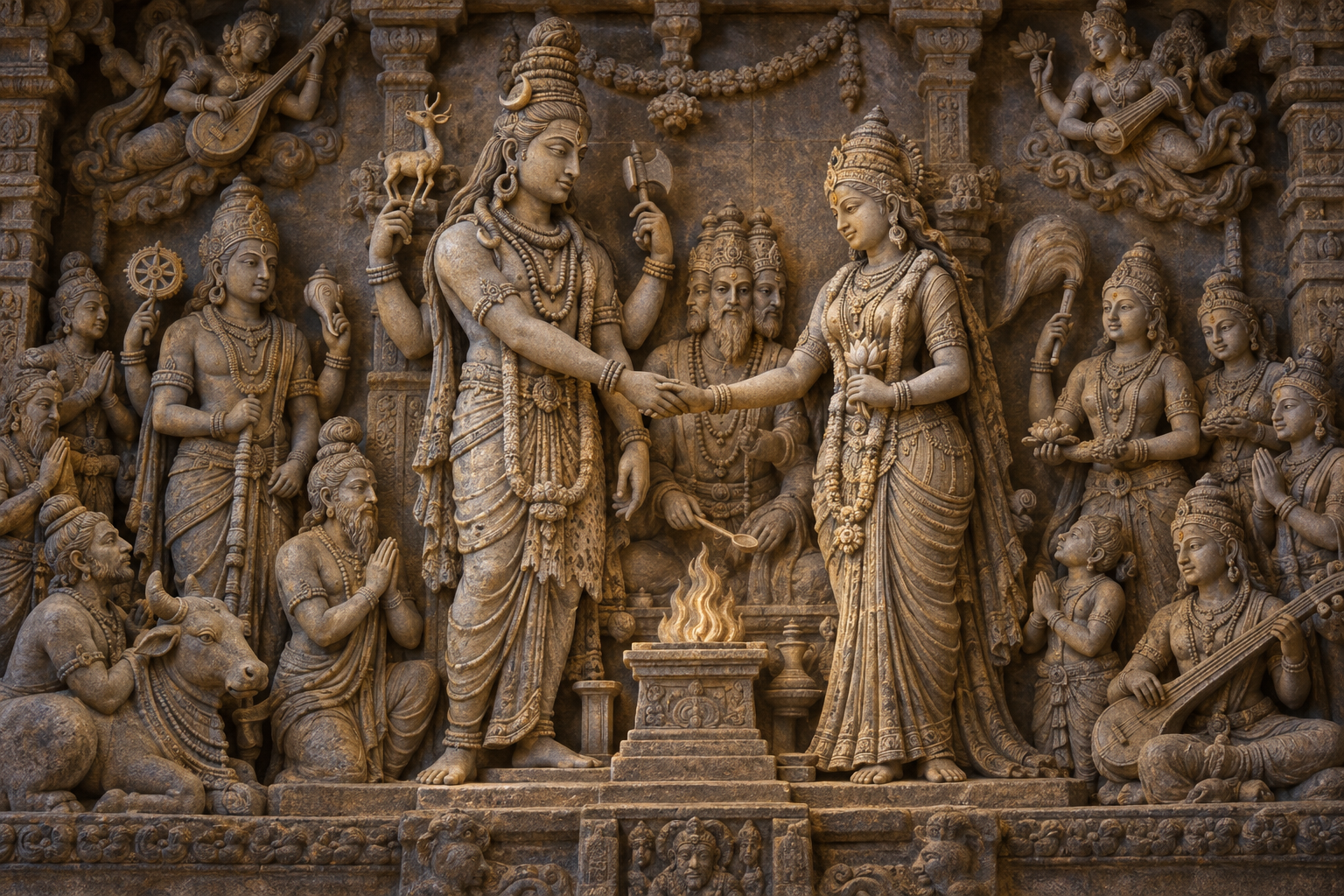
If you are facing a temple relief, bronze, or museum photograph and wondering whether it depicts the wedding of Shiva and Parvati, begin with the hands. Crowns, ornaments, attendants, and divine attributes vary. The ritual connection between the central figures is the scene’s clearest clue.
That observation turns a crowded sacred image into something you can read. First identify the couple, then the hand-taking, then the witnesses. Only after that should you interpret the theological meaning of the whole composition.
The quickest way to recognize Kalyanasundara Murti
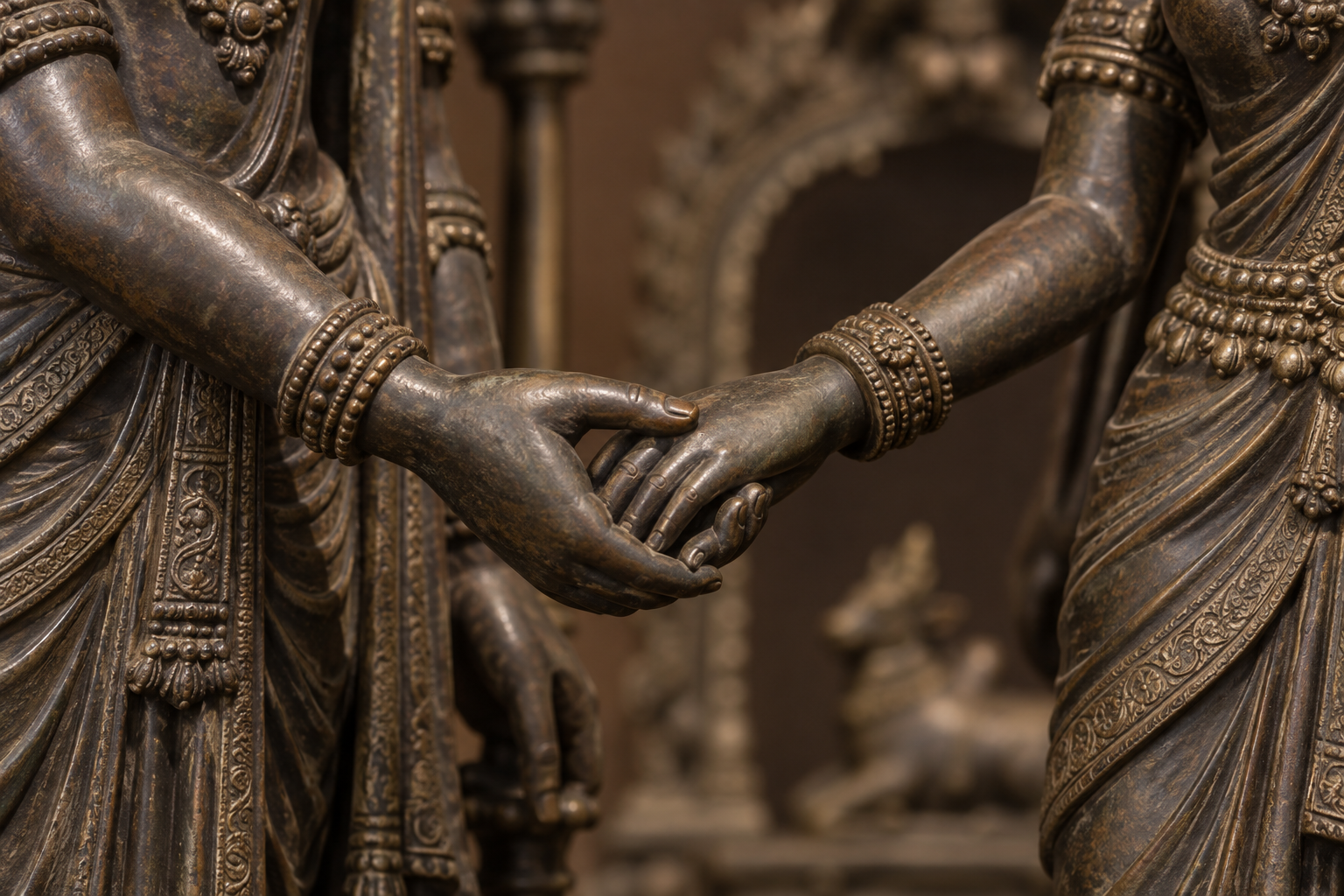
The name tells you what kind of image you are looking for. Kalyana conveys marriage and auspiciousness, sundara means beautiful, and murti is the deity’s embodied sacred form. Kalyanasundara Murti is therefore the beautiful, auspicious wedding form of Shiva, not merely a general image of Shiva standing beside Parvati. This distinction gives the form its particular place in Shaiva iconography.
The decisive action is panigrahana, the ritual taking of the bride’s hand. Shiva extends a hand toward Parvati and receives or holds her hand as the marriage is solemnized. If the sculpture is intact, follow the forearms of the two central figures until you find this contact. It is more reliable than trying to identify every object held in Shiva’s other hands.
Use the figures’ anatomical right and left, not your own viewing position, when reading a catalogue description. A deity’s right hand may appear on the left side of a photograph. This simple correction prevents a surprising number of misreadings.
Do not depend on one feature in isolation. A secure identification rests on a cluster: a recognizably Shaiva groom, Parvati presented as a bride, a formal hand-taking gesture, and, in fuller compositions, a ceremonial assembly. If the joined hands have broken away, treat the identification as probable rather than certain until the surrounding figures supply more evidence.
Read Shiva and Parvati before studying the attendants
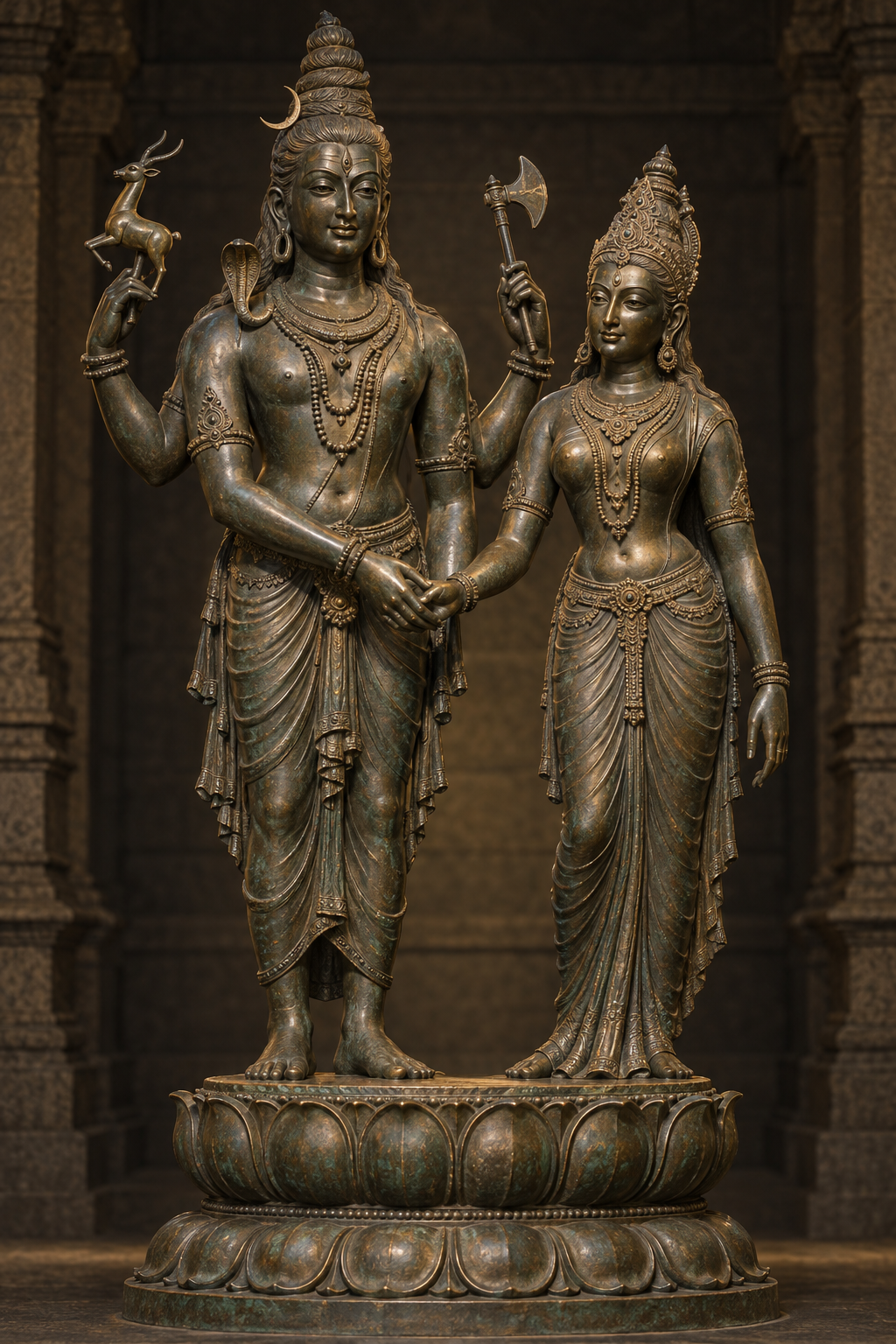
Shiva remains Shiva at his wedding. Look for the visual language that marks his identity: piled or matted hair, the third eye, and ascetic or divine attributes. Depending on the image, additional arms may carry recognizable emblems. Damage, regional convention, scale, and the sculptor’s chosen moment can change which details survive or appear, so no single attribute should become an absolute test.
Parvati is usually distinguished through bridal bearing, ornament, dress, and her participation in the hand-taking. Her posture may appear reserved, but she is not a decorative appendage to Shiva. She is one of the two indispensable participants whose union makes the image Kalyanasundara.
Notice what the sculptor does with contrast. Shiva’s ascetic signs do not have to disappear when he assumes the role of bridegroom. Their continued presence allows the image to hold apparent opposites together: ascetic power and household life, stillness and generative energy, renunciation and responsible participation in the world. Parvati likewise appears not as a force outside Shiva but as the divine presence with whom the auspicious union becomes manifest.
Next examine scale and stance. The central pair normally commands the composition even when numerous witnesses surround them. Smaller attendants are not necessarily spiritually unimportant; reduced scale can direct your attention to the principal ritual action. Read hierarchy as a compositional device before treating it as a judgement about status.
The surrounding figures reveal a public sacred wedding
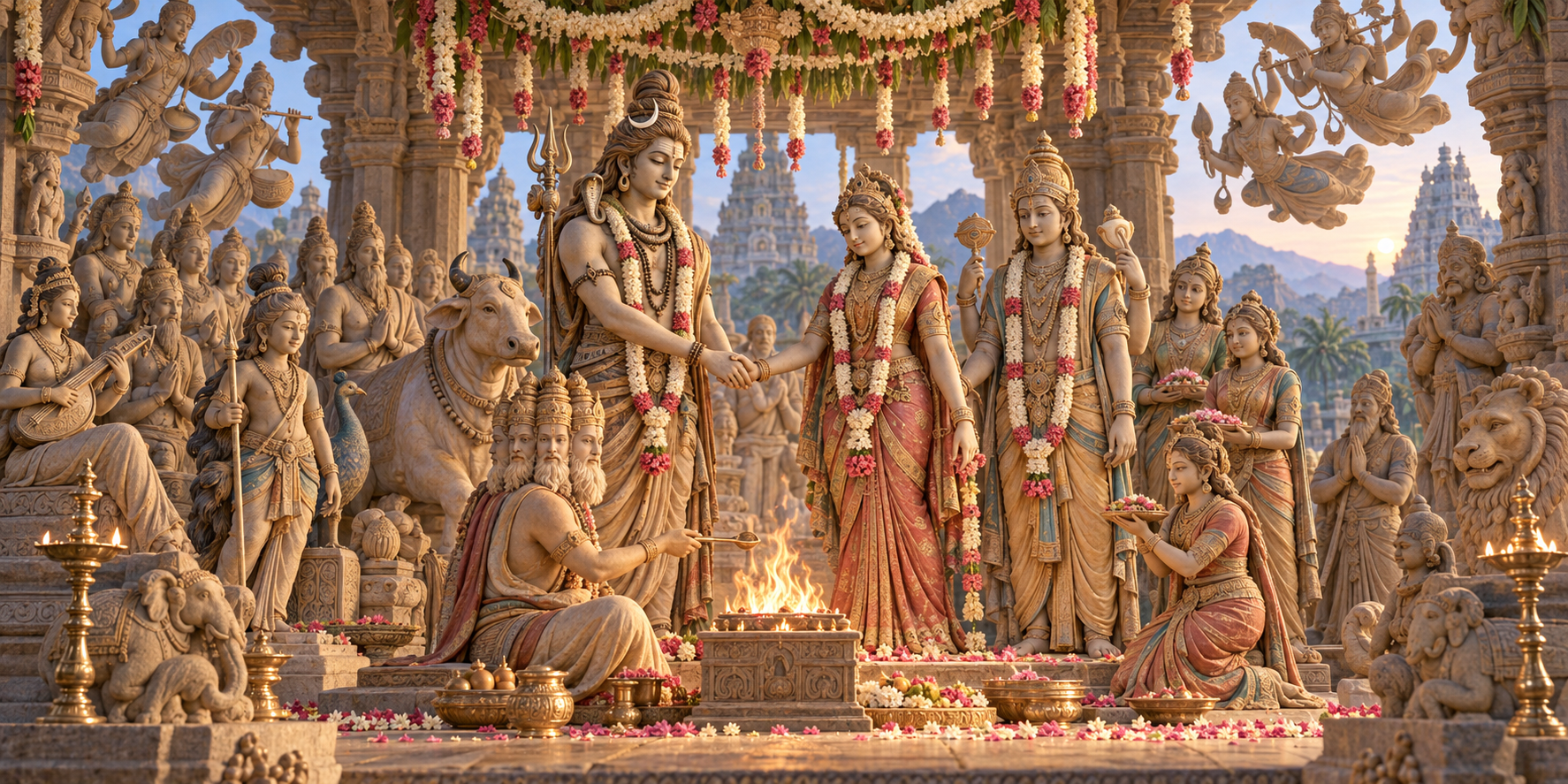
A fuller Kalyanasundara composition is an assembly, not a private portrait. Brahma commonly appears in a priestly or officiating role, often near the ritual center or sacrificial fire. Vishnu may stand on Parvati’s side in the ceremonial role associated with presenting the bride. Other deities, divine attendants, and ganas may witness the union.
Use these figures to confirm the scene, not to impose a rigid attendance list. A crowded stone relief can preserve a substantial wedding party, while a smaller or portable image may concentrate almost entirely on Shiva, Parvati, and their linked hands. The absence of Vishnu, Brahma, a visible fire, or a particular attendant does not by itself disqualify the identification.
When a relief is damaged, read its spatial grammar. Ask who occupies the center, which way the secondary figures turn, and whether their gestures converge on the couple’s hands or on a ritual point below them. A small seated figure near the lower center may function as an officiant rather than an unrelated worshipper. Figures carrying vessels or standing in formal attendance can also strengthen the wedding reading, although they should not replace evidence from the central pair.
This order matters: couple, gesture, officiant, witnesses. Beginning with a minor figure encourages overconfident identifications, especially when erosion has removed the object that once clarified that figure’s role.
Do not confuse the wedding with other Shiva-Parvati forms
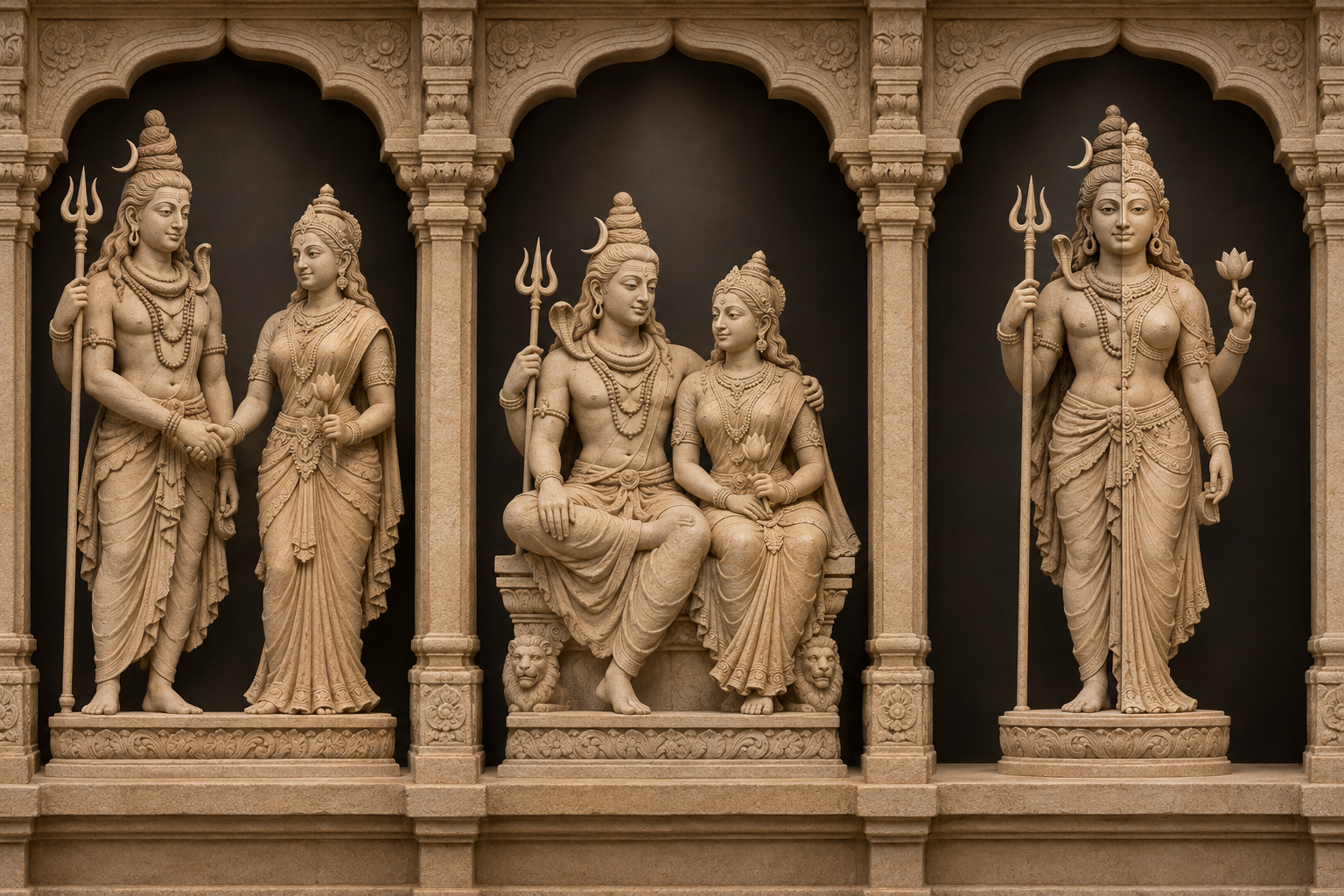
Shiva and Parvati appear together in several important iconographic forms. The relationship between their bodies, rather than their mere presence, tells you which form you are seeing.
| Form | Primary visual test | What not to mistake for the wedding |
|---|---|---|
| Kalyanasundara Murti | Shiva and Parvati enact a formal hand-taking, sometimes before an officiant and witnesses. | Ornament alone does not establish a wedding; look for ritual action. |
| Uma-Maheshvara | The divine couple appears together, often in an intimate or enthroned arrangement. | Proximity between Shiva and Uma is not the same as panigrahana. |
| Somaskanda | Shiva, Uma, and the child Skanda form a family group. | The child’s central presence shifts the subject from marriage to the divine family. |
| Ardhanarishvara | Shiva and the feminine divine occupy one composite body. | This is bodily unity, not two figures participating in a wedding rite. |
A standing pair is therefore only your starting point. If no ritual handclasp survives, no officiating context is visible, and no catalogue or inscription confirms the subject, keep the label tentative. Sacred art deserves the same discipline we would bring to any historical evidence: say what the image supports, and distinguish that from what you expect to find.
Also resist assigning a date or region from the subject alone. The wedding of Shiva and Parvati can be represented in different periods, materials, and local styles. Iconography identifies what is happening; style, inscriptions, provenance, and archaeological context are needed to establish where and when a particular object was made.
Key takeaways for viewing the murti with understanding
- Begin with the central hands. The formal joining of Shiva and Parvati is the strongest diagnostic feature.
- Confirm Shiva through a combination of Shaiva features rather than one weapon, ornament, or hairstyle.
- Read Parvati as an active participant in the rite, not as a secondary ornament beside the groom.
- Use Brahma, Vishnu, the ritual fire, and other witnesses as supporting evidence; their number and arrangement can vary.
- Distinguish a wedding action from the seated couple, divine family, and composite-body forms.
- Interpret the image on three levels: a divine marriage, an auspicious sacred presence, and the joining of complementary modes of divine power.
The form’s deepest teaching is carried by its most concrete gesture. Shiva and Parvati do not lose their distinct identities, yet their union becomes the center around which the divine assembly gathers. Within a Shaiva understanding, this makes the wedding more than an episode in a sacred story. It presents complementary divine powers in ordered relationship and places auspicious household life within the field of the sacred.
That does not mean every modern idea about romance, marriage, or gender should be projected onto the sculpture. Begin with what the image actually shows: a formal rite, distinct divine participants, witnesses, and a public declaration of union. The theological reading should grow from those visible relationships rather than replace them.
At your next temple or museum visit, spend the first minute without trying to name every figure. Trace the central hands, identify the Shaiva marks, and follow the attendants’ attention toward the ritual action. Once you can see that structure, Kalyanasundara Murti stops looking like a crowded tableau and begins to disclose the sacred wedding it was made to hold.
References

Leave a Reply
You must be logged in to post a comment.