
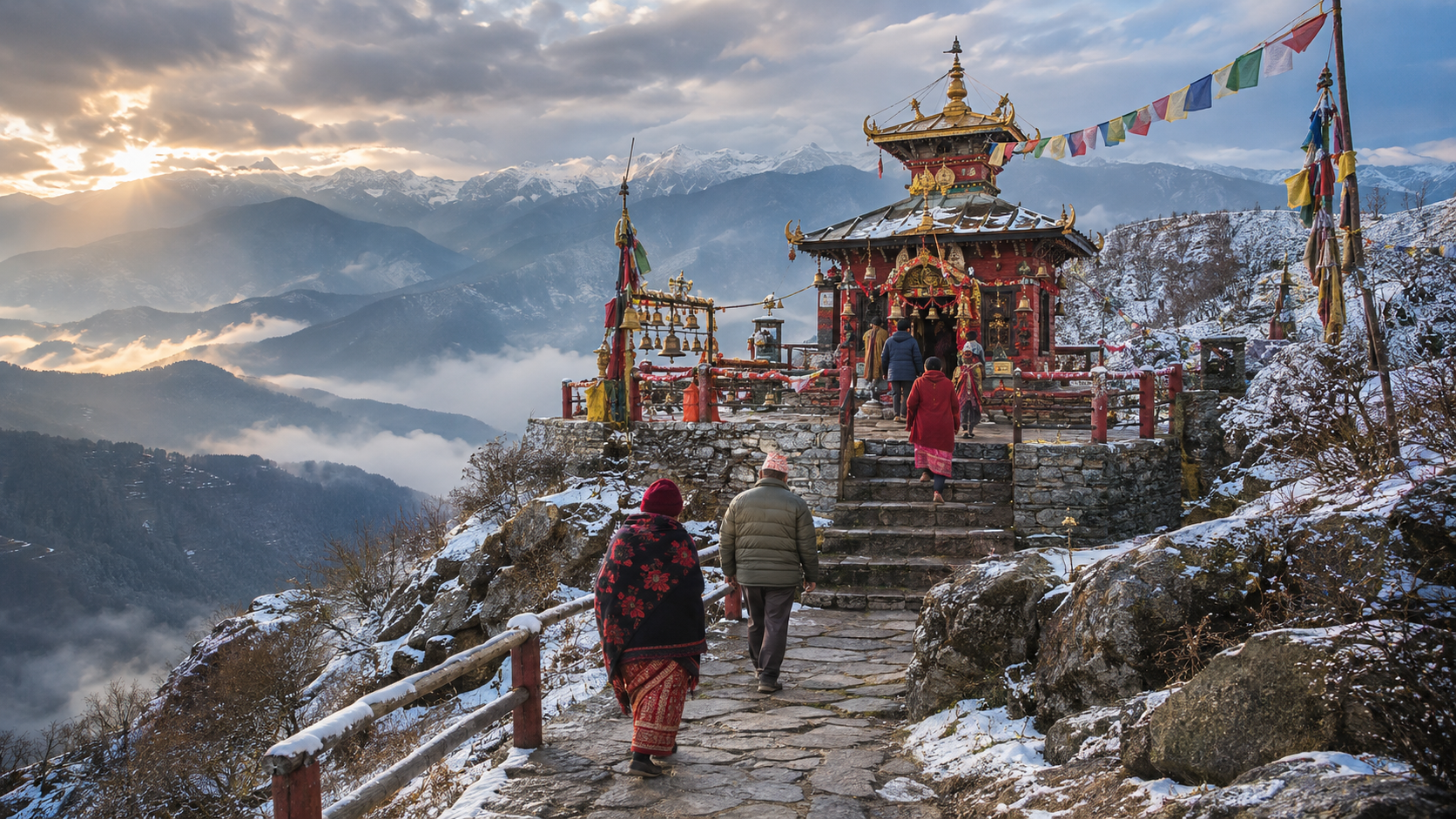
You may be planning a pilgrimage to Kalinchowk Bhagwati and have encountered an unsettling warning: enter the temple once, but never return. Should you understand that as a binding rule, a local custom, or a dramatic retelling of temple lore?
The prudent answer is to treat it seriously as a tradition associated with this particular shrine, without turning an incomplete phrase into a universal Hindu command. Kalinchowk is also a demanding Himalayan destination: the shrine stands at more than 3,000 metres in Nepal’s Dolakha district, with access involving a steep climb or a cable car journey through pine country. You therefore need to prepare for both the temple’s maryada and the mountain.
What the once-only tradition does and does not establish
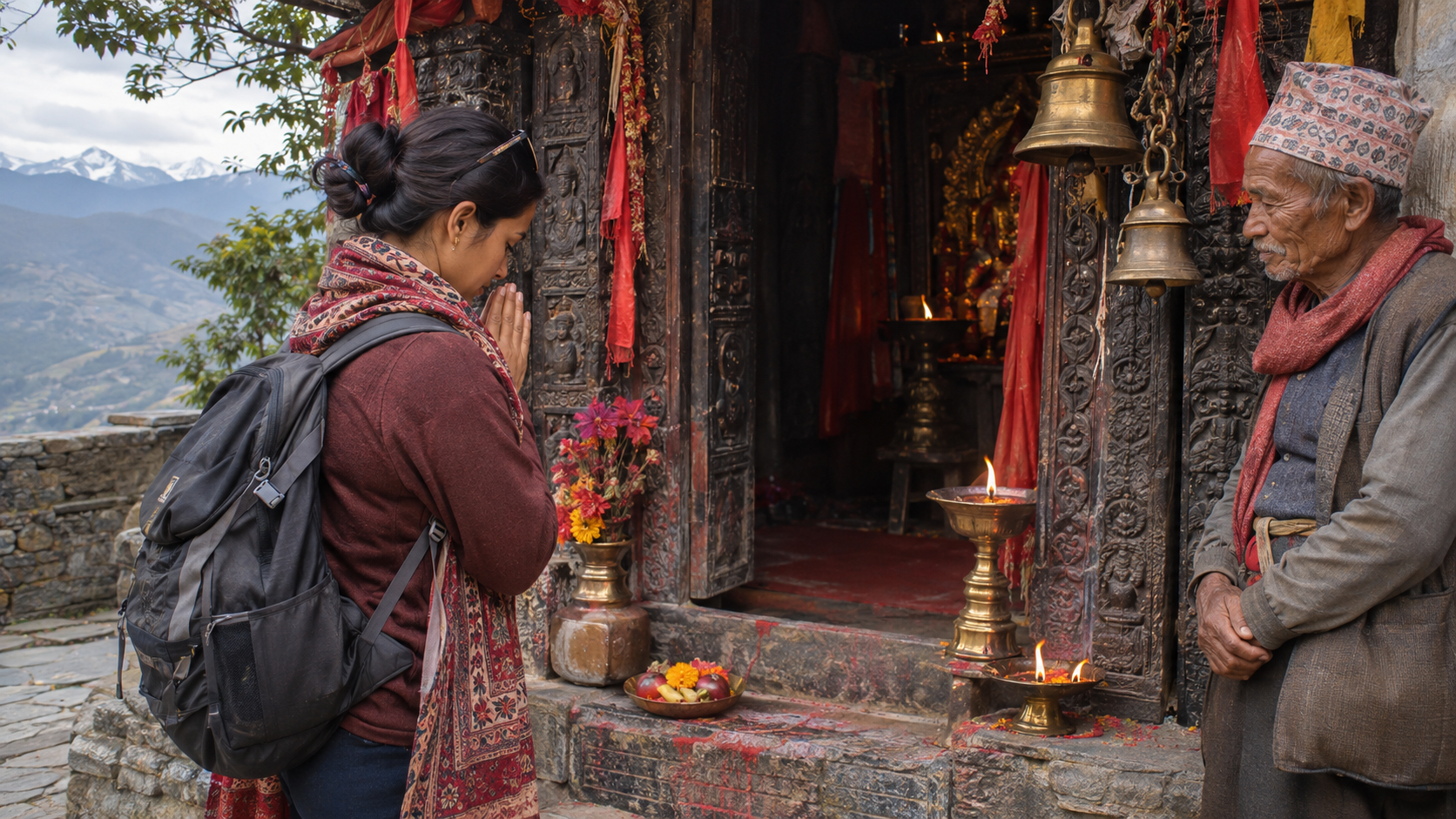
The custom is usually expressed in narrow terms: a pilgrim may enter the shrine but should not return after that visit. It is presented as a distinctive Kalinchowk observance, not as a general rule governing Kali temples or Hindu pilgrimage.
That distinction matters. Hindu temples have local disciplines shaped by their deity, history and community. Respecting those disciplines is part of approaching a kshetra on its own terms. It does not require you to generalise one temple’s custom into a prohibition that applies everywhere else.
The wording nevertheless leaves important practical questions unanswered. It does not define whether entering means crossing into the principal shrine, reaching the wider temple precinct, or simply making the pilgrimage to the hill. It does not establish whether the observance applies identically to every visitor, whether it is connected with a particular vow, or what a returning pilgrim should do. Filling those gaps with rumours about curses or punishments would add claims that the tradition itself does not establish.
Before entering, ask a priest or authorised local caretaker four direct questions:
- What exactly counts as the single visit: entering the main shrine, receiving darshan, or reaching the temple area?
- Is the custom expected of every pilgrim, or is it connected with a particular sankalpa or circumstance?
- Does entering involve any promise that the pilgrim should understand beforehand?
- Is there a customary act to complete before departing?
Ask before you cross the relevant boundary, not after. If the answer will determine whether you enter and no knowledgeable person is available, wait until you can obtain clear local guidance. Reverence does not require a hurried decision made under uncertainty.
If you have already visited once and are considering another journey, do not conceal that fact or rely on an online stranger’s interpretation. Tell the priest plainly that you have been before and ask how the temple understands the situation. That gives local custodians the opportunity to distinguish actual maryada from an embellished version circulating beyond the shrine.
Why Raktabija is central to understanding the shrine
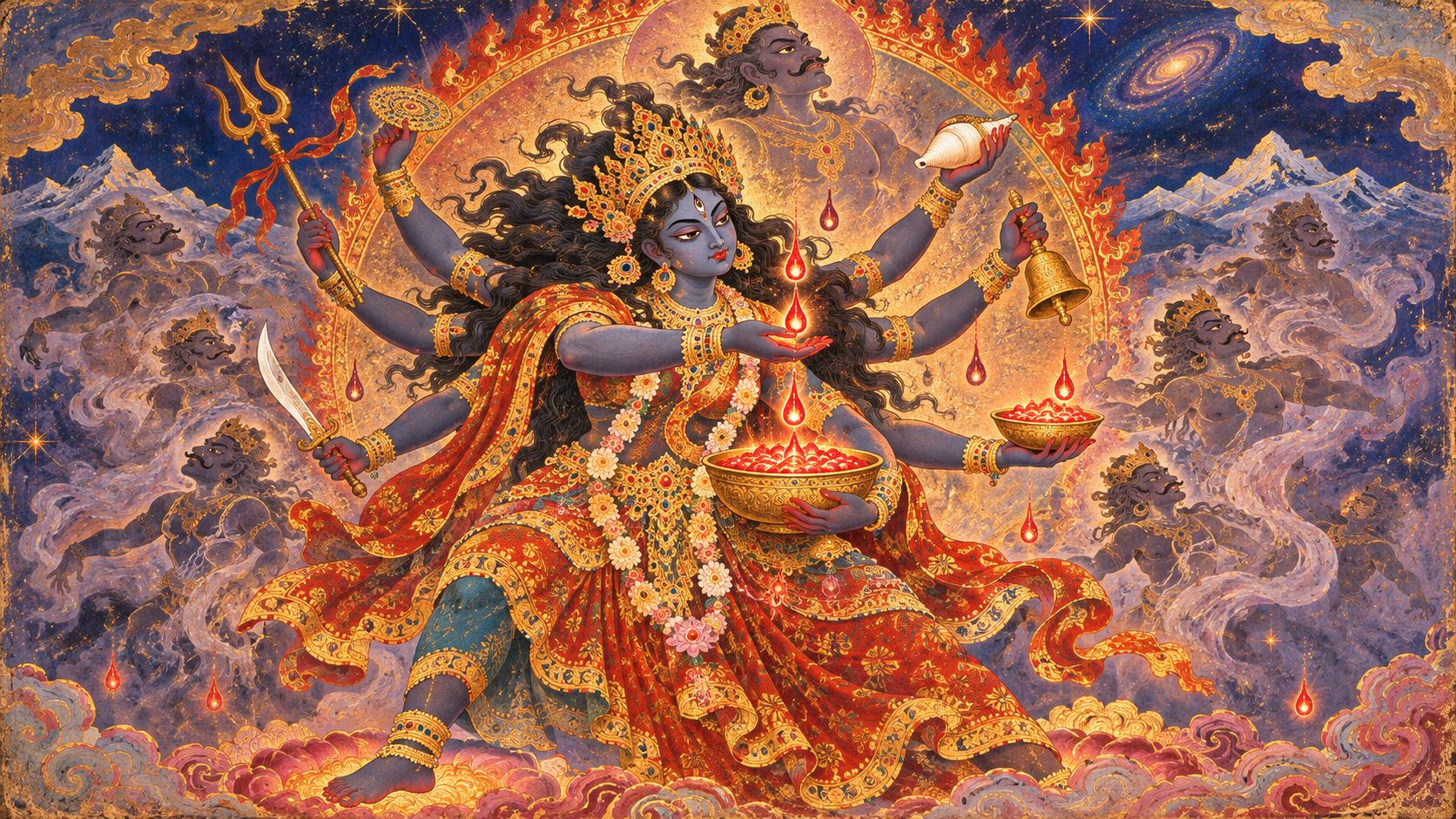
Kalinchowk Bhagwati is associated with Kali and the defeat of Raktabija. In the well-known account, each drop of the asura’s blood that reached the ground could perpetuate his destructive force. Kali broke that multiplying cycle by drinking Raktabija’s blood before it could continue reproducing the threat.
This imagery can appear severe when detached from its theological purpose. Its centre is not a fascination with blood. It is the Devi’s capacity to confront a form of adharma that becomes stronger whenever it is attacked only at the surface. Ordinary blows cannot end a force that reproduces through the very act intended to destroy it. Kali therefore stops the mechanism at its root.
That gives you a useful devotional frame for darshan. Instead of approaching only with a list of desired outcomes, identify one harmful tendency that keeps regenerating in your life. It might be anger that returns through repeated argument, fear reinforced by avoidance, or resentment sustained by constant recollection. The parallel is contemplative rather than literal: ask what feeds the pattern, not merely what its latest expression looks like.
You can hold that question silently as you approach the Goddess, while following whatever worship the temple actually permits. Do not present a personal interpretation as the shrine’s prescribed ritual. The Raktabija narrative can deepen your attention without authorising you to invent an offering, mantra, vow or ceremony.
Prepare for the mountain before planning the ritual
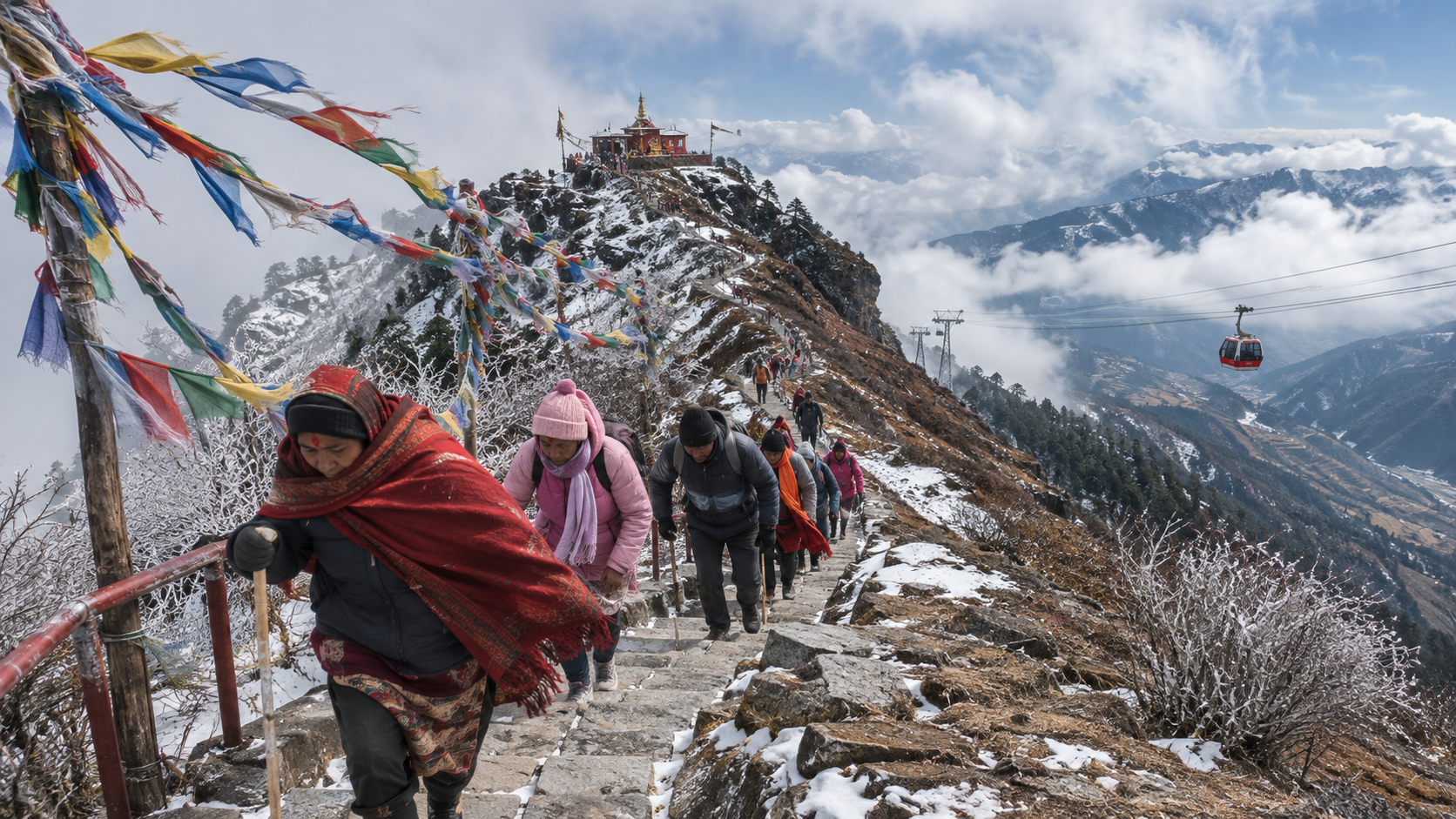
A cable car can reduce the amount of climbing, but it does not change the temple’s Himalayan elevation. The height, steep approach and possibility of changing mountain conditions should shape your schedule. A rushed itinerary is especially unhelpful when you may also need time to clarify an unfamiliar temple custom.
- Confirm current access locally. Check the cable car’s operating status, the condition of the walking route and the weather close to the day of travel. Do not build the entire journey around an assumed service.
- Choose the route for your actual capacity. Walking and using the cable car are means of reaching darshan, not competing measures of devotion.
- Carry water, secure footwear and layers suitable for a high mountain setting. Keep your hands free enough to manage uneven or steep ground safely.
- Leave room in the schedule. Allow time to pause, ask about the temple’s maryada and observe how worshippers proceed instead of arriving under pressure to enter immediately.
- Do not force the ascent if you become unwell. Stop, tell a companion or local attendant and seek appropriate local help. Completing darshan is not worth ignoring a deteriorating physical condition.
- Separate travel access from ritual permission. Reaching the hill or leaving the cable car does not answer what the once-only custom means at the temple entrance; ask before making that assumption.
If you are travelling with children, older relatives or anyone whose mobility may be limited, decide in advance who will accompany them and when the group will turn back. The mountain should not become an arena for proving endurance. A pilgrimage remains meaningful when prudence determines how far a person proceeds.
Let local practice govern your conduct
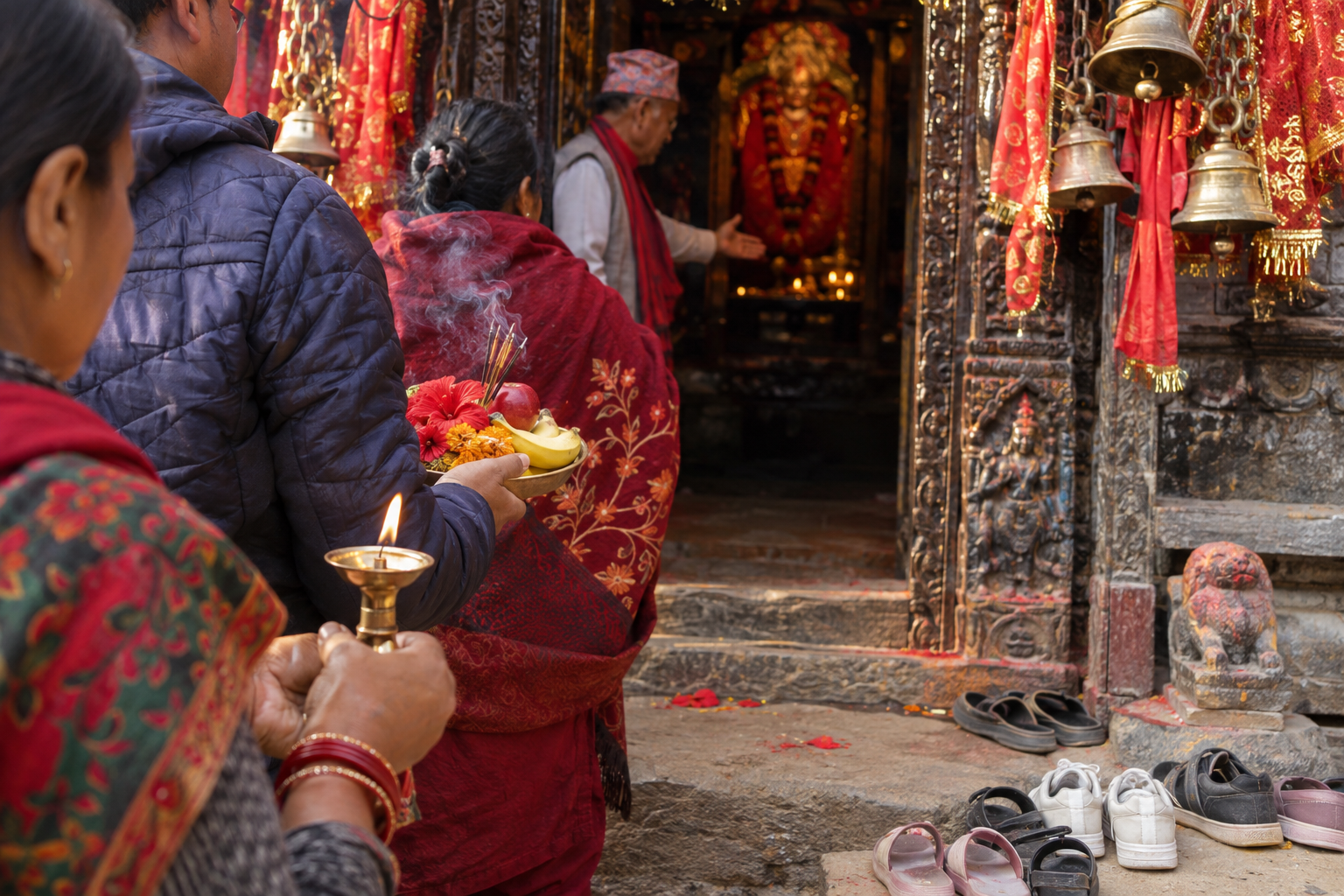
When a shrine has an unusual tradition, visitors often make one of two mistakes. Some dismiss the custom because they cannot fit it into a familiar rule. Others become so fascinated by it that they treat the temple as a spectacle. Both responses shift attention away from the presiding Devi and the community that maintains her place of worship.
At the temple, watch first and ask quietly. Follow instructions about footwear, queues, offerings and photography. If no sign or instruction is visible, permission is safer than assumption. A photograph of the landscape does not imply permission to photograph worshippers, priests or the sacred space.
Do not bring or perform something merely because the Raktabija story involves blood. A mythic event is not a personal licence to improvise ritual practice. Offer only what the temple accepts, and let its custodians explain how Bhagwati is worshipped there.
The same discipline applies to conversation. You can ask why the once-only custom exists without demanding that a priest defend it in the categories of another temple or tradition. If different local people give different explanations, note the difference and avoid declaring one informal answer to be the final doctrine. The most urgent question for a pilgrim is simpler: what conduct is expected here, before entering and before leaving?
Key takeaways for your pilgrimage
- Treat the single-visit belief as a Kalinchowk-specific tradition, not a universal restriction on revisiting Hindu temples.
- Ask a priest what counts as entering and whether the custom applies to your circumstances before you proceed.
- Understand Raktabija through Kali’s destruction of a threat that multiplies when addressed only at the surface.
- Prepare for an elevation above 3,000 metres even if you intend to use the cable car.
- Follow the temple’s actual rules for offerings, worship and photography rather than inventing practices from the shrine’s mythology.
Your next step is practical: confirm the mountain access you can safely manage, then identify whom you will ask about the once-only maryada before entering. Arrive ready to listen. That is the clearest way to honour both Bhagwati and the living tradition of her Himalayan shrine.
References

Leave a Reply
You must be logged in to post a comment.