
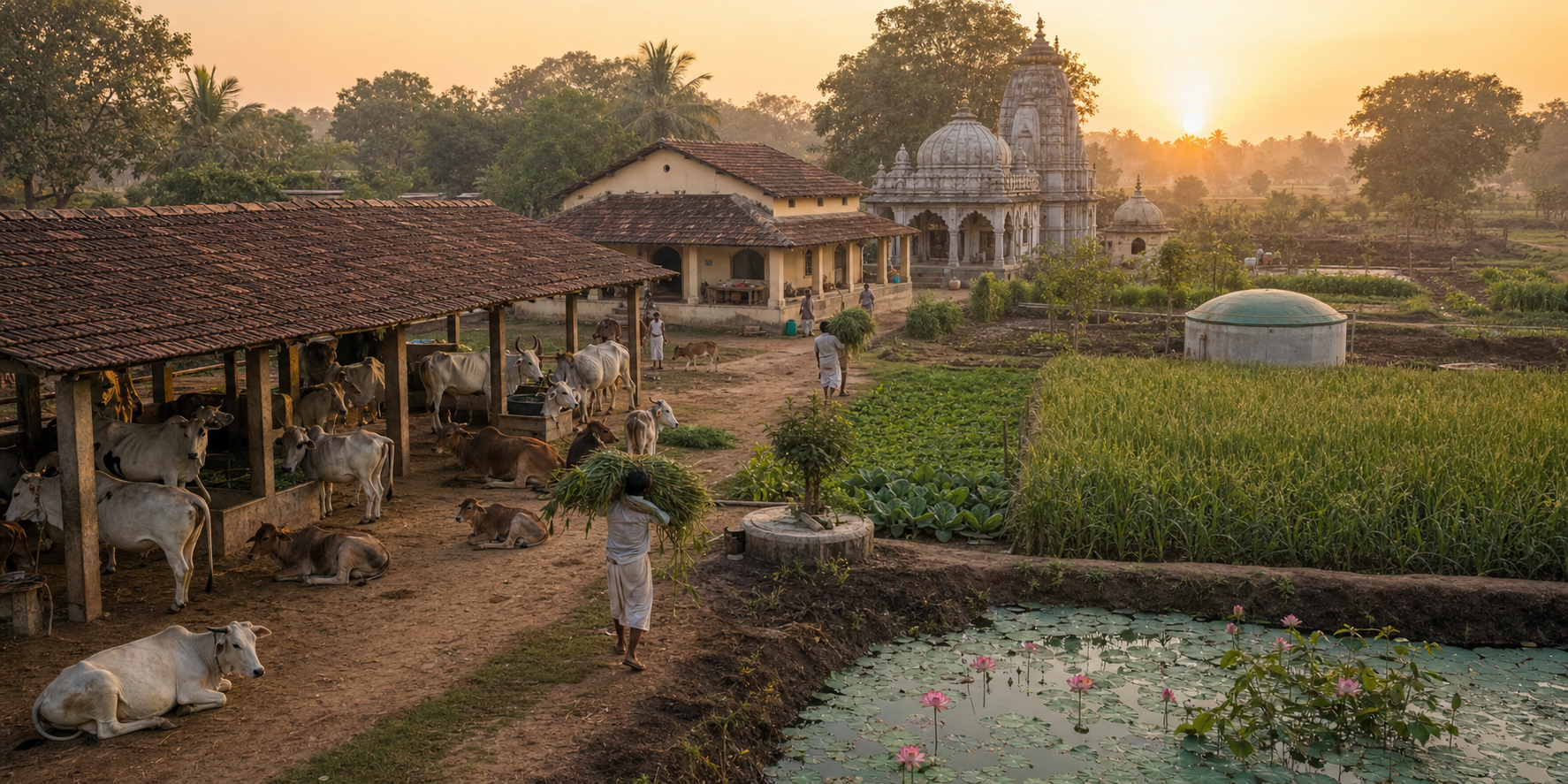
If you help run an ISKCON temple, goshala or farm, the difficult question isn’t whether cow protection is sacred. It is how to provide dependable care for every animal, including those that do not produce milk, without leaving the entire mission exposed to fodder prices, weak harvests or irregular donations.
The durable answer is to manage the herd, fields, water, manure, energy and temple kitchen as one system. The temple gives farmers predictable demand. The farm supplies food and fodder. The goshala returns fertility and potentially fuel. Clear records show whether this circle is actually improving animal welfare, soil health and financial resilience.
Key takeaways for temple and goshala leaders
- Treat cow protection as a whole-herd responsibility, not as a dairy business with a charitable wing.
- Approve herd expansion only after checking year-round fodder, water, housing, veterinary access, labor and the operating budget.
- Collect dung systematically and choose a defined use for it: manure, compost, a standardized farm input, biogas or an appropriate combination.
- Turn the temple kitchen into an anchor customer by publishing seasonal demand, quality standards and delivery schedules before crops are planted.
- Review animal welfare, soil, procurement and cash flow on the same monthly dashboard. A gain in one area must not conceal deterioration in another.
Build one operating loop around the cow
A goshala becomes vulnerable when milk is expected to pay for everything. Milk production varies, while feed, shelter and health care continue across the animal’s life. Sustainable cow protection therefore requires more than adding a compost pit or selling a few bottles of a value-added product. It requires a deliberate relationship among agriculture, protection and exchange.
The useful frame is Krishi Go-Raksha Vanijyam: agriculture, cow protection and values-led trade functioning as an integrated model. Each part has a defined role:
- The farm grows suitable food and fodder, uses water according to local availability, and returns organic residues to the soil where appropriate.
- The goshala protects the herd, maintains animal records, collects dung and urine cleanly, and converts those materials into useful outputs under documented procedures.
- The temple becomes a disciplined institutional buyer rather than an occasional customer. Its kitchen can also use properly produced biogas where the scale and installation make sense.
- The trading and administrative function sets grades, prices, batch records, delivery expectations, accounts and compliance responsibilities.
Put this loop on one sheet of paper. For every material entering the system, write its supplier, cost, storage requirement and responsible person. For every output, identify its user, quality standard, volume record and destination. If dung is called an asset but regularly accumulates beside a shed, it does not yet have an operating pathway. If the farm grows vegetables without a kitchen demand schedule, it does not yet have an assured market.
The budget should also reflect the whole mission. Potential value can come from milk and ghee, compost and other farm inputs, biogas savings, appropriate draught services, educational visits and training. These are possibilities, not guaranteed income streams. Each has its own labor, equipment, quality and marketing costs. Work out the unit economics separately before combining them in an optimistic headline figure.
Cost per litre is useful for diagnosing dairy operations, but it is not a verdict on whether cow protection is worthwhile. It cannot represent the care of calves, bulls, dry cows, elderly animals or animals receiving treatment. Keep a dairy ledger and a whole-goshala ledger. That makes the temple’s cross-subsidy and donor-supported care visible instead of hiding them inside the milk account.
This is also where dharmic ethics become operational. Ahimsa governs how the animal is treated. Loka-sangraha, collective welfare, asks whether the arrangement also protects soil, water, workers and the surrounding village. Jain traditions of long-term animal care, Sikh langar discipline and Buddhist compassion offer complementary lessons for building institutions in which care and competent administration reinforce one another.
Secure fodder, water and health before expanding the herd
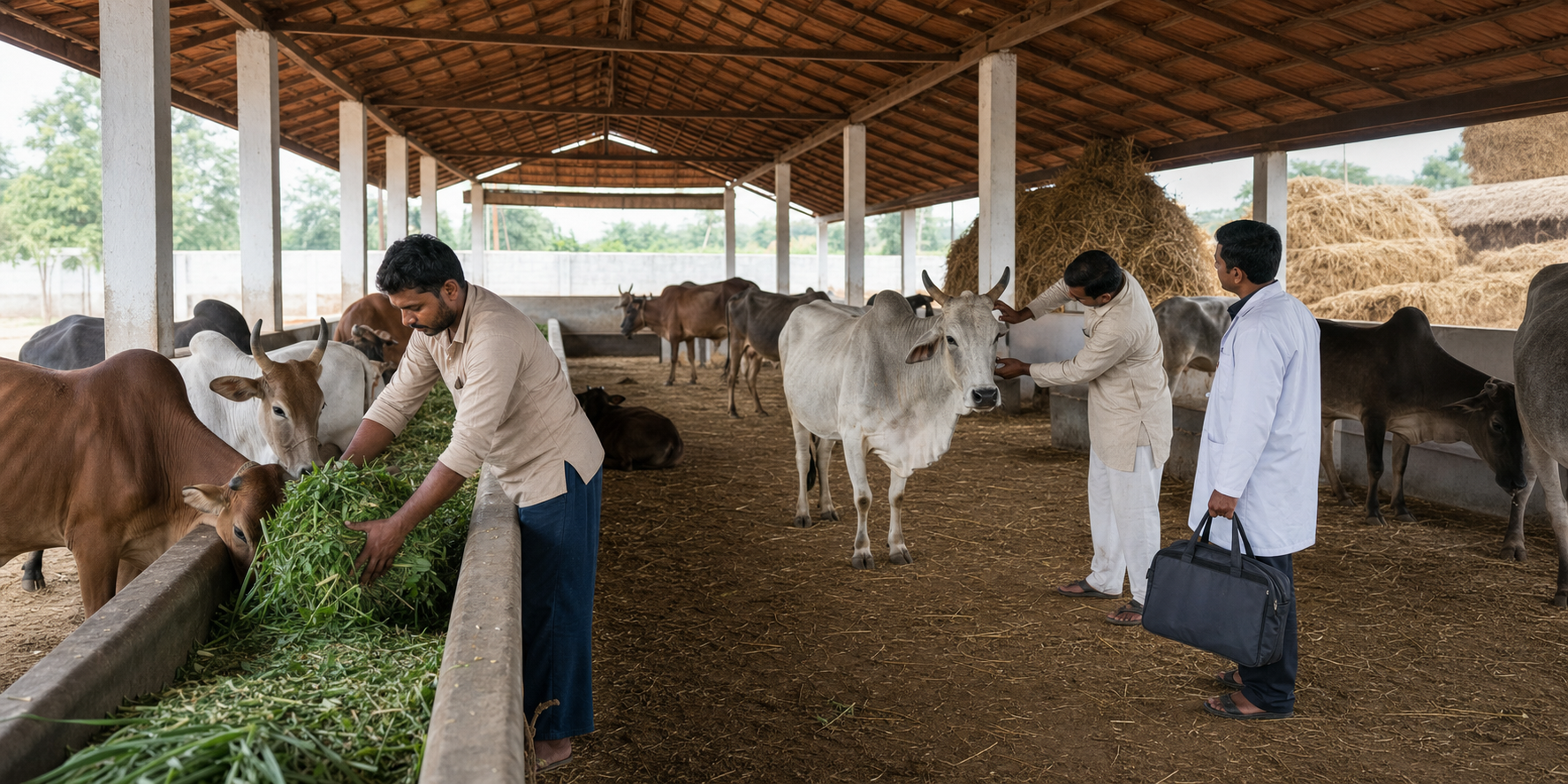
The carrying capacity of a goshala is set by its least reliable necessity. A new shed does not solve a dry-season fodder deficit, and a productive monsoon crop does not guarantee water for the rest of the year. Before accepting more animals, test whether the system can feed, house and treat the existing herd consistently through difficult seasons.
Write a year-round fodder plan
Begin with an identified herd register. Record each animal’s age, sex, life stage, health status and periodic condition score. Then match the herd’s expected needs to an annual calendar of cultivated forage, purchased feed, conserved fodder and mineral supplementation. This prevents the common mistake of treating the herd count as though every animal has an identical ration.
A resilient forage system normally has several layers rather than one favored crop. In Gujarat, practical options include perennial grasses, seasonal sorghum and maize, legumes such as cowpea and seasonally suitable berseem, and fodder trees including Leucaena and moringa. These are regional examples, not a universal prescription. Soil, rainfall, irrigation, animal ration and local agronomic advice must determine the mix at your site.
- Map when each forage enters and leaves the field, not merely how much seed will be purchased.
- Mark the months in which the plan depends on market purchases. Those are your fodder-price exposure points.
- Conserve suitable surplus as hay or silage before the dry period. A buffer created after prices rise is already late.
- Balance rations and mineral mixtures with qualified livestock guidance. More bulk does not necessarily correct a nutrient deficiency.
- Record rejected, spoiled and wasted feed. A procurement total alone will not reveal how much the animals actually receive.
Water planning belongs on the same sheet. Farm ponds, micro-irrigation, organic mulches and contour-based runoff harvesting can buffer dry spells, but none removes the need for a catchment-level water budget. Decide which crops are defensible in each season before allocating irrigation. The goshala’s drinking, cleaning and processing requirements must remain visible rather than being treated as a residual claim on farm water.
Make preventive care routine
Animal identification and periodic health scoring turn vague impressions into cases that can be followed. The basic operating plan should cover biosecurity, vaccination, vector control, strategic deworming, hygienic milking, mastitis prevention, shade, ventilation, clean bedding and access to an emergency veterinary network. Foot-and-Mouth Disease vaccination, in particular, should follow the notified schedule applicable to the location.
This is an operational checklist, not a treatment schedule. Disease prevalence, approved products and government requirements vary. Have a qualified local veterinarian set the actual vaccination, deworming and treatment protocols, and record every intervention against the identified animal. Copying another goshala’s dates or medicines without that review can leave animals under-protected or expose them to inappropriate treatment.
Breed conservation needs the same discipline. Gir and Kankrej cattle have particular relevance in Gujarat because of their adaptation, resilience and cultural importance. Preserve those strengths through reliable identification and performance records, careful selection and responsible breeding. Indiscriminate crossbreeding can erode genetic diversity and long-term herd resilience. Breeding decisions must still remain subordinate to welfare; an animal’s value cannot be reduced to reproductive or milk performance.
Convert dung into soil fertility and useful energy
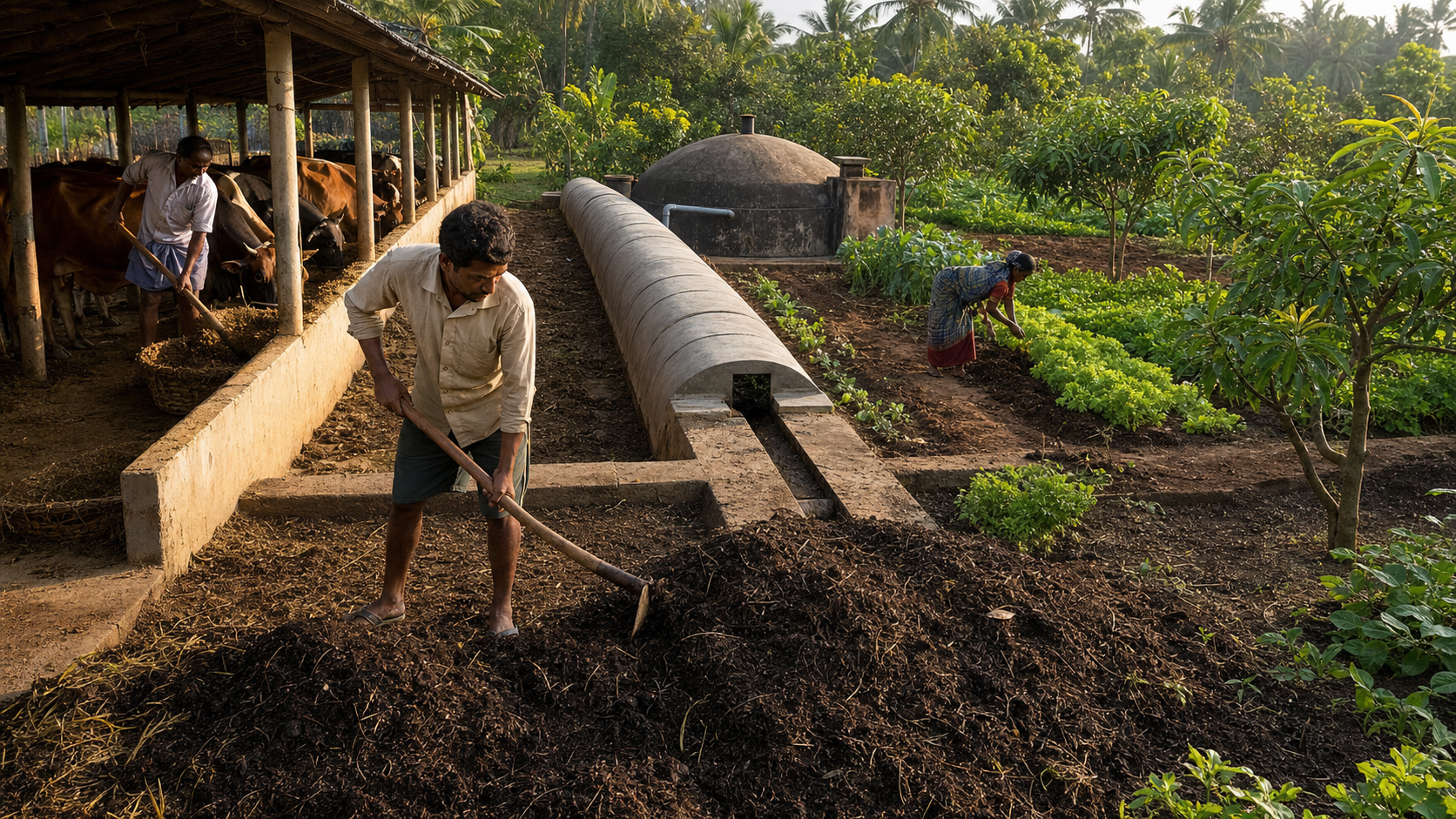
A typical adult indigenous animal can produce roughly 10-15 kg of fresh dung and several litres of urine in a day. Across a herd, that is a substantial daily flow. Whether it becomes an asset or a sanitation burden depends on collection, segregation, processing and quality control.
Choose the simplest pathway that matches your capacity and a real internal or external need:
- Farmyard manure: Establish reliable collection, curing and field application before attempting a large catalogue of products.
- Vermicompost or fortified compost: Add these only when staff can control feedstock, moisture, processing and maturity consistently.
- Liquid agricultural preparations: Panchagavya, jeevamrut and other bio-stimulant preparations need written formulations, identified batches, clean handling and field validation. Traditional standing does not remove the need to test agronomic performance and microbial safety.
- Biogas and digestate: A suitable digester can displace some purchased cooking fuel in a temple kitchen, while the nutrient-bearing digestate returns to the fields as a flowable fertilizer.
Do not launch every pathway at once. A single dependable compost operation is more useful than several inconsistent products whose costs, composition and buyers are unknown. Nor should agricultural uses of dung and urine be turned into unsupported human-health claims. Keep the purpose, evidence and applicable quality controls clear.
Give every batch a history
Use a batch record for composts, digestate and liquid preparations. At minimum, it should identify the feedstock, processing dates, operator, method, output quantity, intended field and any quality check. Keep plastic, stones, chemical wash water and other unsuitable material out of the collection stream. Periodic laboratory checks and controlled on-farm trials are especially important when a product will be sold or applied widely.
Soil tests should guide the combination of compost, digestate and any targeted mineral inputs. Organic material is not automatically balanced plant nutrition. Across successive seasons, well-managed organic inputs can improve soil structure, water-holding capacity and nutrient cycling while reducing dependence on synthetic inputs, but the farm should verify that direction through soil organic matter trends, crop performance and field observations.
Size biogas around dependable feedstock
Design a digester around dung that can actually be collected every day, not the nominal size of the herd. Stable operation depends on segregated feedstock, consistent substrate, suitable seasonal temperature management and a plan for digestate. Insulation may be needed for seasonal stability, while sound collection and housekeeping help control odor.
Gas handling and kitchen connections introduce fire and asphyxiation risks. Use qualified design and installation, maintain ventilation, and establish inspection and emergency procedures. Do not promise a fixed energy output from dung weight alone: moisture, temperature, digester design and operating consistency all affect performance. Record the dung fed, usable gas or commercial fuel displaced, downtime and digestate returned to fields. Those figures will show whether the installation is serving the temple-farm loop.
Use temple demand to stabilize farming, then measure the result
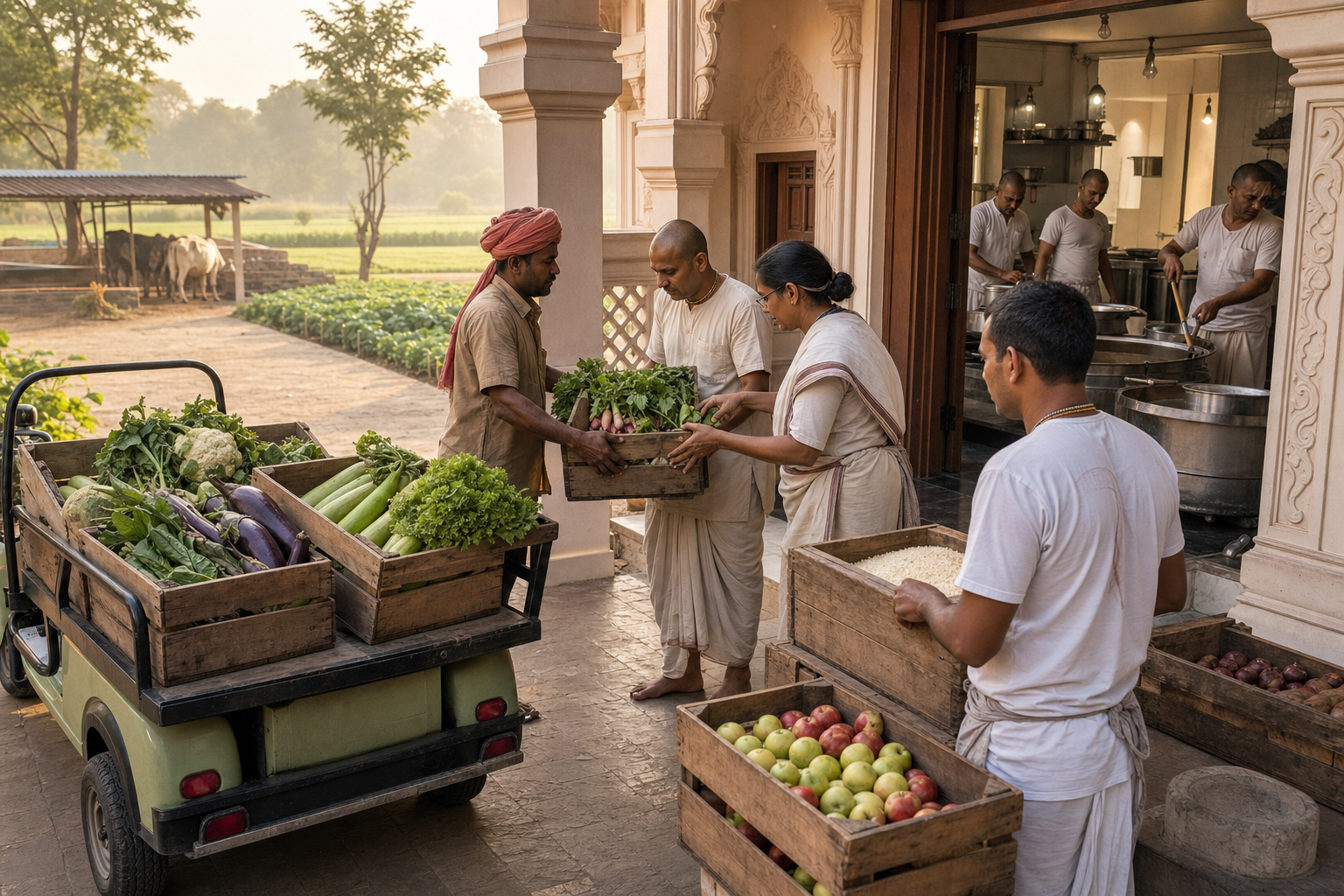
A temple kitchen can give an affiliated farm something many small producers lack: visible, recurring demand. That advantage disappears when the kitchen orders informally after harvest. Procurement must begin before planting, with the kitchen and farm agreeing on what can be grown, when it is needed and what quality will be accepted.
Create a farm-to-temple procurement cycle
- Translate menus into demand. The kitchen lists its normal and festival requirements by crop, season, acceptable grade, expected delivery pattern and storage limits.
- Test demand against the farm. The farm checks soil, water, planting windows, labor and climate risk before committing. A sacred purpose does not make an unsuitable crop agronomically suitable.
- Agree on standards before sowing. Document grading, pesticide-responsible practices, residue compliance where applicable, batch traceability, packaging, price and the procedure for rejected produce.
- Plan the handoff. Fix harvest communication, delivery windows and receiving responsibility. Add packhouse or basic cold-chain capacity only where the perishability and volume justify it.
- Record every delivery. The ledger should connect the field or supplying farmer, harvest batch, quantity offered, quantity accepted, rejection reason and kitchen destination.
- Adjust the next crop cycle. Use actual kitchen consumption, loss and fulfillment data instead of repeating the original estimate.
Responsible procurement does not require the kitchen to accept spoiled or nonconforming produce. It requires standards to be visible early enough for farmers to meet them. If one ISKCON farm cannot supply the required range or volume, a Farmer Producer Organization or a network of aligned farms can aggregate supply while preserving batch-wise traceability.
The same discipline supports dignified rural work. Youth can be trained in herd records, fodder planning and equipment operation. Women’s self-help groups can take defined roles in nursery raising, compost quality control, packaging and logistics. Give those roles written standards, training and payment; do not rely on the language of seva to conceal an unmanaged labor requirement.
Review one dashboard every month
The dashboard should be small enough to use and broad enough to expose trade-offs. Choose measures that lead to a decision:
| Area | What to track | What the result should change |
|---|---|---|
| Animal welfare | Mortality, mastitis incidence, health scores, calving interval and age at first calving where relevant | Veterinary review, housing, hygiene, ration or breeding decisions |
| Fodder and water | Available forage, conserved fodder, purchase exposure, spoilage and seasonal water demand | Planting, storage, herd-capacity and procurement decisions |
| Manure and soil | Dung collected, dung-to-compost conversion, batch quality and soil organic matter trend | Collection practice, processing controls and field application |
| Energy | Digester feed, downtime, cooking fuel displaced and digestate returned | Maintenance, operating practice and realistic savings forecasts |
| Temple procurement | Schedule fulfillment, accepted quantity, rejection reasons and post-harvest loss | Crop plan, standards, handling and delivery arrangements |
| Finance | Fodder, health, labor, utilities, infrastructure and compliance costs; product income and energy savings | Pricing, subsidy, investment and scale decisions |
Measures such as mortality, mastitis incidence, dung-to-compost efficiency, soil organic matter and fulfillment against temple schedules make compassion accountable without reducing it to a financial ratio. Set an owner and an expected response for every measure. A dashboard that produces no decision becomes a monthly ceremony.
Keep a short risk register beside it. Fodder-price spikes call for conserved reserves and pre-identified suppliers. Disease outbreaks call for biosecurity, an emergency veterinary network and rehearsed responsibilities. Climate extremes call for seasonal crop choices, water harvesting and scenario planning. Livestock insurance may reduce exposure where suitable coverage is available, but it does not replace prevention.
Be equally conservative with projected environmental-service income. Soil improvement, avoided fuel use and other environmental gains may become valuable, but revenue should not enter the core budget until the monitoring method, eligibility and buyer are verifiable. The animals must not depend on speculative credits or future schemes for their present care.
Start with one complete operating cycle
- Appoint one accountable coordinator and named owners for animal care, farming, processing, kitchen procurement and accounts.
- Baseline the herd, fodder, water, housing, health events, dung flow, kitchen demand and current costs.
- Select one farm-to-kitchen supply line and one manure pathway that already have a clear user.
- Write the welfare, production, quality, delivery and record-keeping procedures before spending on additional equipment.
- Run the crop and procurement cycle, reviewing the shared dashboard every month.
- Expand only after animal care, product quality, delivery reliability and cash flow remain stable together.
Your next move is a working meeting, not a larger vision statement. Put the one-page temple-farm-goshala loop on the table. Name the owner of each handoff, choose the first crop and byproduct pathway, and set the first monthly review date. That is where go-raksha moves from sincere intention to a durable institution.
References
