
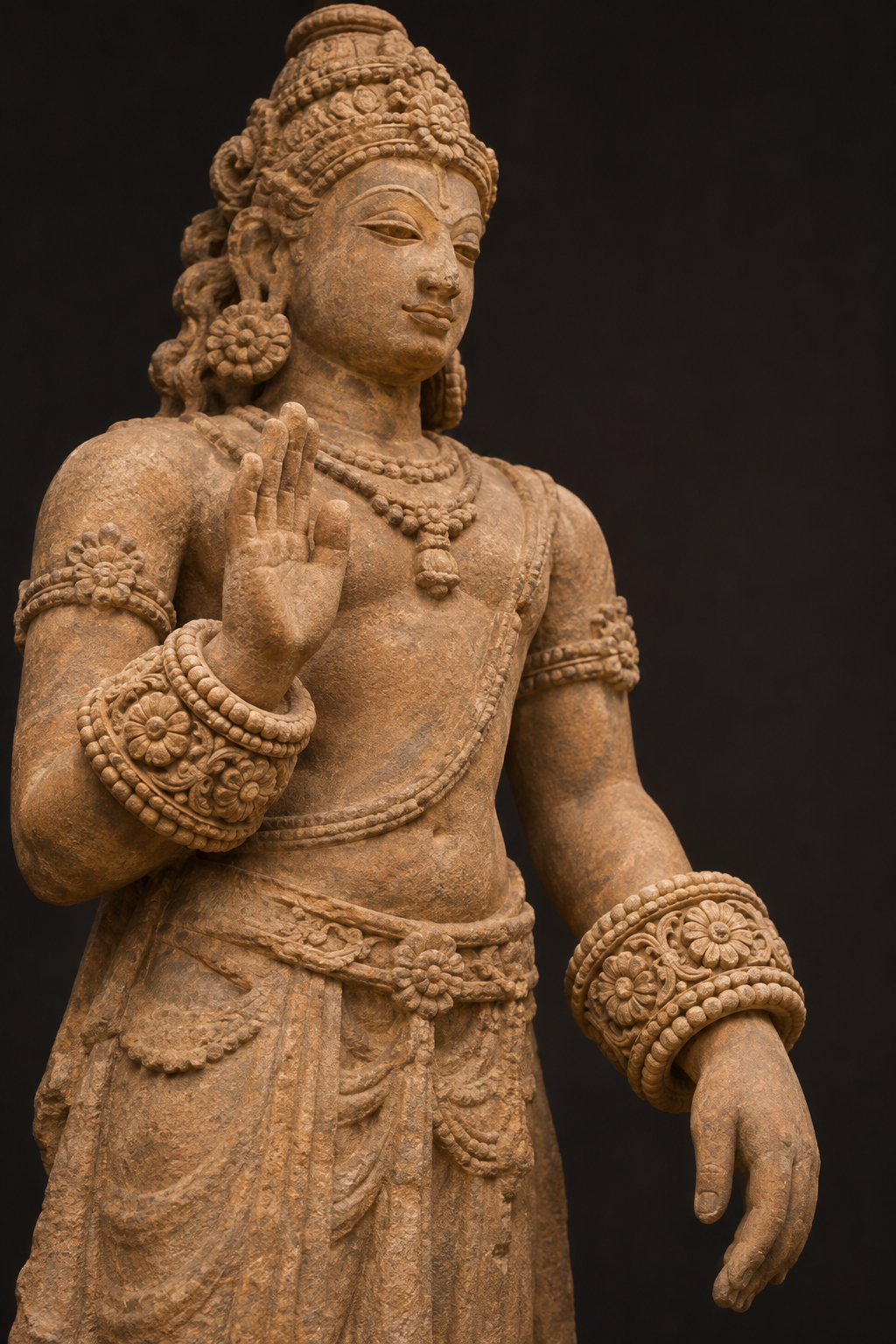
You are standing before a murti, a museum display, or a photograph of a temple sculpture. The figure wears several ornaments, and the band at the wrist looks important – but is it a kataka, an ordinary bracelet, or the finer ornament called a kankana?
The answer begins with proportion, placement, and visual emphasis. Once you learn to check those three things, you can identify a probable kataka without inventing a symbolic meaning that the image itself does not support.
Identify the kataka by placement and visual weight
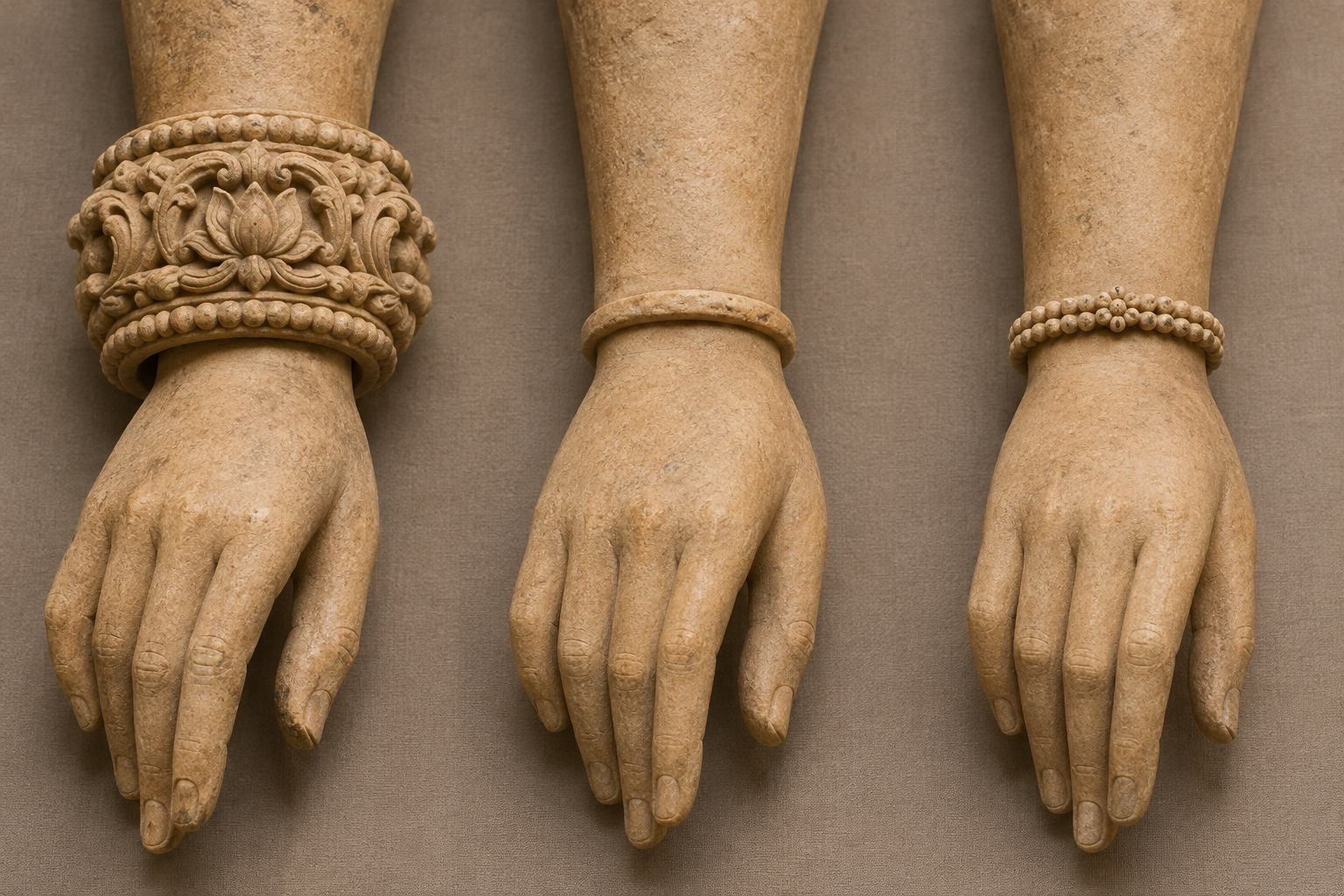
A kataka is a substantial ornament worn around the wrist. It is broader and more prominent than the kankana, its comparatively delicate counterpart. That relative distinction is more useful than trying to impose a universal measurement on sculptures of different sizes and styles.
Start with anatomy, not decoration. Find the point where the forearm narrows and the hand begins. An ornament encircling that junction is a candidate. A band higher on the arm belongs to a different part of the figure’s ornamentation, while a form extending into the palm may be part of a held object or another sculptural detail.
- Locate the wrist before deciding what the band represents. Follow the forearm toward the hand and identify the joint.
- Compare the band’s breadth with other bracelets on the figure. A kataka should read as substantial rather than fine or thread-like.
- Check its prominence. Strong projection, a broad carved surface, or a clearly defined boundary can give the ornament the visual weight associated with a kataka.
- Trace as much of the band as the viewing angle permits. Confirm that it belongs to the wrist rather than to a nearby attribute, garment edge, or damaged contour.
- Record your confidence. Use “kataka” when the evidence is clear, “probable kataka” when placement and proportion fit but the carving is worn, and “wrist ornament” when the distinction cannot be made responsibly.
The fourth and fifth steps matter in photographs. A frontal image can flatten depth, shadows can create a false border, and damage can make a broad ornament appear narrow. A cautious label is more accurate than a confident guess.
Read the ornament together with the hand
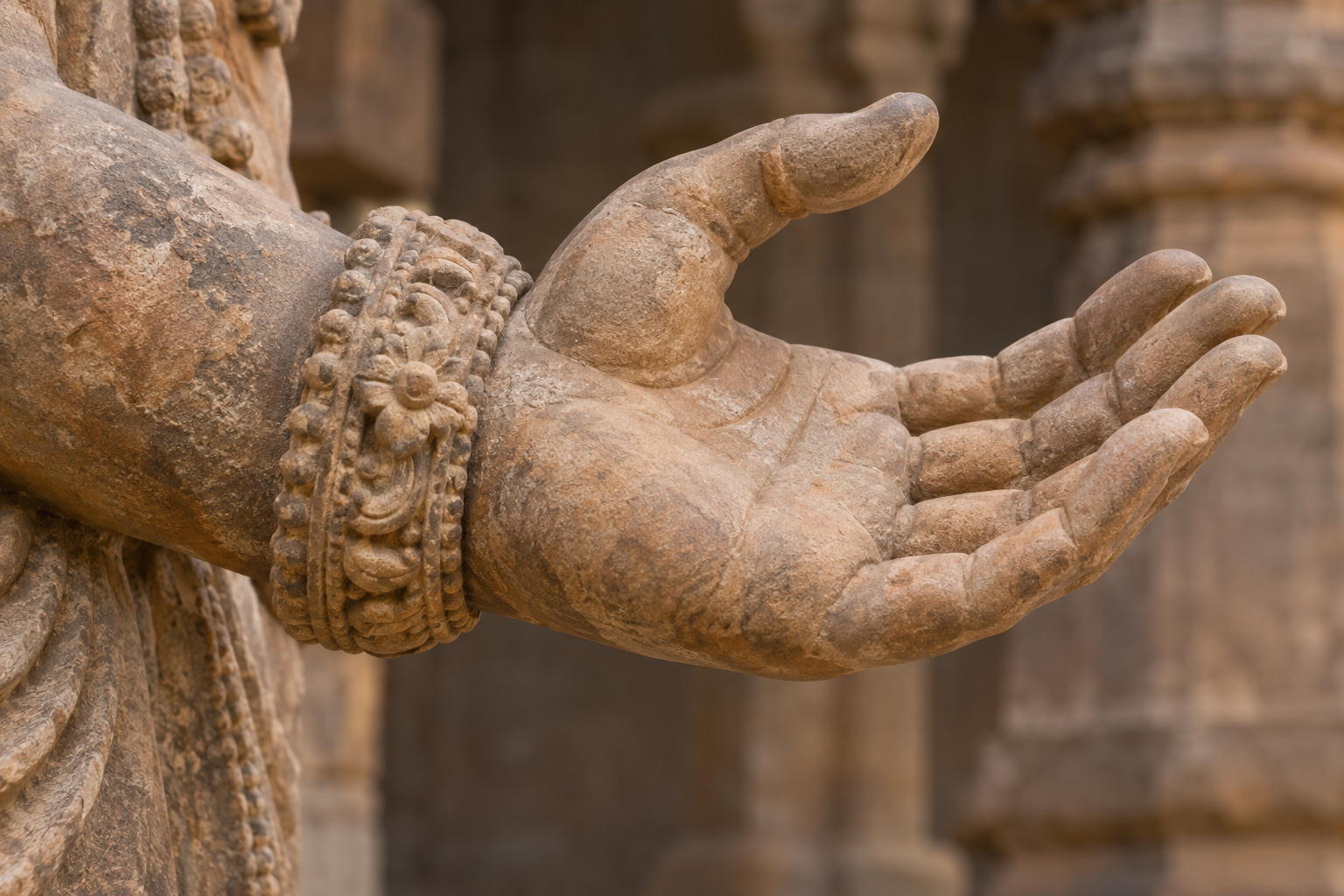
The wrist is the transition between the arm and the expressive hand. A broad ornament can make that transition visually emphatic. It may frame a gesture, mark the direction of an extended arm, or draw your eye toward an object held by the figure. This compositional effect is visible even when the kataka’s wider symbolic significance remains uncertain.
Look immediately beyond the ornament. Is the hand open, lowered, raised, or closed around an attribute? If it forms a recognisable gesture such as Abhaya Mudra, note that gesture separately. The kataka adorns and visually punctuates the wrist; it should not be mistaken for the gesture itself or treated as proof of the gesture’s meaning.
Then compare the two arms. Matching ornaments may contribute to balance. A more prominent ornament on one visible wrist may strengthen the emphasis already created by that arm’s position. Apparent asymmetry, however, can also result from loss, erosion, obstruction, or an incomplete photograph. Inspect before interpreting.
This is where the distinction from a kankana becomes practical. A delicate band tends to recede into the larger ornamental scheme. A kataka carries greater visual weight. Ask which description fits what the carving actually does to your eye, rather than which modern jewellery name the object resembles.
Interpret symbolism without forcing a fixed meaning
Sacred ornament deserves serious attention, but seriousness is not the same as assigning a universal code to every carved band. The presence of a kataka does not, by itself, establish one exclusive theological meaning. Its significance must be read with the identity, posture, gesture, attributes, and complete ornamental programme of the figure.
A disciplined interpretation moves through three levels:
- Description: State what is materially visible – a broad, prominent band around the wrist.
- Visual function: Explain what it does in the composition – for example, giving weight to the wrist or directing attention toward the hand.
- Contextual meaning: Consider what the ornament may contribute when read with the figure’s identity and action. Mark this as interpretation unless the surrounding context makes it explicit.
This sequence prevents a common error: moving directly from “ornament” to “symbol” without showing the evidence between them. A defensible description might say, “The prominent wrist ornament gives visual weight to the extended arm and helps frame the hand.” A stronger claim about divine authority, protection, power, status, or a particular doctrine would require further contextual support.
Ask five questions before attaching a symbolic reading:
- Who is the figure, and is that identification secure?
- What is the adjoining hand doing?
- Does the ornament appear on both wrists or only one?
- How does its scale compare with the figure’s other ornaments?
- Could damage, restoration, lighting, or the viewing angle be shaping what you see?
If those questions cannot be answered, remain at the descriptive level. “Broad wrist ornament, possibly a kataka” preserves useful information. An unsupported symbolic claim obscures it.
Use a repeatable method in temples, museums, and photographs
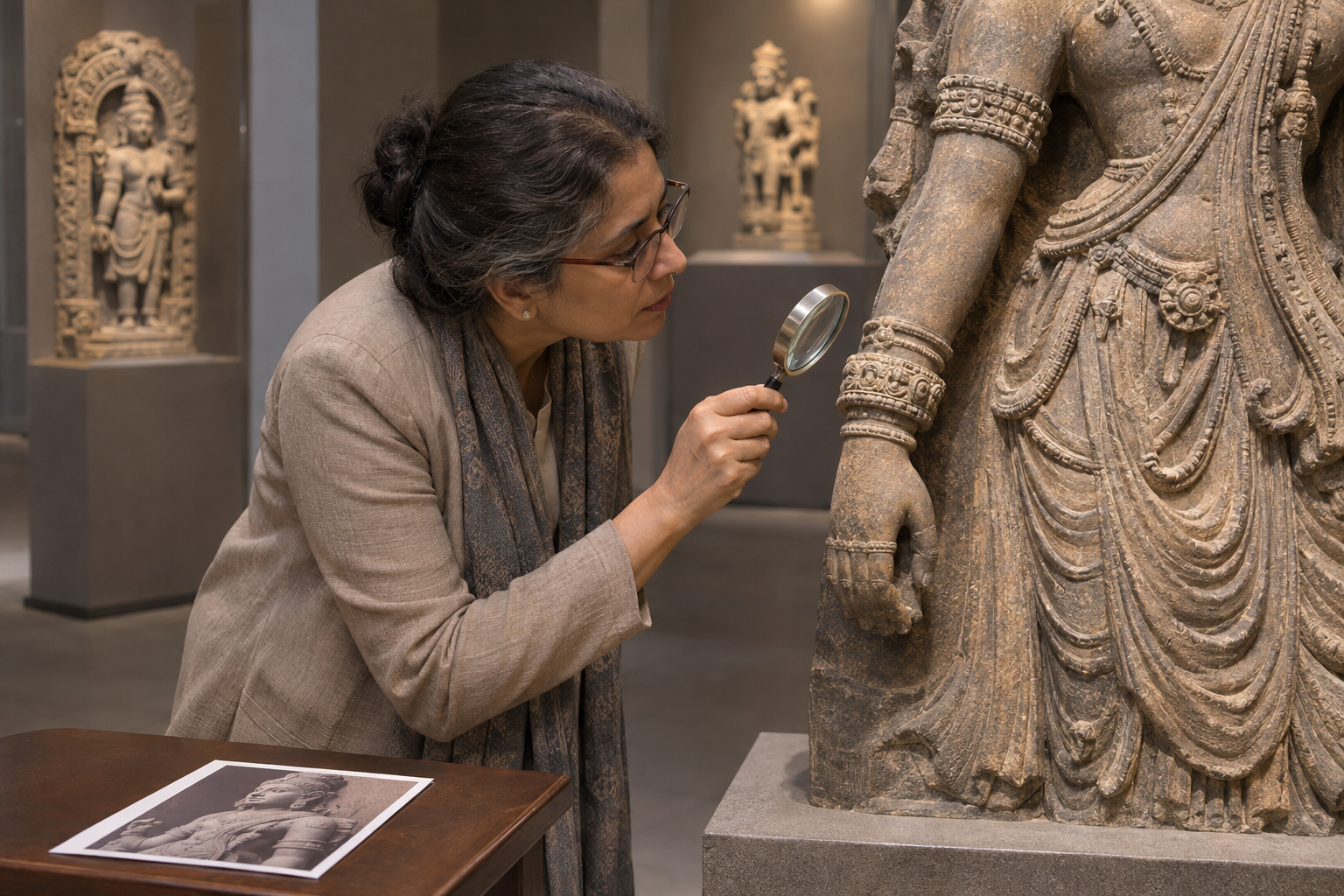
You can turn a casual observation into a reliable record with a short field method. It works whether you are examining a sculpture directly or studying a digital image.
- Begin with the complete figure. Note the identity given by the temple or museum, the pose, and the visible attributes. Do not crop your attention to the bracelet too early.
- Inspect both wrists. Record whether each is visible, obscured, damaged, or differently ornamented.
- Describe before naming. Write down placement, relative breadth, projection, surface detail, and condition. Only then decide whether “kataka,” “kankana,” or the neutral “wrist ornament” is justified.
- Connect the wrist to the hand. Note the hand’s direction, gesture, or held object. Keep the observation distinct from its possible interpretation.
- Capture more than one view when permitted. A side or oblique view can reveal breadth and projection that disappear in a frontal photograph.
- Preserve the context. Record the image caption, object label, location, or page URL. A close-up without its parent figure is much harder to interpret responsibly.
A compact note can follow this pattern: “Right wrist: broad, prominent encircling band; probable kataka. Left wrist: obscured. Right hand: raised and open. Surface worn; symbolic interpretation not attempted.” That entry separates observation, identification, condition, and restraint. Another reader can understand exactly how you reached the label.
For a photograph, retain one full-figure frame and one wrist detail. Include a scale reference only where the site or collection permits it, and never touch a sacred image or protected object to obtain a measurement. Relative breadth within the sculpture is usually the more relevant evidence for distinguishing a substantial kataka from a finer kankana.
Key takeaways for recognising a kataka
- A kataka belongs at the wrist and should appear substantial and visually prominent.
- A kankana is the finer, more delicate comparison; use relative proportion rather than an invented universal measurement.
- Read the ornament with the adjoining hand, gesture, and attribute, not in isolation.
- Separate what you see from what you think it means. Description comes first; contextual interpretation comes last.
- When damage or angle prevents certainty, label the object as a probable kataka or simply a wrist ornament.
The next time you examine a Hindu sculpture, begin at the wrist joint and work outward: band, hand, arm, figure, context. That small change in viewing order will help you recognise the kataka while keeping the sacred image – rather than a modern guess – at the centre of your reading.
References

Leave a Reply
You must be logged in to post a comment.