
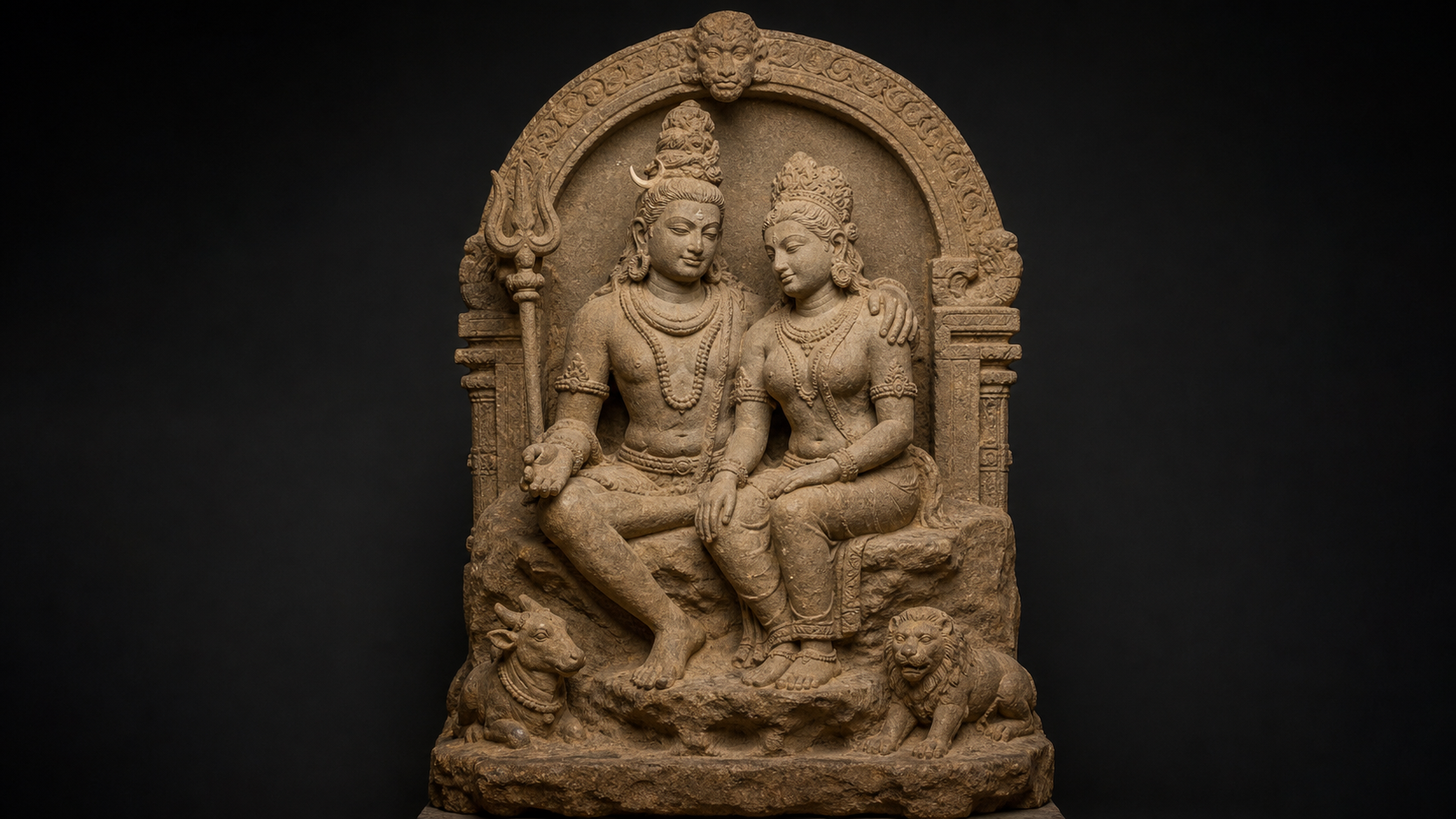
You are looking at a sculpture of Shiva and Parvati seated close together. An arm crosses a shoulder, their bodies incline toward one another, and the space between them nearly disappears. Is this divine romance, a marriage scene, an auspicious decoration, or a statement about the nature of reality?
A reliable answer begins with what the sculpture actually shows: its setting, the identities of the figures, the direction of their touch, the hands that remain free, and the companions around them. Once you learn that sequence, you can distinguish Uma-Maheshvara from a wedding, a divine family, or a mithuna couple without reducing sacred intimacy either to erotic display or to an abstract philosophical formula.
The embrace holds distinction and unity together
The embrace is often described as Āliṅgana Mudrā. Āliṅgana conveys holding close or enfolding, while mudrā means a sign or seal. In this setting, the mudrā is not merely a configuration of fingers. The bodily relationship between the figures becomes the sign. This is why it should not be confused with a stand-alone yogic hand exercise bearing a similar name.
In Uma-Maheshvara imagery, Shiva and Uma or Parvati remain visibly distinct, yet their postures and touch make separation impossible to treat as the final truth. A common Shaiva reading sees Shiva as consciousness and Shakti as the power through which manifestation becomes possible. The related language of Purusha and Prakriti expresses the same structural insight within this iconographic context: stillness and activity are distinguishable, but the living cosmos cannot be understood by isolating one from the other.
That distinction-in-unity is carried by details rather than by a written proposition. The goddess is typically placed at Shiva’s left, the vāmāṅga associated with her place beside and within the divine whole. One figure may encircle the other, rest a hand lightly on a torso, or lean inward without losing an independent outline. Their nearness communicates union; the survival of two clear forms communicates difference. If you notice only the embrace, you miss the distinction. If you notice only two separate deities, you miss the union.
The free hands are equally important. Shiva may hold Parvati while extending abhaya, the assurance of protection, or varada, the gesture of generosity, toward the devotee. The composition therefore moves in two directions at once. Divine affection turns inward between the couple, while grace turns outward toward you. The embrace is not a private scene from which the worshipper has been excluded. It becomes the ground of public reassurance.
Agamic and śilpa traditions, including the Manasāra, Mayamata, Śilparatna, and regional temple manuals, organize such images through proportion, measured modules, posture, gesture, and ornament. Pramāṇa and tāla prevent intimacy from becoming visually careless. Tribhaṅga can give the bodies a gently bending rhythm; samabhaṅga can establish quiet balance. Kataka or kapittha hands may accompany a lotus or mirror. No single feature proves the identification, but their coordination reveals that tenderness has been composed with ritual discipline.
This coordination also prevents you from forcing the image into one emotional category. Śrṛṅgāra, the rasa of love and attraction, may be present alongside karuṇā, compassion, and vātsalya, parental or sheltering tenderness. Sacred sculpture does not have to choose between beauty, affection, protection, and metaphysics. Its power lies in making them visible together.
Read the sculpture in a fixed sequence
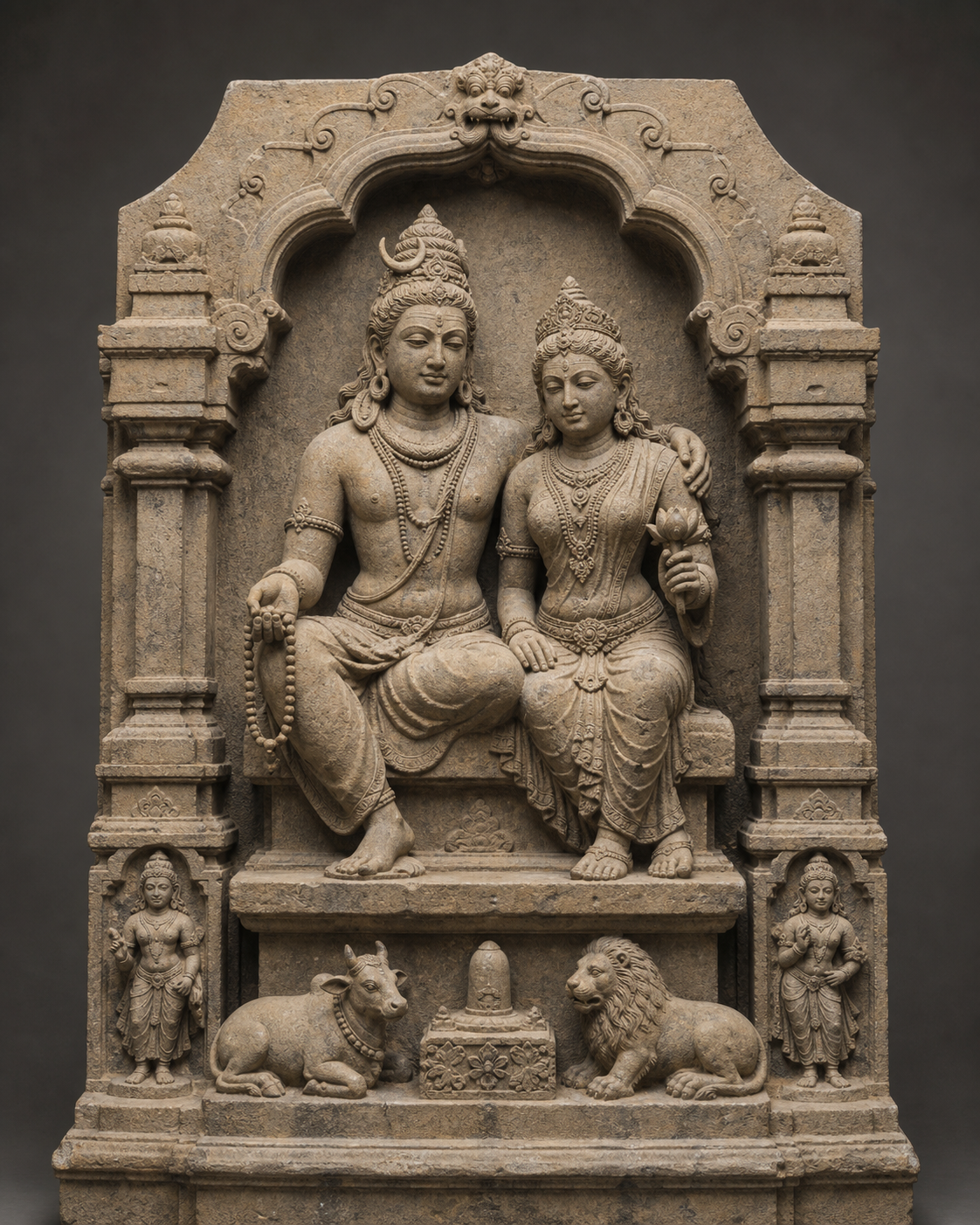
Interpretation becomes more dependable when you postpone the grand meaning until after a careful visual inventory. Use the following sequence in a temple, museum, photograph, or catalogue.
- Locate the image within its architectural setting. A divine pair occupying a shrine, major niche, doorway, or central panel is doing a different job from a small couple woven into an outer-wall procession. Placement is evidence, not background scenery.
- Identify an ensemble rather than a single attractive feature. Look for Shiva and Parvati together with attributes, attendants, vāhanas, or other framing motifs. An embrace alone does not establish that every coupled figure is Uma-Maheshvara.
- Orient yourself from the deity’s body. When checking the convention of the goddess at Shiva’s left, use Shiva’s own left rather than automatically treating your left as you face the image as the iconographic left. Then see whether the rest of the composition supports the identification.
- Trace the direction and quality of touch. An arm may encircle a shoulder, rest on the torso, or draw the figures into measured proximity. Notice whether the contact looks reciprocal and balanced. The narrow interval between two bodies can communicate union as clearly as the touching hands.
- Read every hand that is not part of the embrace. Abhaya or varada turns the couple toward the devotee. A lotus, mirror, or related object held in kataka or kapittha adds identity and mood. Do not let the most emotionally striking arm make the other hands invisible.
- Study posture, gaze, and surrounding figures together. A serene vertical stance, a three-bend rhythm, a shared glance, a child, or a marriage action can change the subject. Decide what scene you are seeing before deciding what doctrine it expresses.
After completing that sequence, describe the image in one literal sentence. You might have a seated Shiva and Parvati in reciprocal contact, with the goddess at the divine left, an outward-facing protective hand, and attendants framing the pair. Only then add the theological reading. This small discipline keeps interpretation answerable to the sculpture instead of using the sculpture as a blank surface for whatever idea you brought with you.
Do not confuse embrace, marriage, family, and mithuna
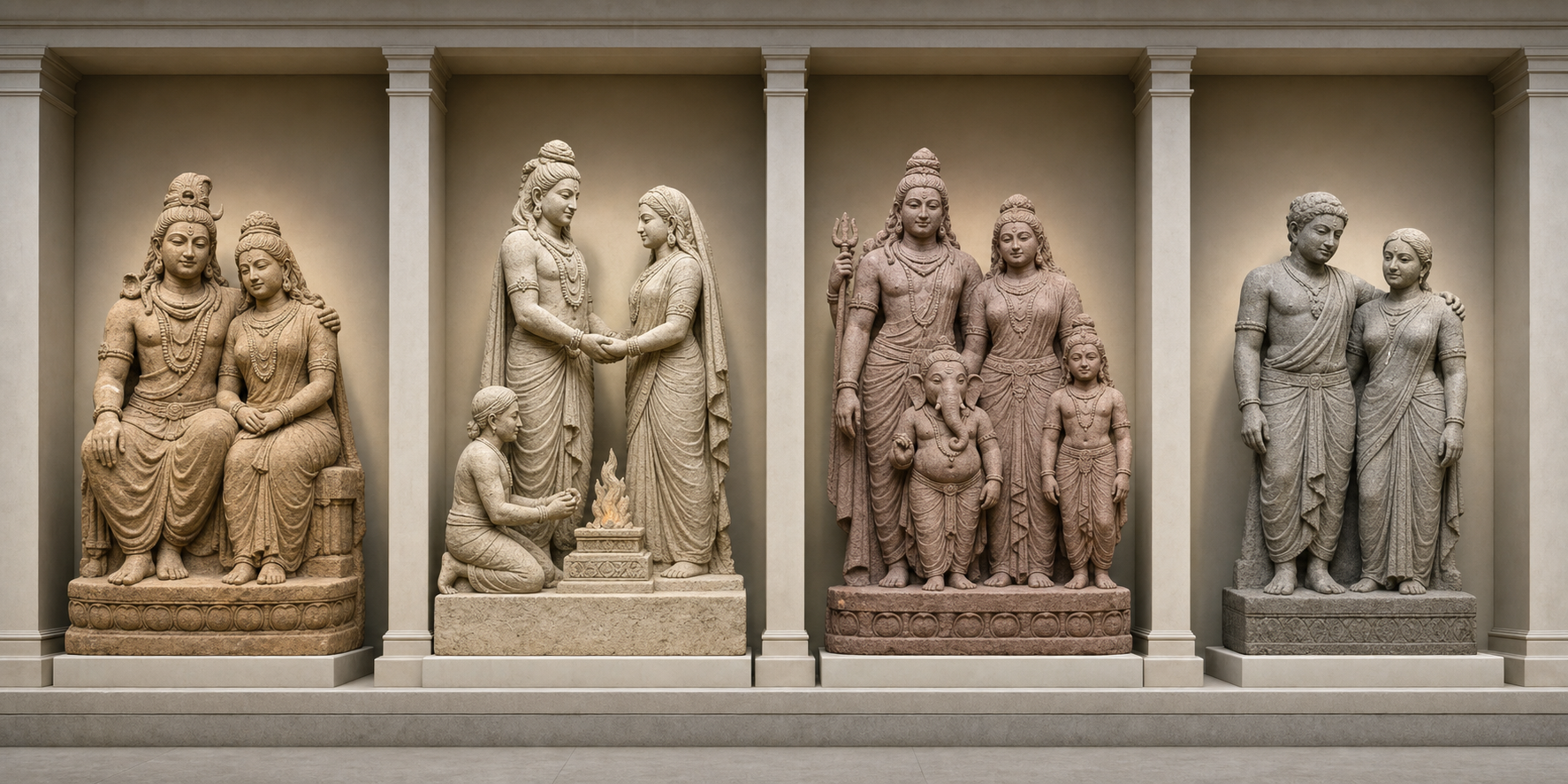
Several sacred subjects place male and female figures close together. The quickest way to misread them is to treat intimacy as the subject rather than as one clue within the subject. Ask what action is taking place, who else is present, and where the image has been installed.
| Iconographic subject | Primary visual clue | What the composition emphasizes | Your identification check |
|---|---|---|---|
| Uma-Maheshvara | Shiva and Parvati seated or standing in gentle, often reciprocal contact | Divine nearness, complementary power, protection, and auspicious unity | Look for the embrace together with the goddess at Shiva’s left, benedictory hands, attributes, attendants, or vāhanas |
| Kalyāṇasundara | The formal marriage moment, especially pāṇigrahaṇa or taking the hand | The sacred rite that joins Shiva and Parvati | Identify a ceremonial hand-taking action rather than assuming that every contact is a full embrace |
| Somāskanda | Shiva and Uma appear with Skanda | The divine household and familial presence | Let the child determine the subject instead of treating Skanda as a minor attendant |
| Mithuna | An auspicious couple, often integrated into an outer temple wall or larger decorative sequence | Fertility, prosperity, beauty, and maṅgala | Use architectural placement and the absence of deity-specific identifiers before naming the pair Shiva and Parvati |
Mithuna figures require particular care because their sensuousness is sometimes detached from the temple program and judged as an isolated spectacle. On the outer walls of a sacred structure, the couple may participate in a larger ecology of abundance, protection, fertility, and well-being. The body is not automatically opposed to transcendence. Within Dharmic architecture, embodied beauty can become one of the means by which cosmic order is affirmed.
The opposite error is possible too. Not every affectionate pair is automatically a metaphysical diagram of non-duality. First establish whether you are seeing Shiva and Shakti, a marriage, a family, or an auspicious human couple. An erotic-only reading is too small because it ignores ritual and theology. A metaphysics-only reading can be just as small because it refuses to see the tenderness, attraction, and embodied grace the sculptor deliberately preserved.
Let region and material change the accent
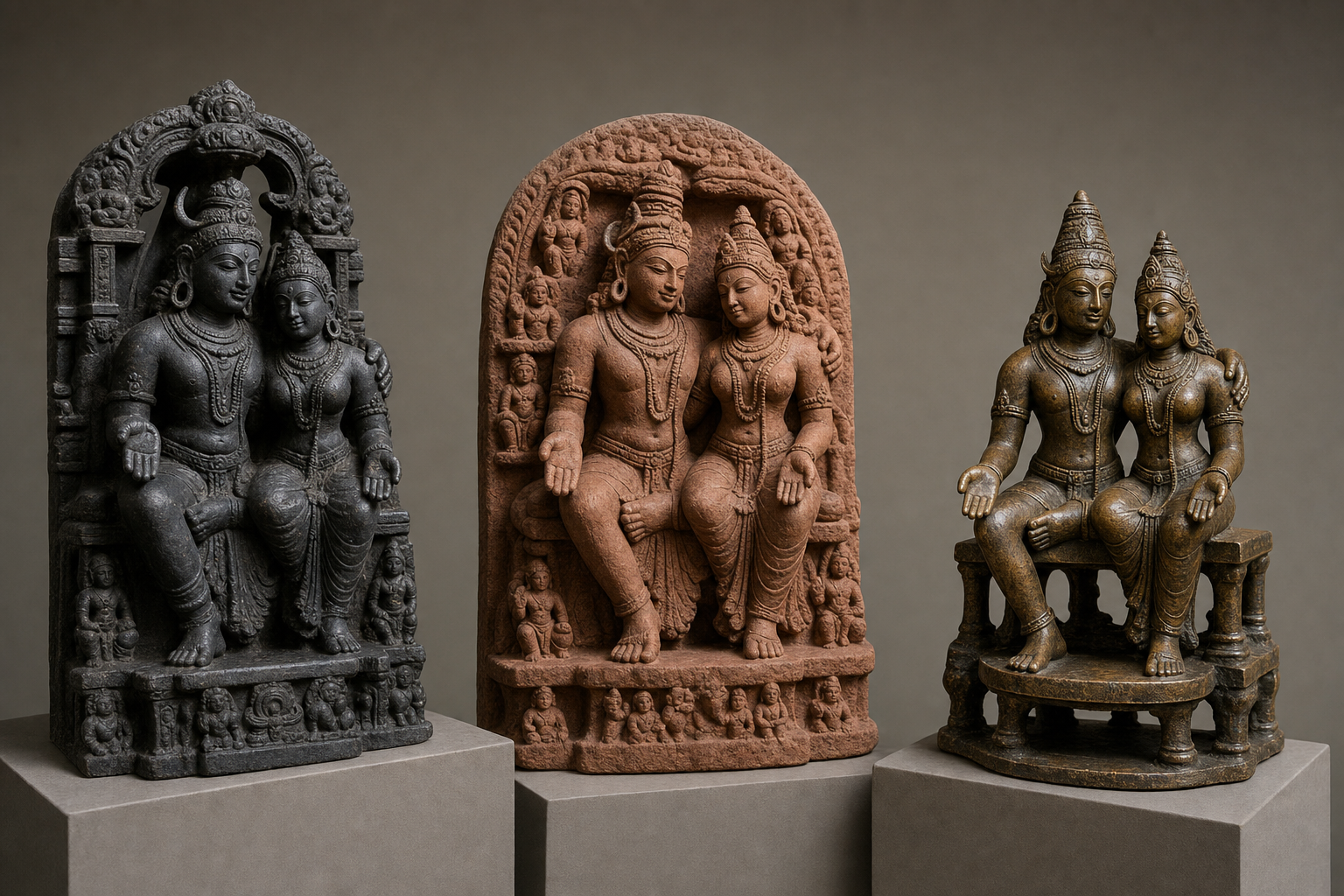
The underlying grammar remains recognizable across Chola metalwork, Nepal Valley reliefs, Kalinga temples, and Hoysala soapstone sculpture, but each tradition directs your attention differently. Do not expect a bronze, a doorway panel, an outer-wall couple, and an intricately carved narrative surface to communicate through identical visual means.
Chola bronzes: begin with silhouette and interval
Chola bronzes from Tamil Nadu, especially those of roughly the ninth through thirteenth centuries, use the lost-wax process to create fluid bodies, lucid outlines, and subtly turning torsos. Start by viewing the pair as a single silhouette. Then look at the carefully controlled gaps between arms, waists, and shoulders. The metal can make Shiva and Uma appear rhythmically continuous without erasing the identity of either figure. Ornament matters, but the line of the whole composition usually tells you about their relationship before any individual jewel does.
Nepal Valley reliefs: treat the threshold as part of the image
Uma-Maheshvara panels from the Licchavi and Malla periods often appear above doorways and shrines. That location is not incidental. The embracing pair presides over passage, placing entry into a household or sacred space beneath an image of auspicious unity. Fine carving can give jewelry and drapery crisp definition while the faces remain publicly serene. When you encounter such a relief, widen your field of view. Ask what boundary lies below it and what kind of passage the divine couple is marking.
Kalinga temples: read the couple as part of a wall rhythm
At the Kalinga temples of Odisha, including those associated with Bhubaneswar and Konark, mithuna couples are woven into architectural zones such as the jangha and bhadra projections. Their movement, sensuality, and abundance participate in the rhythm of the façade. If a museum photograph crops one couple from the wall, mentally restore the surrounding sequence before interpreting it. The Śilpa Prakāśa’s concern with auspicious temple imagery helps explain why fertility and beauty belong within, rather than outside, the sacred program.
Hoysala soapstone: alternate between distance and detail
At Belur and Halebidu, fine-grained soapstone permits dense jewelry, complex bends, lively attendants, and layered narrative detail. Stand back first and find the principal couple’s posture and line of contact. Move closer only after you know where the compositional center lies. Otherwise the virtuosity of a bracelet, garment edge, or minor figure can overwhelm the relationship that organizes the scene. The surrounding figures often amplify the central rasa rather than merely filling unused stone.
Regional difference should sharpen recognition, not become a ranking of refinement. A restrained bronze interval, a threshold relief, a festive wall couple, and a crowded soapstone tableau can all express sacred concord. Material and location determine which visual instrument carries the meaning.
Keep devotion, comparison, and museum context in proportion
In a living temple, the sculpture is not only an object awaiting classification. It belongs to ritual space and darśan. Iconographic knowledge should deepen attention rather than turn the encounter into a hunt for labels. Notice how the image can hold power without aggression and intimacy without possession. The arm around the goddess shelters but does not visually erase her; the hand facing the devotee gives while the couple remains united. That is an ethical as well as a metaphysical pattern.
In a museum, where architecture, worship, and accompanying images may have been removed, a responsible label should supply at least the missing essentials: the name Uma-Maheshvara where the identification is secure, the region and material, the goddess’s placement, the meaning of prominent hastas, and the probable architectural or ritual setting. A label that says only divine couple or erotic scene withholds the information needed to understand the work. One that says only symbol of non-duality can conceal its aesthetic and devotional dimensions.
Compare Dharmic traditions without making them interchangeable
Other Dharmic traditions also use the language of union, but resemblance does not make the images or doctrines identical. Vajrayāna Buddhist yab-yum imagery joins method or compassionate means, upāya, with wisdom, prajñā. That offers a meaningful structural parallel to Shiva-Shakti complementarity, yet it must be interpreted through its own Buddhist contemplative setting rather than renamed as a Shaiva embrace.
Jaina temple programs can place auspicious mithuna figures at the periphery while maintaining the ascetic stillness of the Jina at the sacred center. The contrast is part of the temple’s meaning: worldly prosperity and protective auspiciousness remain visible without displacing liberation as the sanctum’s governing aim. Read the location before assuming that every coupled figure expresses the theology of the central icon.
Sikh teachings carry the metaphor of the soul-bride and the Divine Groom toward the experience of unity with Ik Onkar, although a figural embrace is not the central artistic vehicle. The comparison is therefore strongest at the level of devotional longing and union, not sculptural form. Keeping these boundaries clear allows shared Dharmic aspirations to become visible without flattening Hindu, Buddhist, Jaina, and Sikh traditions into one undifferentiated system.
Key takeaways
- Begin with architectural setting, identities, posture, touch, free hands, and surrounding figures; interpret the theology afterward.
- In Uma-Maheshvara imagery, reciprocal nearness, the goddess at Shiva’s left, and an outward-facing abhaya or varada hand often work together.
- Kalyāṇasundara centers the marriage action, Somāskanda includes Skanda, and mithuna couples often serve auspicious architectural functions.
- Read material and location as evidence: bronze silhouette, threshold placement, wall rhythm, and soapstone detail lead the eye in different ways.
- Use parallels with Vajrayāna, Jaina, or Sikh traditions to illuminate a shared concern with union, never to erase doctrinal and artistic differences.
When you next encounter a Shiva-Shakti embrace, resist the urge to name its meaning immediately. Describe what the bodies, hands, setting, and surrounding figures are doing. Then test whether your interpretation accounts for all of them. That shift from quick recognition to disciplined attention is how a beautiful couple becomes legible as sacred sculpture.
References
