
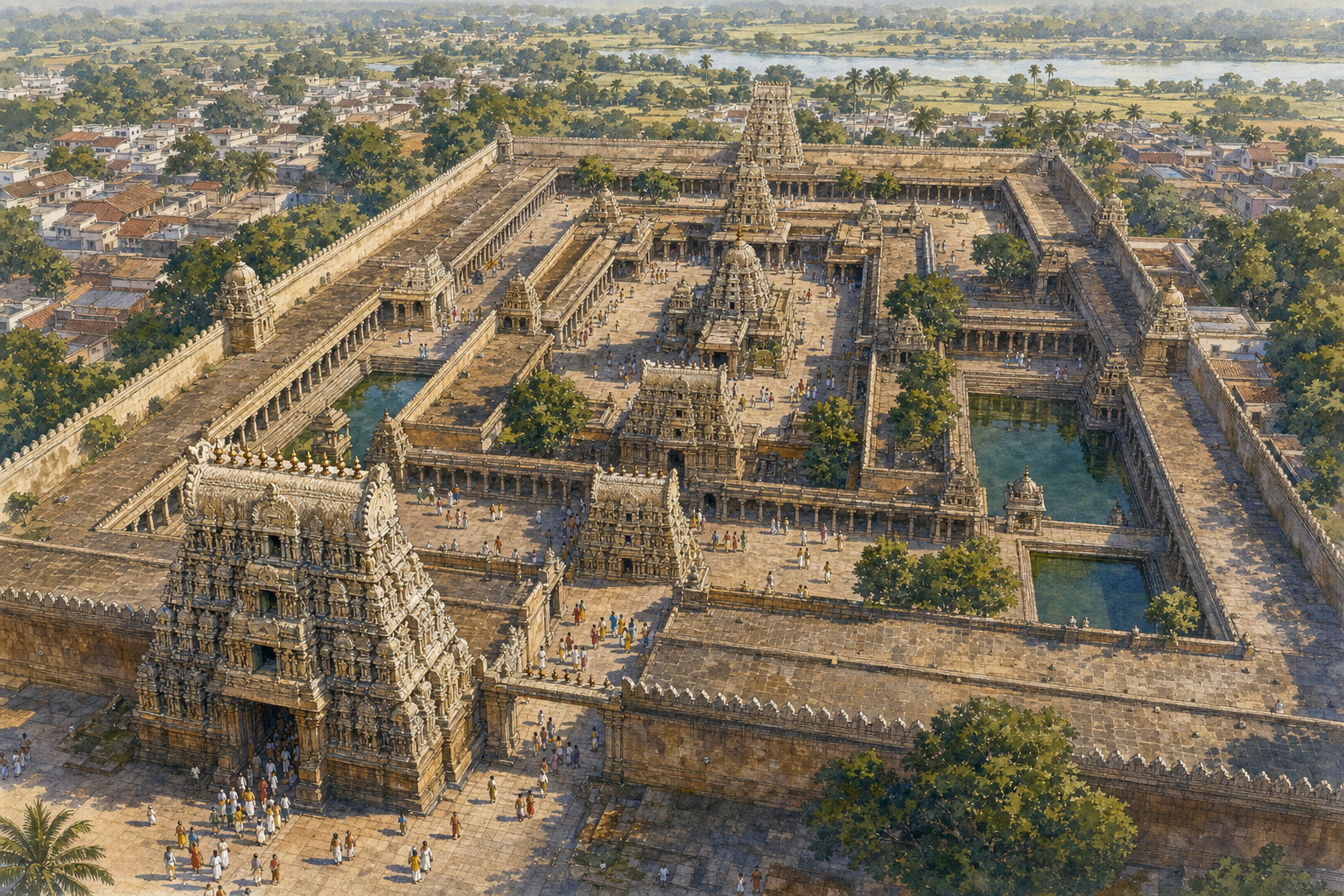
You may pass beneath a monumental gopuram, see the sanctum somewhere ahead, and wonder why the route still leads through walls, courts and long corridors. Those intervening spaces are not architectural delay. They are part of the preparation for darshan.
If you learn to read the prakara, a temple visit changes. You begin to notice where ordinary movement gives way to ritual movement, why a gateway narrows your attention, and how each circuit relates you to the sacred centre. This is a practical way to understand the temple as a journey through ordered space, rather than as a collection of impressive buildings.
First identify what the prakara includes
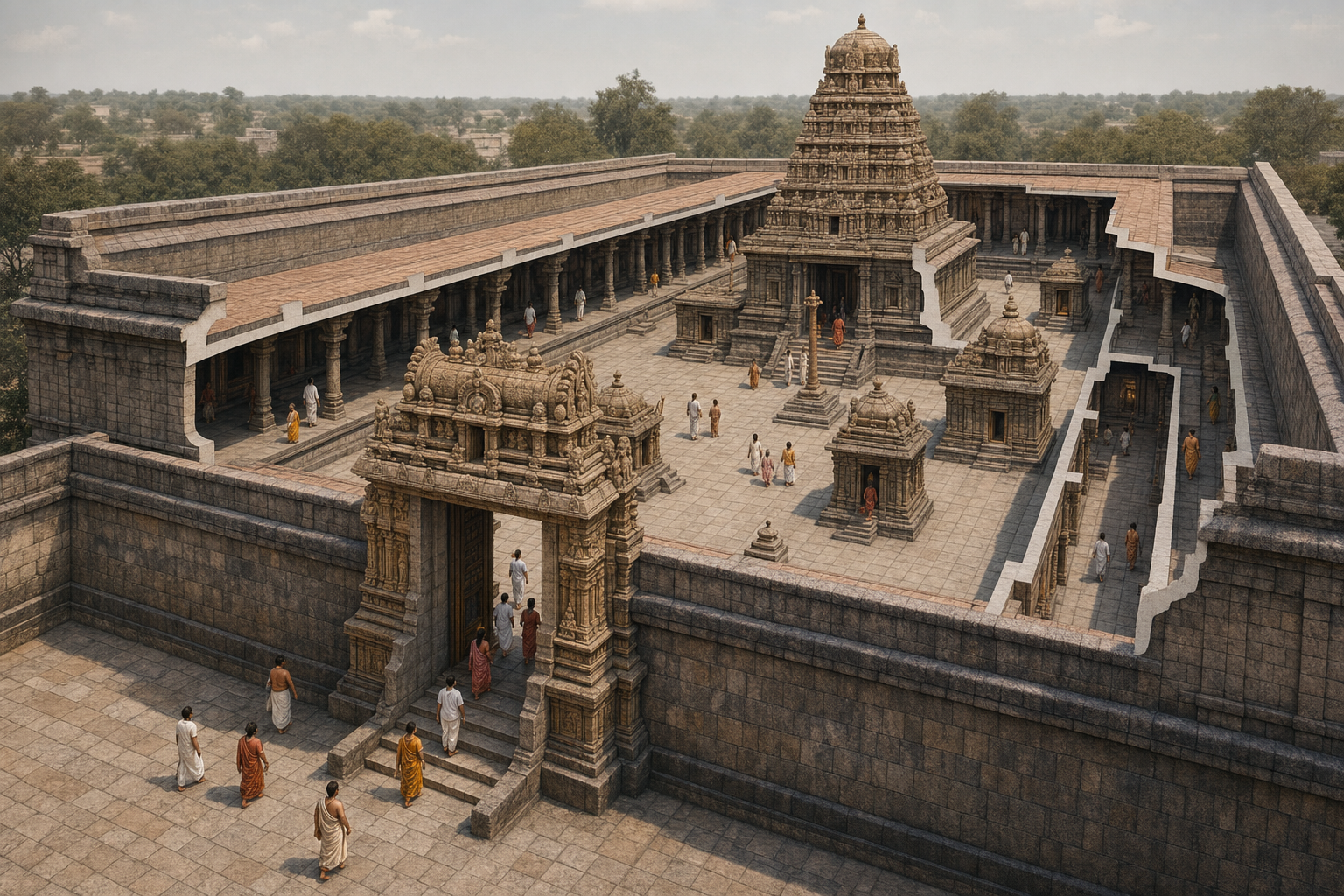
In its clearest architectural sense, a prakara is an enclosure around a Hindu temple or one of its inner sacred zones. It may include a substantial perimeter wall, gateways through that wall, and a passage or court used for circulation. In a large complex, several such enclosures can stand one inside another.
The vocabulary shifts with region and context. In Tamil usage, prakaram or praharam can refer to the enclosed precinct as well as its circumambulatory corridor; the wall itself may be called a madil. This explains why one person may point to the masonry boundary while another uses the same term for the route beside it. They are describing connected parts of one spatial system.
- The prakara is not the gopuram. The prakara establishes the enclosure; the gopuram monumentalises an entrance through it.
- The prakara is not simply a mandapa. A mandapa is a pillared hall with a particular ritual or congregational role. Mandapas can join a prakara corridor or stand within its court, but the terms are not interchangeable.
- The prakara is more than a property wall. Even when it provides security, its position, gates and paths organise sacred movement.
- The prakara need not be a roofed corridor. Depending on the temple, the route may be open to the sky, shaded by a cloister, bordered by pillars or spread across a broad court.
When the layout is unfamiliar, apply three tests. Ask whether the feature marks the edge of a consecrated zone, whether a controlled gateway pierces it, and whether movement is organised along or within it. If all three are present, you are probably looking at a prakara system rather than an incidental boundary.
Also resist the habit of measuring a temple’s importance by the number of its walls. Concentric prakaras are especially prominent in large Dravidian complexes, while many Nagara and Kalinga temples use fewer and more compact enclosures. The architectural form changes; the underlying act of distinguishing sacred ground remains.
The boundary changes how you see, move and prepare
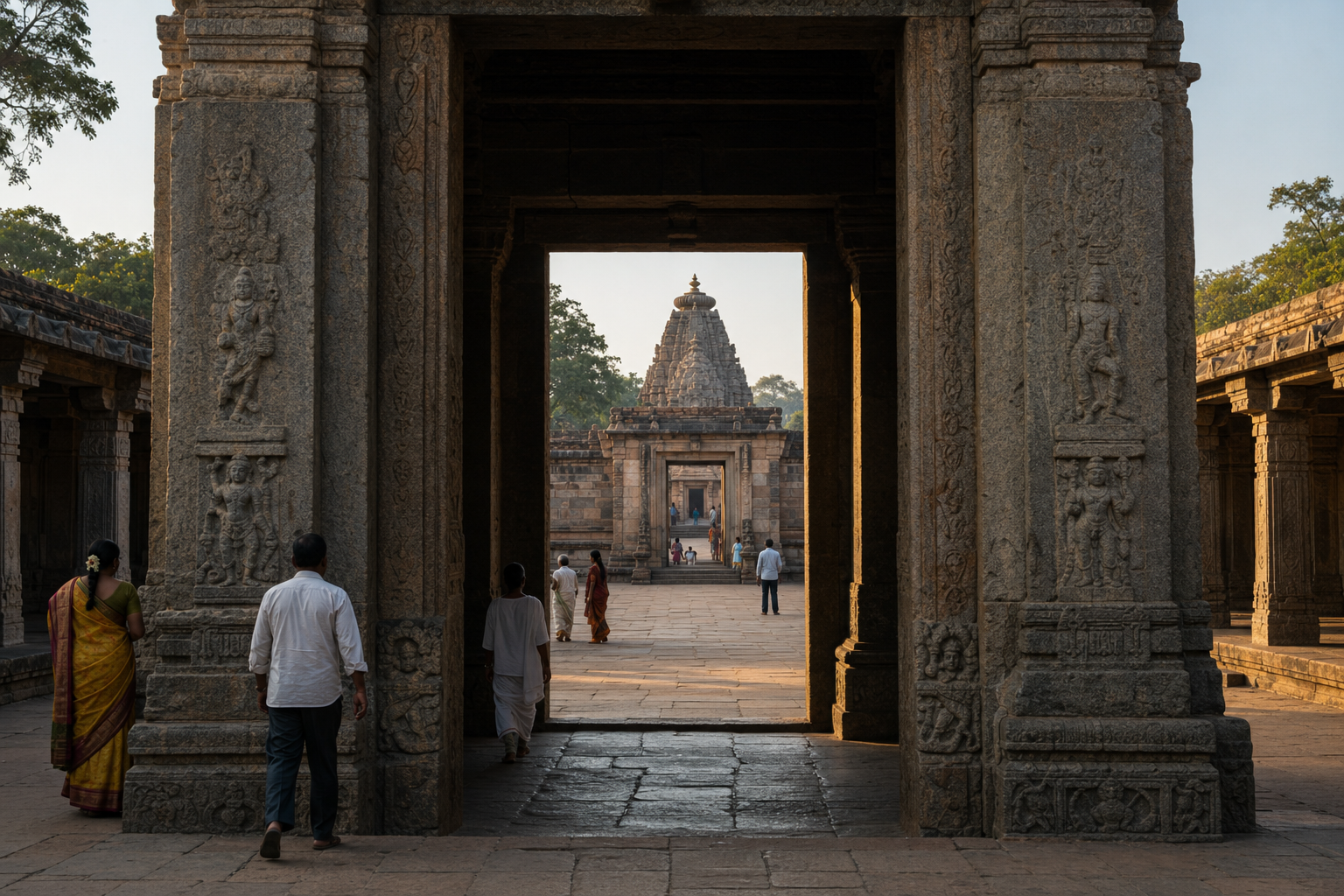
A temple boundary works through controlled transitions. The wall limits casual entry. The gateway selects a direction. The corridor establishes a pace. The next opening frames what you are about to encounter. Architecture is therefore doing some of the work that a verbal instruction might otherwise have to do: leave distraction behind, orient yourself and approach deliberately.
Pay attention at the gateway and you may notice several changes at once. Street noise becomes less dominant. Stone underfoot alters the cadence of walking. Shade replaces glare, or a dark passage opens suddenly into a bright court. A tower, doorway or sanctum appears within a framed line of sight. These effects vary from temple to temple, but the modulation of sound, movement and vision is central to how an enclosure prepares attention.
The Agamic traditions and Shilpa Shastras treat the temple boundary as part of sacred order, not as an afterthought. Gates may be aligned with cardinal directions and associated with dikpalas, the guardians of direction. The enclosure contains the consecrated precinct, while the sanctum functions as its concentrated centre. Read against the Vaastu-Purusha-Mandala, the prakara belongs to the outer ordering of a built microcosm whose focus is the garbhagriha.
This helps explain why crossing a gate can feel more significant than merely walking through a door. It is a deliberate aperture in a boundary. You leave one order of space and enter another. If several enclosures follow, that action is repeated, allowing attention to be gathered in stages rather than demanded all at once.
Successive enclosures are sometimes contemplated as the koshas, the sheaths of embodied existence, or as concentric levels of a mandala. Other readings relate them to the chakras. These are meaningful spiritual lenses, but they should not be turned into a universal architectural formula. Not every temple has five walls because there are five koshas, and not every sequence was designed to encode one identical map. Unless a local tradition makes a specific correspondence, use such interpretations to deepen contemplation rather than to make a rigid historical claim.
The physical construction deserves equal attention. Prakaras have been built from brick, laterite and carefully joined stone, including granite ashlar. Foundations and plinths carry the wall; drainage limits monsoon damage; covered passages protect movement; parapets, niches and battlement-like profiles give the boundary additional functions. Traditional lime mortars could provide a measure of structural flexibility. When you examine an old enclosure, look down as well as up: the plinth, slope and drainage often reveal as much architectural intelligence as the gateway sculpture.
That observation matters for conservation. A prakara is not preserved merely by keeping its most photogenic elevation intact. Its foundation, water management, usable passage, thresholds and relationship to adjacent structures have to continue working as a system. A wall separated from its route and gate may survive materially while losing much of its architectural meaning.
One sacred principle produces very different temple forms
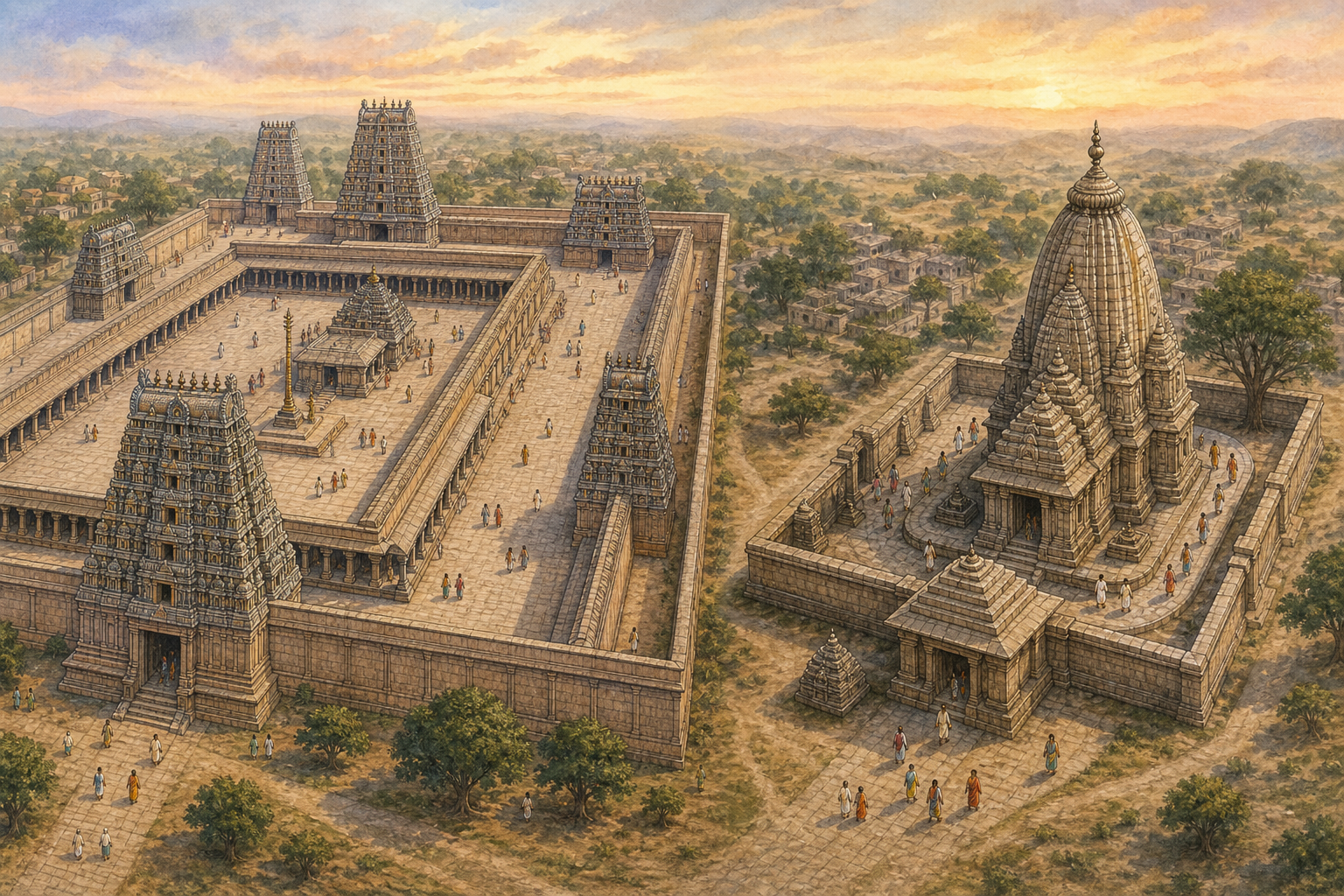
The most useful comparison is not which temple has the grandest enclosure. It is what each enclosure asks movement, space and community to do. The following examples give you specific features to watch for.
| Temple or complex | What to notice | What the prakara accomplishes |
|---|---|---|
| Srirangam | Seven concentric enclosures containing gateways, streets, residences, bazaars, cloisters and ritual structures | The outer rings support a temple-city, while movement through successive thresholds steadily concentrates attention on Sri Ranganatha. |
| Chidambaram | Cardinal gopurams, layered enclosures, axial relationships and changing encounters with open sky and built mass | The journey frames the Chidambara Rahasya and makes space itself part of the devotee’s contemplation. |
| Rameswaram | Exceptionally long pillared corridors, repeated columns and extended sight-lines | The enclosure becomes a measured promenade in which repetition disciplines the gaze and pace of pradakshina. |
| Brihadeeshwara, Thanjavur | A strong enclosure around a comparatively open precinct dominated by the great vimana | The surrounding space magnifies the central mass instead of competing with it, joining sacred geometry to Chola architectural authority. |
| Jagannath Puri | High walls, concentric boundaries, monumental gates and routes that connect the temple with the town | The enclosure balances sanctity, governance and public movement, especially when festival processions carry devotion beyond the inner precinct. |
Srirangam’s sapta-prakara arrangement is the clearest warning against treating every outer enclosure as merely peripheral. Some rings contain forms of everyday life that sustain the sacred centre: homes, commerce, hospitality, service and processional streets. Moving inward does not mean that the outer zones are spiritually worthless. It means that a temple-city can hold different intensities and functions within one ordered whole.
Chidambaram asks you to watch alignment and openness. The walls organise approach, but they do not make the experience one of enclosure alone. Open sky, stone, gateways and axes participate in a theology where space and consciousness matter. Rameswaram uses another language: its long colonnades turn walking into rhythm. Do not rush through those repetitions as though nothing changes until the destination. Their sameness is precisely what can settle a restless gaze.
Brihadeeshwara demonstrates that a prakara can create eloquence through restraint. The broad space held by the enclosure allows the vimana to dominate the horizon. Here the wall’s importance lies partly in what it leaves open. The lesson is useful wherever you visit: empty court is not unused architecture. It can establish proportion, distance, light and the visual authority of the centre.
In Odisha, Lingaraja and Jagannath Puri show the force of high perimeter walls within eastern temple traditions. Their enclosures are not copies of the expansive Tamil temple-city model. At Puri, gates and walls regulate the relationship between worship, administration and the public realm, while the Ratha Yatra extends sacred movement into the town. The prakara here acts as a hinge: it preserves an inner order while allowing festival devotion to flow outward.
This outward movement matters. Daily worship draws people towards the sanctum, but utsavas can reverse or enlarge the route. Processional deities, vahanas, offering points and halts activate the corridors and gateways. Routes may pass from inner prakaras to outer streets, including mada veedhis around South Indian temples. The enclosure is therefore not a permanently sealed shell. It regulates the temple’s breathing between concentrated worship and public celebration.
The same principle travelled beyond Bharat without producing identical forms. At Angkor Wat, moats, vast enclosures, cardinal gates and long axial approaches enlarge the sacred precinct to a territorial scale. Khmer builders adapted the grammar to their own aesthetic and engineering context. What endured was not a fixed template but a conviction that boundary, direction and measured approach could make cosmological order tangible.
You can also recognise a wider Dharmic family resemblance without erasing differences among traditions. Buddhist stupas use railings, gateways and circumambulatory paths. Jain temple-cities group shrines within bounded precincts that order ascent and contemplation. At Harmandir Sahib, parikrama around the sarovar and sanctum places movement within a sacred composition. These are not all prakaras in the same technical sense, but they share an understanding that a defined perimeter and mindful circuit can discipline attention.
Walk the prakara as part of worship, not as a bypass
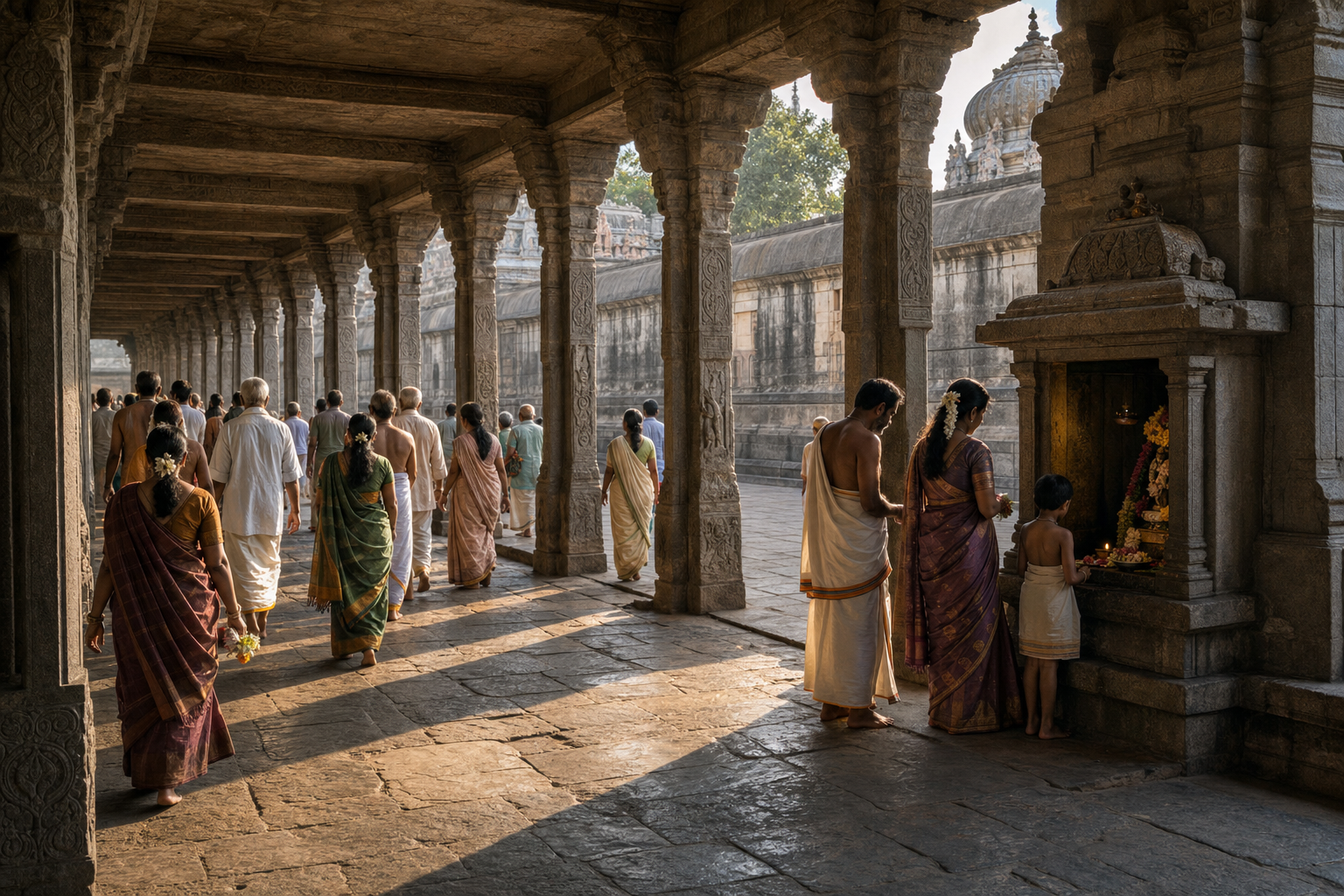
You do not need specialist training to experience the enclosure intelligently. On your next visit, use the following sequence. Local rules, ritual restrictions and instructions from temple authorities always take precedence over a general architectural method.
- Read the edge before entering. From outside, locate the wall, principal gateway and any visible sequence of towers. Notice whether the temple meets a dense street, market, tank, open court or processional road. This tells you how the sacred precinct relates to civic life.
- Pause at the threshold. Do not stop where you obstruct others, but give yourself a moment to register the change in sound, temperature, light and visual focus. The purpose is not to manufacture a mystical feeling. It is to become attentive to the transition the building has created.
- Find the principal axis. Look for the succession of gateway, flagstaff or bali area, halls and sanctum, where these are visible and accessible. A large complex may interrupt or complicate that line, so use temple signs or ask an attendant rather than assuming every prominent doorway leads directly to the main deity.
- Follow the permitted pradakshina route. Pradakshina ordinarily keeps the sacred centre to the devotee’s right, but the available circuit is determined by the temple’s layout and custom. Do not cross barriers, reverse a managed crowd flow or enter a restricted corridor merely to complete the shape you expected.
- Let sub-shrines form a sequence. Navagraha shrines, guardian deities, saints and other sacred figures often occupy points along a prakara. Notice their relationship to the main shrine instead of treating them as unrelated stops on a checklist. Their placement can show how a tradition gathers a wider sacred community around its centre.
- Watch how the enclosure is used. Look for processional width, pillared resting places, offering points, stored vahanas, niches, drainage and doors into adjoining courts. These details tell you whether a passage supports daily circumambulation, festival movement, teaching, music, service or several functions at once.
- Approach the next threshold with less distraction. If there is another enclosure, repeat the act of orientation. Put away the impulse to photograph every surface. By the time you reach the garbhagriha, the accumulated crossings should have made your attention more concentrated, not merely your route longer.
Pradakshina uses the prakara as a moving discipline. A stable route lets breath, step, mantra and sight settle into relation. The circuit is neither a race nor an architectural scavenger hunt. Its value lies in sustained orientation around a centre that remains sacred even when it passes out of view.
This also gives you a practical test for your own pace. If you are continually overtaking worshippers, blocking the corridor for photographs or breaking away from the marked route, the building’s ritual choreography has been replaced by personal convenience. Move with the local flow. Pause only where space and custom permit it.
If distance, heat, crowding or limited mobility makes a full circuit difficult, ask which shorter route is permitted. A vast complex such as Srirangam or an extended corridor such as Rameswaram places different demands on the body from a compact enclosure. Respecting your actual capacity is better than forcing an unsafe circuit or entering a closed passage.
Festival days require a different reading. A quiet circumambulatory corridor may become a processional artery; a gateway may control surging movement; an outer street may temporarily function as the temple’s expanded circuit. Follow the managed route and watch where the deity pauses, turns or emerges into public space. Those actions reveal the enclosure’s ritual purpose more clearly than an empty plan can.
Key takeaways for your next temple visit
- A prakara is an enclosure system: wall, threshold and movement belong together, even when local vocabulary emphasises one part.
- A gopuram marks a passage through the enclosure; it is not another name for the prakara.
- Successive walls can intensify sacred focus, but the number of enclosures is not a measure of a temple’s authenticity or spiritual rank.
- Cosmological readings such as the mandala, koshas or chakras can illuminate the inward journey, but they should not be imposed as one universal construction code.
- Pradakshina is the clearest way to experience the prakara: follow the permitted route, keep the sacred centre in mind and let repeated movement collect your attention.
- Outer enclosures may sustain markets, residences, learning, music, administration and festivals. Their social activity is part of temple life, not evidence that sacredness has disappeared.
- Regional difference is essential. Read a compact Nagara or Kalinga enclosure on its own terms instead of expecting every temple to resemble a many-ringed Dravidian complex.
At the next temple you enter, choose one threshold and one complete, permitted circuit to observe carefully. Note what changes at the gate, what the path keeps at your right, what appears along the wall, and how the next opening redirects your gaze. That small discipline will show you more than trying to catalogue every sculpture at once.
Then carry the architectural lesson into darshan: approach is not separate from arrival. The prakara has already begun the worship by asking your body to slow, your direction to become deliberate and your attention to turn towards the sacred centre.
References
