
What should you say when you have investigated honestly and still do not know? In a meeting, a family argument, a classroom, or a public debate, a polished answer can look stronger than a truthful limit. The danger begins when the demand for a conclusion outruns the evidence.
Lingodbhava gives you a demanding but practical rule: do not turn the boundary of your knowledge into a claim about reality. The one who returns without the summit but with the truth has understood more than the one who invents a summit. If you are deciding whether to answer, qualify, investigate further, or simply say “I do not know,” this sacred narrative offers a method.
The contest cannot be won by travelling farther

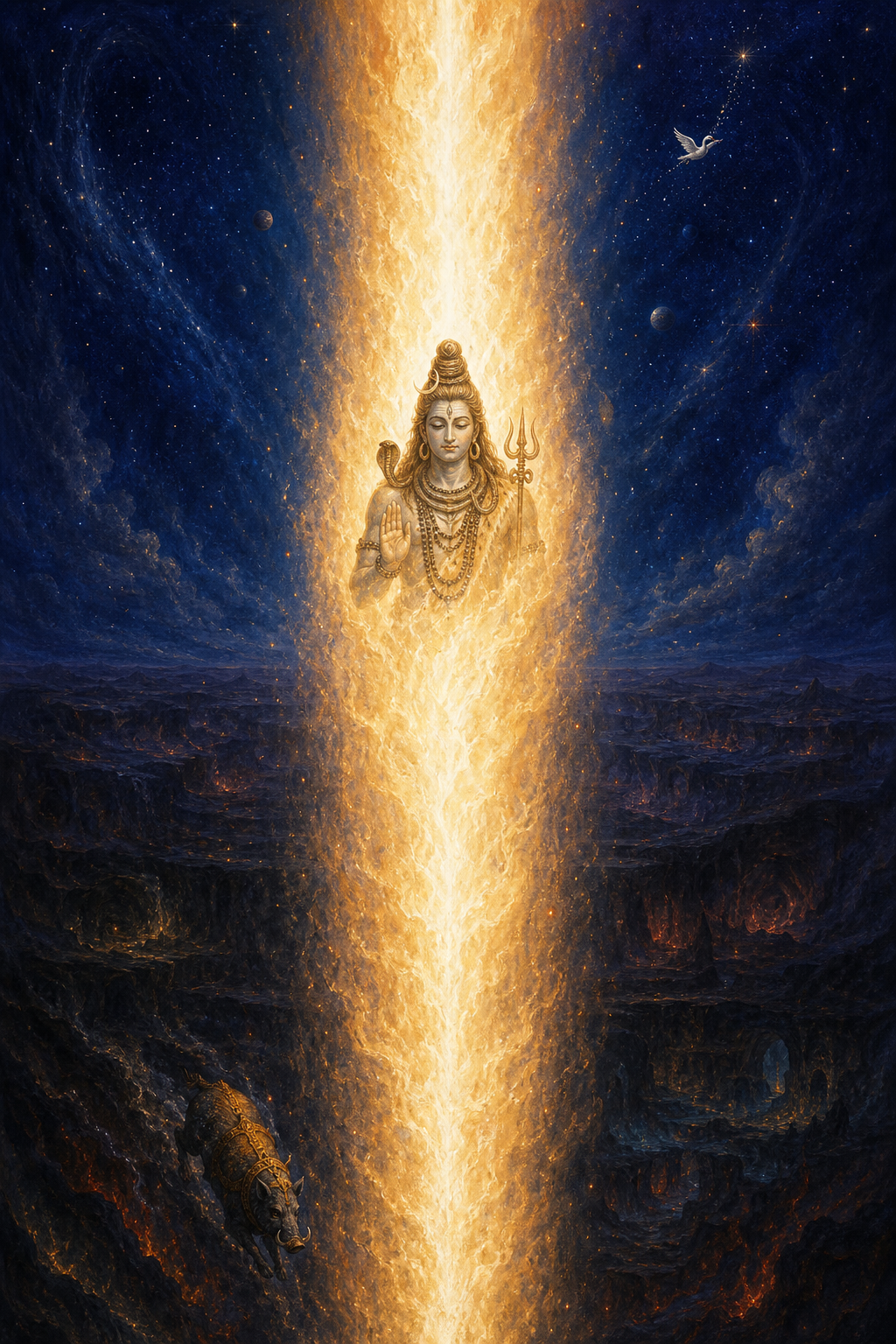
Shiva appears before Brahma and Vishnu as a column of fire with no visible origin or end. Vishnu becomes Varaha and descends in search of its base. Brahma becomes a Hamsa and flies upward in search of its crown. Neither reaches an extremity. Vishnu returns and states the truth. Brahma claims success and recruits the ketaki flower as a false witness. Shiva then discloses that the fiery pillar is endless and exposes the lie. This core narrative is preserved in the Shiva Purana and Linga Purana, with an influential elaboration in the Arunachala Mahatmyam associated with the Skanda Purana.
It is easy to read the episode as a race between deities. But distance is not the real obstacle. Both searches assume that the object must have a boundary somewhere and that enough movement will eventually disclose it. That method works for a mountain, a road, or a river. It cannot master infinity. Moving upward forever does not make the infinite finite; moving downward does not turn the ground of existence into an object waiting to be found.
The Taittiriya Upanishad describes Brahman as satyam, jnanam, anantam: truth, knowledge, and infinity. Lingodbhava gives dramatic form to anantam. The flame is not merely very tall. It defeats the assumption that reality as a whole can be placed before the observer, measured from outside, and possessed as a completed object.
This is not an argument against reason. Brahma and Vishnu are not rebuked for searching. The decisive moment comes after the search reaches its limit. Reason has done valuable work when it identifies what its method cannot establish. It ceases to serve truth when it hides that limit behind an impressive conclusion.
When you face an unresolved question, distinguish four different conditions before speaking:
- Known: you have adequate grounds for the claim you are making.
- Not yet known: the answer may be available, but the necessary inquiry has not been completed.
- Not found: your search produced no result, which is not automatically proof that no result exists.
- Beyond the method: the tool, category, or viewpoint you are using cannot settle the question as framed.
Those conditions are not interchangeable. “I did not find the base” is justified by an unsuccessful search. “There is no base” is a larger metaphysical claim. Lingodbhava asks you to notice exactly where the first sentence is silently converted into the second.
Vishnu’s admission is knowledge, not defeat
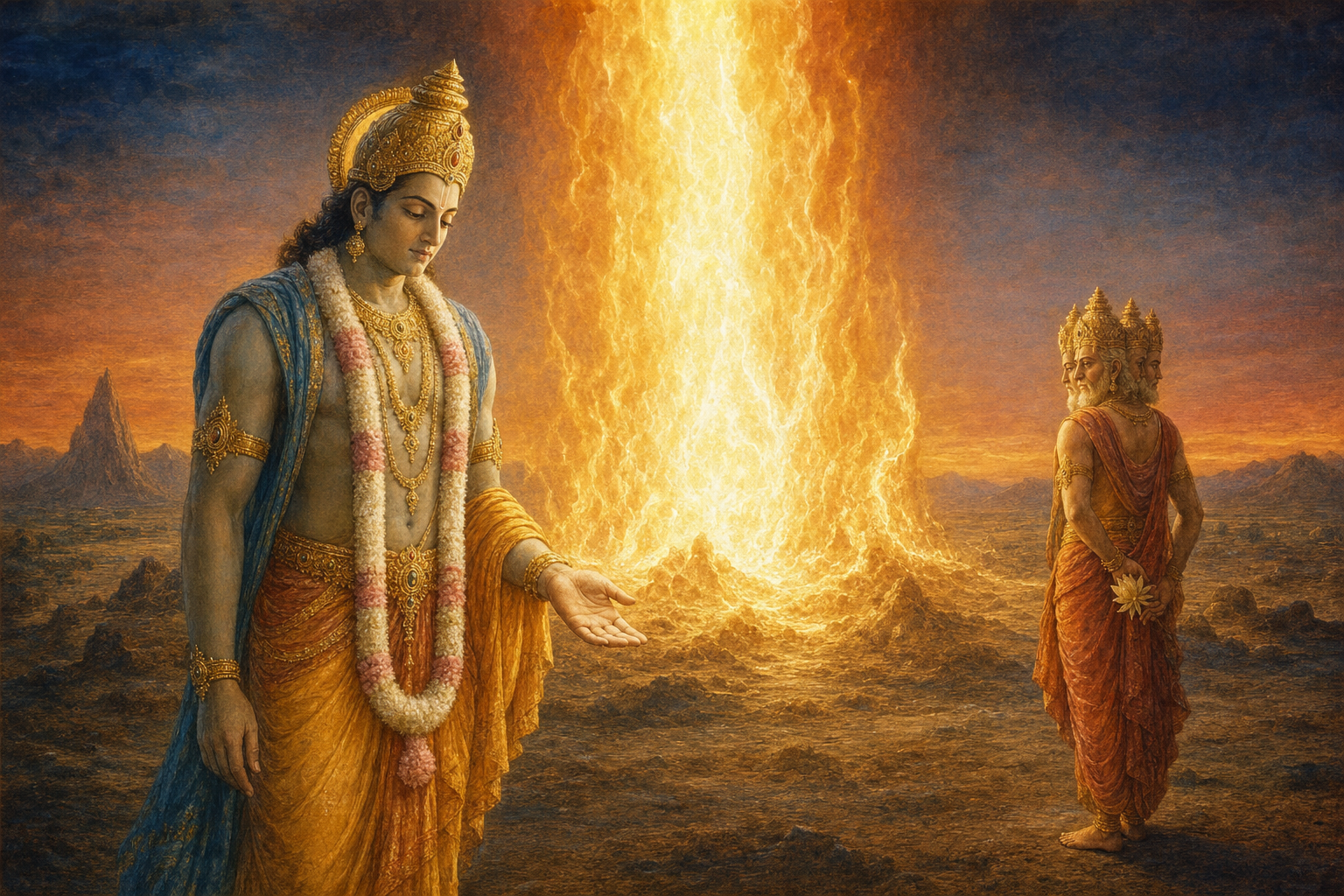
Vishnu does not return with the requested answer. He returns with an accurate account of what the inquiry established: the base could not be reached. His statement preserves three things at once. He searched seriously, he recognised the result, and he refused to enlarge that result for the sake of status.
That is why his apparent failure becomes the episode’s epistemic success. He knows something important about the pillar, something about the limits of the search, and something about his own position before the immeasurable. Brahma’s fabricated success contains less knowledge, even though it sounds more complete.
In the language of dharma, Vishnu joins satya with vinaya. Satya requires that speech remain answerable to reality. Vinaya keeps the speaker from treating personal prestige as a measure of what is true. Read through the three gunas, his response displays the lucidity and balance associated with sattva. This does not mean that uncertainty is always sattvic. It means that a clear admission of uncertainty is better than an answer manufactured by restless self-assertion.
Humility here is not low self-esteem. Vishnu does not say that he is worthless, incapable, or forbidden to inquire. Nor does he pretend that every opinion is equally sound. He makes a precisely bounded claim. Epistemic humility is not thinking less of your capacity; it is refusing to claim more than that capacity has established.
You can practise the same discipline by replacing vague disclaimers with exact limits:
- Say, “I checked these records, but I have not checked the remaining period,” rather than, “There is no evidence.”
- Say, “This is the interpretation I can support,” rather than, “No informed person could disagree.”
- Say, “The available facts support a provisional decision,” rather than presenting the decision as certain.
- Say, “I do not know yet; the next reliable check is this,” when further inquiry is possible.
- Say, “This method cannot answer that question,” when more effort with the same method would only repeat the mismatch.
There is also a false humility that avoids responsibility. “No one can know anything” can be as evasive as false certainty. Vishnu searches before he reports the limit. If you have not defined the question, consulted the relevant evidence, or used an appropriate means of inquiry, “I do not know” may describe unfinished work rather than wisdom. The honest response then includes the next step.
A useful test is simple: can you name what you examined, what it established, what remains open, and what could change your conclusion? If you can, your uncertainty has structure. If you cannot, you may be using uncertainty to escape scrutiny.
Brahma’s lie begins before he speaks
Brahma’s false statement is the visible offence, but the inward distortion begins earlier. The search has become a contest of identity. Once being “the one who reached the summit” matters more than discovering whether the summit can be reached, evidence is no longer allowed to decide the outcome.
The ketaki flower then becomes more than a narrative accessory. Brahma does not find confirmation and revise his belief. He first chooses the conclusion he needs and then recruits a witness to support it. The order has been reversed: the verdict creates the evidence.
This is one of ahamkara’s most recognisable movements. Ego does not always shout, boast, or demand worship. It can appear as the quiet conviction that your reputation must be protected from an inconvenient fact. Watch for the sequence:
- A question becomes a contest that you feel you must win.
- The evidence fails to produce the answer you promised or expected.
- Admitting the limit begins to feel like a loss of identity.
- You select testimony, wording, or context that preserves the desired conclusion.
- You speak with greater confidence precisely because the underlying support is weak.
The episode can also be read through rajas, the guna of motion, projection, appetite, and assertion. Brahma’s cosmic association with creation makes this reading especially suggestive: the power that brings forms and names into being can, when entangled with ahamkara, begin creating a story about its own supremacy. This is a moral-psychological interpretation of the lapse, not a claim that Brahma is essentially false or that creative activity is impure.
That distinction matters because Lingodbhava should not become a sectarian scorecard. Vishnu is honoured for truthfulness; Brahma is corrected for a particular act; Shiva stands as the reality that neither directional search could contain. The ethical line runs through the conduct of the seeker, not through a licence to demean one deity or one sampradaya.
The narrative gives Brahma’s lie liturgical consequences. He is denied broad cultic prominence, and ketaki is generally excluded from Shiva worship for bearing false witness. Popular teaching also connects the relative scarcity of Brahma temples, with Pushkar as the best-known exception, to this censure. That explanation functions powerfully within sacred memory, but it need not serve as a complete historical theory of Hindu worship. The distributed character of creation and the devotional centrality of preservation, liberation, and transcendence also help explain the pattern.
The practical warning is sharper than “do not lie.” Ask what your speech is being made to protect. If the answer is a deadline, a title, a faction, a public image, or the need to appear spiritually advanced, you have found the point where Brahma’s ascent can become your own. Pause there. Remove the identity claim, and restate only what the evidence can carry.
The linga turns a limit of thought into a practice
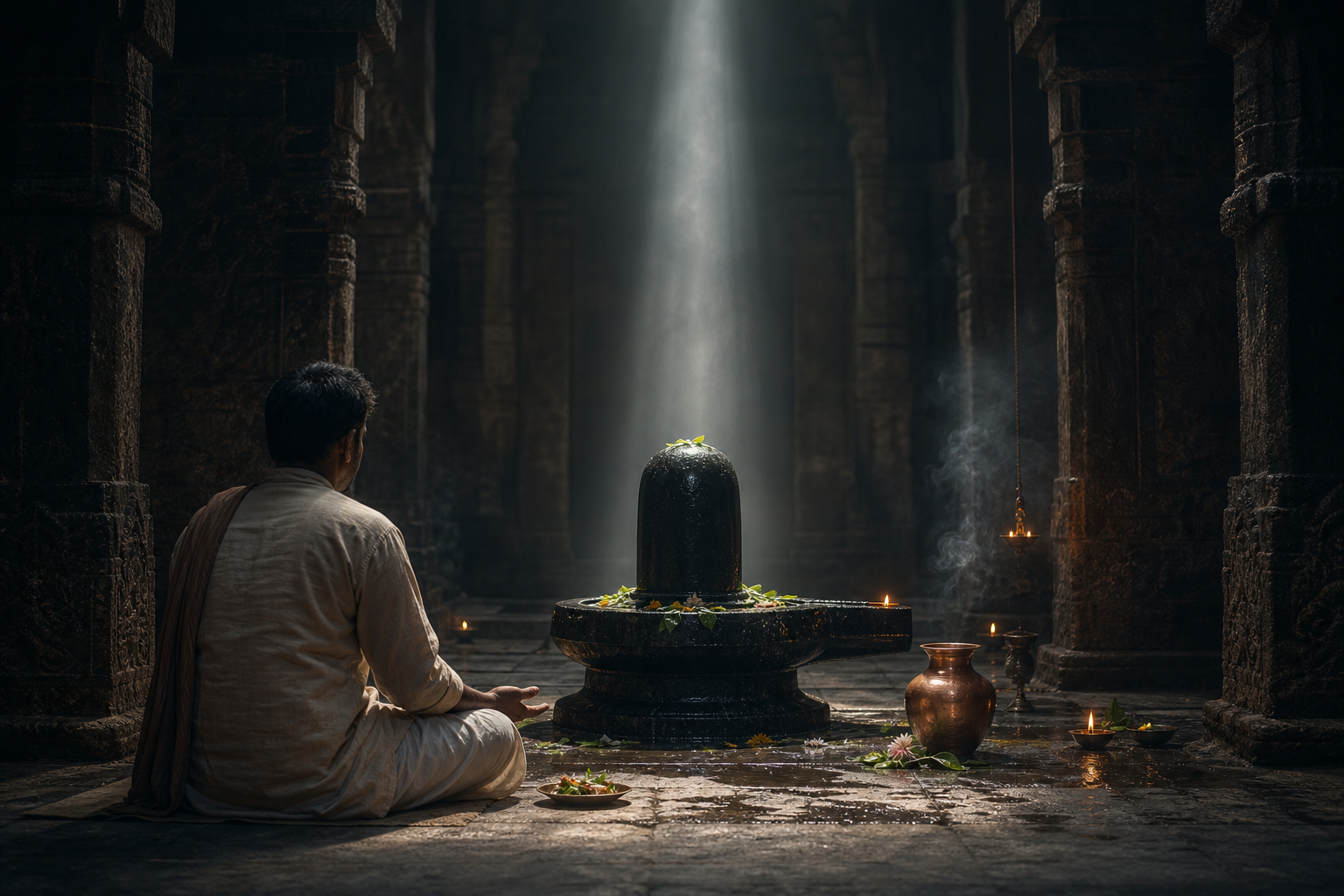
A linga is a mark or sign. In the Lingodbhava setting, it does not function as a deficient image waiting to become a more detailed statue. It gives form to a disciplined paradox: the sacred can be approached through a visible sign without being reduced to that sign.
Shaiva traditions distinguish Shiva as nishkala, beyond parts and form, and sakala, manifest with form. The linga occupies a potent middle ground. It is tangible enough for darshana, puja, abhishekam, and devotion, yet spare enough to resist the illusion that the Absolute has been visually exhausted. It permits relationship without pretending to offer possession.
The temple image makes the lesson readable. On the western wall of the garbhagriha in many South Indian temples, Lingodbhava iconography places Shiva at the centre of the fiery vertical axis. Vishnu as Varaha searches below. Brahma as Hamsa searches above. The ketaki flower recalls the false witness. The arrangement turns theology, ethics, and the limits of cognition into a single visual field.
When you encounter this image, do not hurry past it as a decorative account of something that happened long ago. Use its vertical structure as a short contemplation:
- Identify your pillar. Bring to mind one question you are trying to force into a complete answer.
- Notice your direction. What method, assumption, or inherited category are you using to reach its “top” or “bottom”?
- Name the honest result. State what you actually know without adding the conclusion you want.
- Find the ketaki. Notice the person, quotation, fragment, or credential you are tempted to use as decorative confirmation.
- Return to the centre. Let the linga remind you that reverence can begin where possession ends.
Karthigai Deepam at Arunachala expands the same meditation to the scale of a landscape and a community. A beacon is lit atop the hill, which the Arunachala Mahatmyam understands as the cooled embodiment of the primordial flame. Fire becomes mountain; mountain becomes a visible sign; the sign directs attention back toward what cannot be bounded. The ritual does not solve infinity as a puzzle. It trains a community to stand before it.
Shared discipline does not require identical doctrine
The lesson also gives you a careful way to recognise kinship across dharmic traditions. Jain anekantavada emphasises the many-sided character of reality and the partiality of any single standpoint. It strengthens the demand that you qualify a claim without dissolving truth into “anything goes.” A partial view can be valid as partial and false when advertised as complete.
Buddhist Right Speech brings the ethical quality of the statement into focus, while the diagnosis of clinging shows why the mind becomes attached to a conclusion as “mine.” Teachings on shunyata challenge the tendency to treat concepts as self-sufficient realities. These ideas are not interchangeable with Shaiva theology, but they converge on the need to loosen ego’s hold on speech.
Sikh affirmations of Satnam and Hukam place truth and alignment with cosmic order above the isolated will’s demand to prevail. Vishnu’s return can therefore illuminate a recognisable dharmic posture: effort without self-deification, speech without embellishment, and acceptance without passivity.
When discussing these parallels, do not claim that Hinduism, Jainism, Buddhism, and Sikhism secretly teach the same metaphysics. Ask a narrower and more fruitful question: what discipline of seeing and speaking does each tradition require when the ego confronts a reality larger than itself? Shared ethical direction can be honoured without erasing real doctrinal differences.
Use the Lingodbhava test before certainty becomes a performance

You do not need to be settling a cosmic question to repeat Brahma’s error. It appears whenever a conclusion is rewarded more quickly than a careful account of uncertainty: before publishing a claim, forwarding a provocative message, giving professional advice, interpreting scripture, defending a community, or reporting a result.
Before you speak with authority, apply this six-step test:
- State the exact question. “What happened?” is different from “What can these records establish?” A vague question allows the answer to expand without notice.
- Separate observation from inference. Write down what you directly found, then write the interpretation you placed upon it. Do not merge the two sentences.
- Test the method. Ask whether your chosen means of knowledge can answer the question. Repeating an unsuitable search does not make the conclusion stronger.
- Calibrate the language. Use “shows,” “supports,” “is consistent with,” “I did not find,” or “remains unresolved” according to the strength of the grounds. These phrases are not cosmetic; they define the claim.
- Refuse the false witness. Do not use a respected name, an isolated line, a friendly witness, or a devotional preference to simulate proof that you do not have.
- Name the next honest action. Investigate further, seek someone with the relevant competence, make a provisional decision, or accept that the question exceeds the present method.
The difference becomes easier to see when the same limit is expressed honestly and dishonestly:
| What happened | Truthful statement | Unjustified upgrade |
|---|---|---|
| Your search found no supporting record | “I found no record in the material I checked.” | “It never happened.” |
| A decision must be made with incomplete facts | “This is provisional and depends on these assumptions.” | “The outcome is certain.” |
| You know one traditional interpretation | “This sampradaya reads the teaching in this way.” | “Every dharmic tradition teaches exactly this.” |
| Your method cannot settle a metaphysical claim | “This method does not establish the answer.” | “There can be no answer.” |
Truthfulness does not require paralysis. Leaders, householders, scholars, and communities often must act before complete knowledge is available. The dharmic alternative to fabricated certainty is a proportionate decision: disclose the limit, explain the grounds, identify the risk of error, and remain willing to revise. A decision can be firm in action while modest in its claim to knowledge.
This also changes disagreement. If another person has seen only one side, you need not pretend that every side is equally adequate. But you should identify the boundary of your own view before condemning theirs. The relevant question is not only “Is my position true?” It is also “Am I claiming a summit that my position has not reached?”
Key takeaways
- Lingodbhava distinguishes an honest limit of knowledge from a fabricated completion of knowledge.
- Vishnu’s search is not wasted: admitting what it could not establish is itself a valid result.
- Brahma’s lie begins when winning becomes more important than allowing reality to decide the conclusion.
- The linga makes the Infinite approachable as a sign without pretending that the sign contains the whole.
- Your practical duty is to match the confidence of your words to the strength and scope of your grounds.
The next time someone expects certainty from you, take one pause before supplying it. Name what you checked, what you found, where the limit lies, and what you will do next. That sentence may not reach the imagined summit. It will keep you aligned with truth.
References
