
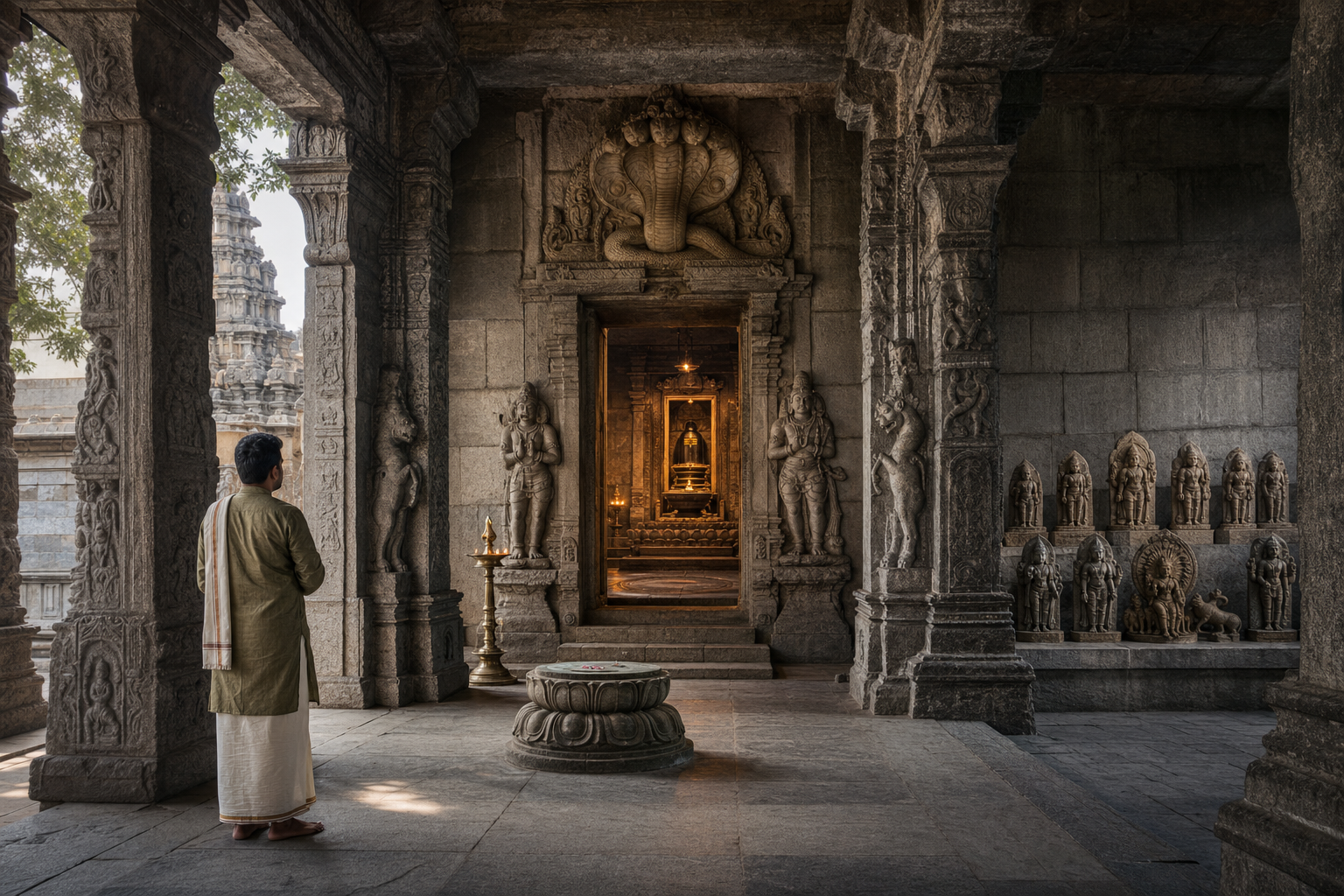
You recognize the deity, but the rest of the image still feels difficult to read. Why is a serpent spreading its hoods above Vishnu, circling Shiva’s neck, or standing behind a linga? Why are nine planetary deities placed in an outer courtyard rather than beside the principal murti? These details are not ornamental leftovers. They tell you how the sacred presence acts and how you are meant to approach it.
You do not need to memorize a vast dictionary before your next temple visit. Start with four things: the central figure, the relationship between the figures, their location in the temple, and the movement the arrangement asks you to make. That method will take you much further than attaching one fixed meaning to every object.
Read the whole relationship before decoding the symbol
A Hindu icon works as a composition, not as a pile of separate pictograms. A serpent can be dangerous potency, protective intelligence, cosmic duration, subterranean guardianship, or awakened energy. Its meaning becomes clearer only when you see what it is doing: sheltering, supporting, encircling, rising, or guarding.
Use these four passes whenever you meet an unfamiliar murti or relief:
- Find the center. Which figure occupies the main axis, receives the largest scale, or sits within the principal frame? Begin there rather than with the most unusual detail.
- Turn relationships into verbs. Ask whether one figure shelters, carries, faces, accompanies, subdues, or surrounds another. The verb often reveals more than the object’s name.
- Read the location. A form at a threshold may guard a transition. The same form above a deity may confer protection or sovereignty. Placement beside water can introduce fertility, abundance, and guardianship of life-sustaining resources.
- Notice the required movement. Does the arrangement draw you toward the sanctum, send you around a plinth, or make you cross a guarded threshold? Temple symbolism is experienced with the feet as well as the eyes.
This relational method also prevents a common mistake: treating every sculptural feature as if it had one meaning everywhere. Agamic and Shilpa Shastra traditions govern proportions, mudras, and the arrangement of forms, but artisans work within regional paramparas. Tamil, Kerala, Odisha, Karnataka, and Bengal traditions can express a shared theological idea through different curves, numbers, materials, and compositional emphases.
When two temples handle a symbol differently, do not rush to declare one incorrect. First ask whether the main relationship remains intact. Canon provides discipline; local tradition gives that discipline a particular visual accent.
Let the temple tell you which images are primary
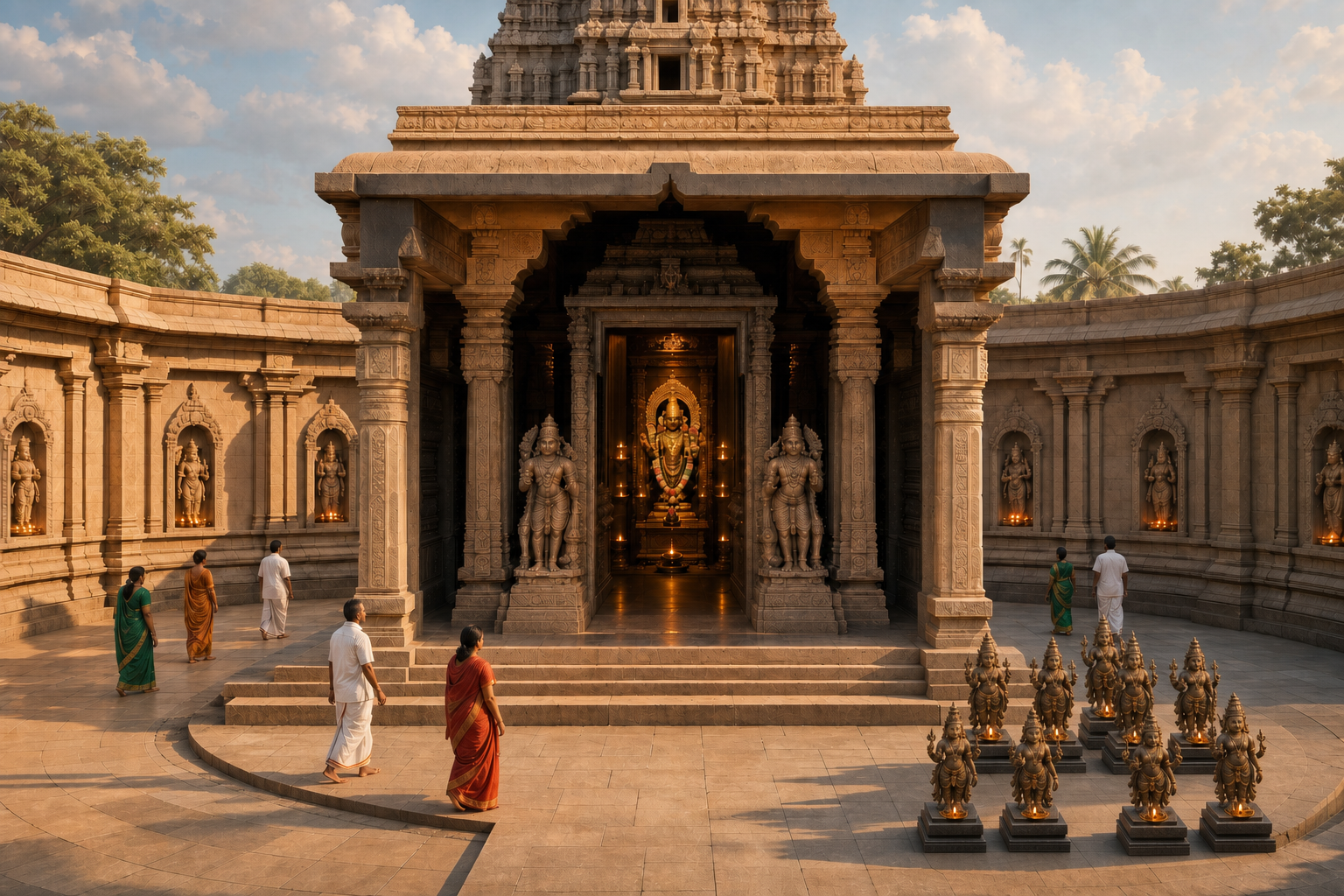
The building establishes a hierarchy before any individual attribute does. The garbhagriha is the concentrated liturgical center. The mandapa prepares approach and assembly. The prakaras create successive fields of movement around that center. Subsidiary shrines, guardians, planetary deities, water features, the bali-pitha, and the dhvaja-stambha participate in the whole without displacing the principal deity.
This is why sacred architecture should not be read as a gallery in which every image has equal rank. The Vastu Purusha Mandala, the sanctum axis, and circumambulatory paths organize the complex as a miniature cosmos. Scale, direction, distance from the sanctum, and ease of access all help define an image’s role.
| Where you see the image | Question to ask first | What the placement may be doing |
|---|---|---|
| On or near the sanctum axis | What is the temple’s primary focus? | Establishing liturgical and visual precedence |
| At a doorway, stair, or causeway | What boundary am I crossing? | Guarding a transition and preparing entry |
| Near a tank, water outlet, or low-lying shrine | How is water being acknowledged? | Linking guardianship, fertility, land, and subterranean abundance |
| In an outer prakara | What supporting rite or cosmic order is represented? | Providing accessible worship without competing with the sanctum |
| On a plinth meant for circumambulation | Which figure anchors the arrangement? | Turning sequence and bodily movement into meaning |
On arrival, pause before joining the flow of visitors. Look from the gateway toward the sanctum and identify the strongest axis. Then note which shrines sit beside that route and which sit farther out. A busy subsidiary shrine may answer an urgent devotional need, but activity alone does not make it the architectural center.
Direction matters, but it is not a shortcut that overrides local practice. An east-facing solar orientation is intelligible because it meets the rising light, while other placements respond to the site’s geometry, circulation, and inherited custom. Use direction as one clue among several, not as a test imposed on every temple.
Read the serpent by position, deity, and context
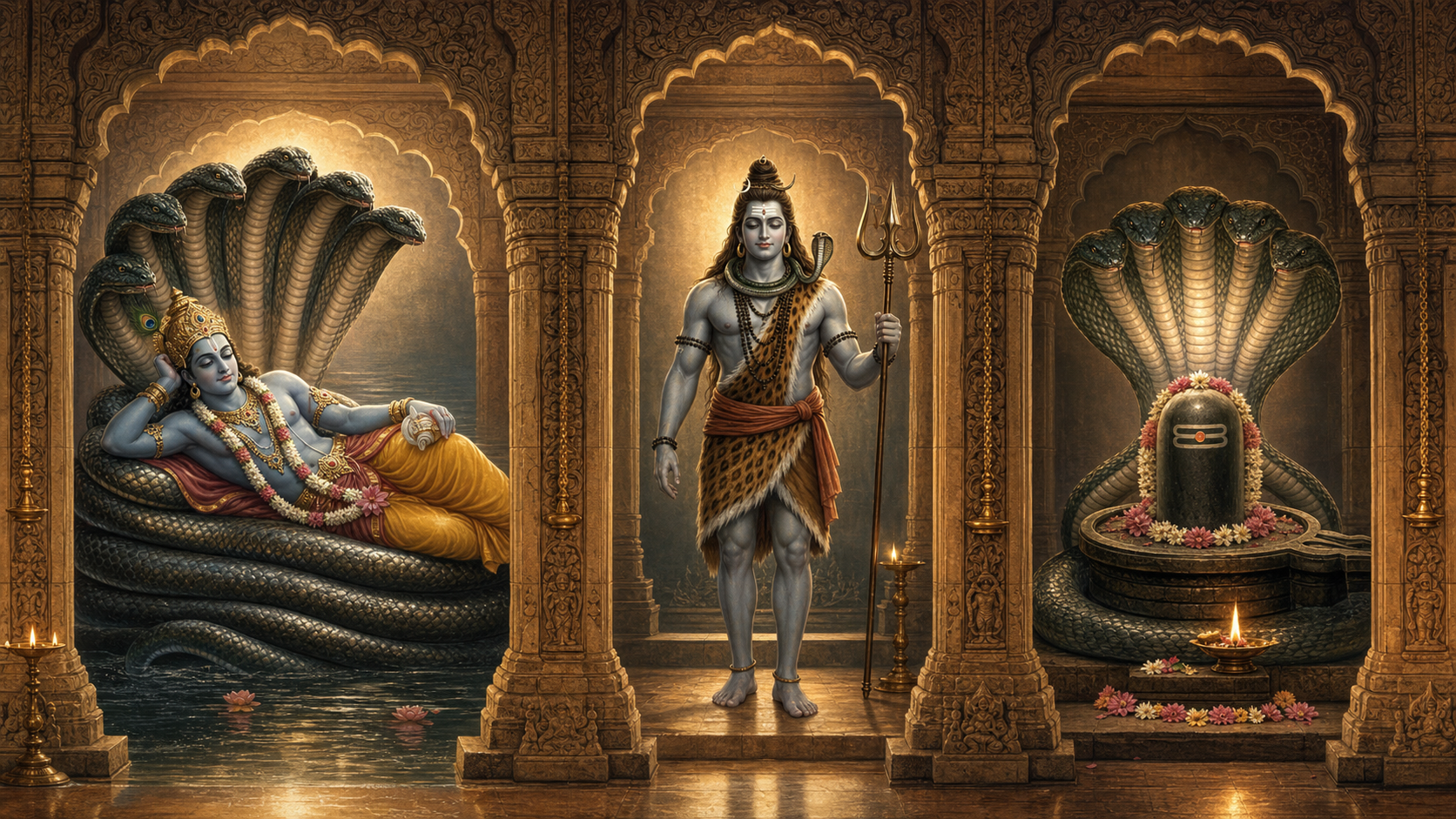
The naga is an excellent test of the relational method because an imported assumption can reverse its meaning. If you begin with the idea that every serpent must signify evil or temptation, a sheltering hood will look threatening. In Hindu imagery, the serpent’s power is deliberately ambivalent. Unordered potency can be dangerous; potency brought into dharmic relationship can support, protect, and reveal sovereignty.
First determine what the serpent is doing
- A hood spread above a deity: Read it first as a canopy. It can signify refuge and royal or cosmic authority, much as a chatra marks an exalted presence.
- Coils beneath a reclining or seated figure: Read them as a foundation or throne. Their continuity can evoke duration, recurrence, and a stable ground beneath cosmic change.
- A serpent worn on the body: Ask what has been mastered and incorporated. The creature is no longer an external enemy; its potency has become an ornament, discipline, or sign of fearlessness.
- A naga at a threshold or near water: Read it as a liminal guardian before reaching for a yogic interpretation. Location may connect the figure with water, fertility, land, and hidden abundance.
The shape helps direct your gaze. A symmetrical fan of hoods frames the deity’s face and produces the visual effect of a living parasol. Grounded coils make the upper body appear still and secure. A rising curve introduces contained movement. These are aesthetic decisions, but they also perform theological work.
Then identify whose composition you are seeing
- Vishnu and Ananta-Sesha: Vishnu reclines upon the cosmic serpent in the Kshira Sagara while the hoods form a vault above him. Ananta means without end. The composition places divine repose at the center while universes emerge and dissolve around it. The serpent is duration made into a throne and canopy.
- Shiva and Vasuki: A serpent around Shiva’s neck, hair, or body announces mastery over poison, fear, and kala, or time. Vasuki’s role as the churning rope in the Samudra Manthana adds another lesson: immense force becomes creative when it is harnessed. A hood rising behind a linga similarly places manifest form within a field of pervasive consciousness.
- Devi traditions: Manasa Devi makes the serpent’s protective connection with health, fertility, and land explicit. In fiercer forms such as Chamunda, serpents can intensify the image of ascetic command and fearless compassion. Do not assume that visual ferocity cancels protection.
- Subrahmanya or Karttikeya: The famous peacock-serpent tension is not always a simple scene of destruction. At Kukke Subrahmanya, the deity protects the nagas and mediates between human and serpent realms. The deeper pattern is the ordering and guardianship of power.
The same hood-and-coil grammar appears around distinct deities without making their meanings interchangeable. Identity narrows the field of interpretation; position reveals the serpent’s immediate task.
Count the hoods only after reading the composition
Numbers can refine a reading, but they rarely settle it by themselves. Five hoods may point toward the five elements or the five vital airs. Seven may indicate layered worlds or stages of spiritual ascent. A thousand announces immeasurability rather than asking you to perform a literal inventory.
Treat the count as a candidate meaning. Check the deity, the region, the surrounding figures, and any temple explanation before choosing between possibilities. A five-hooded canopy does not automatically mean the same thing as five serpents carved beside a water tank.
The yogic reading belongs in this wider context. Kundalini Shakti is envisioned as coiled at the muladhara and ascending through the sushumna as ida and pingala are harmonized through disciplined practice. This can illuminate the naga as awakened potency. It should not erase the icon’s equally important meanings of kingship, time, water, guardianship, and cosmic support.
The wider Dharmic world confirms the canopy’s protective function. Mucalinda shelters the Buddha during a storm, while Dharanendra spreads his hoods over the Jain Tirthankara Parshvanatha. Shared visual grammar does not collapse Hindu, Buddhist, and Jain theology into one system. It shows that the civilizations recognized a common possibility: formidable energy can become the protector of realized awareness.
You can follow that civilizational vocabulary beyond Bharat as well. Multi-hooded naga balustrades mark temple approaches in Cambodia and Thailand, while Samudra Manthana reliefs make the serpent’s cosmic role monumental. When a naga lines a causeway, ask which realms the path is joining. The answer may involve water and land, the human precinct and sanctuary, or the ordinary world and sacred center.
Use the Navagrahas to read sacred space in motion

The Navagraha ensemble shows why placement cannot be separated from symbolism. Surya, Chandra, Mangala, Budha, Guru, Shukra, Shani, Rahu, and Ketu represent a cosmic order of time, causality, and karma. In a temple, however, they normally remain subordinate to the mula-vigraha. Their location in an outer prakara makes planetary worship accessible while preserving the sanctum’s primacy.
Begin with the layout rather than trying to identify nine faces at once. Three arrangements are especially useful to recognize:
- Central mandala: Surya anchors a circular or square group, with the other eight grahas surrounding him.
- Linear arrangement: The grahas appear in a measured row, often following the liturgical order from Surya through Ketu.
- Compact cluster: The ensemble occupies a corner or outer corridor where space and festival circulation require a tighter plan.
These variations are not evidence of careless inconsistency. Regional practice reconciles cosmology with site conditions, access, sightlines, and circumambulatory movement. Tamil temple ensembles often place Surya at the center of a raised plinth. Compact clusters occur in Karnataka and Andhra traditions, open courtyard ensembles are familiar in Maharashtra, and Kalinga priorities can shift the group toward an outer precinct.
After you have found Surya, use attributes to test your identification. Lotuses and a radiant bearing point toward Surya; a cooler composure toward Chandra; martial poise toward Mangala; youthful clarity toward Budha; the bearing of a preceptor toward Guru; ascetic wisdom toward Shukra; and austere gravity toward Shani. Rahu may appear as a serpent-inflected upper body, while Ketu may carry a serpent tail or banner association. Styles vary, so use these as confirming clues rather than rigid rules.
Next watch how the group expects you to move. A plinth with space on all sides invites pradakshina. A central Surya makes the surrounding circuit legible. A row permits sequential salutations. The canonical sequence – Surya, Chandra, Mangala, Budha, Guru, Shukra, Shani, Rahu, Ketu – may also appear in recitation and individual worship.
The practical lesson is not that the planets imprison you. The Navagraha circuit places personal karma within an intelligible cosmic order while keeping prayer, ethical action, and the grace of the principal deity in view. If fear of a graha becomes the only thing you notice, step back and look at the architecture again. The modest scale and outer placement of the ensemble restore the intended hierarchy.
A five-minute practice for your next temple visit
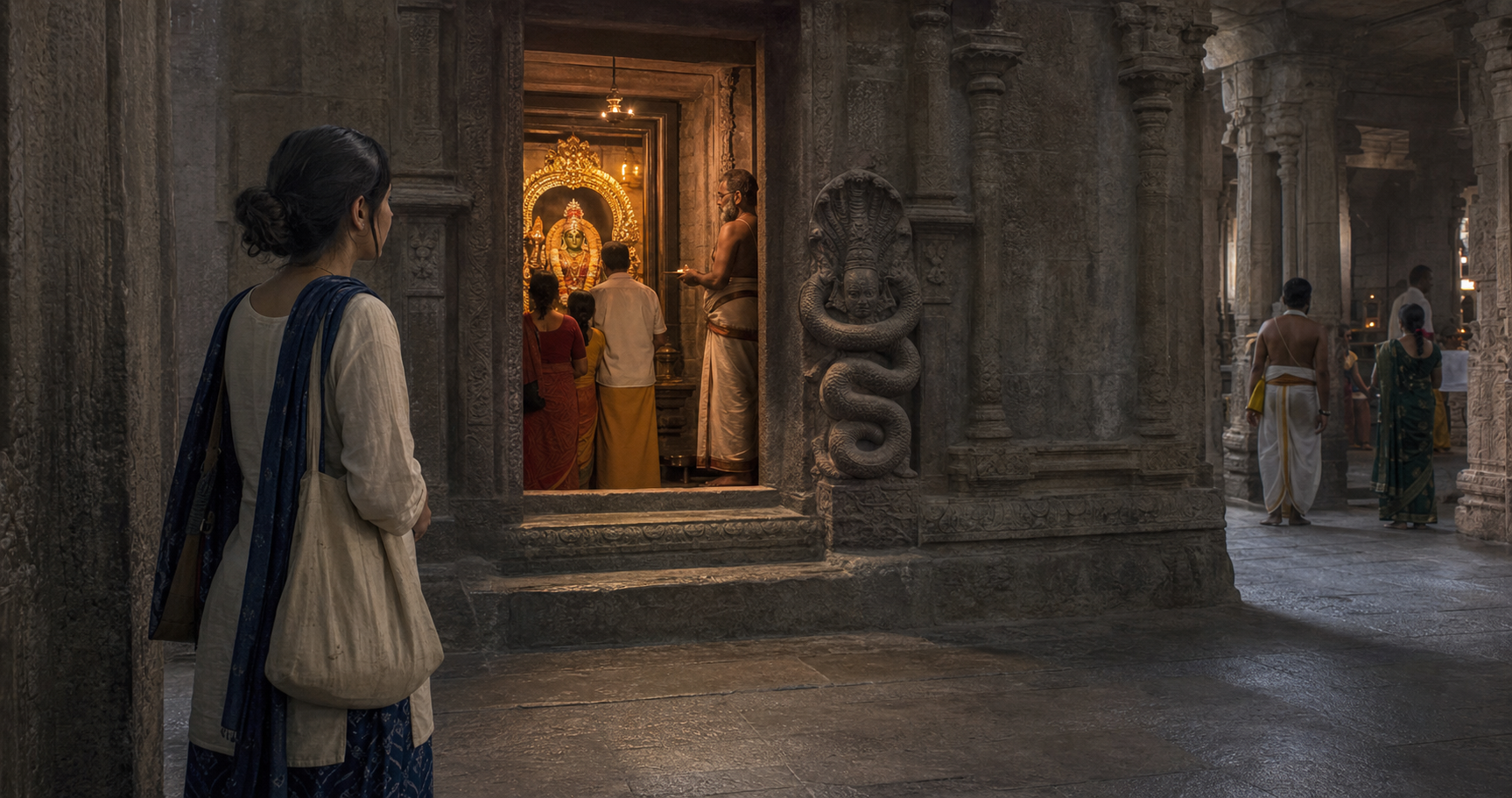
Do this before searching for an explanation online or taking a close photograph. It trains you to see what the temple has already placed in front of you.
- Take in the complete field. Stand far enough back to see the frame, pedestal, canopy, attendants, neighboring shrines, and route of approach.
- Locate the hierarchy. Identify the central figure and compare scale, height, axis, and architectural enclosure. Do not let the strangest object become the center by accident.
- Name three relationships. Use simple verbs such as shelters, supports, faces, surrounds, guards, or accompanies. Avoid interpretation until you can describe the composition accurately.
- Add the spatial clue. Decide whether you are at the sanctum, a threshold, a water feature, an outer prakara, or a circumambulatory plinth. Ask what that location contributes.
- Check identity and attributes. Name the deity if you can, then use posture, vehicle, objects, and accompanying figures to confirm rather than guess.
- Use number last. Count hoods, figures, or directional positions only after the larger scene is clear. A number narrows a reading; it does not replace context.
- Verify locally. Read the temple’s labels or ask which agama, sthala tradition, or regional parampara governs the shrine. Frame the question precisely: ask why the naga is above this deity here, not merely what a snake means.
Key takeaways
- A sacred symbol gains meaning from the figure it serves, the action it performs, and the place it occupies.
- The temple’s axis and spatial hierarchy tell you what is primary before individual attributes do.
- A naga canopy normally communicates shelter and sovereignty, not an attack on the deity beneath it.
- Hood counts offer possible layers of meaning, but deity, region, and placement must confirm the reading.
- Navagraha layouts place planetary causality within a larger order of dharma, worship, and ethical agency.
On your next visit, choose one composition and stay with it for five minutes. Describe its center, verbs, location, and movement before naming its doctrine. Once that habit becomes natural, a temple stops looking like a crowded collection of mysterious objects. It begins to disclose a carefully ordered sacred world that you can enter with attention.
References
- DharmaRenaissance Blog – Under the Naga’s Canopy: The Powerful, Timeless Meaning of Serpent Hoods in Hindu Icons
- DharmaRenaissance Blog – Unlocking the Sacred Geometry of Navagrahas: How Temple Placement Shapes Cosmic Harmony