
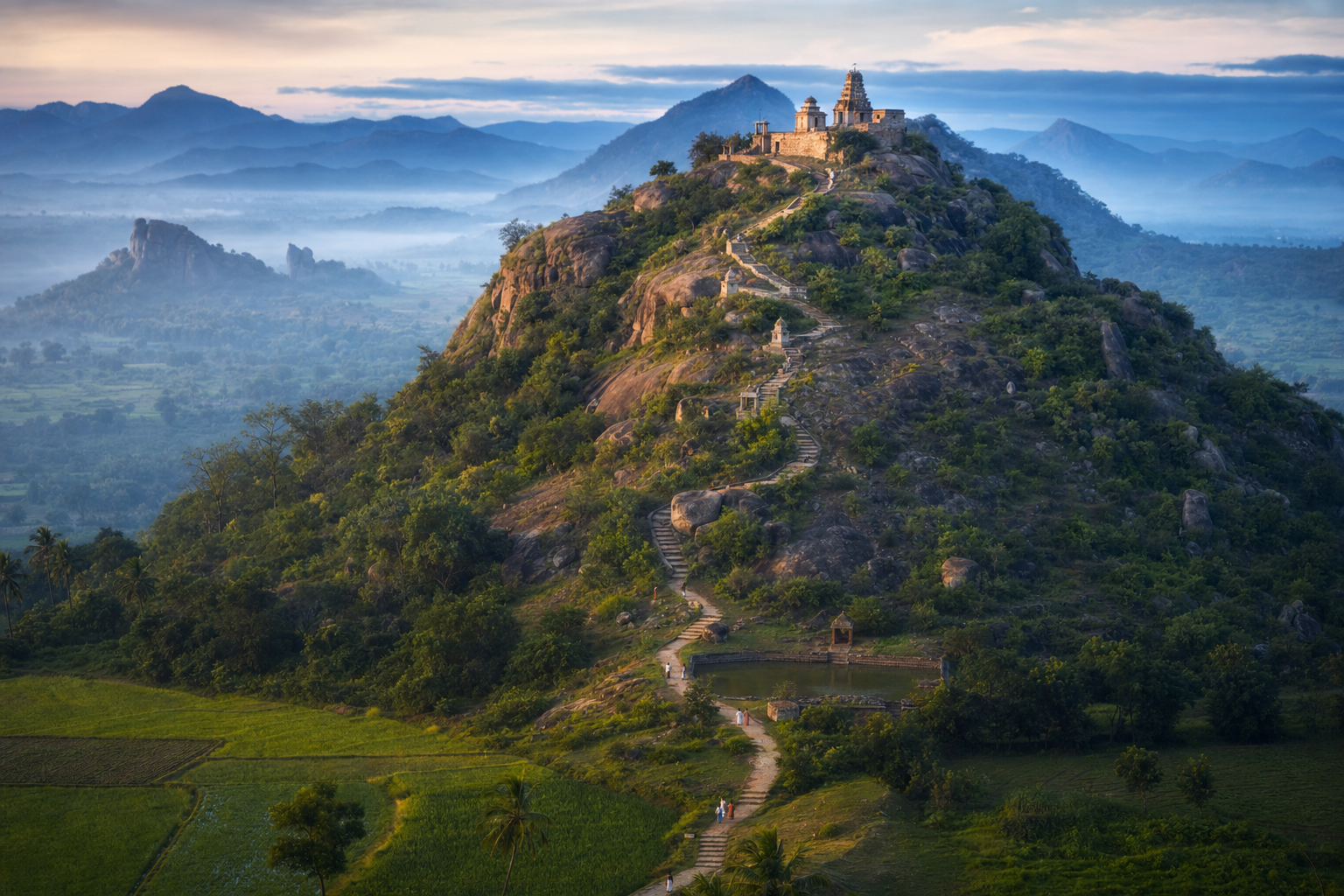
If you are planning your first visit to a South Indian hill shrine, ask one question before you map the route: where does the temple begin? At the sanctum door, at the first step, or at the first sight of the hill?
At a hill shrine, the sacred precinct usually unfolds by degrees. The approach changes your pace, the terrain shapes the architecture, associated shrines establish a ritual sequence, and the summit alters how you see the country below. If you treat the climb as inconvenient access to a building, you can complete darshan and still miss much of the kshetra. Read the whole route, and the visit becomes more coherent, safer and more respectful.
The sacred boundary begins below the sanctum
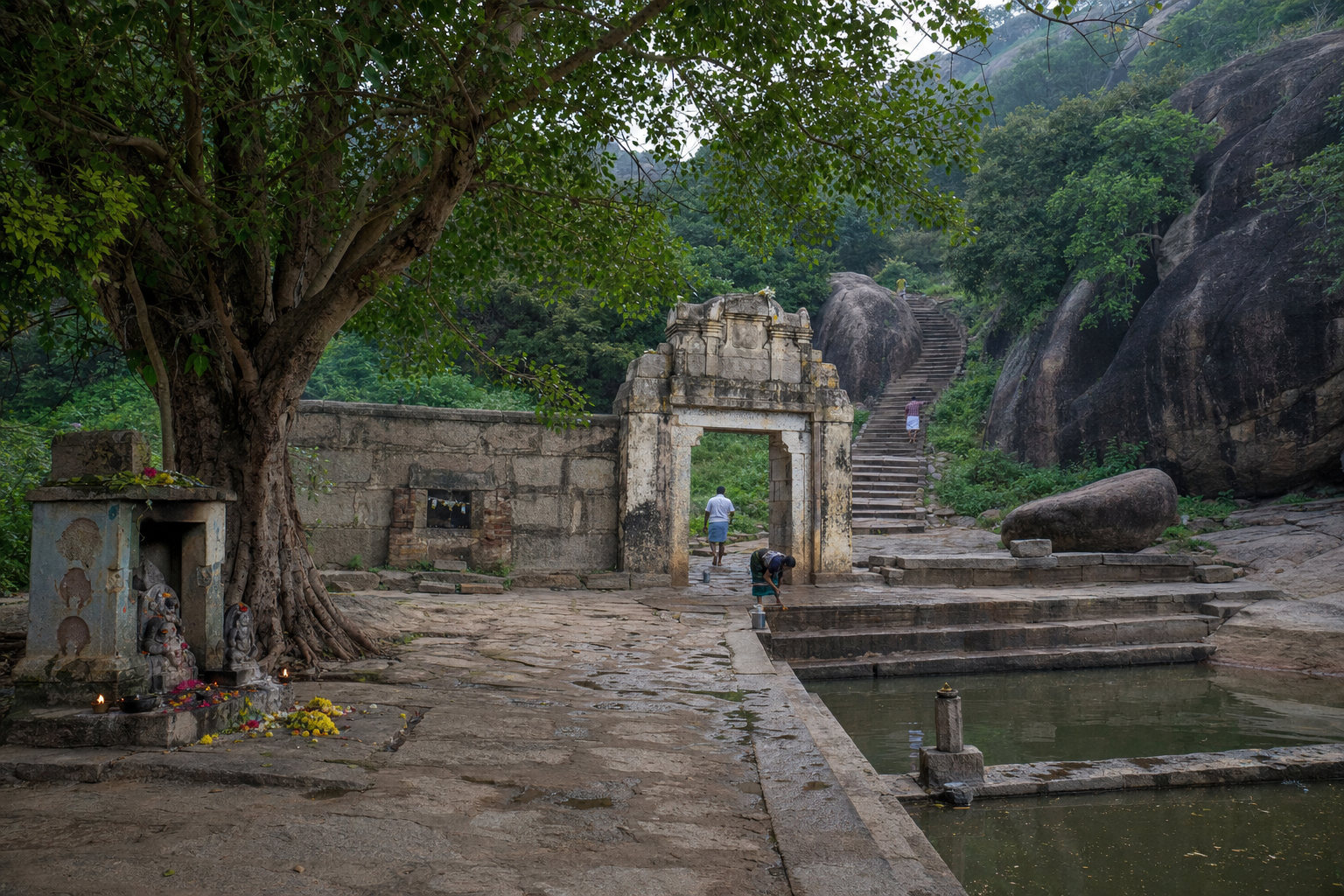
Sacred geography is more precise than a temple with a beautiful view. It is the relationship among deity, landform, route, architecture, adjoining shrines, ritual time and the communities that maintain them. The hill is not automatically sacred merely because it is high. It becomes part of a kshetra when terrain and worship have been joined through repeated movement, memory and ritual.
At Haddinakallu in Karnataka, that relationship is unusually visible. The Hanumantharaya shrine occupies an exposed granite height known as Eagle Stone Hill. Uneven bedrock affects the compact sanctum, modest mandapa and circumambulatory routes, which follow natural ledges rather than imposing a perfectly level plan. Robust masonry and restrained construction make practical sense where wind, rain and exposure govern what can endure.
The local name also helps you read the place. Raptors riding the thermals give Eagle Stone Hill an immediate visual identity, while Hanumantharaya presents Hanuman in a protective, guardian-like idiom suited to an elevated shrine overlooking settlements and movement corridors. A bird sighting does not prove how the name originated, and a commanding view does not by itself prove a defensive purpose. What you can notice responsibly is the fit among name, landscape and the devotional image of steadfast guardianship.
Tiruttani in Tamil Nadu reveals a different arrangement. Its sacred geography works as a network rather than a single isolated summit. The celebrated Murugan temple is one of the Arupadai Veedu, while the Chengalvaraya Swami Temple and Sengashuneer Vinayagar sannidhi occupy the quieter rear side of the hill. Pilgrims can therefore move between a major processional centre and a smaller precinct suited to more intimate worship.
Do not translate that vertical or institutional difference into a hierarchy of spiritual worth. The larger shrine may organize the public pilgrimage, while a smaller sannidhi gives a family the stillness in which the day acquires meaning. Sacred geography often depends on precisely this relationship between prominent and quiet spaces.
On your next visit, make four observations before consulting a plaque or reaching for a camera. Notice where your walking pace first changes. Find the point where dressed masonry yields to living rock. Watch which associated shrine local devotees approach and in what order. Then listen for connections across the hill: a bell carried by the wind, a procession route, a sightline or a path joining one precinct to another. Those observations will tell you more about how the kshetra functions than a summit photograph alone.
Read historical layers without manufacturing certainty
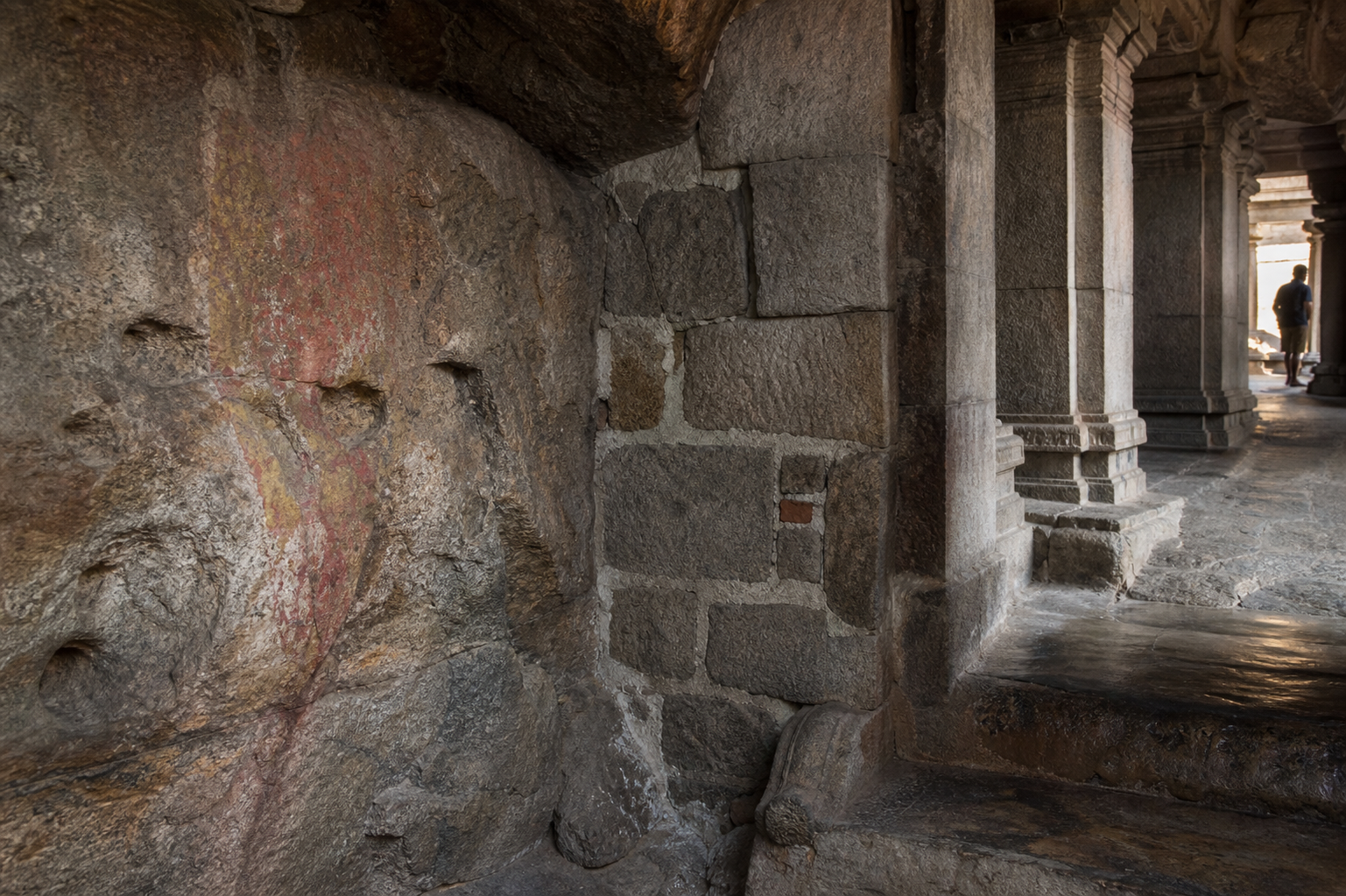
Weathered stone is not a dating method. Neither is an old-looking sanctum, a local royal association or a confident caption on social media. A living temple may contain early masonry, later mandapas, repaired steps, renewed plaster, modern paint and a ritual tradition older than several visible surfaces. Trying to force all of those layers into one foundation date usually produces a cleaner story than the evidence permits.
Haddinakallu offers a useful example of the distinction. Oral tradition places its foundation in the 8th century CE under a regional ruler, but the attribution remains provisional because securely dated inscriptions are not publicly available. You can preserve that tradition without converting it into a demonstrated archaeological conclusion. The accurate formulation is simple: this is the inherited account, and confirmation would require stronger inscriptional or documentary support.
At Tiruttani, formal documentation of the Chengalvaraya Swami Temple’s foundation is likewise limited. Its compact Dravidian vocabulary, stone plinths, lime-mortar finishes and stucco work are consistent with a late-medieval to early-modern continuum associated with Vijayanagara-Nayaka influence. Stylistic consistency establishes a plausible context, not an exact founding year. Repeated patronage and repair may explain the present building better than a single construction event.
Use four labels when you record what you learn:
- Visible: what you can directly observe, such as the rock-cut gradient, masonry joints, plaster, a mandapa or an altered path.
- Oral: a name, foundation account, festival memory or explanation transmitted by priests, residents and devotees.
- Stylistic: an informed comparison based on architectural or iconographic features. It can suggest a period but should not be presented as a dated record.
- Inscriptional or documentary: a text or record that can anchor a person, gift, repair or date. Even then, it may date an addition rather than the original sanctum.
This discipline matters when you speak about the shrine later. A careful caption preserves both faith and credibility: identify what is known, name what is inherited memory, and leave an unresolved date unresolved. Historical uncertainty does not diminish sanctity. It tells you that the temple is a living inheritance whose full chronology has yet to be documented.
If photography is permitted, record a public inscription or architectural feature in context before taking a close view. Note its location within the complex. Never apply chalk, water, powder or a rubbing material to make faint letters more visible; an amateur attempt to improve legibility can damage the surface that future specialists need to examine.
Let ritual sequence, not speed, organize your yatra
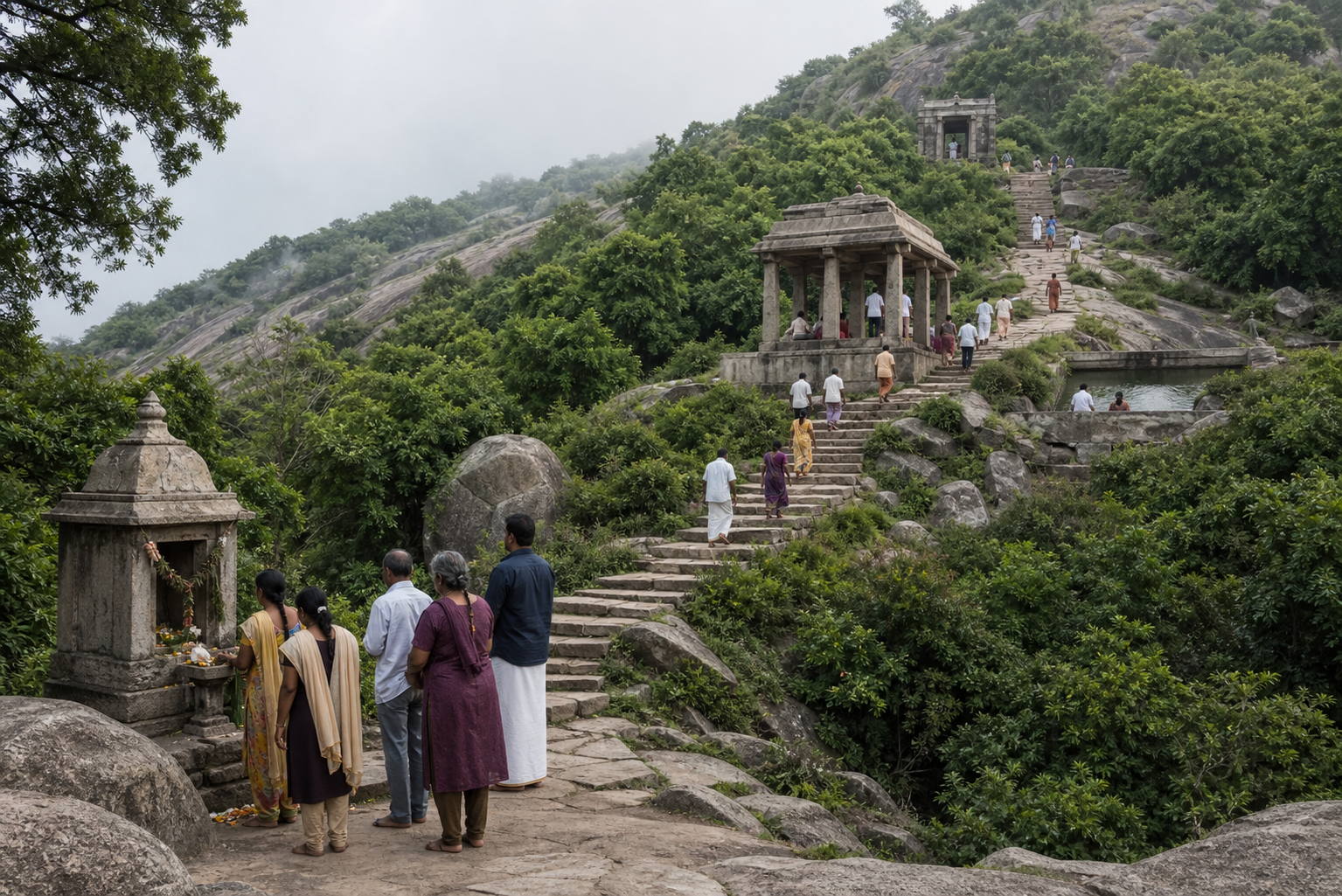
A hill-shrine visit is shaped by time as well as terrain. Daily worship commonly moves through abhishekam, alankaram, naivedyam and deeparadhana: bathing, adornment, food offering and the presentation of light. These are not decorative intervals around the real attraction. They establish the rhythm in which the deity is approached and darshan is received.
The particular rhythm varies by shrine. At Haddinakallu, Hanuman worship includes oil anointment, alankara, archana, collective kirtan and recitation associated with the Hanuman Chalisa and Sundara Kanda. Hanuman Jayanti and Rama Navami bring heightened observance, while Tuesdays and Saturdays commonly attract more devotees. Amavasya and Purnima may also bring extended pradakshina and bhajan gatherings.
At the Chengalvaraya Swami precinct, the daily cadence centres on abhishekam, alankaram, naivedyam, deeparadhana and requested archana, with additional attention at the Sengashuneer Vinayagar sannidhi on Vinayagar-related observances. Festivals at the neighbouring Murugan temple can increase footfall across the hill. A day that is quiet in an ordinary week may therefore feel entirely different during the larger festival cycle.
For a first visit, use this sequence:
- Verify current opening times, puja access, photography rules and mobility conditions locally. Do not rely on an undated itinerary for a living temple.
- Decide whether your priority is a festival congregation, a particular ritual or unhurried darshan. That decision should determine your arrival time.
- At the foot of the ascent, put away distractions and settle your pace. The climb is a transition into the precinct, not a race to the principal image.
- Ask or observe the locally followed order of sannidhis. Do not impose a sequence remembered from another temple, because associated shrines and circulation patterns differ.
- During puja, follow the priest’s or attendant’s direction, keep the darshan line moving, and step aside before beginning a longer prayer.
- After darshan, pause where stopping is permitted. Let the sound, wind, rock and outward view register before you begin the descent.
Tiruttani allows you to apply this method across a multi-shrine circuit. You might begin in the quieter rear-side precinct before joining the larger flow at the Murugan temple, or visit the smaller shrine after the main darshan when you need a less hurried close to the day. The point is not to discover one compulsory order. It is to choose an order that respects local practice and matches the devotional experience you are seeking.
At Haddinakallu, the ascent itself can narrow attention. Measured steps, steady breathing and the need to read the rock underfoot create conditions resembling one-pointed practice. You do not need to manufacture a dramatic feeling at the summit. Let physical attention do its quieter work, then carry that steadiness into darshan.
Prepare for a living hill and leave it intact
Match your plan to the actual terrain
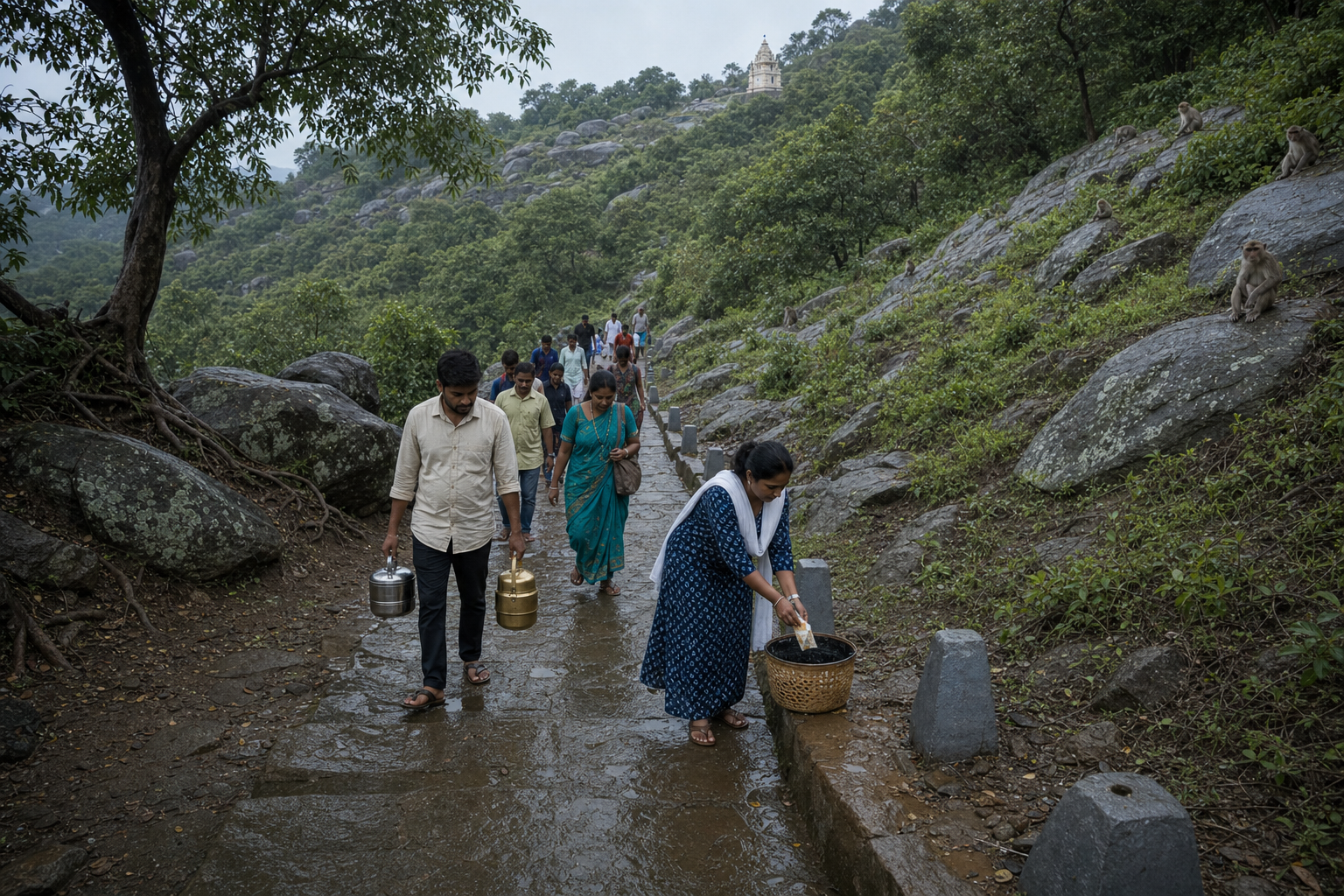
Hill shrines do not share one access profile. Haddinakallu involves exposed, weathered granite and steeper pitches. Post-monsoon visits generally offer cooler mornings and clearer skies there, while hotter periods favour an early ascent, adequate water and footwear with reliable grip. Move patiently around elders and children rather than overtaking on a narrow or uneven section.
The rear-side approach at Tiruttani can offer shorter distances and easier gradients for families and visitors with limited mobility. That does not mean the entire precinct is step-free. Thresholds, local slopes and connections between shrines may still require assistance. Confirm the route that matches the least mobile person in your group before committing everyone to a full circuit.
Carry a reusable water bottle if local rules allow it, keep your hands free on difficult stretches, and wear modest clothing that permits safe movement. Approach footwear should provide traction, but remove it where the sacred precinct requires. If rain, heat or a wet rock surface makes the ascent unsafe for someone in your party, turn back or shorten the circuit. Completing every stop is not worth a fall.
Plan crowd conditions with the same care. A devotee seeking silent prayer should not unknowingly choose a major festival period, while someone hoping to witness collective bhajan should not arrive expecting it on an ordinary afternoon. Tuesdays, Saturdays and major Hanuman observances matter particularly at Haddinakallu; the Murugan festival calendar can affect movement throughout Tiruttani. Check locally because ritual schedules and access arrangements can change.
Make seva compatible with conservation
The main threats to a hill shrine are often cumulative rather than spectacular. Repeated footfall wears stone. Monsoon water follows small depressions until they become channels. A shortcut kills vegetation and gives runoff a new route. Plastic packaging and discarded offerings spread downslope beyond the visible temple yard.
Your part is concrete: stay on established approaches, carry your waste back or use a designated collection point, avoid plastic-heavy offerings, respect restrictions near sanctums, and do not climb on masonry for a photograph. Keep sound low outside collective worship. The open hill may look expansive, but bells, conversation and amplified audio travel far across it.
Cleanliness seva should also respect the material fabric. Collecting litter under local direction is helpful; scrubbing old stone, repainting a surface or moving a carved fragment without authorization is not. Devotional enthusiasm cannot substitute for conservation judgment.
For communities responsible for a shrine, low-impact paths, carefully planned rainwater channels, restrained signage and organized cleanliness drives address the mechanisms that cause damage. Documentation has a different but complementary role. Epigraphic survey can test historical claims; architectural recording and 3D photogrammetry can map deterioration; oral-history work can preserve songs, ritual knowledge and local names that stone alone cannot carry.
The people who sustain daily worship must remain central to that work. Priests, residents, long-time devotees, heritage specialists and administrators hold different kinds of knowledge. A sound conservation effort brings those forms of knowledge into conversation before altering the route, drainage or appearance of the precinct.
Key takeaways for your next hill-shrine visit
- The temple begins with the approach. Read the gradient, rock, paths, associated shrines, sounds and sightlines before focusing on the summit.
- Keep oral memory, visible fabric, stylistic interpretation and dated evidence distinct. A provisional history can be meaningful without being presented as proven.
- Choose your arrival around the experience you actually seek: festival participation, a particular puja or quiet darshan.
- Do not generalize access conditions. Plan for the terrain, weather and least mobile person at the particular hill you are visiting.
- Treat low-impact conduct as part of seva. Stay on the path, minimize waste, observe photography rules and leave physical conservation to authorized teams.
Before your next yatra, prepare a short note with three things: the ritual time you hope to attend, the access needs of your group, and one honest question about the hill’s history or local name. Arrive early enough to walk without rushing, ask when you do not know the local practice, and descend without leaving a trace. That small discipline turns a stop at a hilltop building into attentive participation in a living sacred landscape.
References
- DharmaRenaissance Blog — Haddinakallu Hanumantharaya Temple: A Timeless Ascent to Eagle Stone Hill’s Sacred Heritage
- DharmaRenaissance Blog — Timeless Sanctity at Chengalvaraya Swami Temple, Tiruttani: History, Architecture, Travel