
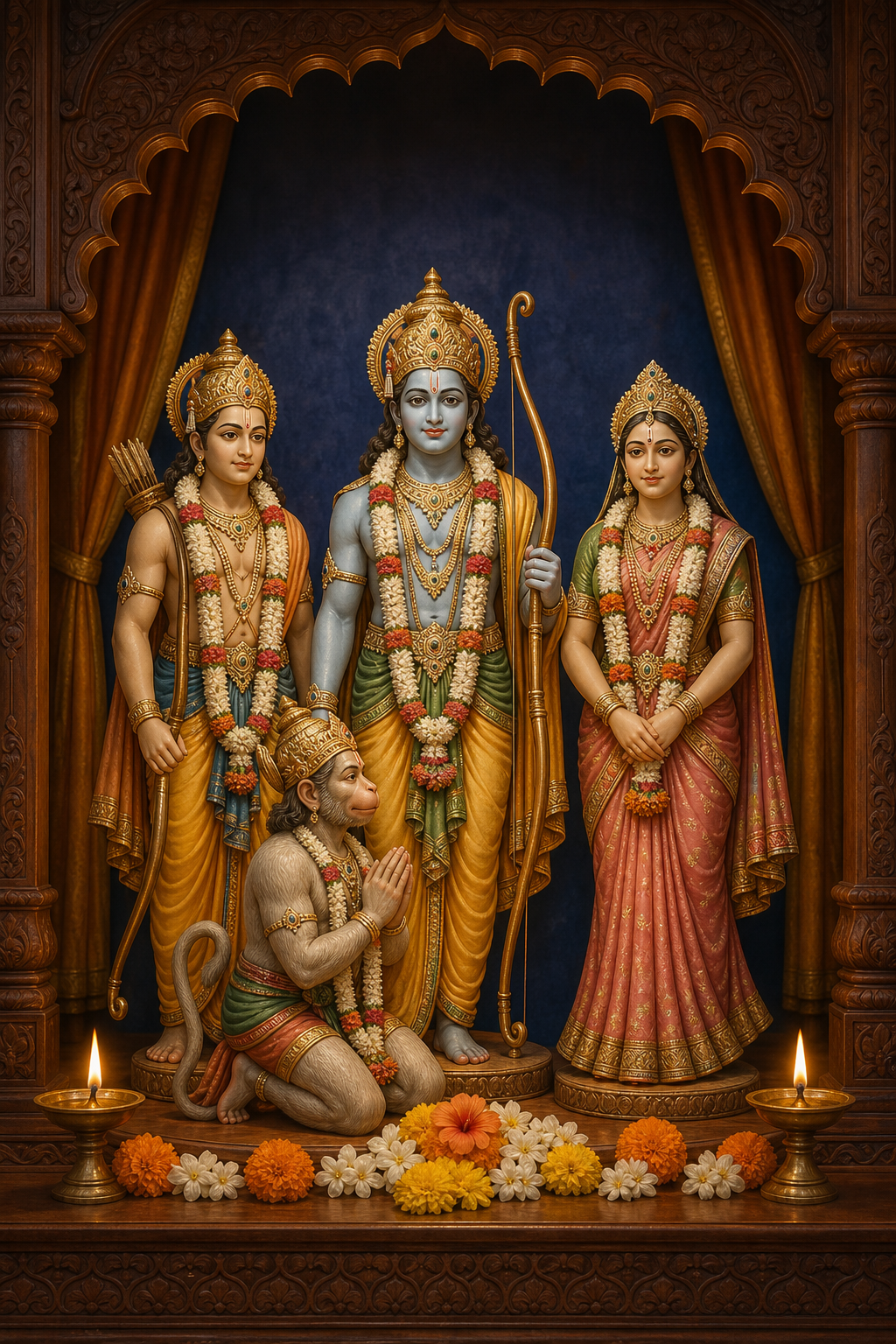
You may recognize Rama, Sita, Lakshmana, and Hanuman immediately, yet still wonder why they stand in a particular order, why one figure is smaller, or why Hanuman kneels while the others stand. Those details are not ornamental trivia. They tell you how each person relates to dharma and how you, as the viewer, are being invited to respond.
Begin with one simple shift: do not read a Ramayana murti as an isolated portrait or a frozen scene. Read the entire arrangement as a sacred relationship. Position, scale, gaze, weapon, ornament, color, and ritual adornment work together to turn the Ramayana’s ideals into a form you can see, worship, and practice.
Read the group before studying the individual figures
A Rama parivara is a visual map of ordered relationships. Sri Rama normally occupies the center, holding his kodanda bow and accompanied by a quiver. Sita stands at Rama’s right, which is the viewer’s left. Lakshmana stands at Rama’s left, which is the viewer’s right. Hanuman commonly kneels near Rama’s feet, often toward the viewer’s left, and looks upward in devotion. This stable relational arrangement appears across temple sculpture, processional bronzes, reliefs, and painting, although regional traditions may vary its details.
The first thing to notice is not who appears most impressive. Notice who faces whom, who stands beside whom, and who places strength at another’s service. Rama’s centrality expresses sovereign dharma. Sita’s place beside him prevents kingship from being reduced to solitary power. Lakshmana’s nearness expresses vigilant companionship. Hanuman’s position at the feet makes humility active rather than passive: the kneeling figure is also the figure capable of extraordinary action.
Treat the arrangement as a grammar, not an inflexible seating chart. A regional painting may alter orientation, compress the figures, or place Hanuman elsewhere to serve a narrative episode. When the layout differs, look for the deeper constants: Rama remains the axis, Lakshmana remains the armed companion, and Hanuman’s body and gaze remain directed toward service.
Placement, scale, and attributes assign each form a dharmic role
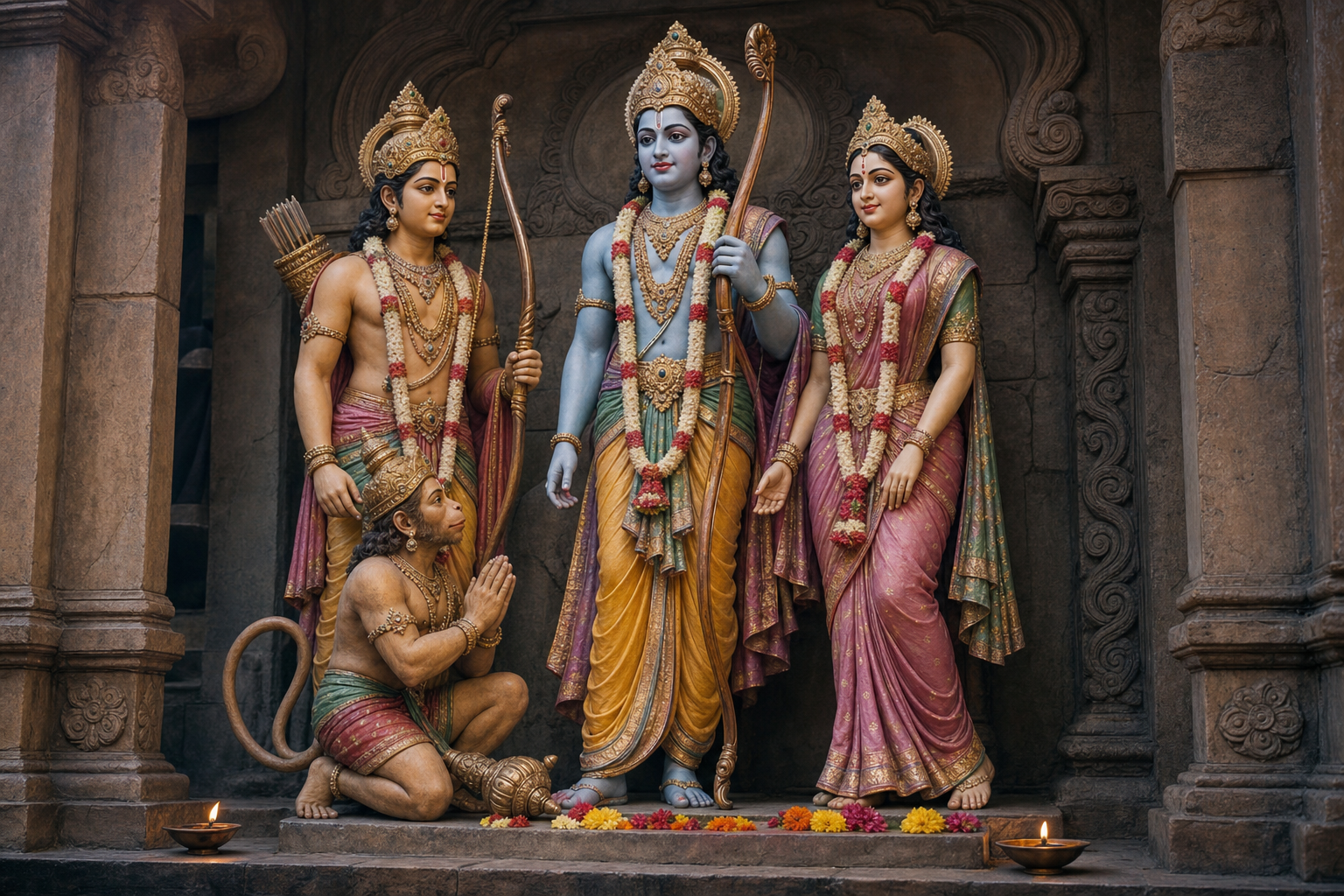
The figures share a family resemblance, but sacred artists avoid making them interchangeable. Each visual distinction tells you how power is being used.
| Figure | What to notice | What the form teaches |
|---|---|---|
| Sri Rama | Central position, kodanda bow, and quiver | Authority governed by righteousness and restraint |
| Sita | Position at Rama’s right, within the central family relationship | Dharma is relational and cannot be reduced to the heroism of one individual |
| Lakshmana | Bow, arrows, quiver, alert stance, and a form usually slightly smaller or less opulent than Rama’s | Strength becomes sacred when disciplined by seva, loyalty, and vigilance |
| Hanuman | Kneeling posture, upward gaze, proximity to Rama’s feet, and in many regions a red-orange coating | Humility and immense capacity can inhabit the same devotee |
Lakshmana offers the clearest example of visual hierarchy without humiliation. He is typically two-armed and carries the equipment of a warrior. His crown, sacred thread, armlets, necklaces, waistband, and anklets establish his princely dignity, but his ornamentation is commonly quieter than Rama’s. His right hand may grasp an arrow or remain ready near the bowstring, while his left steadies the bow. Even when the bodies are similar, a small difference in scale and breadth identifies Rama as the central sovereign and Lakshmana as the devoted younger brother.
If two bow-bearing princes are difficult to distinguish, use several clues together. First compare their positions relative to Sita. Then compare scale, ornament, and posture. In painted traditions, Rama is often shown with a dark complexion while Lakshmana is fair. Do not identify Lakshmana by a conch, discus, or Srivatsa; his identity rests primarily in martial attributes, youthful composure, and proximity to Rama.
Vaishnava theology also understands Lakshmana as a manifestation of Adi Sesha, the cosmic support of Vishnu. His apparently subordinate place therefore has metaphysical depth. He is not marginal to divine action; he represents the sustaining power that willingly remains near the Divine. This is why reduced scale should be read as relational hierarchy, not diminished spiritual worth.
Regional style changes the surface without erasing this grammar. Chola bronzes commonly make Lakshmana slender and rhythmically poised. Hoysala sculpture favors dense jewelry and sharply rendered textiles. Vijayanagara and Nayaka works give the figures a more emphatic regal presence. North Indian, Himalayan, Rajasthani, and Pahari paintings use color and costume to separate the brothers. At Angkor, adjacency and martial attributes help identify Lakshmana within crowded Ramayana narratives. When you encounter an unfamiliar style, follow relationships before judging it by the conventions of another region.
One feature remains especially instructive: composure. Even in battle scenes, Lakshmana is often balanced rather than uncontrolled. The calm face, measured body, and ready bow depict kshatra governed by dharma. The image asks you to distinguish protection from aggression and preparedness from anger.
Ritual completes what the iconography begins
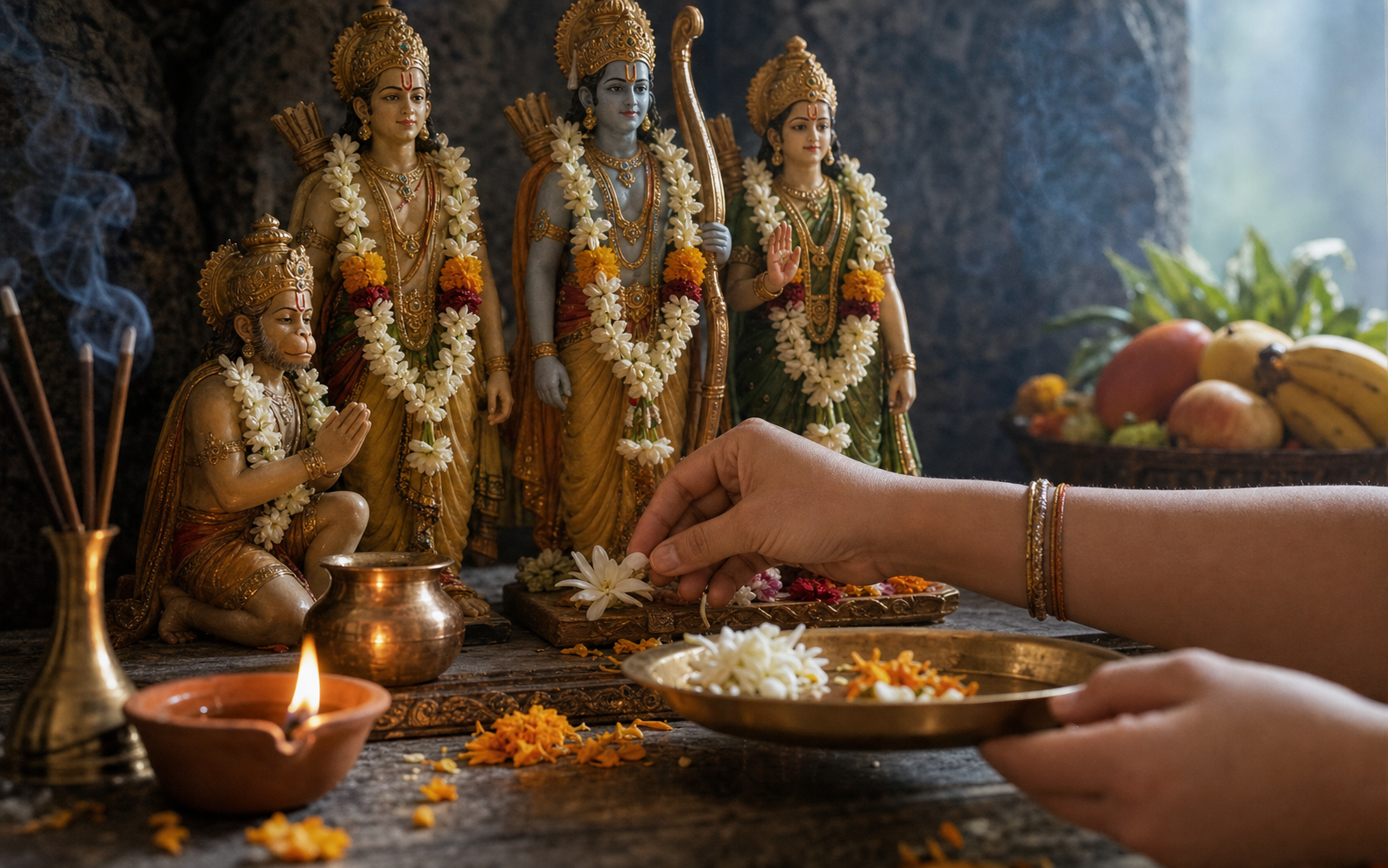
A sacred image is not finished when the sculptor puts down the tools. Daily alankara, offerings, recitation, and procession activate its relationships in the life of a community. Temple attendants adorn Lakshmana as Rama’s vigilant companion. During utsavas, Rama-parivara bronzes travel together rather than becoming disconnected personalities. The procession carries a whole order of dharma into public space: rightful authority, faithful companionship, protective service, and surrendered strength.
Hanuman’s sindoor makes this union of story, image, and ritual especially visible. A cherished regional legend recounts that Hanuman saw Sita applying sindoor for Rama’s well-being. He then covered his own body with it, reasoning that a greater offering would express greater devotion to Rama. The resulting red-orange form became a material proclamation of courage, tapas, protective energy, and wholehearted seva.
The pigment does more than make Hanuman visually distinctive. Its application is itself an act of devotion, so the icon displays the accumulated attention of worshippers. In some settings, an oil-based shendur layer has also helped protect a stone or metal surface. That practical effect does not exhaust the symbolism, but it shows how ritual care and material care can meet.
Care must remain part of the offering. Chemical vermilion may contain unsafe substances, and repeated thick application can damage an old or sensitive image. Use a natural, non-toxic preparation only where the temple or household tradition permits it. If the surface should not be touched, place a small amount on a betel leaf or designated offering plate before Hanuman. Sindoor is not compulsory; flowers, chandan, a lamp, japa, or simple pranam can express the same devotion without risking the murti.
This principle applies beyond pigment. Alankara should reveal the deity’s form rather than obscure it, and an offering should preserve the sacred object entrusted to the next generation. Following the temple’s instructions is therefore not a restriction on bhakti. It is bhakti expressed as stewardship.
Honor living devotion without confusing textual chronology
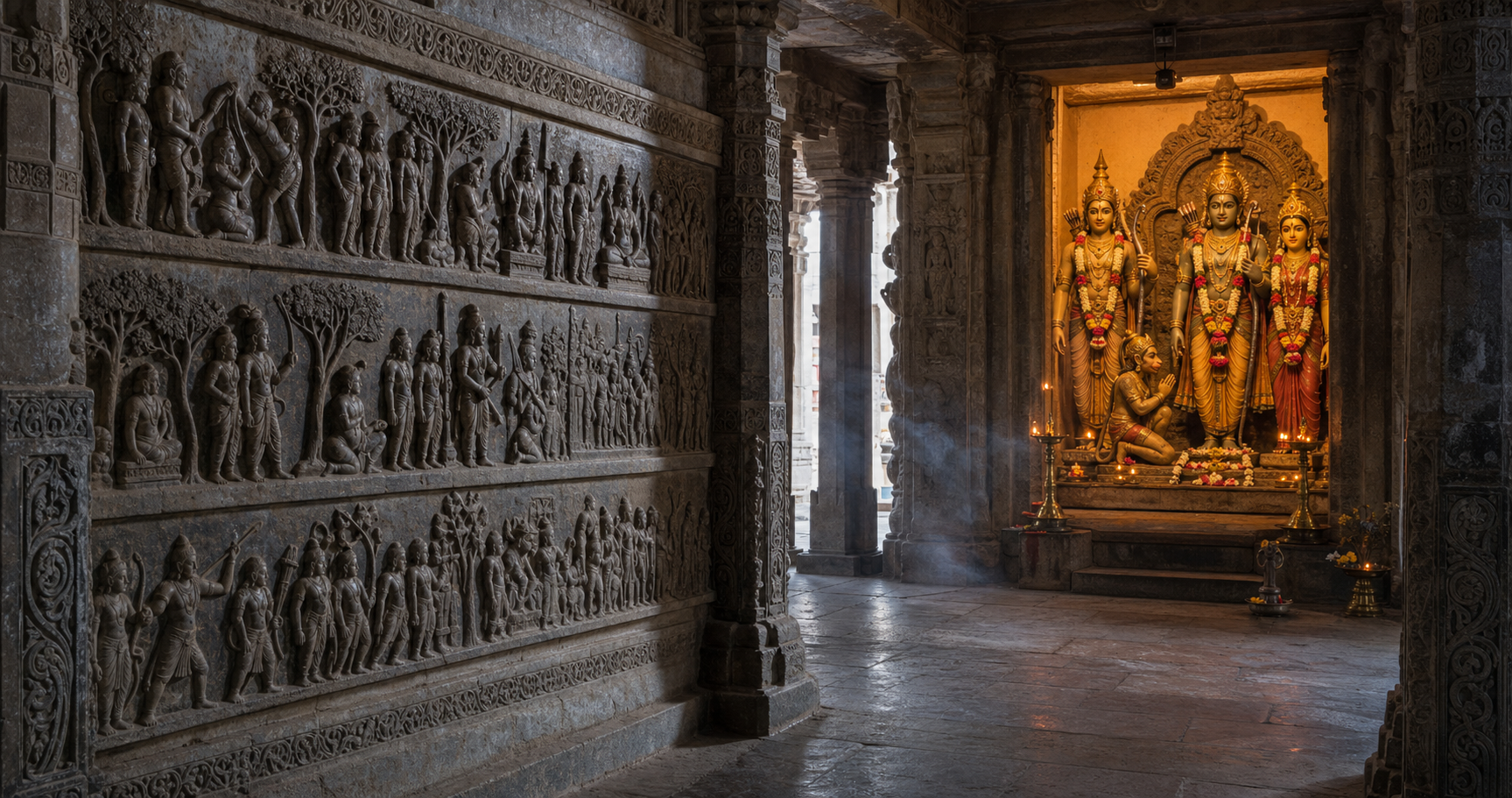
Ramayana devotion has never been limited to illustrating a single manuscript line by line. Recitation, theater, regional poetry, oral memory, pilgrimage, and household ritual have added motifs that communities now cherish. You can honor those motifs without assigning every one of them to the earliest textual layer.
The full-body sindoor story belongs primarily to later oral and regional Ram-bhakti traditions rather than the earliest Ramayana strata. The Lakshmana Rekha is another familiar devotional amplification: it is prominent in later literary and performative memory, but it does not occur in the Valmiki Ramayana and is uncommon in durable temple sculpture. That distinction matters whenever someone claims that a beloved custom or image comes directly from Valmiki.
Chronology does not require contempt. A later tradition may reveal how devotees understood Hanuman’s self-offering or Lakshmana’s protective vigilance. What it cannot do is retroactively become a passage in an earlier text. A mature reading holds both truths at once: the textual record deserves accuracy, and living bhakti has a genuine history of its own.
When you meet an unfamiliar Ramayana image, ask three questions in order. Which relationship or episode is being shown? Which visual conventions identify the figures? Does a surprising detail come from the epic narrative, a later devotional tradition, or a local ritual practice? That sequence prevents two opposite errors: dismissing regional bhakti because it is later, and calling every later motif part of the Valmiki Ramayana.
Use the sacred image as a discipline at home
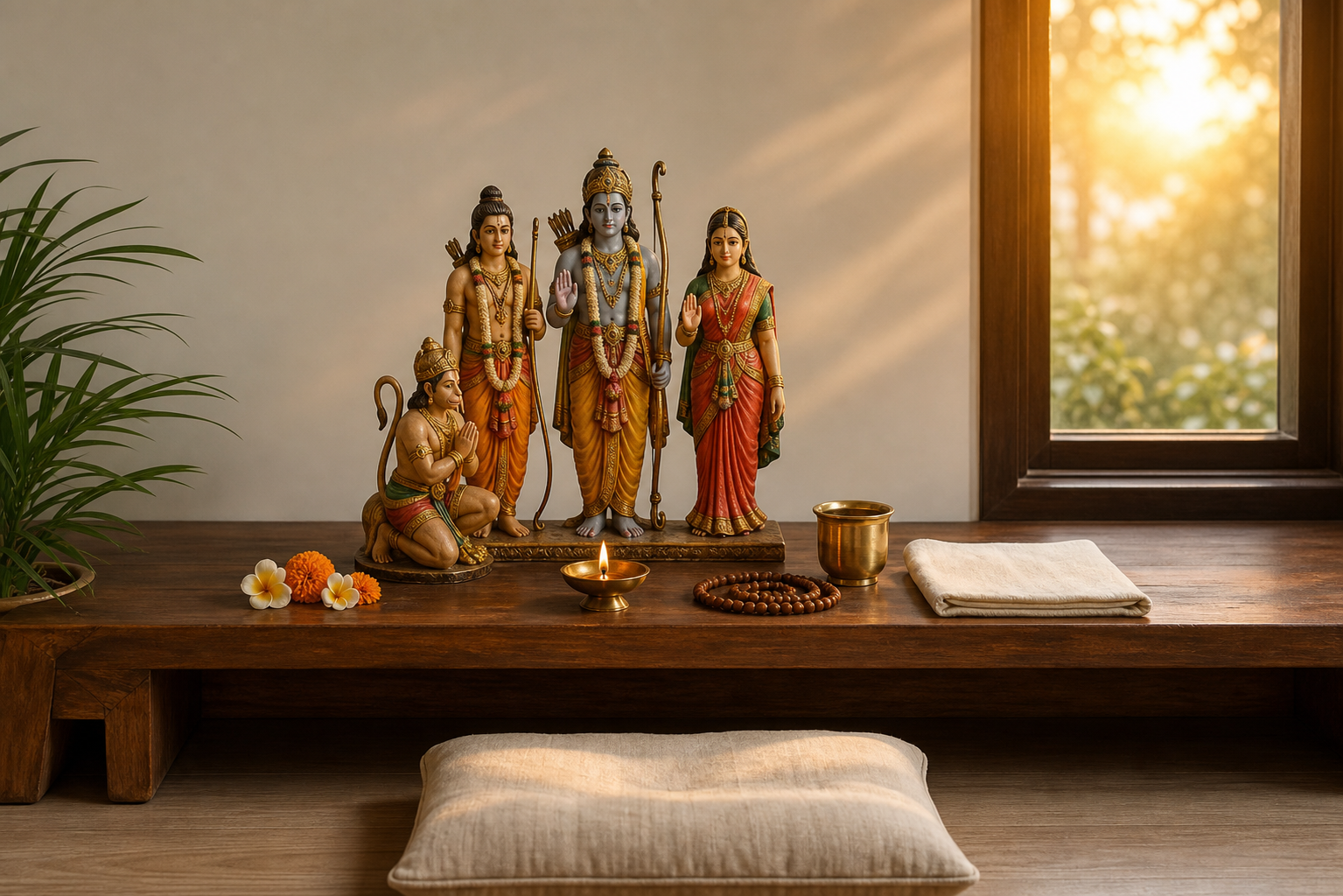
You do not need an elaborate collection of ritual materials to engage the icon properly. A clean image, attentive looking, a simple offering, and one concrete act of dharma are enough to begin. If your family follows a particular sampradaya, keep its sequence and mantras; the outline below is a general practice, not a replacement for lineage guidance.
- See the whole parivara first. Before focusing on one face, notice the central axis, the sides occupied by Sita and Lakshmana, Hanuman’s level, and the direction of each gaze.
- Name the relationship expressed by each posture. Read Rama as righteous authority, Sita as indispensable presence within the dharmic household, Lakshmana as vigilant seva, and Hanuman as power surrendered to devotion.
- Choose one quality for the day’s practice. If you are carrying responsibility, contemplate Rama’s restraint. If you must support someone without seeking attention, contemplate Lakshmana. If pride is obstructing service, contemplate Hanuman at Rama’s feet.
- Make a simple offering. Light a lamp where it is safe, offer water or flowers, and recite a familiar Rama or Hanuman mantra. If you offer sindoor, use a safe preparation and protect the image’s surface.
- Complete the worship outside the shrine. Decide on one act that gives the image practical consequence: finish an unglamorous duty, protect someone without losing self-command, repair a family obligation, or serve without announcing the service.
Key takeaways
- Read a Rama-parivara image as a network of relationships before examining individual ornaments.
- Position, relative scale, attributes, gaze, and posture identify each figure more reliably than one clue alone.
- Lakshmana’s smaller scale expresses disciplined seva, not lesser spiritual worth; his link with Adi Sesha deepens that meaning.
- Hanuman’s sindoor is a living expression of Rama-bhakti, but it is optional and should never endanger a sacred image or a devotee’s health.
- Later devotional motifs deserve respect without being misrepresented as episodes from the Valmiki Ramayana.
- The icon fulfills its purpose when darshan becomes conduct: authority with restraint, vigilance without rage, and strength placed in service.
The next time you stand before Rama, Sita, Lakshmana, and Hanuman, pause before asking for anything. Read the relationships built into the image. Then choose the one form of dharmic service that your own relationships require from you that day.
References
- DharmaRenaissance Blog — Lakshmana in Sacred Art: Powerful Iconography, Proportion Rules, and Spiritual Meaning
- DharmaRenaissance Blog — Why Sindoor Adorns Hanuman: Sacred Legend, Protective Power, and Puja Guide