
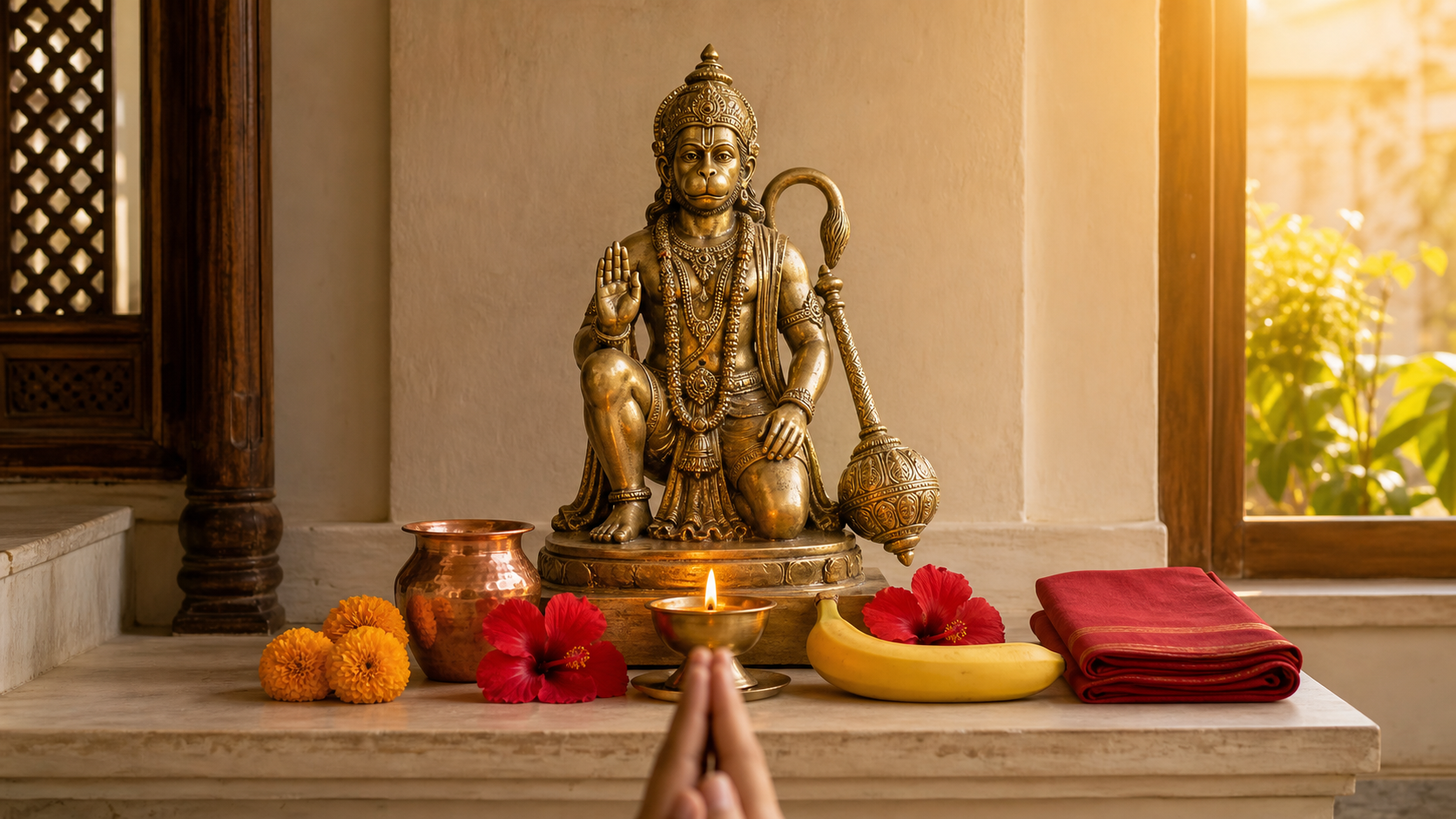
If you want to worship Hanuman but keep hesitating over the correct day, mantra, or ritual sequence, separate two questions. Liturgy tells you what to do. Muhurta helps you decide when to do it. You need a workable answer to both, but timing should support devotion rather than postpone it.
You can begin with a clean place, a clear sankalpa, a lamp, one mantra, and one stotra. Once that practice is stable, refine the date through your local Panchanga and expand the offerings according to your family, temple, or guru-parampara.
Choose the timing in the right order
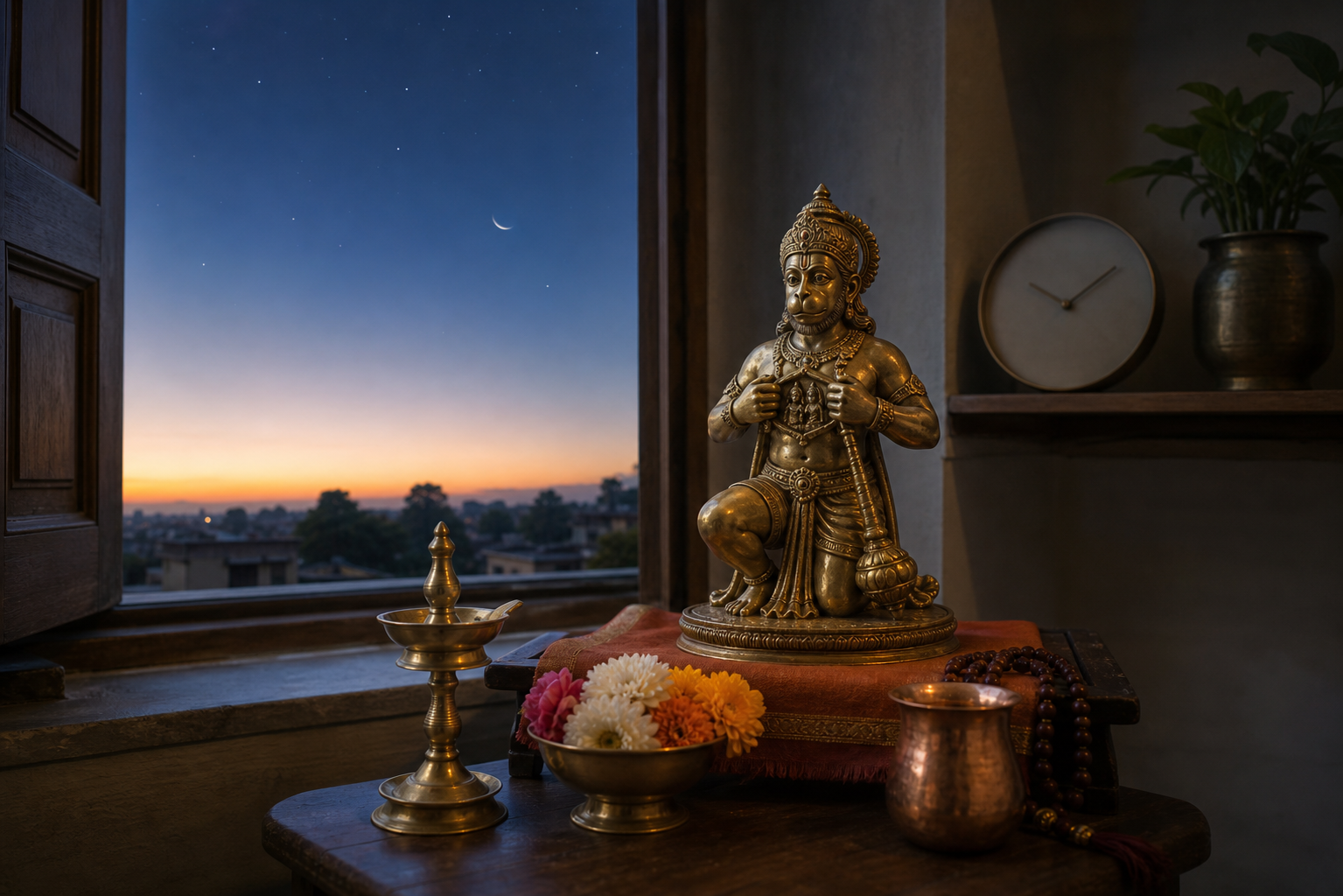
For ordinary household worship, Tuesday and Saturday are the dependable weekly choices. Tuesday is associated with courage, discipline, and resolute action. Saturday worship is commonly connected with steadiness and prayer for relief from Shani-related difficulties. A Saturday evening lamp during Pradosha Kala has a distinct place in many homes.
Sunrise and the evening sandhya are widely observed windows. Brahma Muhurta before sunrise can suit a quiet personal practice, while Abhijit Muhurta around midday is a practical fallback in traditions that use it. Exact clock times depend on the date and place, so consult a Panchanga calculated for your location rather than copying a time published for another city.
Use this order of priority:
- Honor established maryada. If your family, temple, or guru-parampara prescribes a day, festival date, mantra, or sequence, begin there.
- Select a sustainable weekday. Choose Tuesday or Saturday according to the rhythm you can actually maintain.
- Choose a suitable part of the day. Sunrise or evening sandhya works for most household observances; Saturday Pradosha may be selected where customary.
- Check local start and end times. A Tithi or Nakshatra may change within the civil day. The label printed beside a date is not enough.
- Avoid Rahu Kalam and Yamaganda when selecting a formal window. Read these intervals from the same local Panchanga.
- Refine with Tithi and Nakshatra. Do this when planning a vrata, an extended parayana, or a more elaborate puja.
- Personalize only if useful. Tarabala and Chandrabala can distinguish between otherwise suitable dates, but they are refinements rather than prerequisites for sincere remembrance.
| Your observance | Practical starting point | Useful refinement |
|---|---|---|
| Daily remembrance | A consistent sunrise or evening period | Keep the same short liturgy instead of waiting for a special alignment |
| Weekly household puja | Tuesday or Saturday | Choose a favorable Tithi or Nakshatra and remain outside Rahu Kalam and Yamaganda |
| Tuesday vrata | A cycle of 11, 21, or 41 consecutive Tuesdays, where this discipline belongs to your practice | Select the opening date through the local Panchanga and keep the ritual format manageable |
| Hanuman Jayanti | The date observed by your region and lineage | Follow the temple calendar rather than imposing a date from another regional tradition |
| Extended Sundara Kanda recitation | A chosen Tuesday, Saturday, festival, or established vrata day | Use a supportive Tithi and Nakshatra if the schedule permits |
How far should you take Panchanga refinement?
The Panchanga has five limbs: Vara, Tithi, Nakshatra, Yoga, and Karana. Most householders can make a sound choice by working first with Vara, Tithi, and Nakshatra.
Within the repeating fivefold Tithi classification, Bhadra Tithis are numbered 2, 7, and 12; Jaya Tithis are 3, 8, and 13; and Purna Tithis are 5, 10, and 15. These groups are generally supportive of devotional works. Rikta Tithis, numbered 4, 9, and 14, are usually avoided for beginning something new. Remedial or protective rites on a Rikta Tithi are better left to qualified guidance rather than improvised at home.
Pushya is a widely favored Nakshatra for sacred activity and is especially valued for Hanuman worship in Chaitra. Month-specific Nakshatra combinations differ across regional almanacs, so do not turn one local convention into a universal rule. The same care applies to Hanuman Jayanti: Chaitra Purnima is observed in many regions, while some southern traditions follow another lunar phase or Moola Nakshatra in Margazhi.
If you know your Janma Nakshatra, Tarabala offers a personal check. Count from the birth star to the day’s Nakshatra through the ninefold sequence: Janma, Sampat, Vipat, Kshema, Pratyak, Sadhana, Naidhana, Mitra, and Ati-Mitra, then repeat. Sampat, Kshema, Sadhana, Mitra, and Ati-Mitra are favored for devotional acts. Vipat, Pratyak, and Naidhana are generally avoided.
Chandrabala is checked from your Janma Rashi. The Moon in the 1st, 3rd, 6th, 7th, 10th, or 11th sign from the Janma Rashi is considered favorable for most spiritual practices. If you do not know your birth star or Rashi reliably, do not guess. Keep the Tuesday or Saturday observance, or ask a priest who works with the Panchanga used in your community.
Advanced selection may favor Siddha or Amrita Siddhi Yogas and avoid Vyatipata or Vaidhriti where possible. Mangal Hora on Tuesday can also mark the beginning of a discipline centered on courage and right action. These filters are useful only while they clarify the decision. If stacking them leaves you perpetually waiting, return to the weekly day, local sandhya, and steady practice.
Follow one stable home liturgy before adding more
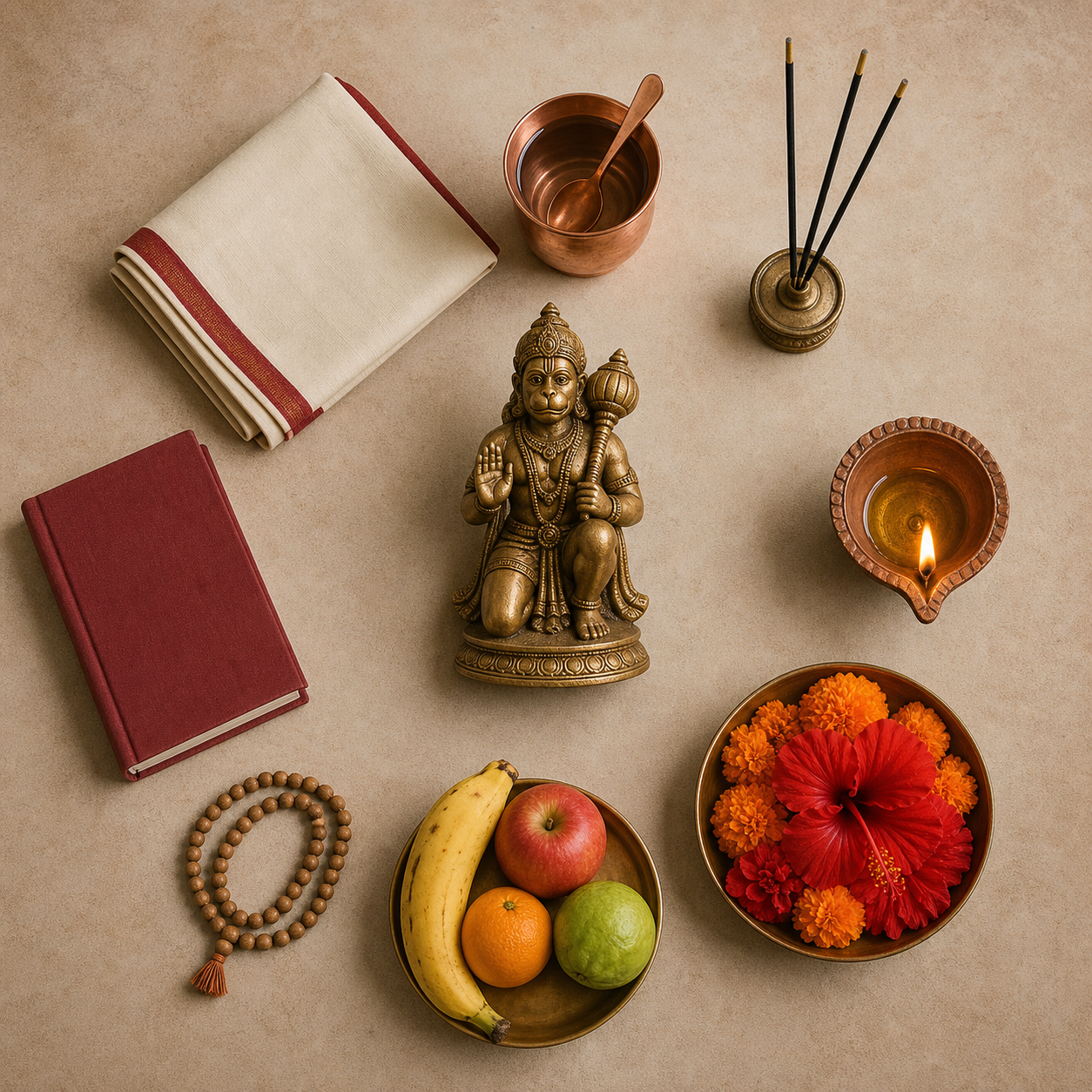
A coherent Hanuman puja has a beginning, a central act of remembrance, and a proper conclusion. The number of items can change, but that inner structure should remain visible. The following sequence is suitable as a household framework; adapt details wherever your sampradaya has its own instructions.
- Prepare yourself and the space. Bathe or complete your normal personal cleansing, wear clean clothing, and clear the worship area.
- Arrange the essentials. Set out the deepa, flowers, incense, gandha, naivedya, water, and the text or mala you will use. Place the flame on a stable surface away from loose fabric, and never leave it unattended.
- Settle the breath. Sit quietly and take a few gentle, even breaths. A brief pranayama may be used if it is already part of your practice.
- Perform achamana if customary. Do not add unfamiliar ritual actions merely to make the puja look elaborate.
- State the sankalpa. Name the day or observance and the dharmic quality you seek to cultivate. Keep the intention benevolent.
- Light the deepa and invoke Hanuman. Offer a dhyana verse if you know one, or contemplate Hanuman as the devoted servant of Sri Rama: powerful, discerning, humble, and completely directed toward dharma.
- Make the offerings. In panchopachara, offer gandha, pushpa, dhupa, deepa, and naivedya. Use shodashopachara only when you know the fuller sequence through family or lineage practice.
- Perform mantra japa. Recite one selected mantra at an even pace. Eleven repetitions are sufficient for a short observance; 27, 54, or 108 can anchor a fuller session.
- Recite one principal stotra. The Hanuman Chalisa is the most accessible choice. Add the Sankat Mochan Hanuman Ashtak or Hanuman Pancharatnam when time and familiarity allow.
- Conclude with aarti and pranam. Aarti Kijai Hanuman Lala Ki is commonly sung, but your household version takes precedence.
- Share prasada and sit briefly in silence. Let the rite settle before returning immediately to conversation, a screen, or another task.
Your sankalpa need not imitate a complex Sanskrit formula you have not learned. A plain statement can be specific and reverent: On this Tuesday, I offer this worship to Sri Hanuman so that courage, clarity, discipline, and the spirit of service may grow in me, and so that I may carry out my dharma without harming anyone. This is a suggested intention, not a mandatory liturgical text.
Three practical levels of observance
For a short daily practice: cleanse the space, make a sankalpa, light the lamp, recite Om Hanumate Namah 11 times, offer one familiar stotra or a brief period of remembrance, then perform pranam. Keep this form steady before increasing the count.
For a Tuesday or Saturday puja: perform panchopachara, complete 27, 54, or 108 repetitions of the moola mantra or Hanuman Gayatri, recite the Hanuman Chalisa, add one other hymn if desired, and close with aarti, prasada, and silence.
For a festival, vrata, or extended observance: add the Hanuman Ashtottara Shatanamavali, a larger japa count, or Sundara Kanda parayana. You may read one sarga each day, complete the whole Sundara Kanda on an auspicious day, or follow an established Shodasha-Dina, or 16-day, cycle. A longer rite is not automatically a deeper one; choose a form you can complete attentively.
Match the chant to your purpose and level of training
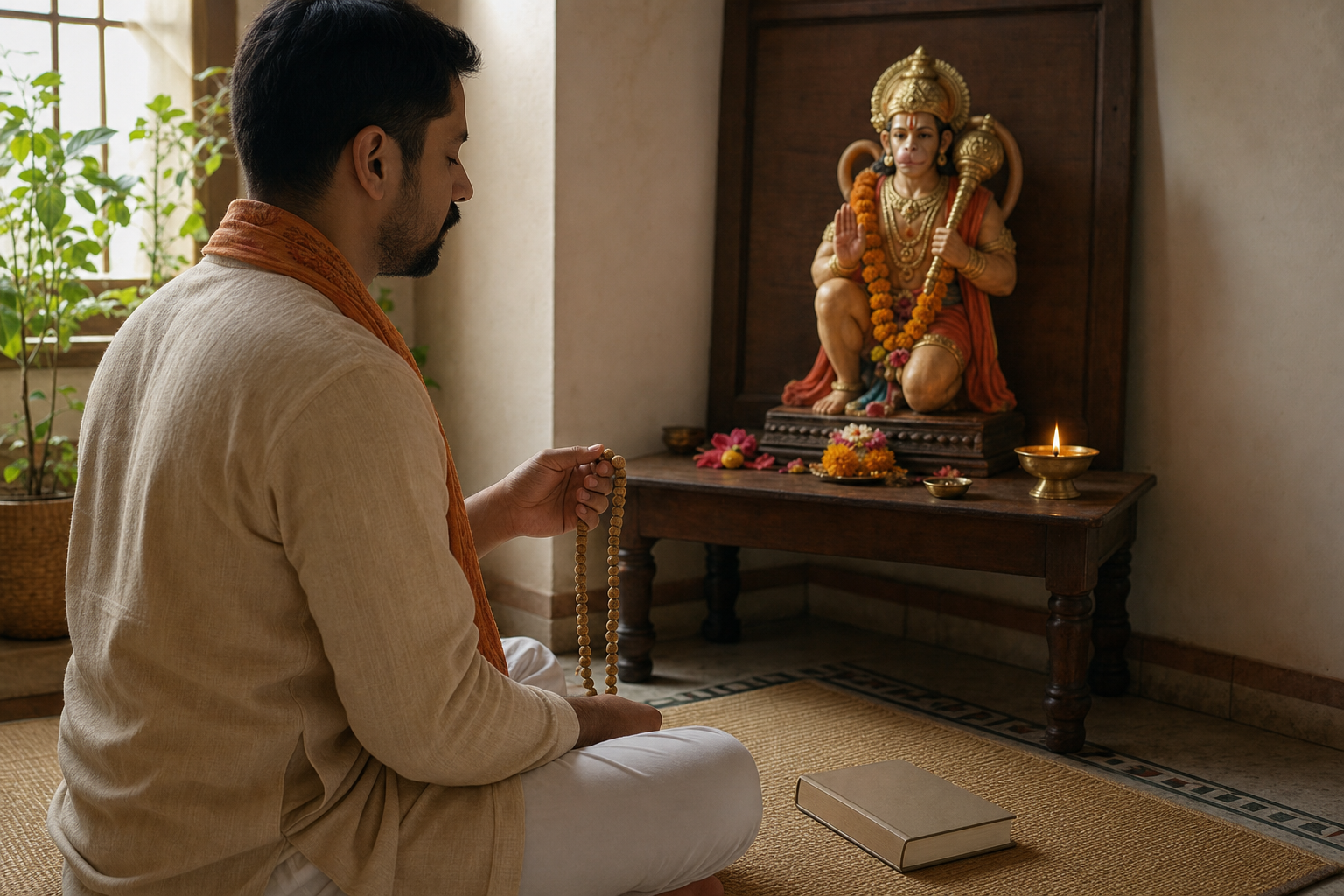
More texts do not necessarily produce a more focused puja. Select one mantra for japa and one principal hymn, then let each do its work. The main liturgical choices have distinct uses.
| Chant or text | Where it fits | What to remember |
|---|---|---|
| Om Hanumate Namah | Daily japa, a new practice, or the central mantra in a short puja | Its simplicity makes it suitable when you do not have formal initiation into a longer formula |
| Hanuman Gayatri | Focused japa after dhyana | Use an even count such as 11, 27, 54, or 108 |
| Hanuman Chalisa | Daily recitation and Tuesday or Saturday worship | It is an Awadhi composition of 40 chaupais framed by opening and closing dohas; do not impose Sanskrit pronunciation on its Awadhi diction |
| Sankat Mochan Hanuman Ashtak | Tuesday or Saturday worship, especially when fear or inner distress is dominating the mind | Approach its eight verses as remembrance of courage, refuge, and steadfast devotion |
| Hanuman Pancharatnam | A concise Sanskrit contemplation after japa | Its five verses emphasize intellect, self-mastery, devotion, and heroic service |
| Hanuman Ashtottara Shatanamavali | A fuller panchopachara or shodashopachara puja after dhyana | Offer a flower or contemplative pause with each of the 108 names according to your practice |
| Sundara Kanda | Extended parayana, a vrata, or an auspicious-day observance | Read by sarga, as a complete recitation, or through an established cycle rather than rushing through the narrative |
The Hanuman Gayatri may be recited as:
Om Anjaneyaya Vidmahe Vayuputraya Dhimahi Tanno Hanumat Prachodayat.
Let the breath remain natural. Do not compress the words merely to finish 108 repetitions quickly. With Sanskrit, listen for aspirates such as kh and gh, distinguish the sibilants sh, sh, and s as your transliteration system teaches them, and learn the difference between dental and retroflex consonants from a competent reciter. With the Chalisa, follow a reliable Awadhi recitation rather than assuming every written syllable follows classical Sanskrit intonation.
Counts such as 1, 11, 21, 51, or 108 recitations of the Hanuman Chalisa appear in established devotional practice. A high count belongs to an anushthana that you can sustain with attention, time, and physical steadiness. It should not become a race. For weekly worship, one careful recitation can be more coherent than a larger count performed mechanically.
Longer Rudravatara formulae are traditionally approached with greater solemnity and parampara guidance. If you have not received such instruction, remain with Om Hanumate Namah, the Hanuman Gayatri, and familiar stotras. This is not a lesser practice; it is the disciplined choice to use what you understand and can pronounce responsibly.
Offer simply, protect the sacred form, and complete the worship through conduct
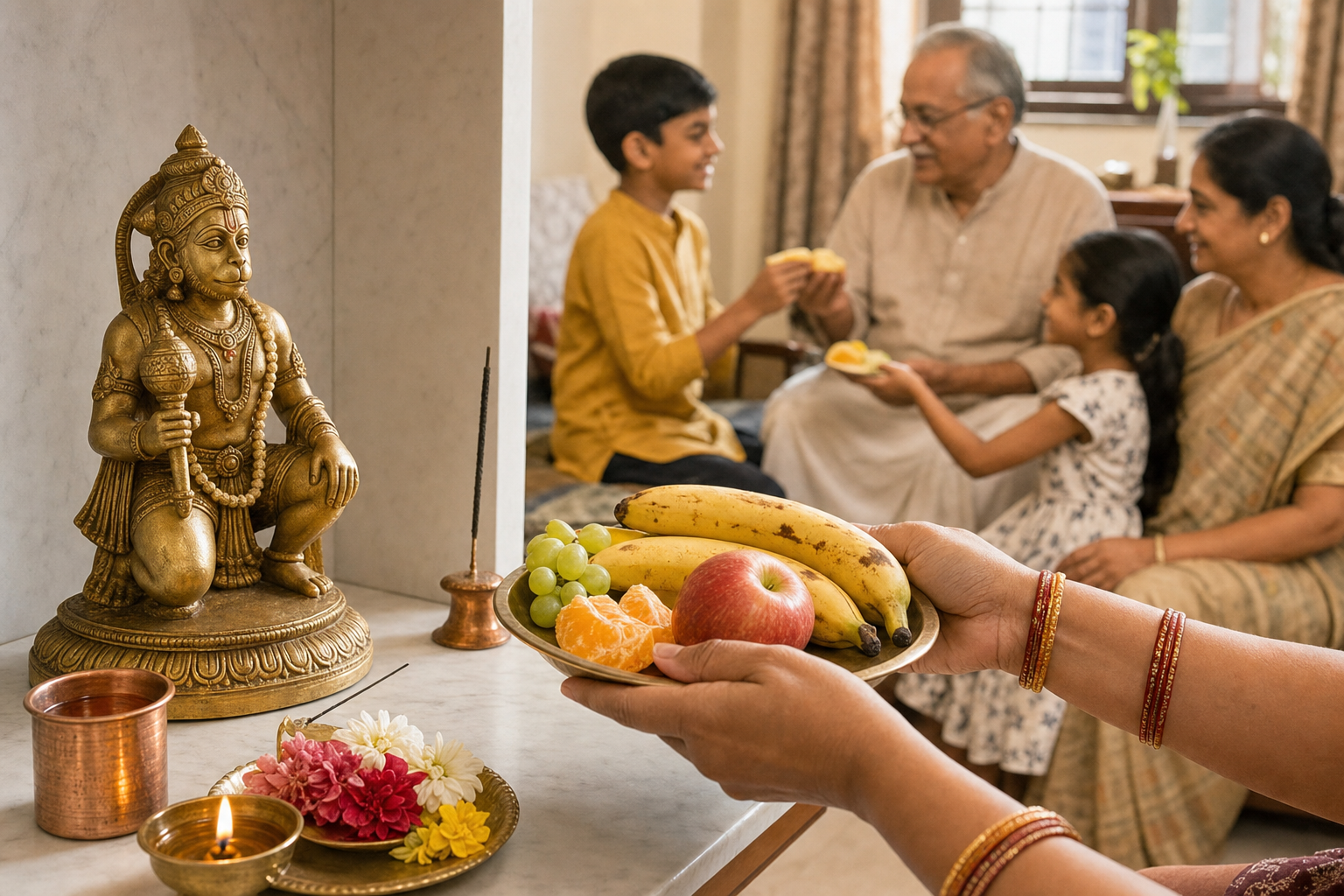
Common offerings include red or orange flowers, bananas, boondi or besan laddoo, and a sesame-oil lamp. Vada-mala is customary in many South Indian Anjaneya traditions. Tulasi is offered where the local tradition permits it. These are regional expressions of bhakti, not a shopping list that every household must reproduce.
Sindoor is applied to Hanuman murtis in many North Indian temples, but not every substance is suitable for every murti, shila, finish, or consecrated form. Do not apply sindoor, oil, paste, or water merely because you have seen it done elsewhere. Ask the priest responsible for a temple murti, and follow the care instructions attached to a home murti. Agama and temple maryada take precedence over a generalized ritual description.
Keep the sankalpa sattvic. Even when a hymn is popularly associated with protection or the removal of enemies and obstacles, do not direct it toward harming another person. Ask instead for discernment, moral courage, freedom from fear, protection from adharma, and the strength to act rightly. Hanuman’s force is inseparable from devotion to Rama and from service; separating power from dharma distorts the worship.
The rite is complete when remembrance changes the next action you take. After aarti, choose one concrete act of seva: fulfill a neglected duty, help someone without seeking recognition, speak truth without cruelty, or give disciplined attention to work that serves your family or community. This carries the puja beyond the altar without turning it into a display.
Key takeaways
- Use your family, temple, or guru-parampara maryada first; use general Panchanga rules only where that living tradition leaves room for choice.
- Tuesday and Saturday are the reliable weekly days. Sunrise and evening sandhya are practical windows, with Saturday Pradosha important in many household traditions.
- For a formal date, favor Bhadra, Jaya, or Purna Tithis, consider Pushya Nakshatra, and remain outside locally calculated Rahu Kalam and Yamaganda.
- A complete basic liturgy is preparation, sankalpa, invocation, offerings, mantra japa, one principal stotra, aarti, pranam, prasada, and a brief silence.
- If you lack initiation, use Om Hanumate Namah or the Hanuman Gayatri rather than adopting a longer formula without guidance.
- Calendar precision can strengthen discipline, but it should never become the reason you repeatedly postpone sincere worship.
For your next Tuesday or Saturday, decide the local time in advance, place the lamp and offerings before you sit, choose one japa count, and mark one stotra. Complete that form attentively. Once it has become a dependable rhythm, consult your local Panchanga for a stronger Tithi or Nakshatra and build the observance from there.
References
- DharmaRenaissance Blog – Hanuman Puja Mantras and Stotras: A Definitive, Devotional Guide to Chanting and Ritual
- DharmaRenaissance Blog – Best Days for Hanuman Puja: Auspicious Nakshatras, Tithis, and a Practical Muhurta Blueprint