

If you heard that Kedarnath’s Roop Chhad had gone missing, you may have asked two questions at once: how can a consecrated object disappear from one of Bharat’s most revered temples, and can tighter security be introduced without turning seva into bureaucracy?
The answer begins with a firm distinction. Sanctity governs how an object may be touched, moved, seen, and used. Custody proves that those rules were followed at every handover. Kedarnath needs both. On March 10, 2026, the Roop Chhad was publicly reported missing, Uttarakhand ordered a time-bound inquiry, and no recovery had yet been announced. That missing status does not by itself establish theft, identify a responsible person, or explain where the control failed. Those are questions for evidence, not rumour.
The first duty is to establish custody, not a culprit

The Roop Chhad is more than an item made from silver. It is understood as a consecrated ritual insignia associated with the sovereignty and ceremonial presence of the deity. Its precise liturgical protocols belong to Kedarnath’s hereditary and appointed functionaries. That religious status makes disciplined custody more necessary, not less.
A credible inquiry must separate three questions that are often collapsed into one: which physical object is being sought, when and where its custody was last verified, and what happened after that point. If the first two cannot be answered from contemporaneous records, accusations about the third will outrun the evidence.
The initial case file should answer five questions in order:
- Identity: What photographs, dimensions, inscriptions, material records, repairs, or distinctive marks establish the exact identity of the Roop Chhad?
- Last verified custody: Who physically saw and accepted it, at what place and time, and under which ritual or storage procedure?
- Movement: Was every transfer between storage, sanctum, ceremonial space, and return storage recorded by both the giver and receiver?
- Access: Who could enter each relevant location, and do access records agree with the movement register?
- Corroboration: What surveillance footage, seal records, duty rosters, and witness accounts independently support or contradict the written timeline?
The practical sequence matters. Relevant registers, footage, access records, and movement forms should be frozen before routine systems overwrite or alter them. Storage rooms and ritual cabinets should be secured with fresh tamper-evident seals, while the condition and opening of every seal are documented. Interviews should proceed under due process and without public naming based on suspicion alone. A hurried search for someone to blame can contaminate testimony and make recovery harder.
Investigators should also preserve the difference between an inventory discrepancy and a proven criminal act. The inquiry may ultimately find deliberate removal, an undocumented ritual transfer, a storage error, or another explanation. Until the chain of custody is reconstructed, each remains a hypothesis. Respect for Kedarnath is not served by presenting a hypothesis as a verdict.
Security must follow the ritual journey

A museum protects an object mainly by keeping it still. A living temple cannot. Ritual objects move between secure storage and sacred use, sometimes along processional routes and through spaces governed by different religious rules. The correct security model therefore follows the object rather than relying only on locks around a room.
The record that should accompany every movement
Every planned movement needs a single chain-of-custody record opened before the object leaves storage and closed when it returns. A workable procedure has three stages:
- Before release: verify the unique inventory ID against photographs and identifying details; record the object’s visible condition, authorised ritual purpose, destination, expected route, time of release, and the two custodians accepting it.
- During use: keep responsibility continuous. If ritual protocol requires a handover to another authorised functionary, record that handover at the time it occurs rather than reconstructing it later.
- On return: verify identity and condition again, record the return time and storage location, obtain the giver’s and receiver’s acknowledgements, and reconcile the movement before the day’s register is closed.
The two-person rule is easily misunderstood. It does not mean collecting a second signature after the event. Two authorised people must be present for access, removal, handover, return, and resealing. Their roles should be distinct enough that one person is not merely confirming his or her own action. Any ritual or emergency exception should record why the standard procedure could not be followed, who authorised the exception, what happened to the object, and when the exception was reviewed.
The master inventory should be capable of identifying an object even after separation from its papers. That requires high-resolution overall, macro, and detail photography; measurements; material and assay information where available; inscriptions; repairs; conservation condition; storage assignment; and movement history. Active ritual objects should be classified separately from archival or display objects because their exposure, access, and conservation needs differ.
Discreet forensic marking can help establish ownership if an artefact is recovered away from the temple. Any microdot, nanomarker, RFID, or UHF system must first be accepted by the relevant ritual authority and documented under dual custody. The marker’s existence may be public, but its identifying data and exact placement should remain protected. Technology that violates handling rules or damages an object is not a safeguard.
Use technology to corroborate human custody
CCTV should provide overlapping views of storage access points and authorised movement routes, with redundant and protected recording. Its purpose is not to replace the signed register. It should independently test whether the recorded movement occurred as claimed. Camera placement must also respect restrictions established for sacred spaces; where direct coverage is impermissible, coverage of controlled entry and exit points becomes especially important.
Storage needs the same layered approach: tamper-evident and fire-rated enclosures, logged access, two-person opening, and prompt reconciliation after each use. Randomised audits matter because a control tested only on a predictable date can be staged for inspection. Quarterly surprise audits by an independent panel provide a practical minimum rhythm for checking whether written procedures are actually being followed.
Conservation and financial records belong in the same protective system. A documented condition baseline makes it easier to detect damage or substitution. Professional valuation and risk-based insurance help define exposure and support recovery, but neither can replace the consecrated object or the continuity it represents. Insurance is a financial backstop, not the measure of sacred worth.
Give dharmic authority a defined governing role
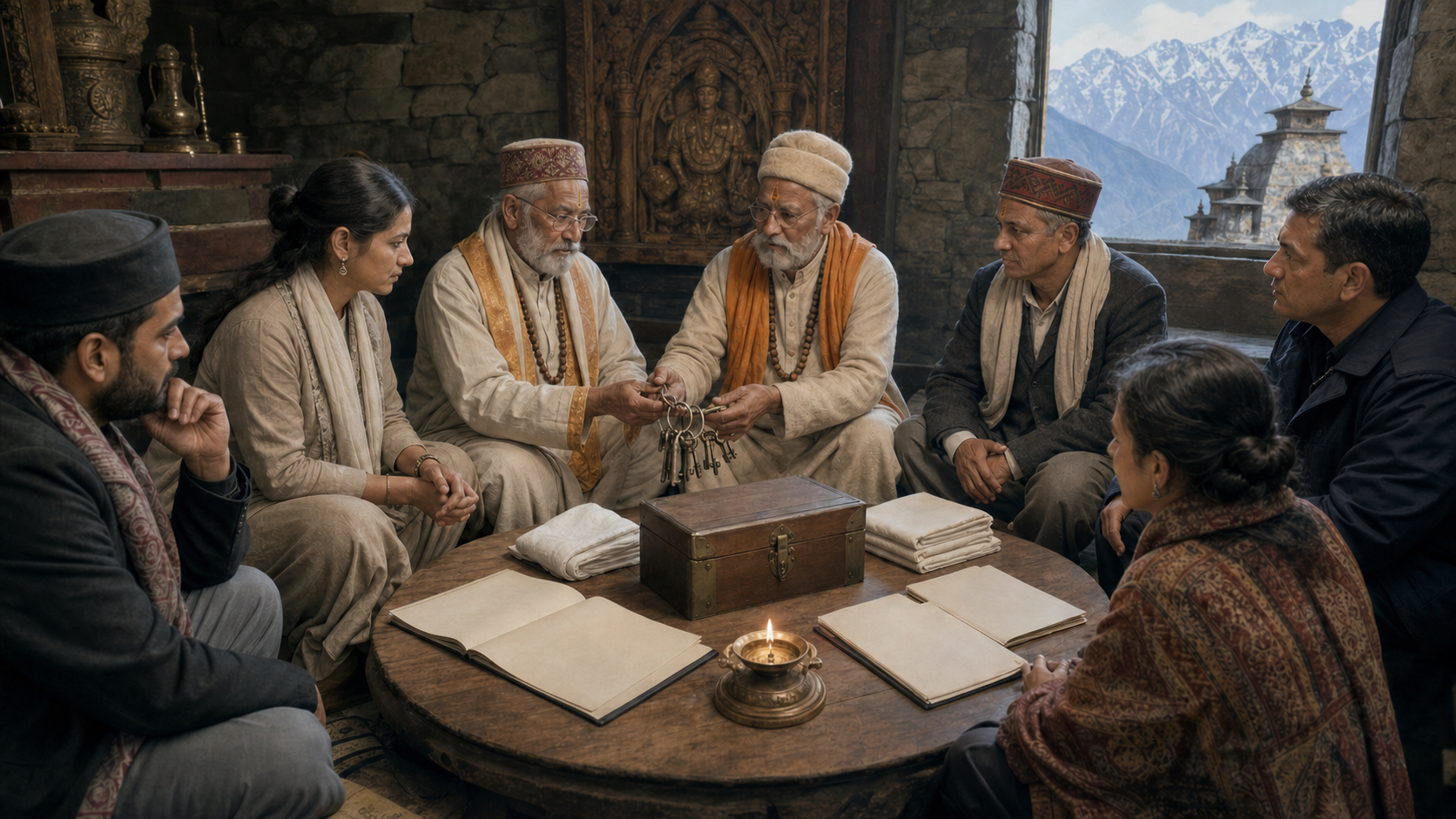
Kedarnath does not need a choice between religious custodians and security professionals. It needs a written covenant showing where each authority begins, what each must document, and who may test compliance. The Badrinath-Kedarnath Temple Committee already carries responsibility for worship, seasonal operations, and protection of ritual property. A stronger system would make the division of duties visible without disclosing sensitive ritual or security information.
| Governance role | Decision it should own | Record it should produce |
|---|---|---|
| Ritual authority | Who may touch the object, when it may move, required purity and handling rules, photography limits, and whether marking or tagging is acceptable | Approved ritual-handling protocol and authorised-role list |
| Designated custodians | Physical release, accompaniment, handover, return, and resealing | Contemporaneous movement and condition record |
| Security and records officer | Access control, surveillance preservation, incident logging, and reconciliation | Access history, evidence-preservation record, and exception log |
| Independent oversight panel | Whether controls operate as written, without judging the correctness of worship | Quarterly surprise-audit findings and closure status |
| State, district, and law-enforcement liaison | Investigation, lawful evidence handling, recovery coordination, and escalation | Official case milestones and approved public updates |
This division protects both sides of the duty. A security officer should not improvise rules about who may handle a consecrated insignia. A ritual custodian should not be expected to administer surveillance retention or evidence preservation without specialist support. Independent auditors should test signatures, timestamps, seal continuity, access permissions, training, and exception handling; they should not turn a security audit into an inquiry about liturgical legitimacy.
Access should follow roles, not personal familiarity or seniority alone. Someone authorised to witness a procession may not need vault access. Someone responsible for a register may not need permission to release an object. Temporary staff and volunteers should receive only the access required for their assigned duty, after verification and training. When responsibilities change, access should change with them.
The same model can serve other dharmic institutions without flattening their traditions. A Jain processional standard, Buddhist monastery thangka set, Sikh palanquin ornament, and Hindu temple insignia do not share identical rites. They do share a governance need: the religious community defines sacred use, while a documented custody system protects continuity across each authorised movement.
A credible 30-60-90 day response

The inquiry and the reform programme should run in parallel, but they should not be confused. Recovery work asks what happened to the Roop Chhad. Resilience work asks which controls must change even if the object is recovered tomorrow. A practical schedule is:
- First 30 days – preserve evidence and establish the timeline. Freeze and review relevant footage, registers, duty rosters, access records, and movement documents. Interview custodial personnel under due process. Secure every related storage location with documented fresh seals. Publish an initial timeline that distinguishes verified facts from open questions. Activate an official community tip line and preserve every credible submission.
- By 60 days – reconcile the wider ritual inventory. Do not limit the review to the missing object. Physically reconcile all ritual artefacts against the master register, record condition, resolve discrepancies, introduce two-person access, issue a written incident-response procedure, and retrain everyone whose duty includes custody or records.
- By 90 days – test the rebuilt system. Complete priority CCTV, storage, and access-control upgrades; conduct a third-party audit; correct failed controls; and publish a public-facing account of improvements, unresolved matters, and lessons that can be applied across other Char Dham shrines.
The dates are governance milestones, not promises that recovery will occur on schedule. An unresolved investigation can continue beyond them. What should not remain unresolved is whether records have been preserved, the rest of the inventory has been checked, dual control is operating, and an independent party has tested the reforms.
While the investigation remains active, one coordinated public bulletin each week would reduce the space in which misinformation grows. It should state what has been verified, what action was completed, what remains unknown, and when the next update is due. It should not expose storage layouts, marker locations, private witness details, or evidence that investigators need to protect. The BKTC, district administration, and state government should use the same verified facts rather than releasing competing narratives.
Training must also be tested in practice. Staff should rehearse one complete authorised movement: opening under two-person control, identity and condition verification, handover, return, reconciliation, and response to a deliberately introduced paperwork discrepancy. A procedure that works only when everyone already knows the expected result is not yet reliable.
Key takeaways for devotees and trustees
- Ask for the last verified point of custody, not a vague account of when the object was last remembered.
- Expect evidence to be preserved before cameras, cabinets, or access systems are replaced.
- Count dual control only when two authorised people are physically present and record the handover at the time it occurs.
- Require ritual authorities to define handling boundaries and independent auditors to test administrative compliance.
- Look for a 30-60-90 day programme that protects the current inquiry while fixing weaknesses across the whole ritual inventory.
- Support factual public updates, but do not amplify names, motives, or recovery claims that officials have not verified.
If you are a devotee with direct information, preserve the original message, photograph, or observation and submit it through an official channel rather than editing it for social media. If you advise, fund, or serve a temple institution, ask to see the inventory standard, movement form, exception log, latest independent audit, and proof that corrective actions were closed. A new camera installation by itself is not evidence of a working custody system.
Before Kedarnath’s next scheduled movement of a consecrated artefact, its custodians should be able to complete and review one full chain-of-custody cycle without improvisation. That is the immediate, testable standard: every sacred movement authorised by tradition, witnessed in service, and accounted for on return.
References
