

Your income has begun to rise, but the choices have not become easier. Family needs are real. So are the pull of a better lifestyle, the duty to prepare for uncertainty, and the feeling that some part of what you earn should serve more than your own household. The question is no longer simply whether you can afford something. It is whether the way you earn and use wealth leaves you more responsible, more generous, and less possessed by money.
Dharmic ethics will not produce one correct salary, savings rate, or donation percentage for every person. They give you something more durable: an order in which to make financial decisions. Dharma tests the means. Artha supplies capacity. Kama receives a rightful but bounded place. Dana shares the benefit. Moksha keeps the entire arrangement from becoming your identity.
Let dharma set the terms before money arrives
Artha, or material capability, is one of the four traditional purusharthas alongside dharma, kama, and moksha. Its inclusion matters. Wealth is not treated as inherently impure, and financial competence is not a spiritual defect. A stable income can shelter a family, educate children, care for elders, preserve sacred learning, support temples and community institutions, and give you room to serve without panic.
But artha is not sovereign. In the Dharmic ordering of wealth, it operates under dharma, disciplines kama, and must not obscure moksha. This changes the sequence of financial thought. You do not first maximize income and ask whether the method was acceptable afterward. You establish ethical boundaries before considering the size of the reward.
The same ordering prevents two opposite errors. One is treating wealth as proof of superior character. The other is treating poverty or modest means as proof of spiritual advancement. A bank balance reveals capacity, not the total worth of a person. It may also reveal habits, opportunities, inherited circumstances, timing, institutions, obligations, and many causes that an outsider cannot see.
Srila Prabhupada’s Vaishnava framing treats material allotment as constrained by karma and Krishna’s sanction. That claim belongs to a theological account of moral causality; it is not a licence to reconstruct another person’s past karma from present circumstances. Nor does it remove agency. You still choose whether to deceive, serve, exploit, conserve, share, or become attached. Results may not be fully yours to command, but the quality of your action remains your responsibility.
This distinction is especially important when fortune changes. A promotion need not produce pride, because your effort was never the only condition behind it. A setback need not produce paralysis, because you still control the next honest action. Karma and daiva place limits on entitlement; purushartha preserves disciplined effort.
You can also use the three gunas as a diagnostic, provided you apply them to tendencies rather than branding people. Sattvic financial action tends toward clarity, sufficiency, responsibility, and service. Rajasik action is driven by restless comparison, display, and the need for another victory. Tamasik action conceals costs, feeds addiction, wastes resources, or depends on not looking closely. One purchase or ambition may contain more than one tendency. Your task is to notice which tendency you are repeatedly strengthening.
Before making a large decision, therefore, ask a prior question: what will this money train me to become? That question catches dangers a spreadsheet cannot. A profitable choice may train secrecy. A beautiful purchase may train gratitude and care, or it may train comparison. A savings plan may express responsibility, or fear disguised as prudence. The outward transaction matters, but so does the habit of mind it rehearses.
Use three gates before accepting income

When a better-paying role, client, contract, or business opportunity appears, begin with three gates: the work itself, the way the work is conducted, and the effects pushed onto other people. Passing only one or two is not enough.
- The work itself: Does the product or service meet a legitimate need, or does its profitability depend on injury, addiction, predation, cruelty, or deliberate confusion?
- The conduct: Are you expected to lie, hide material facts, manipulate consent, evade lawful obligations, pay bribes, break promises, or transfer unreasonable risk to someone with less power?
- The effects: Who bears the cost that does not appear in the price? Look at workers, customers, communities, animals, and ecosystems rather than stopping at the immediate buyer.
These gates reflect a broad Dharmic family resemblance without pretending that Hindu, Buddhist, Jain, and Sikh traditions are interchangeable. Buddhism’s Right Livelihood asks you to avoid work grounded in harm and deception. Jain ethics brings ahiṃsa and aparigraha into enterprise and consumption. Sikh dharma joins honest earning through kirat karo with sharing through vand chhako and service through seva. Hindu thought places livelihood within dharma, yajña, and dana. The shared practical demand is clean earning joined to restraint and generosity.
Real employment decisions are rarely labelled pure or impure. An imperfect organization may still provide a useful product, while an admired organization may hide abusive practices. Examine your causal proximity and your leverage. Are you directly designing the harmful mechanism, merely working elsewhere in a complicated institution, or positioned to change the practice? Is the problem a correctable failure, or the business model itself?
A useful distinction is between a red line, a repairable risk, and an ordinary trade-off. Fraud, coercion, intentional exploitation, and concealed serious harm are red lines. A weak process that leadership acknowledges and gives you authority to repair may be a repairable risk. Differences in pace, prestige, convenience, or personal preference are ordinary trade-offs. Do not turn every inconvenience into a moral crisis, but do not downgrade a red line because the compensation is attractive.
If you support dependants, discovering an ethical problem does not always require an impulsive resignation. Sudden loss of income can transfer the cost of your decision to people who rely on you. Stop participating in a clearly wrongful act where you can, document what you need to understand, seek appropriate professional or legal advice if the conduct may be unlawful, and build a timely exit or remediation plan. Prudence is not complicity when it is being used to reduce harm rather than postpone courage indefinitely.
Dharmic livelihood also asks what you contribute, not only what you avoid. Competence, reliability, truthful communication, useful innovation, and full delivery on promises can turn professional work into seva. Under-earning through neglect, avoidable disorganization, or refusal to develop your abilities is not automatically detachment. If others depend on you, cultivating skill may be part of your dharma.
Finally, do not use charity to launder a harmful income stream. Donating part of a gain does not repair deception built into the way the gain was produced. Dana begins after the means have passed the test of dharma; it cannot substitute for that test.
Make the household resilient before expanding its display

Spending becomes clearer when you stop treating every outflow as the same kind of consumption. Review your recent expenses by purpose. First identify obligations: dignified shelter, food, health, education, care for dependants and elders, and the costs required to earn honestly. Next identify resilience: accessible savings, suitable insurance, debt reduction, maintenance, and productive tools. Then mark cultural and spiritual continuity, dana and seva, restorative enjoyment, status spending, and outlays that create harm or dependency.
This classification is more useful than beginning with guilt. It shows what a rupee is doing. A recurring expense may support health or merely signal status. A costly tool may be justified if it improves productive capacity, while a cheap habit may still be tamasik if it feeds waste or addiction. Price alone does not determine the moral quality of spending.
Define enough before lifestyle inflation defines it for you
Aparigraha is not a command to make your family insecure. It is a restraint on accumulation becoming identity. The practical move is to define what improvement you actually seek before additional income arrives. Better housing may mean safety, shorter travel, room for an elder, or a quieter place for study. Once that need is met, repeated upgrades may be buying comparison rather than function.
For a contemplated non-essential purchase, write down the problem it solves, the full cost of ownership, what you will stop funding to pay for it, and whether you would still want it if nobody else knew you owned it. If the final question changes the answer, status is doing more of the work than utility. Delay the decision until the urge loses its social heat.
Beauty and enjoyment still have a place. Kama is one of the purusharthas, not an intruder. The Dharmic question is whether enjoyment remains truthful, proportionate, and compatible with duty. A well-made object that is used, maintained, and appreciated can fit a simple life better than repeated disposable purchases. Simplicity is curation, not deliberate ugliness.
Distinguish useful debt from debt that rents your future
Debt for education, necessary health needs, productive assets, or a viable household requirement can build capacity. Even then, the purpose alone does not make the terms sound. You must still test repayment demands, uncertainty of future income, total cost, security pledged, and what happens if the expected benefit does not arrive. Debt used to preserve an image, escape discomfort, or fund rapidly fading consumption deserves a much harder presumption against it.
A financial buffer matters because fortune changes. Liquidity, appropriate insurance, and manageable fixed obligations allow you to care for others and continue giving during disruption. The ethical aim is not maximum accumulation. It is enough resilience that one setback does not force panic, deception, predatory borrowing, or abandonment of legitimate duties.
Screen investments for ethics and suitability separately
An investment is participation in an economic activity, even when the connection is mediated through a fund. An ahiṃsa-oriented screen asks whether the underlying enterprise profits from cruelty, predation, deliberate addiction, exploitation, or severe ecological damage. A constructive screen looks for genuine value in areas such as health, education, responsible technology, cleaner energy, infrastructure, and dignified livelihoods.
Do not let an ethical label end the inquiry. Look at the primary business model, major revenue drivers, actual conduct, and material controversies. Then apply an entirely separate financial screen: diversification, liquidity, risk, fees, time horizon, and the possibility of loss. Non-attachment and risk management belong together: vairagya should reduce intoxication in a boom and panic in a decline, not become an excuse for careless decisions.
An ethical preference cannot determine whether a particular loan, investment, insurance policy, or tax arrangement is suitable for you. Before taking a large or irreversible financial step, use a qualified financial, tax, or legal professional in your jurisdiction as appropriate. Ask them to work within your ethical exclusions rather than expecting an ethical screen to replace technical due diligence.
Turn dana from an impulse into a standing practice
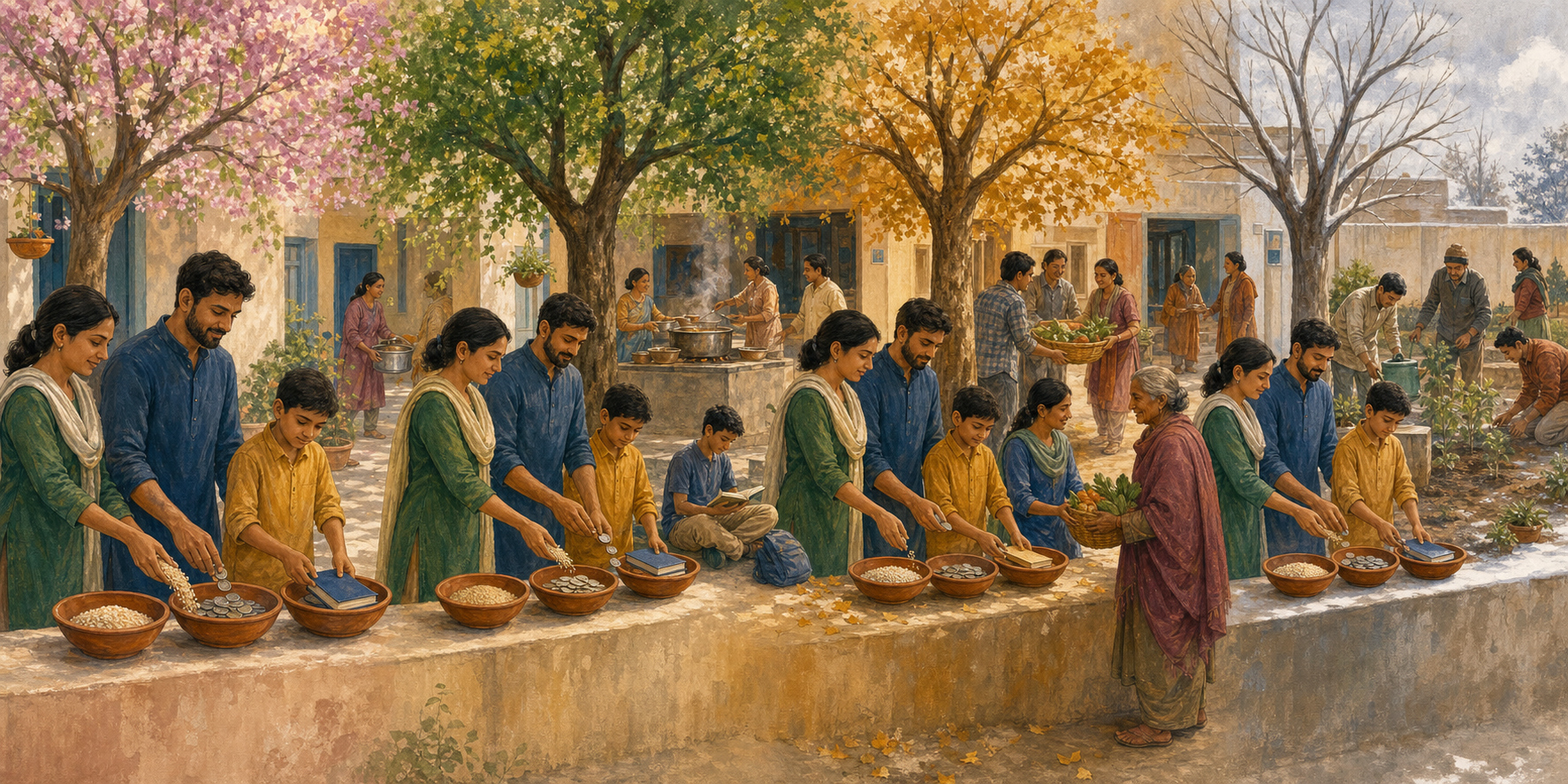
Giving is easiest to postpone when it depends on feeling prosperous. There is always another household expense, market worry, or future goal. A standing rule reverses the default: choose a share of income or a recurring amount for dana before optional spending absorbs the remainder. There is no universal percentage supported by every Dharmic tradition or suitable for every life stage. The right commitment is meaningful, repeatable, and honest about your obligations.
A household with unstable income can set a modest floor for lean periods and increase it in abundant periods. Someone facing urgent medical costs, unmanageable debt, or dependent care may temporarily give more through time, attention, or skill. The principle is continuity without neglecting duty. Generosity that pushes dependants into insecurity merely relocates the burden.
Make the practice operational. Move the chosen amount into a separate giving account when income arrives, keep a short list of causes you have examined, and decide how much will support continuing work versus urgent needs. This removes the pressure to evaluate every emotional appeal from the beginning.
Match the gift to a real form of need
Dharmic traditions offer several concrete forms of generosity. Annadana addresses hunger. Vidyadana supports learning. Community kitchens, healthcare, scholarships, sustainable livelihoods, preservation of sacred knowledge, and care for people in acute distress direct private capacity toward shared well-being. The best choice depends on the need you understand and the institution you can responsibly assess.
Before making a substantial gift, check four things:
- Need: Is the problem serious, and are the intended recipients being treated with dignity rather than used as promotional material?
- Method: Is the proposed intervention plausible, specific, and responsive to what people actually need?
- Integrity: Are leadership, accounts, conflicts of interest, and the use of funds sufficiently transparent for the size of your gift?
- Continuity: Will the gift create durable capacity, meet a genuine emergency, or create a dependency the organization has not planned to sustain?
Due diligence does not require emotional distance. It protects the intended recipient and the trust placed in you as a donor. For tax deductibility or regulated charitable status, verify the rules and records required in your own jurisdiction rather than relying on a spiritual or social endorsement.
Quiet or anonymous giving can protect the inner purpose of dana. Public fundraising sometimes has a legitimate function: it can mobilize others, establish accountability, or normalize support for a neglected cause. But if recognition is the main return you seek, the gift has begun to function as a purchase of reputation. When publicity serves no practical purpose, reduce it.
Generosity should also shape ordinary economic conduct. Pay fairly. Honour invoices and wages on time. Do not bargain a vulnerable worker below dignity and then seek merit through a conspicuous donation. Fulfil lawful tax obligations and community responsibilities. Seva is not an escape hatch from justice.
The transformation of the giver is real but should not become the gift’s advertised objective. Regular dana trains the mind away from grasping and toward compassion, friendliness, and forbearance. Let that change occur quietly. The recipient is not an instrument for your self-improvement.
A five-question Dharmic audit for the next financial choice

Use these questions in order whenever you face a meaningful decision about earning, buying, borrowing, investing, or giving:
- Is it clean? Does the choice require deception, exploitation, coercion, avoidable violence, concealed harm, or evasion of a legitimate obligation?
- Is it responsible? After this choice, can you still meet duties to dependants, workers, creditors, community, and your own basic resilience?
- Is it proportionate? Does the amount fit the real purpose, or are comparison, fear, novelty, and status enlarging it?
- Does it share benefit? Have dana, fair dealing, and the people who helped create the value been considered before optional consumption?
- Can you remain inwardly free? If the gain disappears, the purchase goes unseen, or the gift receives no praise, does the choice still make sense?
Treat the answers differently. A failure at the first gate means stop or redesign the transaction. A failure of responsibility means reduce or delay it. A failure of proportion calls for distance from the immediate urge. A failure to share means build giving into the plan. A failure of inner freedom means pause before acting and examine the attachment itself.
Japa, mindfulness, gratitude, study, and a simple written account can help with that final gate. Their financial function is not mystical prediction. They create enough mental space to see sufficiency, envy, fear, and rationalization before those states become transactions. Santosha steadies your effort; it does not ask you to stop developing your abilities or meeting your duties.
Begin with one pay cycle, not an idealized lifetime plan. Review the income you accepted, the expenses that recur without thought, the risk you have left unattended, and the gift you keep postponing. Change one item before the next cycle: question a harmful revenue stream, cancel a status expense, strengthen a necessary buffer, or establish a recurring act of dana. The next rupee is enough to begin placing artha back under dharma.
References
