

You want to bring bhakti into London’s public life without reducing sankirtan to a sales exercise or exposing volunteers to avoidable strain. The central question is not simply how many books your team can place. It is whether a stranger can meet the tradition through an encounter that is spiritually grounded, freely chosen and worth continuing.
Women-led sankirtan offers a disciplined answer. Its strength comes from joining personal sadhana, attentive conversation, clear boundaries, practical safety and a credible path from the street to community. If you are joining a party, mentoring volunteers or organising an outing, that complete sequence is what you need to build.
Key takeaways
- Treat sankirtan as sadhana and seva before treating it as a distribution target. The team’s inner condition will shape every public interaction.
- Make women the actual leaders of planning, training, field decisions and mentoring. A women-led team is more than a team in which women are visible.
- Ask permission, explain the book plainly and make refusal easy. A graceful exit protects both the passerby’s agency and the dignity of the service.
- Plan safety, public-space etiquette, donations and digital follow-up before arriving on the street. Improvisation is weakest where consequences are greatest.
- Measure conversations, follow-up and community entry alongside books distributed. The lasting result is a relationship with dharma, not a completed transaction.
Begin with the purpose: sadhana, seva and an open door
In Gaudiya Vaishnavism, sankirtan is the congregational glorification of the Divine. Public chanting of the Hare Krishna mantra is its most recognisable form, but the service also includes sharing sacred literature and speaking about spiritual life. That makes it both sadhana, a practice that reforms the devotee, and seva, service offered for another person’s benefit.
This distinction changes the mood of outreach. If book distribution is treated mainly as a target, the passerby can become an obstacle between the volunteer and a result. If it is treated as seva, the person remains a person: hurried, curious, sceptical, lonely, committed to another path or simply uninterested. Your duty is to offer an intelligible opening, not to manufacture agreement.
The ISKCON expression brhat-mrdanga, or the great drum, captures the special role of books. A drum can be heard within its physical range; a book can travel, wait on a shelf and reopen a spiritual question months later. That is why the Bhagavad-gita and other Vaishnava texts matter even when a street conversation lasts only briefly. The book allows reflection to continue privately, at the reader’s own pace.
That does not make every exchange successful merely because a book changed hands. A person who leaves confused about the invitation, pressured about a donation or unsure who approached them has not received the clearest form of the service. A better test is whether the encounter leaves four things intact: the teaching, the person’s freedom, the volunteer’s integrity and the possibility of future contact.
This is the practical value of London’s women-led model of devotional preparation, public dialogue and book distribution. Chanting, literature and conversation do not compete with one another. They form an open door through which a passerby may take one step, several steps or none.
Train the team before you train the pitch
A polished opening line cannot compensate for an unsettled team. Begin the service day with the practices that give volunteers steadiness: japa, scriptural study and kirtan. This is not ceremonial preparation to complete before the real work starts. It is where patience, humility and clarity are cultivated for use on the street.
Follow that spiritual preparation with a short operational briefing. Everyone should know the location, expected conditions, roles, regroup point, check-in method and the circumstances that will end or relocate the outing. Review the book being offered and practise explaining its central themes without insider vocabulary. A volunteer should be able to describe dharma, karma, yoga and bhakti in ordinary language before trying to discuss them in a noisy public setting.
Use distinct roles even when a small team combines them:
- Team lead: watches the whole field, makes safety and location decisions, checks the team’s energy and resolves uncertainty.
- Conversationalist: initiates contact, listens, explains the literature and ends the exchange without pressure.
- Logistics support: manages books, contactless equipment, event information and other materials without distracting the conversation.
- Buddy: remains aware of a partner’s position and condition, especially when several conversations are happening at once.
Women-led must describe authority, not just participation. Women should help choose the location, establish the tone, define safe practice, lead the briefing and decide when an interaction or outing should stop. Senior women can then mentor newer volunteers in both philosophy and public communication. This produces a leadership line that does not depend on one unusually confident person.
Empathy and attentive listening can lower social barriers, but do not turn those abilities into stereotypes about women being naturally gentle. They are disciplines that can be named, practised and assessed. Train volunteers to wait for an answer, notice hesitation, ask an open question and respond to the concern actually expressed. Calibrated confidence means neither shrinking from the service nor overpowering the person in front of you.
Scriptural literacy and interfaith literacy belong in the same training. A volunteer who knows verses but cannot recognise the convictions of a Sikh, Buddhist, Jain, Hindu of another sampradaya or secular Londoner may speak accurately yet communicate poorly. The aim is not to dilute Gaudiya Vaishnava doctrine. It is to present it without pretending that every listener begins from the same assumptions.
Use a consent-first conversation that can end cleanly
A good street conversation has a clear entrance and an equally clear exit. The passerby should understand that you are offering spiritual literature, that engagement is optional and that declining will not produce an argument. The following sequence gives new volunteers enough structure without making them sound mechanical.
- Ask for attention rather than taking it. Try: “May we show you a short book on yoga and purposeful living?” If the person keeps moving, looks uncomfortable or says no, let the exchange end.
- Give the reason in one sentence. Explain that the book introduces ideas such as dharma, karma, self-mastery or devotion. Choose the theme that fits the literature; do not promise that it will solve the person’s life.
- Ask a real question. “Are you more interested in meditation, philosophy or practical ethics?” gives the person room to locate their own interest. Listen before selecting the next point.
- Connect the book to the stated concern. A student asking about direction may be interested in agency and purpose. A professional may want to discuss duty, equanimity or the relationship between action and attachment. A family may respond to gratitude, shared practice or service.
- Make the next choice explicit. Offer the book, explain that any donation is voluntary and, when interest is genuine, mention an appropriate kirtan, class, cooking programme, study circle or service opportunity. Then allow the person to decide.
Do not use every possible benefit in the same conversation. Presenting the Bhagavad-gita as a universal answer to stress, work, relationships, identity and health all at once makes the invitation sound inflated. Select one relevant doorway and preserve the depth of the text. If the listener wants more, let questions lengthen the exchange naturally.
When someone says, “I am not religious,” do not debate the label. You can explain that the text examines action, character, consciousness and devotion, then ask whether any of those questions interest them. If not, close warmly. When someone already follows a spiritual tradition, ask about it before offering a parallel. Conversation is not a race to identify equivalent terms.
Shared Dharmic values can create genuine recognition. Ahimsa, daya or karuna, seva, self-restraint and fellowship in satsang or sangat give Hindus, Buddhists, Jains and Sikhs ethical points of contact. Sikh kirtan and simran, Buddhist cultivation of mindfulness and compassion, and Jain attention to non-violence and restraint may help a listener understand the territory. Use those connections respectfully. A bridge between traditions is not proof that their doctrines, goals or practices are identical.
A refusal tests the team as much as an interested response. “No problem. Have a peaceful day” is enough. Do not follow the person, challenge the refusal or make one more attempt after the answer is clear. A clean ending is not lost outreach. It demonstrates that the invitation was truthful when it claimed to be voluntary.
Protect the public space and the women serving in it
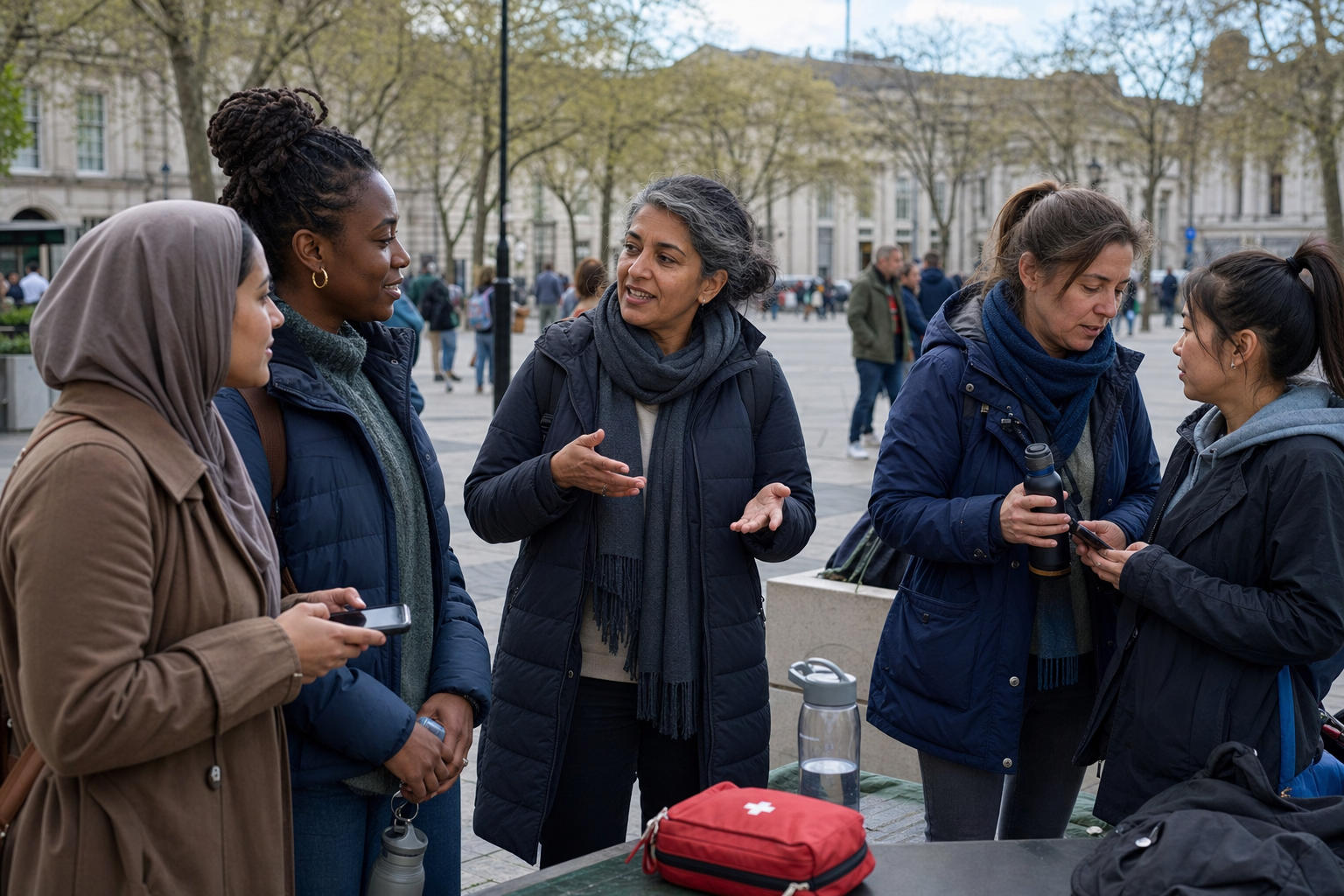
London outreach happens amid commuters, tourists, students, families, shops, queues and other public activity. Choose a position where people can stop without blocking the route. Stay clear of entrances and organised queues. If the space becomes congested, move rather than forcing the public to move around the team. Check the current requirements for the borough and location instead of assuming that a practice accepted elsewhere will be accepted there.
Kirtan requires the same judgment. Mrdanga and hand cymbals can make the encounter joyful and immediately recognisable, but sound must remain suited to the setting. When chanting would create obstruction or needless friction, quiet book distribution and conversation can still carry the spirit of sankirtan. Volume is not a measure of devotional seriousness.
Safety arrangements should be decided before enthusiasm meets a difficult situation. Use a buddy system, agree on check-in times, share live location within the team when appropriate and designate a place to regroup. Consider daylight, weather and changing footfall when choosing the service window. The team lead should know who has left the site, who is in a prolonged conversation and whether anyone needs a break.
If a person becomes abusive, threatening or persistently follows a volunteer, the conversation is over. Rejoin the team, move toward a safer populated setting and follow the agreed escalation plan. No book placement, philosophical correction or public appearance is worth asking a volunteer to remain in an unsafe exchange. A women-led service must give women real authority to recognise and act on that boundary.
Well-being also includes the less dramatic effects of public service. Rejection, cold weather, fatigue and repeated misunderstanding can quietly turn seva into depletion. Build pauses into fieldwork, invite volunteers to say when they are no longer steady and use satsanga, peer encouragement or reflective journaling after difficult days. Sustainable service is not produced by ignoring the servant.
Handle money and data with equal clarity. Say plainly that donations are voluntary and that the literature is being shared for spiritual, cultural and educational engagement rather than as an ordinary retail sale. When using a contactless device, make sure the person understands what they are authorising before they tap.
A QR code should reveal where it leads before someone scans it. If a form collects contact details, ask only for what the promised follow-up requires. Do not turn a request for one event notice into an improvised mailing list. Limit access to the information, keep it only as long as needed for the stated purpose and verify the applicable privacy and public-engagement requirements rather than guessing.
Measure whether the encounter becomes community
Book totals tell you something useful: they show activity and help with planning stock. They do not tell you whether people understood the invitation, returned for a programme or began sustained study. Track quantity, but do not let it erase the outcomes that reveal depth.
Define a meaningful conversation before the team goes out. It might mean that the person stopped voluntarily, heard what the book was, expressed an interest or concern, and received a relevant response. A greeting alone would not qualify. The exact definition matters less than applying it consistently enough to learn from one outing to the next.
During the debrief, record what helps the next team make a better decision:
- Which greeting styles opened comfortable conversations, and which created confusion?
- What questions appeared repeatedly among students, professionals, families or visitors?
- Which locations and periods supported conversation without creating congestion?
- How many books were distributed, and how many exchanges met the team’s definition of meaningful?
- Which people asked for a class, kirtan, study group, cooking programme or service opportunity?
- Did any safety, fatigue, equipment, donation or privacy issue require a change in practice?
Use patterns to refine training rather than to pressure individuals. If people repeatedly misunderstand the opening, rewrite and rehearse it. If volunteers struggle to answer a common question, study that theme together. If a location produces hurried contact and little listening, reconsider the place or timing. Even a modest distribution day can provide valuable information when the debrief is honest.
The central London temple gives interested readers somewhere to go after the initial encounter. Kirtan, Bhagavad-gita discussion, vegetarian cooking, study and service can turn curiosity into practice and practice into belonging. Give only the next invitation that matches the person’s interest. Someone asking about philosophy needs a suitable class or study circle, not a catalogue of every programme available.
Follow-through also reveals whether the outreach was genuinely inclusive. When a new woman arrives through street contact, she should be able to see how participation can develop into learning, responsibility and leadership. Pairing newer volunteers with experienced women turns outreach into capacity-building for the community itself.
Before your next service day, prepare a single field brief containing the purpose, team roles, meeting and regroup points, consent wording, safety triggers, donation explanation, follow-up invitation and debrief questions. Let sadhana establish the mood, and let public response determine the pace. When a person can accept or decline without losing your respect, women-led sankirtan is already demonstrating the bhakti it hopes to share.


References
