
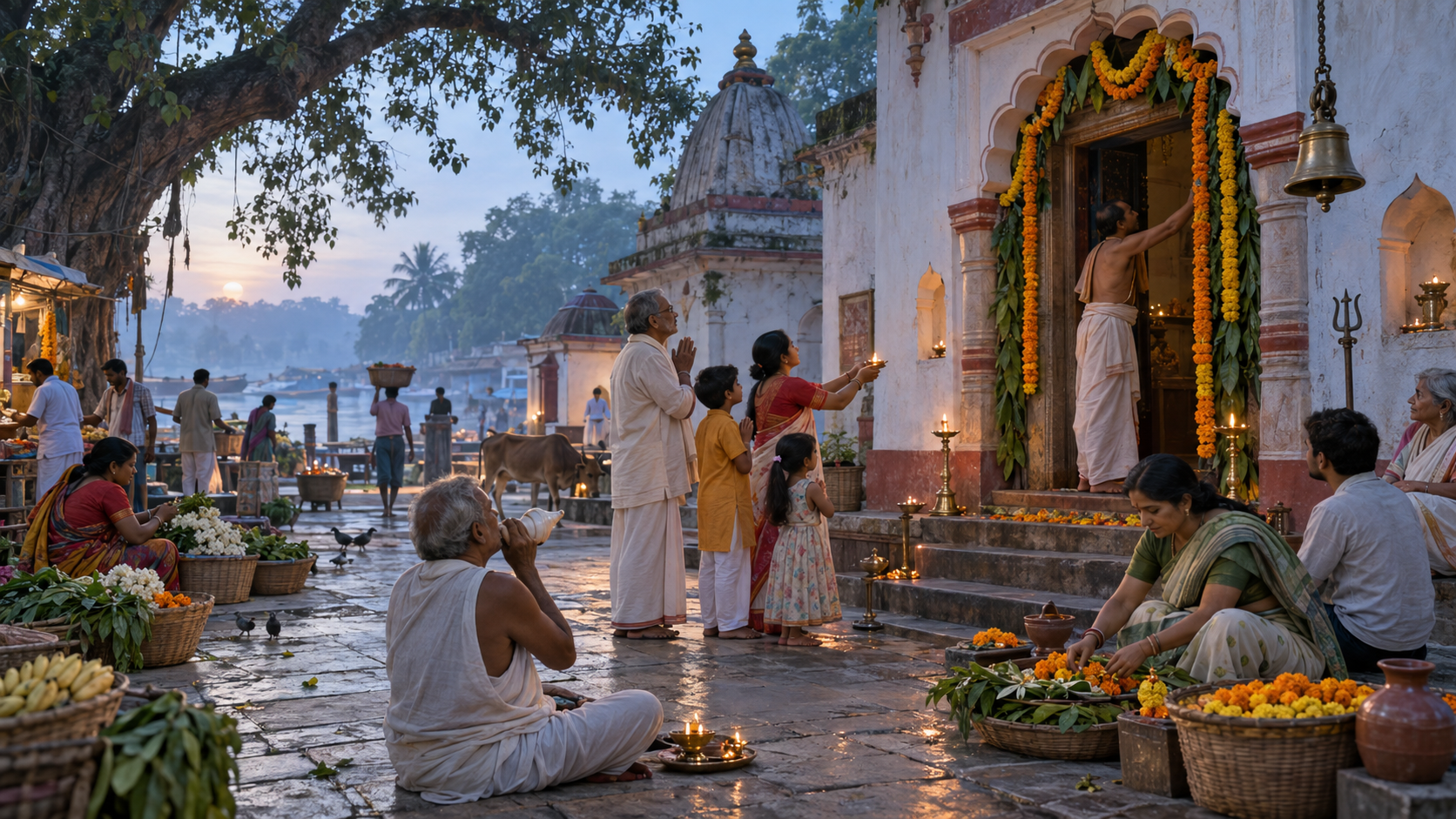
If you are trying to understand Hindu worship in eastern Bharat, do not begin with a catalogue of deities. Begin with movement: what changes between morning and night, how a mandir organizes space, which form of the deity stands in the sanctum, and how ritual joins work, landscape, poetry, music, and community memory.
Traditions from Bengal and Odisha make this way of seeing especially clear. They do not represent every household or locality in the east. They do, however, give you a practical method for approaching a living tradition without flattening it into either folklore or formal theology.
Read the rhythm of worship before interpreting its symbols
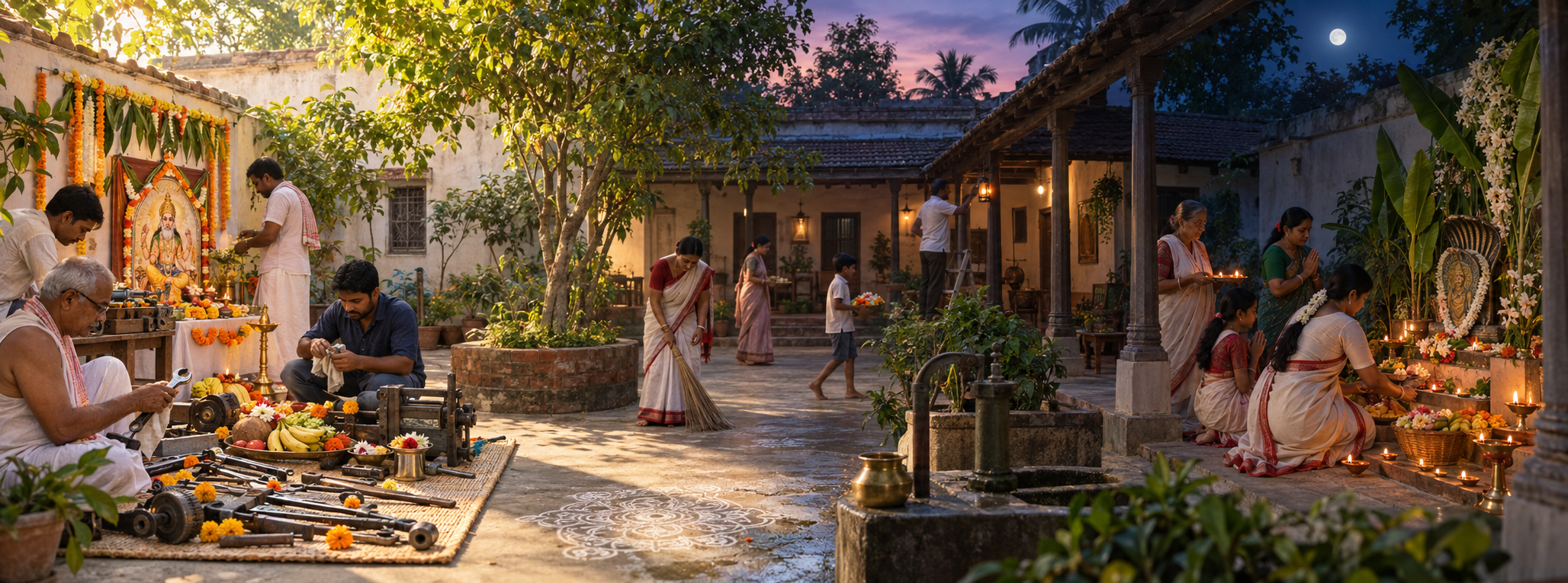
In a Bengali day-to-night observance, Viśvakarma Pūjā fills the daytime with decorated tools and machines, music, community gatherings, and kites, while the evening turns toward Manasā Pūjā with lamps, flowers, offerings, prayers, and folk practices. The change in atmosphere is not incidental. Time itself helps give each act of worship its character.
During the day, sacred attention is directed toward work, skill, craft, and the implements on which livelihoods depend. After sunset, the setting becomes quieter and more intimate, drawing worship toward faith, nature, and inherited household practice. The two pujas retain their own identities, but their sequence joins domains that modern life often separates: occupation, family, community, and the natural world.
This gives you a useful rule when observing any regional festival: ask what happens when, not only whom people worship. A description that names the deity but omits the day’s progression can miss much of the tradition’s meaning.
- Notice which objects receive care or decoration. A machine, tool, lamp, flower, or offering tells you where sacred attention is being placed.
- Watch for changes at sunset. Light, sound, location, participation, and mood may reveal a deliberate transition.
- Distinguish public celebration from household devotion. A single observance can move between a workshop, neighbourhood gathering, and intimate ritual setting.
- Ask how younger family members encounter the tradition. Food, music, decoration, and shared activity often carry memory alongside formal prayer.
- Confirm which details belong to a particular family or locality. A regional pattern should not be turned into a rigid rule for every Bengali household.
The practical lesson is simple: sequence is part of the ritual. If you arrive only for the most visible hour, you may see a celebration while missing the relationship between its parts.
Let the mandir’s spaces show you how devotion is organized
A mandir is not merely a container around a murti. Its halls, subsidiary shrines, narrative art, and ceremonial areas can show how worship brings assembly, performance, prayer, and darśan into one sacred environment.
Odagaon’s Raghunath Mandir in Odisha offers a precise example. Nayagarh’s historical tradition attributes the approximately 60-foot mandir to King Mrityujay Singh in 1763. Its Kalinga-style architecture includes a pyramidal vimana crowned by three golden kalaśas, giving the site the name Swarna Kalash Khetra.
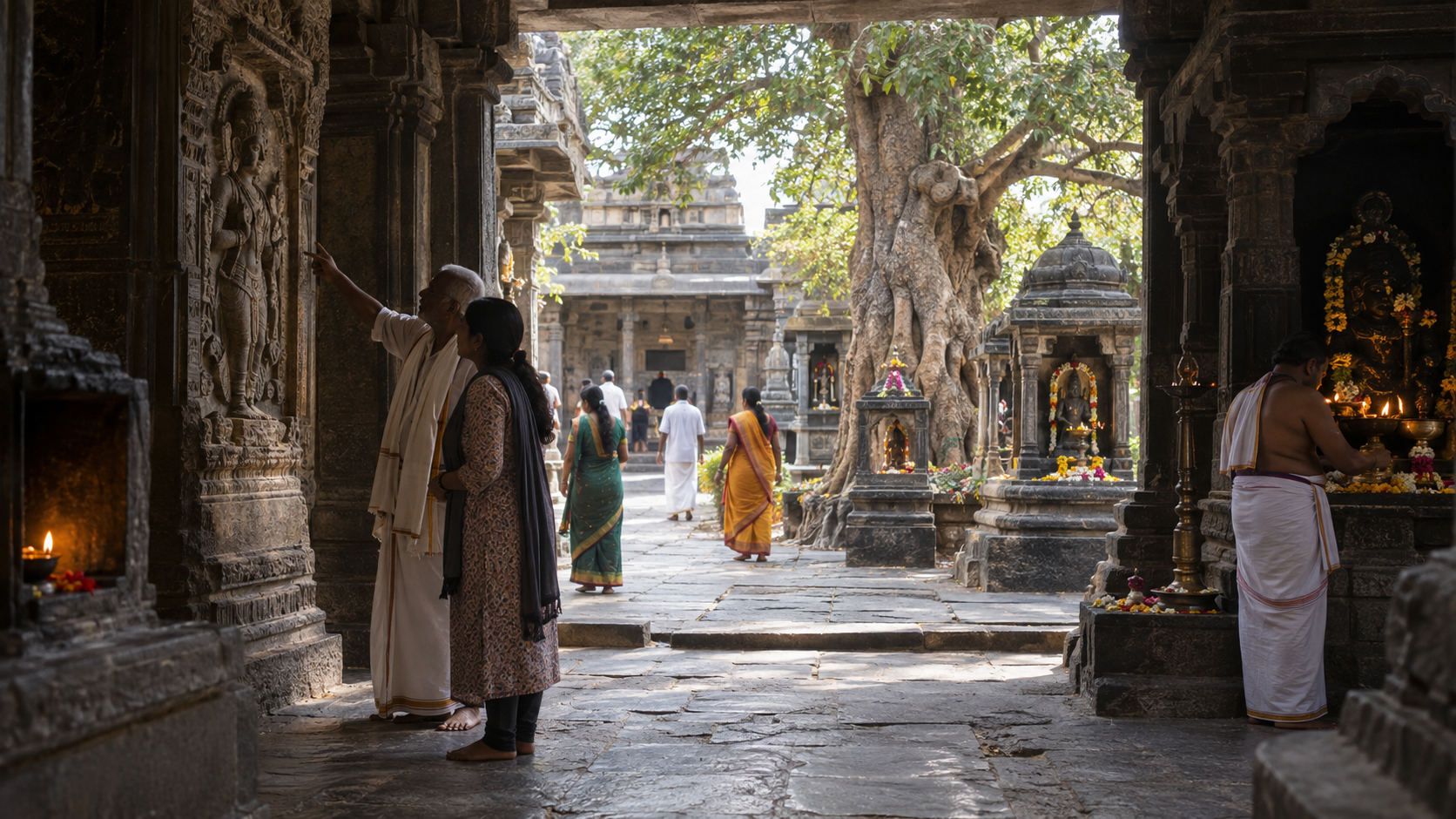
The complex is organized around the Bhadra Mandap, Nata Mandap, and Darshan Mandap: an assembly hall, dancing hall, and prayer hall. These names matter. They show that the sacred life of the mandir is not confined to the innermost point of worship. Gathering, artistic expression, and devotional seeing all have architectural places.
The same principle appears in the surrounding shrines. Although Raghunath Mandir is dedicated to Bhagavan Rama, Maa Durga, Sri Narasimha, Navagraha, Surya, Ganesha, and Narayana are also worshipped within the vicinity. Dedication to one principal deity does not require a spiritually empty perimeter. The complex presents a devotional ecology rather than an isolated cult.
When you visit a mandir of this kind, resist the urge to walk directly to the principal sanctum and leave. First identify the halls. Then note the subsidiary shrines, spaces for performance, narrative images, and the route devotees actually use. You will learn more from that arrangement than from an architectural label alone.
Look at the divine form, not only the deity’s name
Saying that a mandir is dedicated to Rama is only the beginning. Rama can be presented as king, child, warrior, exile, or the centre of a divine family. The chosen form directs attention toward a particular part of the sacred narrative and a corresponding devotional mood.
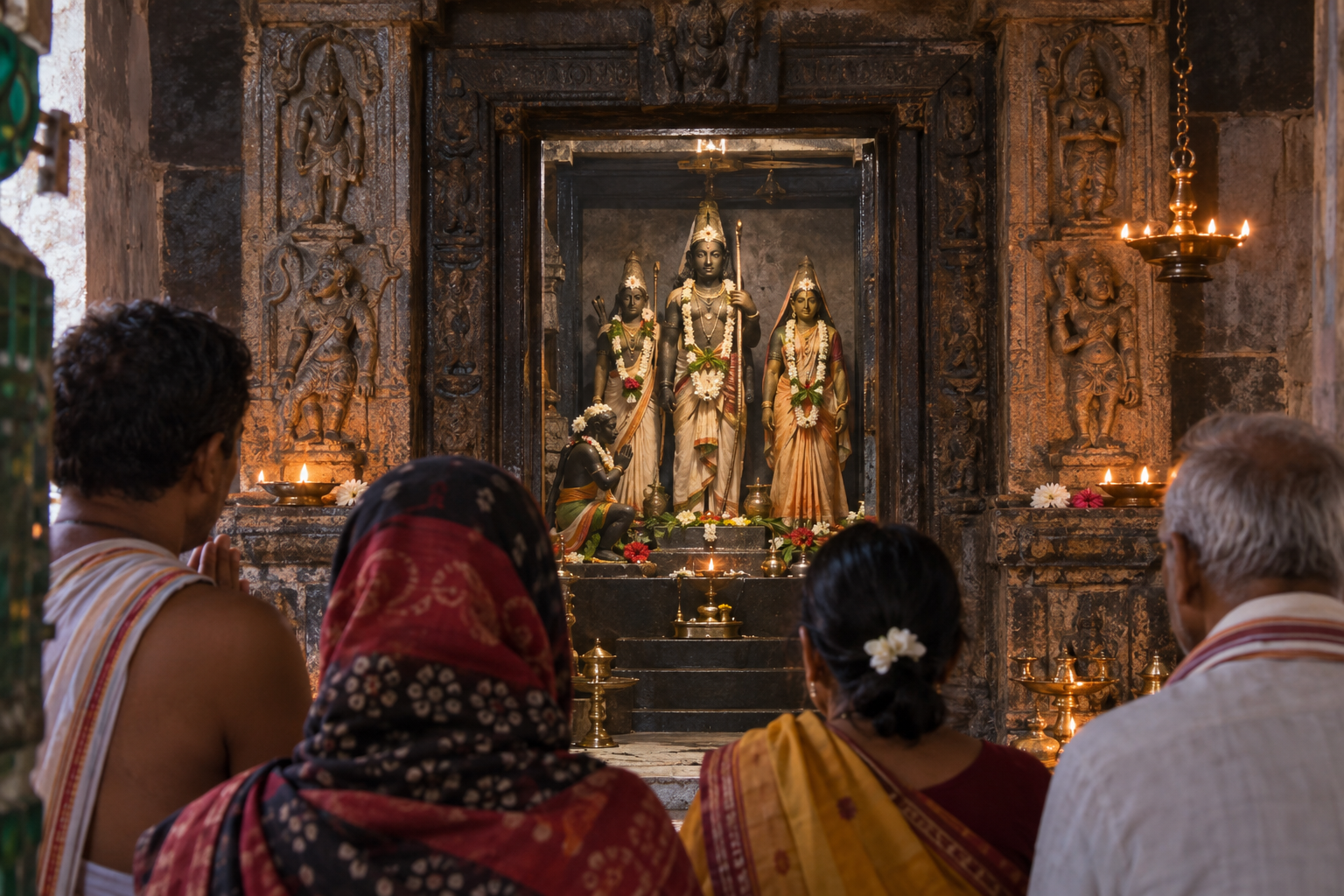
At Odagaon, the neem-wood images of Rama, Sita, and Lakshmana portray them in their Vanavasi, or forest-exile, form. Rama and Lakshmana bear beards and moustaches. This is markedly different from the familiar image of an enthroned or ceremonially consecrated king.
The iconography asks the devotee to contemplate Rama amid austerity and trial. Royal dignity has not disappeared, but it is encountered through voluntary hardship rather than palace splendour. Sita and Lakshmana are not incidental companions in that vision; the three figures place fidelity, shared exile, and sacred relationship before the worshipper.
The mandir grounds extend this visual teaching through clay models depicting scenes from the Ramayana. The sanctum concentrates devotion in the murti, while the models allow episodes of the larger narrative to unfold around it. Theology is therefore carried through material, facial appearance, grouping, and storytelling rather than through words alone.
Use five questions whenever you encounter a regional murti:
- What material is used, and does it belong to a local artistic tradition?
- Which moment in the deity’s life is being shown?
- Which companions, attributes, or bodily features identify that moment?
- What devotional quality does the form foreground: sovereignty, childhood, austerity, protection, learning, or something else?
- How do nearby images, songs, stories, and rituals expand what the central form communicates?
Ritual timing adds another layer. At Raghunath Mandir, daily worship includes Abhishekam and aarti accompanied by Vedic hymns, while night ceremonies are illuminated by oil lamps. Ramanavami is the principal festival, and Dussehra commemorates Rama’s victory over Ravana. If you are planning a visit, decide whether you want to observe the steadier rhythm of daily worship or the scale of a major festival. Do not assume the experience will be the same, and confirm current timings locally.
Keep construction history and sacred memory in their proper places
A mature reading of a sacred site does not force every claim into one category. The date of a present structure, a community’s memory of an ancient landscape, a poet’s association with a deity, and the continuity of daily worship are different kinds of knowledge. They can belong together without being treated as interchangeable evidence.
Odagaon’s local sacred geography identifies the site with Maharṣi Atri’s forest hermitage and yajña-kuṇḍa. The tradition connects it with the Ramayana meeting of Rama, Sita, and Lakshmana with Atri and Anasūyā, placing Rama there before his journey toward the Daṇḍakāraṇya region. This is an oral and folkloric identification of place, not the same claim as the dated construction of the standing mandir.
That distinction protects both history and tradition. Dating the present building to 1763 does not, by itself, tell you when the location first became sacred. Conversely, a living association with Atri’s hermitage should not be presented as though it were a modern construction record. You can respect the site’s sacred memory without disguising the kind of claim being made.
The same care is necessary with literary memory. Odagaon associates the Odia poet and Odissi composer Upendra Bhanja, approximately 1670-1740, with composing Baidehisha Bilasa at the feet of Raghunath. The work is renowned for beginning every line with the Odia letter Ba. Yet the chronology that attributes the present mandir to 1763 places its construction after Bhanja’s lifetime. The dates alone cannot establish whether his association belongs to a predecessor shrine, the wider sacred site, or the present structure as later remembered.
This unresolved point should not be covered with false certainty. What remains clear is that Bhanja’s compositions became central to Odissi music and are used in Odissi dance and related arts. Worship thus travels beyond the sanctum through language, composition, recitation, music, and embodied performance.
When you document a sacred place, keep four separate headings in your notes:
- Built history: dates, patrons, materials, architectural form, and changes to the standing structure.
- Sacred geography: local identifications with sages, deities, epic journeys, forests, rivers, or yajña sites.
- Ritual life: daily worship, annual festivals, offerings, processions, and night ceremonies.
- Artistic memory: poetry, music, dance, sculpture, clay narrative scenes, and other forms through which devotion circulates.
This approach prevents two common errors. One is to dismiss everything beyond a construction date as meaningless legend. The other is to turn every inherited identification into a dated historical event. A living mandir often holds architectural history, sacred memory, and devotional truth at the same time, but not in the same evidentiary form.
Key takeaways for understanding eastern Bharat’s worship
- Follow the clock. Bengal’s movement from daytime Viśvakarma Pūjā to evening Manasā Pūjā shows how a change in time and atmosphere can connect livelihood, community, faith, and nature.
- Read the whole mandir. Assembly halls, dance spaces, prayer halls, subsidiary shrines, and narrative art are part of worship, not merely background architecture.
- Identify the deity’s particular form. Odagaon’s Vanavasi Rama communicates something different from an enthroned Rama because it foregrounds forest exile and austerity.
- Separate kinds of knowledge without severing them. Construction history, oral sacred geography, ritual continuity, and literary association should be recorded distinctly and understood together.
- Expect regional depth, not regional uniformity. These Bengali and Odia examples offer a method of attention, not a template to impose on every community in eastern Bharat.
On your next temple visit or festival day, write down five things before trying to explain what you see: the sequence of events, the objects receiving sacred attention, the form of the deity, the organization of space, and the stories local devotees attach to the place. Then ask which details are widely shared and which belong to that family, mandir, or locality. That small discipline turns observation into understanding while allowing the tradition to speak in its own grammar.
References
- Hindu Post – From Viśvakarma Pūjā to Manasā Pūjā: A Bengali Day-to-Night Tradition
- Hindu Post – Raghunath Mandir, Odagaon, Odisha

Leave a Reply
You must be logged in to post a comment.