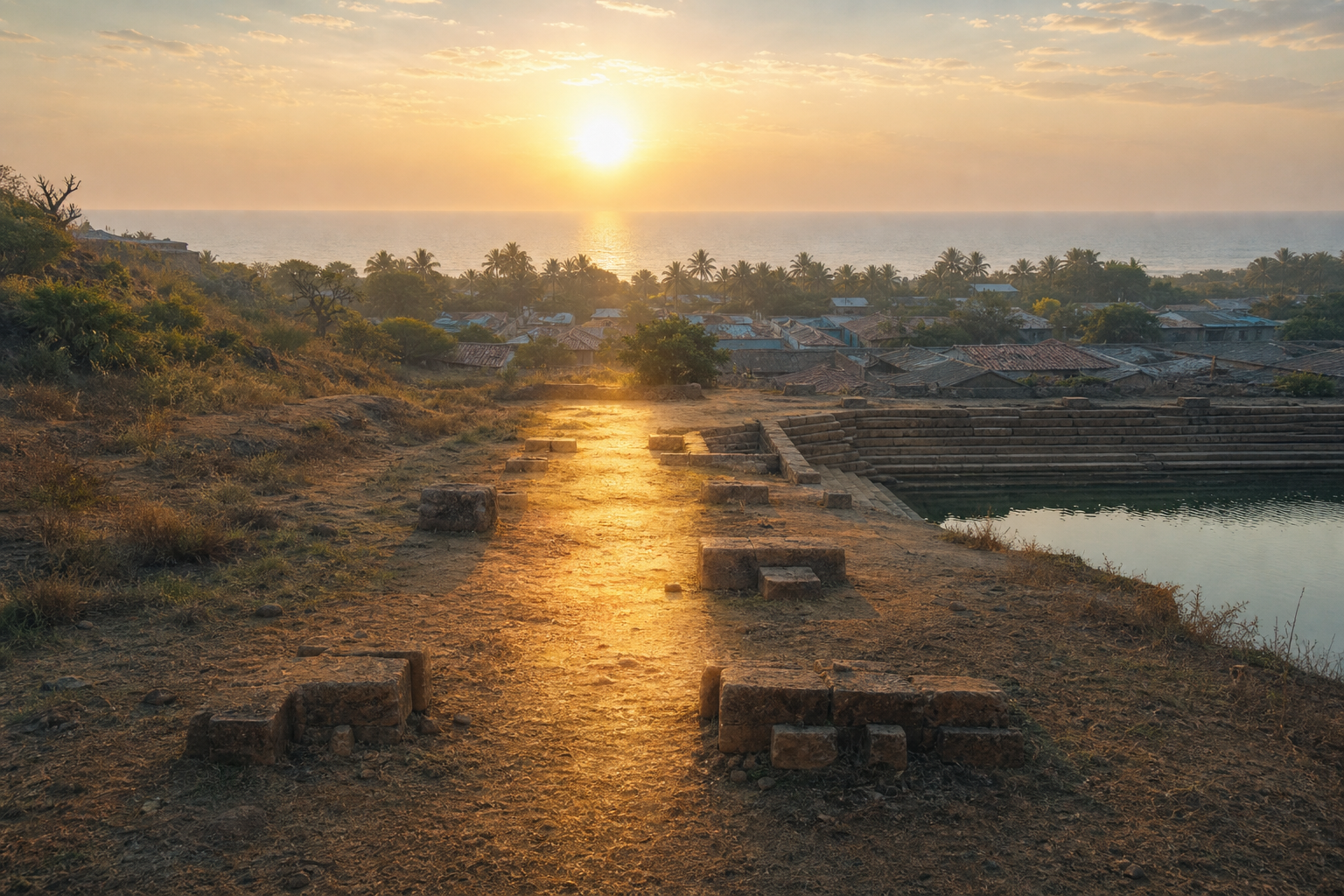
Dhamlej matters because its reported historical record links a coastal village in Saurashtra to a Surya shrine, a sacred water body and a wider network of pilgrimage and patronage around Prabhasa and Somanatha. The evidence does not provide a complete architectural history, but it shows how a sacred place can remain partly legible even after its principal monument has vanished from public view.
Only one secondary article was included in the supplied source material. The account below therefore synthesises the different forms of evidence and interpretation within that article, but does not treat its specific claims as independently corroborated. Questions about the temple’s design, the present condition of its water body and the precise course of the site’s decline remain open.
An inscription anchors Dhamlej’s sacred geography
The supplied DharmaRenaissance Blog article reports that tradition remembered Dhamlej as Mula-Gaya, approximately 33 kilometres south of Sri Somanatha Kshetra. It describes the settlement as a Surya Kshetra whose sanctity was compared with Modhera. That comparison concerns remembered sacred importance; without additional material evidence, it should not be read as proof that Dhamlej resembled Modhera in architecture, date or scale.
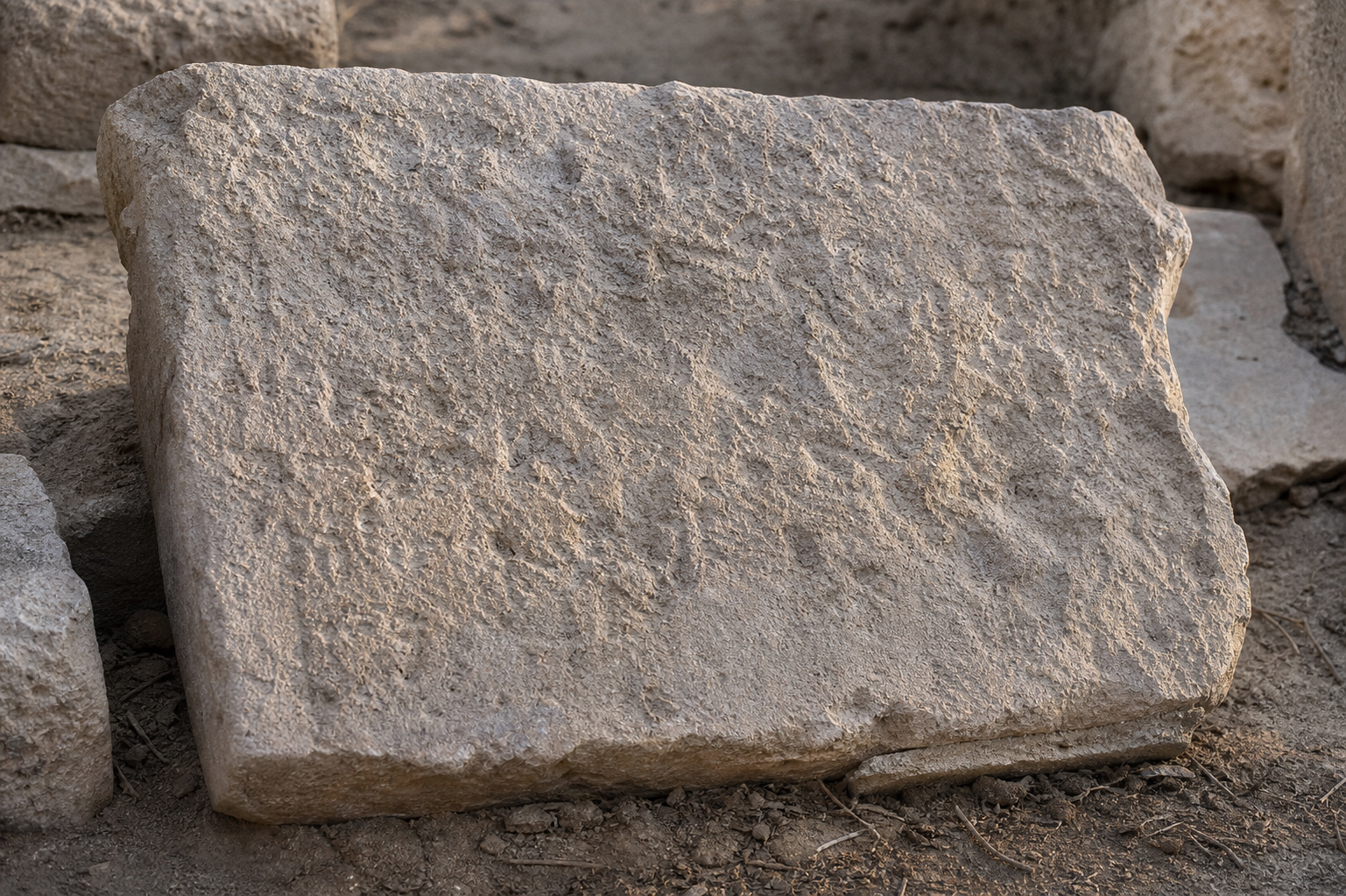
The article’s principal documentary anchor is the Dhamleja Inscription, identified as inscription number 39 and dated 23 June 1380 CE. As presented in the source, it records a Surya Mandira, restoration activity and a sacred water body called Vishnu Gaya or Cakra Tirtha. The source uses the form “Dhamleja” for the inscription while discussing the village as Dhamlej, a naming variation that future documentation should preserve rather than silently standardise.
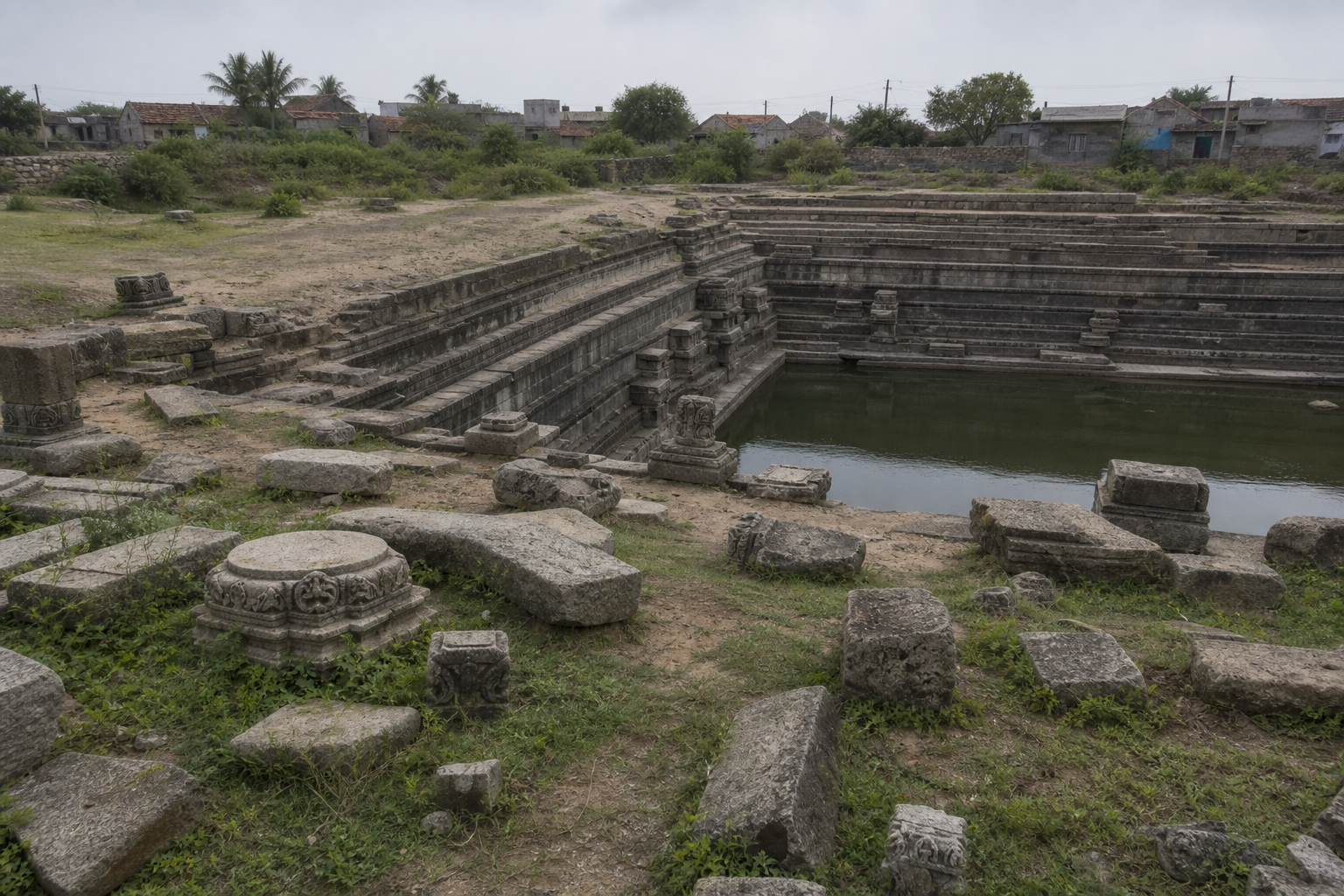
Later observations add a second layer to the record. According to the article, Major J. W. Watson encountered numerous inscriptions and old temple remains while travelling along the Saurashtra coast in the 1870s. It identifies him as President of the Maharajasthanik Court of Kathiawar and says that he considered the coastal concentration worthy of archaeological investigation. The article also reports that historian and epigraphist D. B. Diskalkar visited Dhamleja in 1939. He placed Vishnu Gaya west of the village and recorded that the inscription lay beneath a pipala tree near the Kunda.
Together, these elements form an evidentiary sequence rather than a finished history: sacred tradition supplies the remembered identity, the inscription supplies a dated medieval record, and the nineteenth- and twentieth-century observations locate traces in the landscape. The source does not establish the Kunda’s current condition or the inscription’s present custody, so those points require field and archival verification.
The shrine belonged to a civic and religious system
The strongest insight from the Dhamlej account emerges when the temple is considered alongside water, education, land and public welfare. The source attributes the restoration initiative to Karma Simha, chief minister of Raja Bharma. His reported work encompassed repair of the Surya Mandira and rejuvenation of Vishnu Gaya Kunda. Restoring the shrine would have renewed ritual activity, while restoring the Kunda would have renewed a place identified both as a water resource and a tirtha.
The same account says that Karma Simha granted a village to Brahmanas as an Agrahara so that sacred teaching and learning could continue on a stable foundation. The village was named Meghapura, or Meghapuragraharam, in memory of his deceased elder brother, Megha-Nripa. In this reported arrangement, property, scholarship, family remembrance and religious merit were joined through a durable institution rather than a single ceremonial donation.
A further detail broadens the picture beyond the temple precinct. The source reports that Karma Simha constructed a large drinking trough for cattle at the gate of Prabhasa-Pattana. Read together, the shrine repair, Kunda restoration, educational endowment and animal-welfare provision suggest a connected model of patronage. Sacred infrastructure supported worship, but it also organised water access, learning, memory and care within everyday life.
Karma Simha’s patronage crosses modern sectarian boundaries
The identity of the reported patron is central to Dhamlej’s wider significance. The article describes Karma Simha as a devout Porwal Jaina, relating Porwal to the earlier designation Pragvata. Yet it also presents him as the official responsible for repairing a Surya temple, renewing a Brahmanical learning endowment and performing a daily midday aradhana of Somanatha. The inscriptional phrase cited by the source is “Madhyahnikim anudinam,” referring to that regular observance.
The source also says that Karma Simha’s father, Rano or Rana, was remembered for protecting Brahmanas, safeguarding Dharma and maintaining prosperity during upheaval. These details resist an overly rigid reading of medieval religious identity. A Jain affiliation evidently did not, in this reported case, prevent support for Surya worship, Somanatha devotion or Brahmanical education. The episode does not prove that all relations among traditions were harmonious, but it does document cooperation through patronage, administration and shared institutions.
The political context makes that cooperation more consequential. The article places the inscription after Ala-ud-din Khalji’s campaigns and during the reign of Firoz Shah Tughlaq, reporting that Farhat-ul-Mulk became governor of Gujarat in 1377. It also describes continuing Chudasama influence and identifies the Vaja ruler Bharma as holding authority over Prabhasa. Within the source’s reconstruction, restoring Dhamlej was therefore more than an act of private devotion: it helped preserve organised religious and social life amid contested power.
The source notes that medieval terms such as Mleccha and Turushka occur in connection with conflict and disruption. Such vocabulary belongs to the historical setting in which it was used. It can inform the study of medieval power and temple damage without being converted into a label for present-day communities.
A preservation agenda must separate evidence from inference
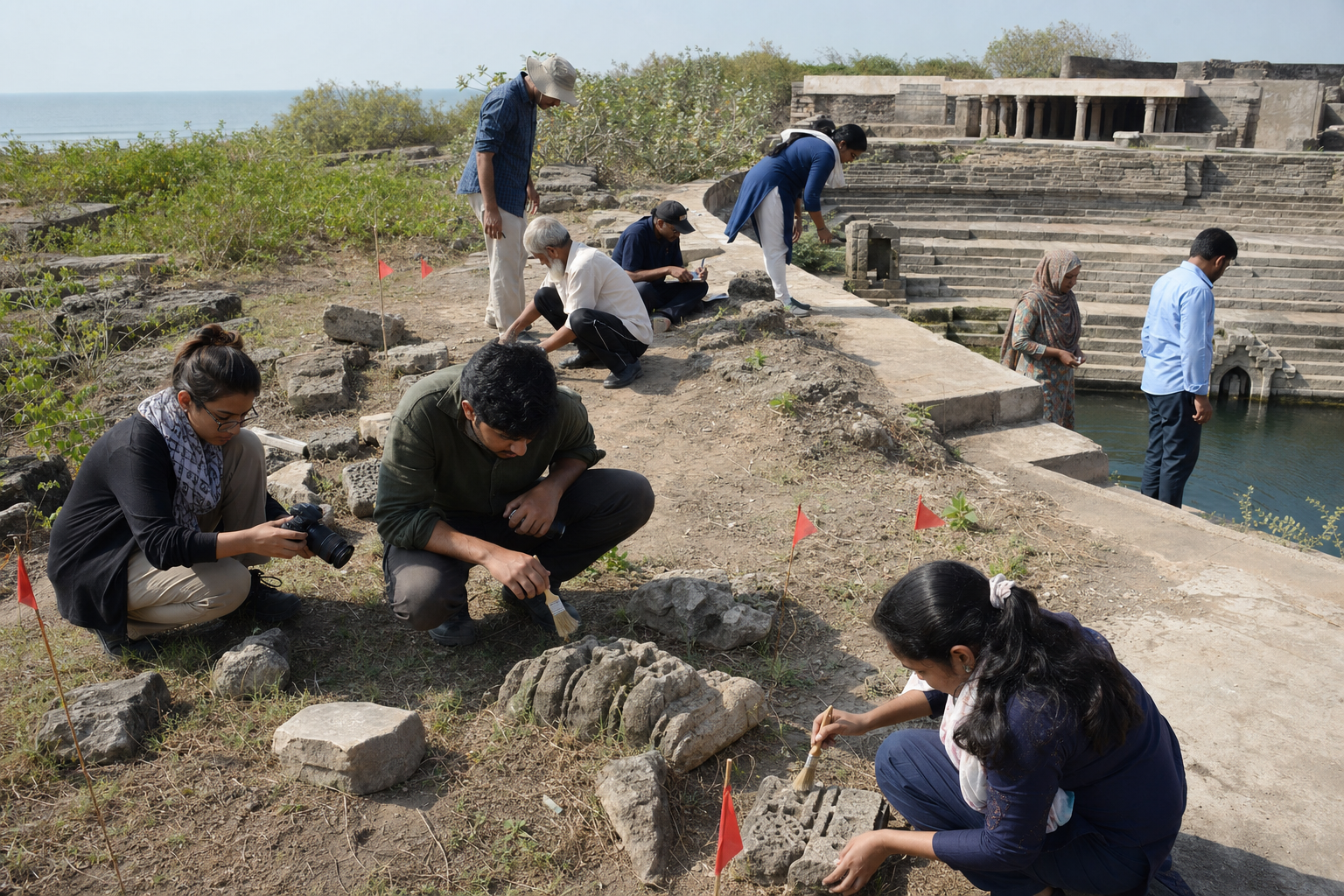
Dhamlej’s heritage case cannot be resolved by repeating that a temple once stood there. The first research need is geographical: Vishnu Gaya or Cakra Tirtha should be located, described and mapped through field observation, land records, historical maps and local testimony. Oral memory could help identify names and uses that formal records have lost, although it would need to be compared carefully with dated evidence.
The inscription requires an equally clear documentary trail. Researchers would need to establish its current location, physical condition, published transcription and translation history. Comparing the recorded text with Watson’s coastal observations and Diskalkar’s 1939 account could distinguish what the inscription itself states from conclusions supplied by later interpreters.
Archaeological investigation could then test whether structural fragments, reused stone, surface remains or older water-management features survive around the reported Kunda and village. Until such work is available, descriptions such as “comparable to Modhera” should remain attributed to sacred tradition rather than presented as an architectural classification.
Public interpretation should retain the full institutional story if the site is documented or conserved. Presenting only a vanished temple would omit the Kunda, Agrahara, cattle trough and Jain minister whose patronage connected them. Dhamlej’s distinctive heritage lies in that network of relationships.
Key takeaways
- The supplied account rests chiefly on a reported inscription numbered 39 and dated 23 June 1380 CE, supplemented by observations from the 1870s and 1939.
- Dhamlej was remembered as Mula-Gaya and a Surya Kshetra, but its reported comparison with Modhera establishes sacred reputation rather than architectural equivalence.
- The restoration associated with Karma Simha linked a Surya shrine, sacred Kunda, educational land grant and provision of water for cattle.
- Karma Simha’s reported identity as a Porwal Jain patron of Surya, Shaiva and Brahmanical institutions illustrates practical cooperation across dharmic traditions.
- The Kunda’s present condition, the inscription’s custody and the temple’s physical form remain research questions rather than settled facts.