
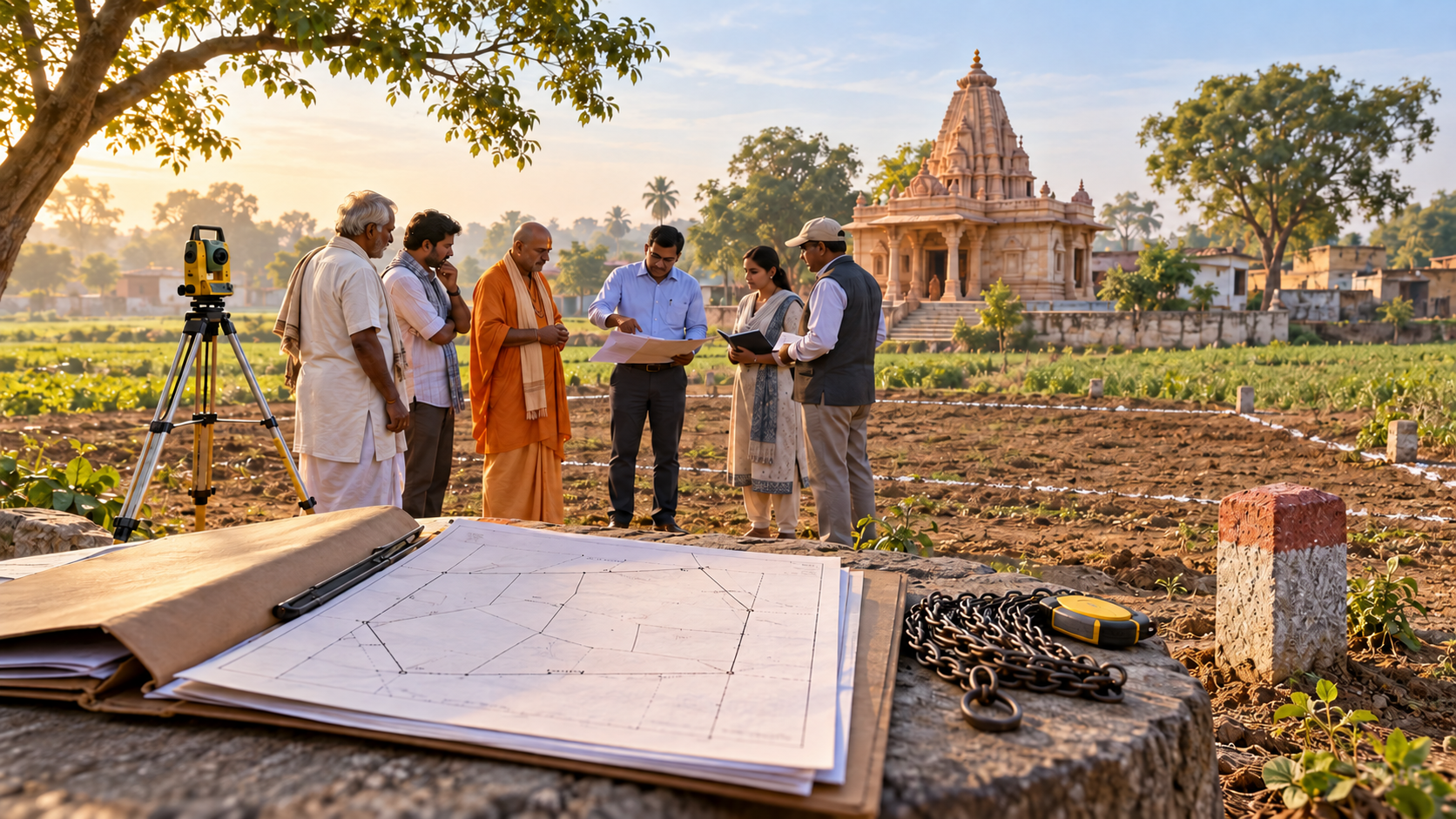
If you are trying to understand the Bijua temple land dispute, begin with the distinction that will decide it: public concern is justified, but an allegation is not yet a legal finding. The temple’s claim, the disputed parcel and the nature of the occupation must all be established through records and an official survey.
That standard does not weaken the defence of sacred property. It strengthens it. A temple community that demands documents, measured boundaries and a written decision is far harder to ignore than one whose case can be dismissed as anger without evidence.
What is known, and what remains unproven
The controversy concerns an alleged encroachment on land belonging to a temple in Bijua, in Uttar Pradesh’s Lakhimpur Kheri district. Local Hindu organisations and residents have sought intervention, treating the matter as a threat to property meant to serve religious and community purposes.
Public pressure increased after Kamaljit, identified as a divisional general secretary associated with the Bajrang Dal, voiced concern about the alleged occupation and warned that legal measures could follow if it was not addressed. That warning puts the administration on notice politically, but it does not by itself prove the temple’s title or the alleged encroachment.
On the information presently available, no completed official survey, written administrative finding or court ruling has been identified. Nor have the exact plot particulars, the claimed encroached area, the occupants’ position or the documents asserted by either side been made clear. Those are not minor omissions. They are the questions on which a lawful remedy depends.
Key takeaways
- The encroachment is an allegation that requires prompt, transparent verification.
- The decisive evidence will be the identity of the parcel, the temple’s legally recognised interest, the measured boundary and the authority, if any, claimed by the present occupant.
- Residents should seek a written administrative process rather than rely on verbal assurances.
- Public mobilisation should preserve evidence and demand action without declaring unverified claims to be proven facts.
- If an irregular occupation is officially established, removal or restoration should proceed through the competent authority or court.
Four questions a credible verification must answer
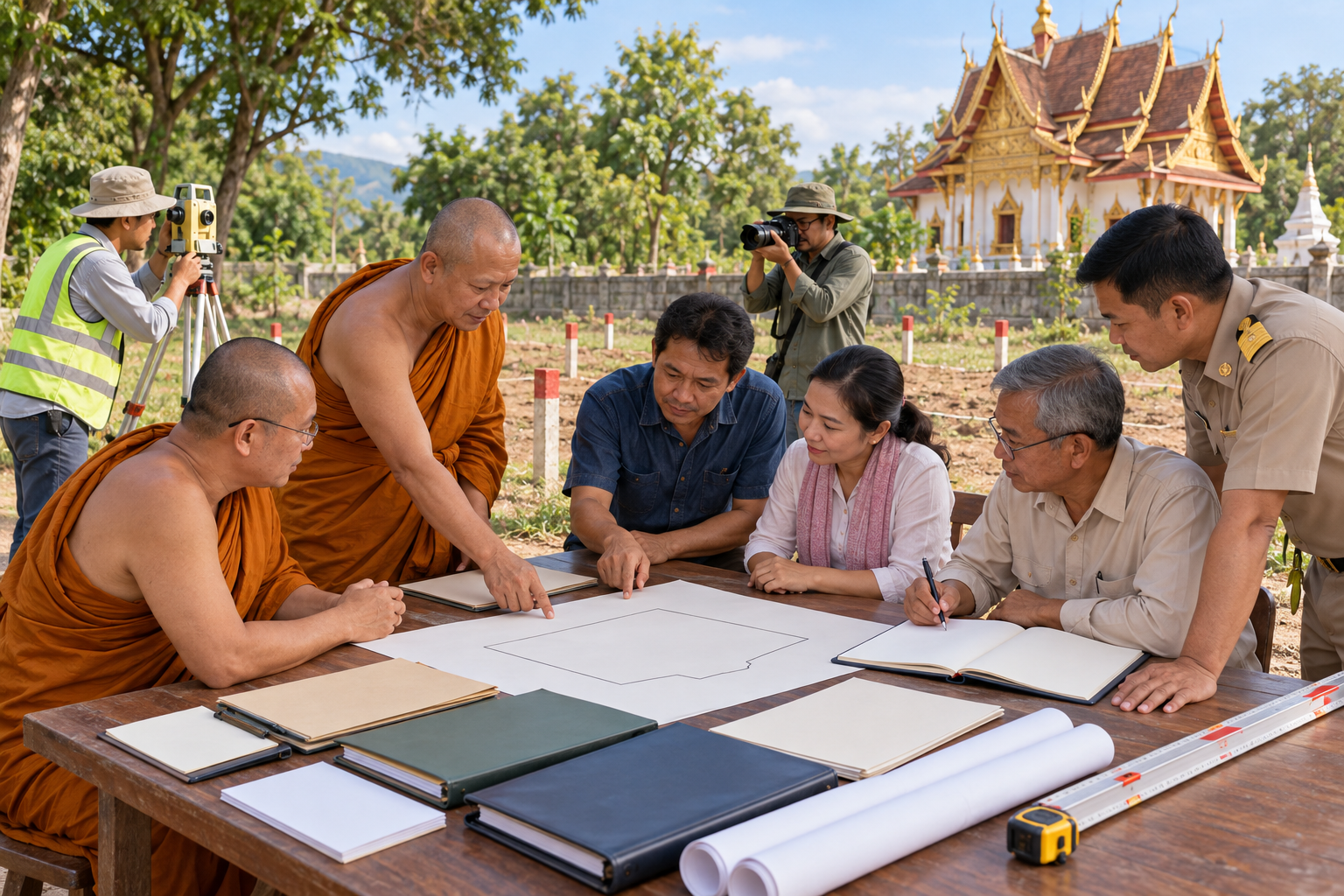
Calling for a survey is useful only when the survey is tied to identifiable records. A visit in which officials merely look at the site and speak to local people cannot settle title or boundaries. The verification must connect what exists on paper with what exists on the ground.
- Which parcel is disputed? The representation should identify the relevant plot or revenue particulars, the claimed extent and the boundaries. If only part of a larger parcel is allegedly occupied, that portion should be described precisely.
- What interest does the temple hold? Officials should examine the relevant revenue entries, historical ownership or dedication documents and any records concerning the institution or its lawful management. The question is not merely who manages daily worship, but what legal interest attaches to the land.
- What is happening on the land? An on-ground survey should record the present boundary, structures, fencing and use of the disputed portion. It should also distinguish long-standing physical features from recent changes where the evidence permits that distinction.
- On what authority is the land occupied? The affected party must have an opportunity to produce any document or legal basis it relies upon. Due process is not a concession to encroachment; it is what makes an eventual finding defensible and enforceable.
The expected administrative examination in Bijua would ordinarily bring together revenue records, historical ownership documents and an on-ground survey. Each answers a different question. A record may indicate a legal interest, while the survey shows whether the actual occupation matches the recorded boundary.
The final finding should identify the documents considered, the parcel measured, the positions of the parties and the reason for the conclusion. Without that written chain of reasoning, residents may receive an answer but still lack an accountable resolution.
How residents can strengthen the temple’s case
If you are part of the local community, the most useful work is disciplined evidence-building. Do not begin with the broadest accusation. Begin with the smallest fact that can be documented, then connect the facts into a complete claim.
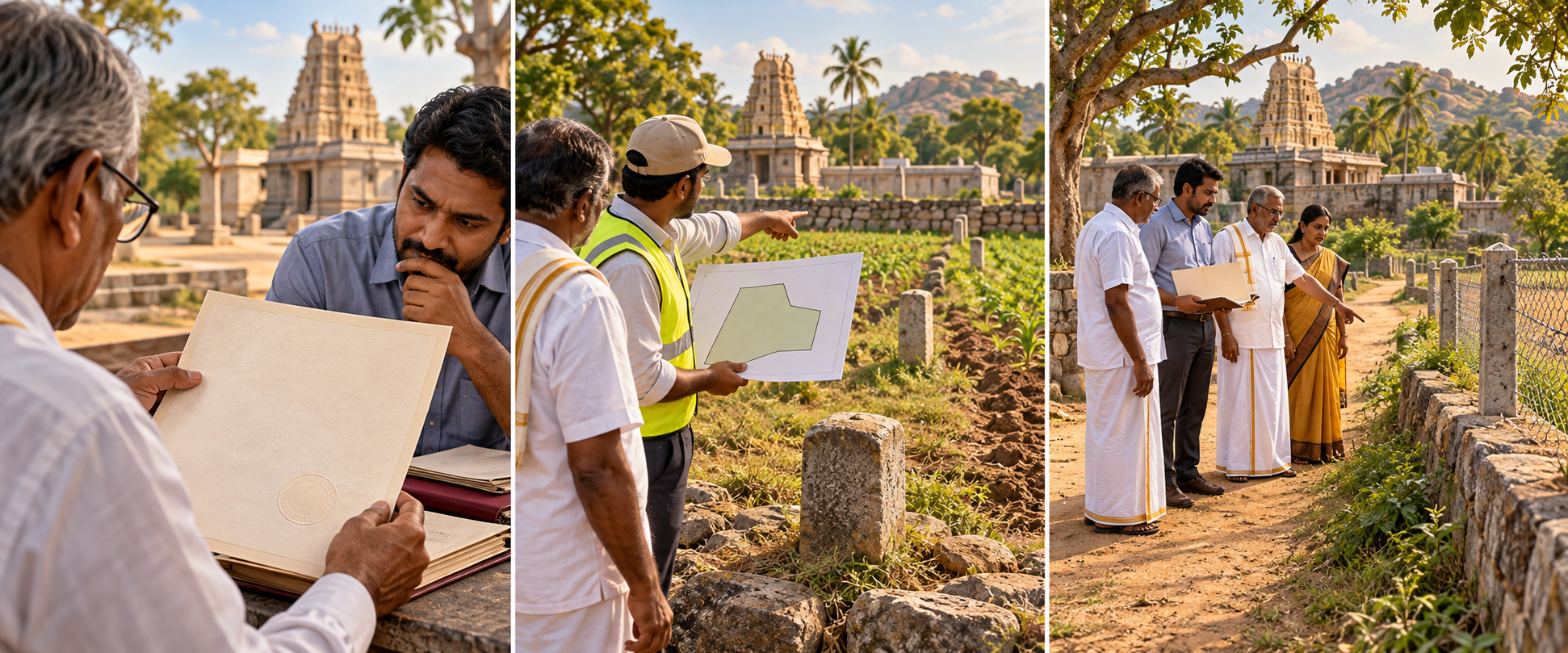
- Create one evidence file. Assemble copies of relevant land entries, maps, historical documents, prior applications, official replies and dated photographs that are lawfully available. Keep an index explaining what each item is meant to establish.
- Write a precise statement of the dispute. Identify the parcel, the temple’s claimed interest, the physical act said to constitute encroachment and the remedy being requested. Do not use a larger area or stronger allegation than the evidence supports.
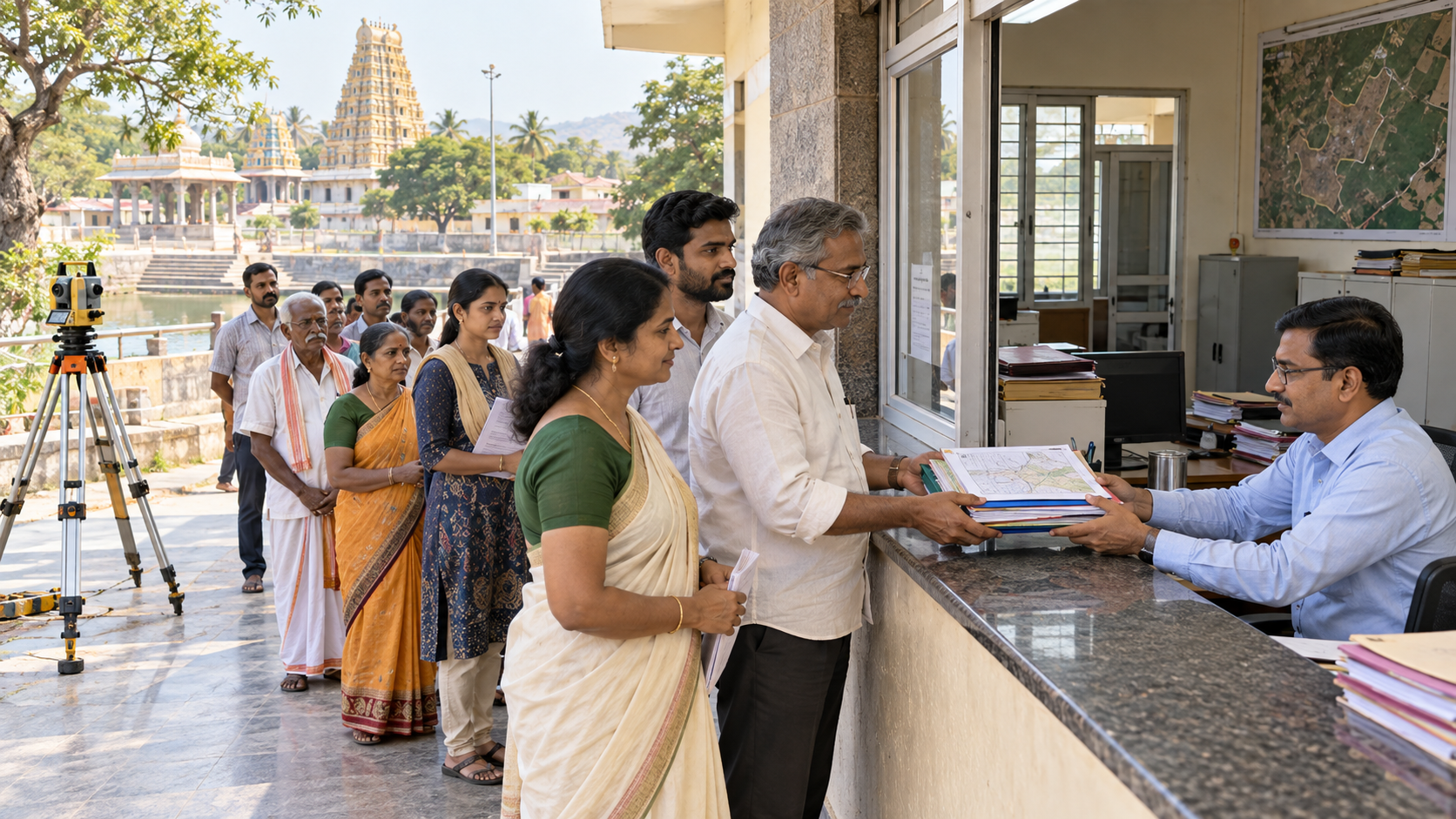
- Submit a signed representation. Ask the competent revenue or district authority for record verification, demarcation through an on-ground survey and a written finding. Obtain an acknowledgement or diary number so the request can be tracked.
- Designate responsible representatives. A small, consistent group can keep the facts straight, preserve correspondence and prevent contradictory statements from weakening the case. Representatives should separate verified information from claims that remain under examination.
- Record administrative movement. Maintain a chronology of submissions, meetings, notices, surveys and replies. After any verbal assurance, send a brief written follow-up stating what was understood and what action remains pending.
- Take legal advice before litigation or physical action. Land records, institutional rights and available remedies can turn on documents not visible from the site. A qualified local lawyer can assess the evidence and the proper forum. This is especially important before seeking an injunction, removal order or other coercive remedy.
Do not publish unverified personal allegations, interfere with the disputed site or attempt to remove an occupant by force. Those actions can create confrontation, expose participants to legal consequences and distract attention from the temple’s documentary case. Preserve the land as far as lawfully possible, document changes from a safe place and ask the competent authority or court for protective action.
What an accountable administrative response looks like
A serious response is visible and traceable. It begins with written acknowledgement, identifies the responsible office, calls for the relevant records, gives affected parties a fair opportunity to respond and arranges a properly documented survey. It ends with findings and, if an irregularity is confirmed, a lawful enforcement decision.
Residents do not need to prejudge the outcome to insist on that process. They can ask direct questions: Which officer has the file? Which land records are being checked? Has a survey been ordered? Were the relevant parties notified? Will the measurements and conclusion be recorded in writing? What legal step will follow if an encroachment is established?
Verbal sympathy is not a resolution. An undated promise to “look into the matter” leaves the community unable to assess progress. The appropriate demand is for named responsibility, recorded action and a reasoned decision. If the administration finds no encroachment, it should explain why. If it finds one, it should state the lawful remedy and carry it out.
Possible legal proceedings can seek clarification of ownership rights, a survey, removal of an established encroachment or court-supervised enforcement. Which remedy is available in Bijua will depend on the verified records and procedural posture. Community leaders should therefore avoid promising a particular legal result before a lawyer has examined the documents.
Protect sacred property through truth and lawful resolve
Temple land is not merely another piece of real estate when it has been dedicated to worship and related cultural or social purposes. Its loss can restrict what the institution is able to sustain for future devotees. That is why an alleged encroachment deserves more than temporary outrage: it deserves an enduring system of records, boundary awareness and accountable management.
A Dharmic response carries two duties at once. We must protect what belongs to the temple, and we must remain truthful about what has and has not been proved. Justice is not served by passivity, but neither is it served by replacing verification with certainty that the evidence has not yet earned.
If you are involved in the Bijua matter, make the next demand exact: identify the parcel, produce and examine the records, conduct the survey, hear the affected parties and issue a written finding. Once those steps establish the facts, insist that the lawful remedy be completed rather than allowed to disappear into another round of assurances.

References

Leave a Reply
You must be logged in to post a comment.