
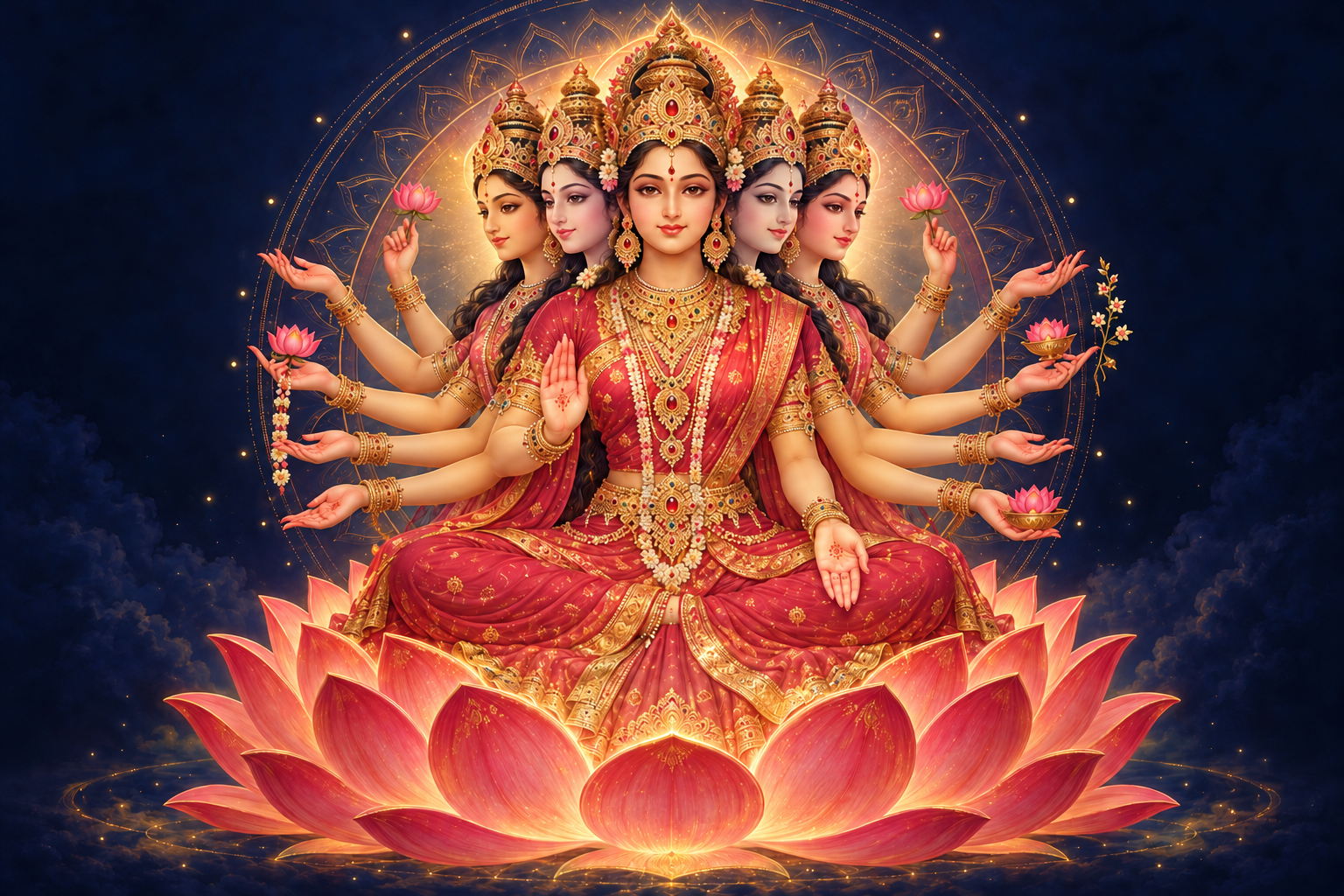
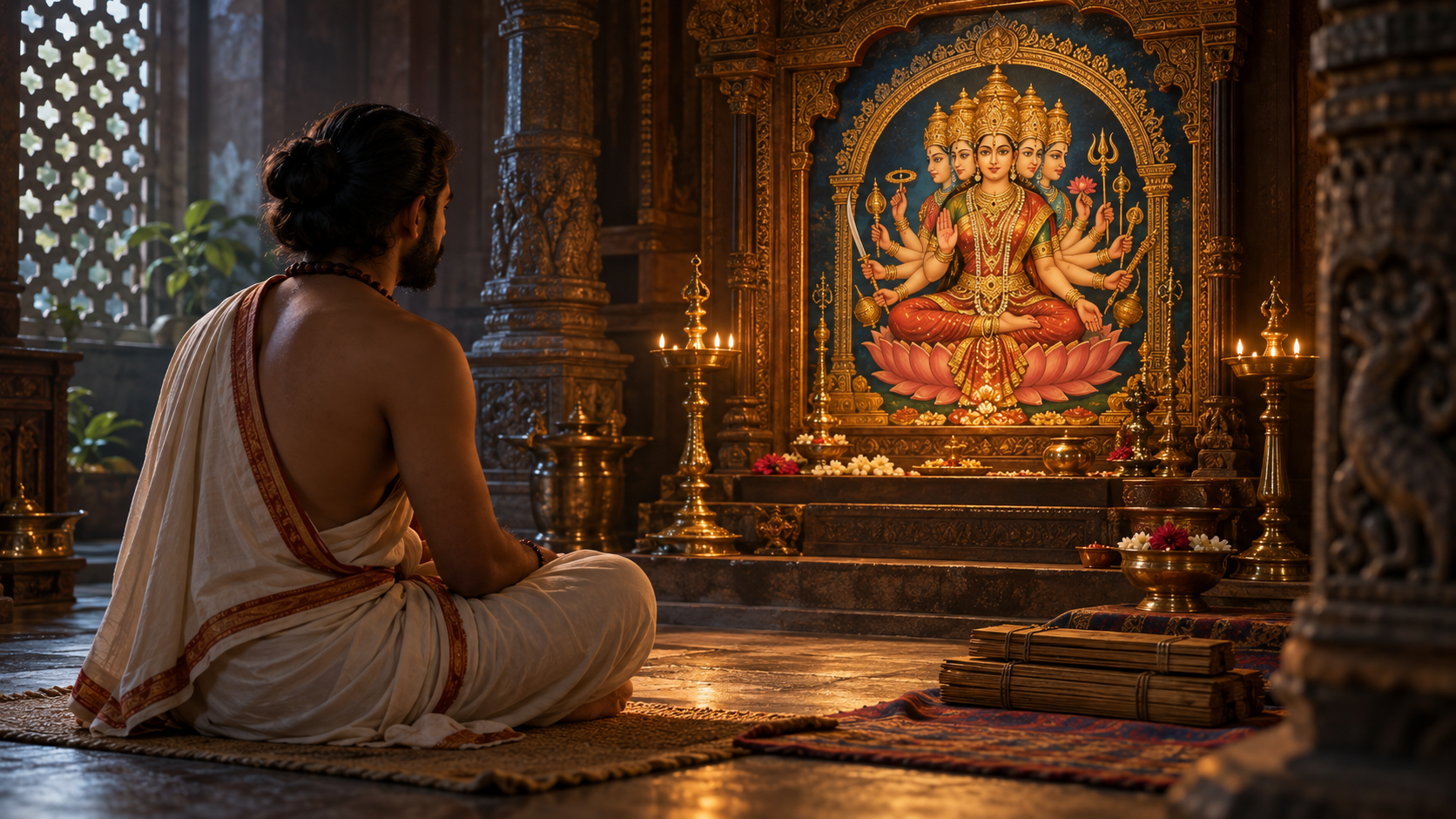
You are looking at a five-faced, many-armed Devi and want to know what you can responsibly conclude from the image. Begin with what is visible: the number of faces, the number of arms, the expression, the objects or gestures, and any ritual name attached to the form.
For Panchamukhi Nitya Devi, the decisive combination is five faces, twelve arms, a merciful countenance, and the Nitya setting of Srividya. Those elements belong together. Reading only the weapons, or treating the five faces as a code that can be solved without context, misses the form’s governing idea: immense divine capacity held within compassion.
The name tells you how to approach the form
Panchamukhi means five-faced. Nitya means eternal or ever-present. Devi identifies the sacred form as the Goddess. In this setting, she is understood as an eternal manifestation of the Mother-goddess, Bhavani, rather than as a merely unusual figure with extra heads and limbs.
That distinction should control your reading. Sacred multiplicity is not a departure from divine unity. One Devi appears through five faces and acts through twelve arms. The image expands what a human body can show because the reality being contemplated cannot be contained within ordinary human limits.
The merciful countenance is especially important. A serene or compassionate face is not a decorative detail added after the symbols of power. It tells you how that power is exercised and how you are meant to encounter it. If the arms communicate abundant capacity, the face establishes the disposition governing that capacity.
When viewing the murti, therefore, look at the expression before trying to name every object. Ask whether the face communicates severity, tranquillity, protection, compassion, or some combination of these. In Panchamukhi Nitya Devi, mercy is the interpretive centre: the many powers are not random displays of force but powers gathered into a compassionate divine presence.
Five faces and twelve arms express different dimensions
The five faces and twelve arms should not be collapsed into one undifferentiated message. Faces concern presence, awareness, orientation, and relation. Arms concern agency: what the Devi bears, grants, restrains, protects, or accomplishes. Read them as two complementary parts of the iconographic grammar.
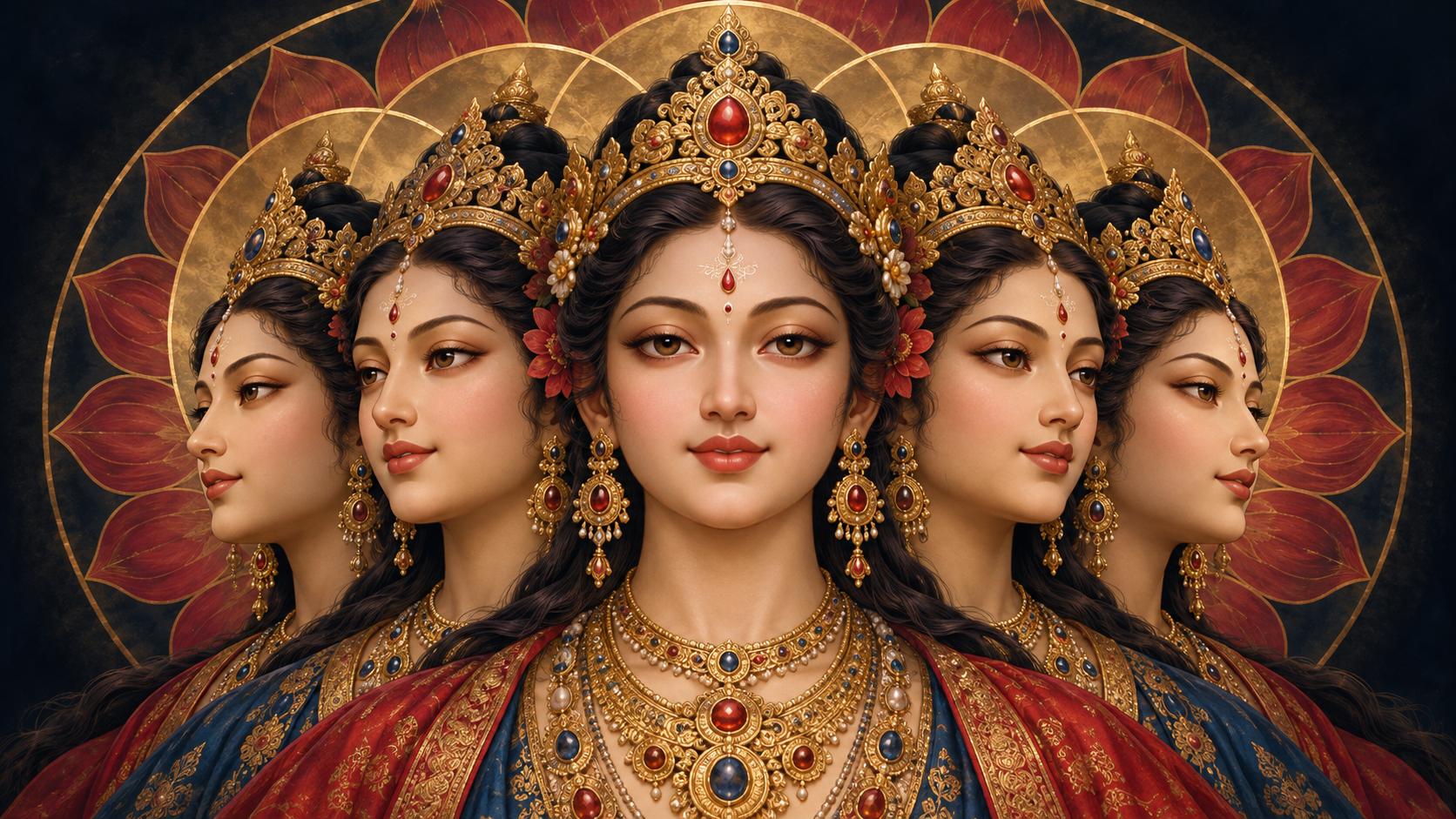
Five faces allow the worshipper to contemplate a presence that exceeds a single human viewpoint. You may reasonably read the multiplicity as an invitation to see the Goddess as unconfined by one perspective. You should not, however, assign a specific element, direction, mantra, colour, or cosmic function to each face unless the relevant lineage, text, inscription, or ritual tradition supplies that correspondence.
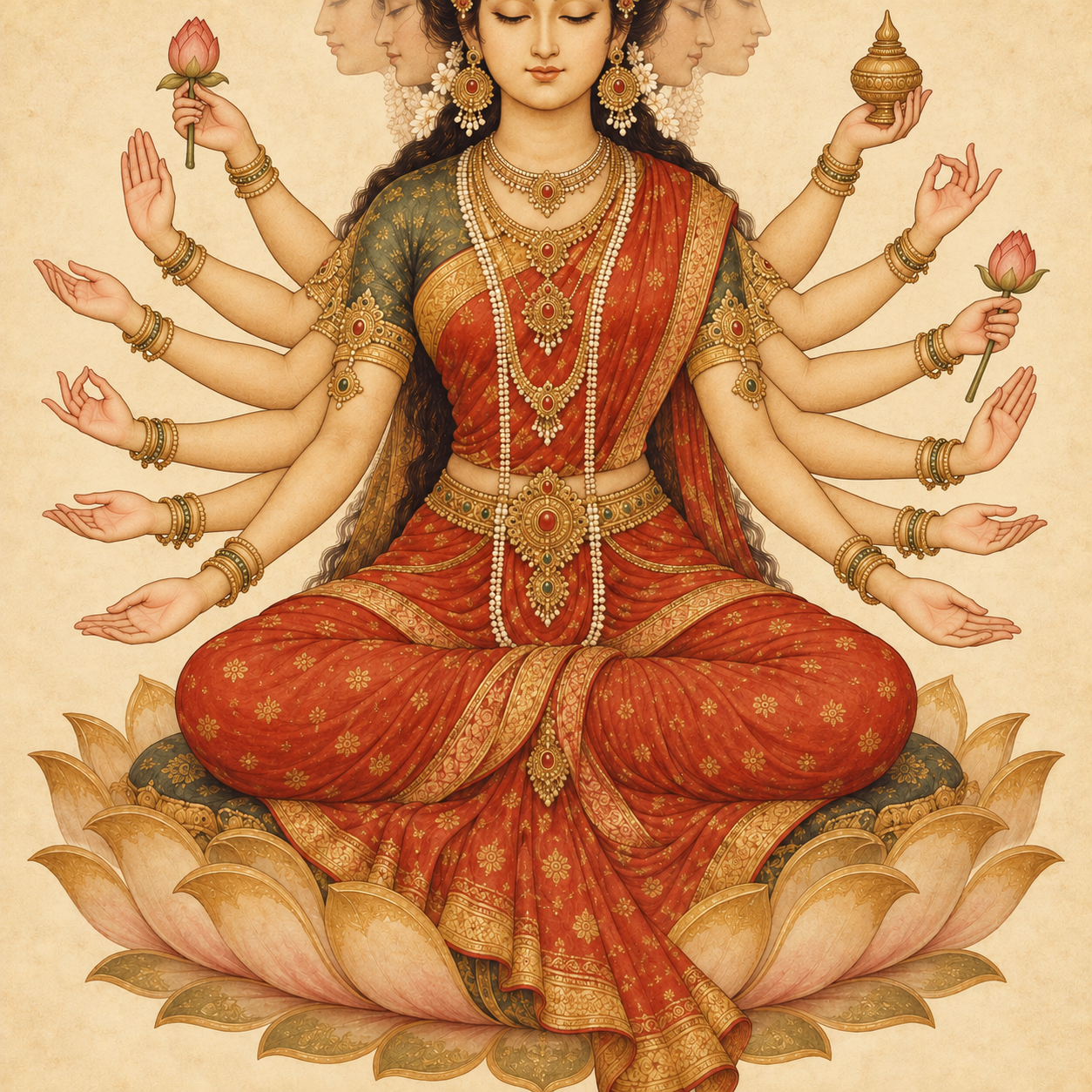
The same discipline applies to the twelve arms. Multiple arms conventionally communicate superhuman capacity and simultaneous action. Yet the number twelve does not by itself identify what every hand means. A held emblem, weapon, vessel, flower, or ritual implement can qualify the action represented by a hand, while an empty hand may form a meaningful gesture. If those details are damaged, obscured, or absent from the available image, leave them unidentified.
This restraint is not a failure of devotion. It protects the integrity of the tradition. A confident but invented list of twelve attributes is less useful than a careful distinction between what the image shows and what still requires authoritative ritual or textual context.
Nitya places the Goddess within sacred lunar time
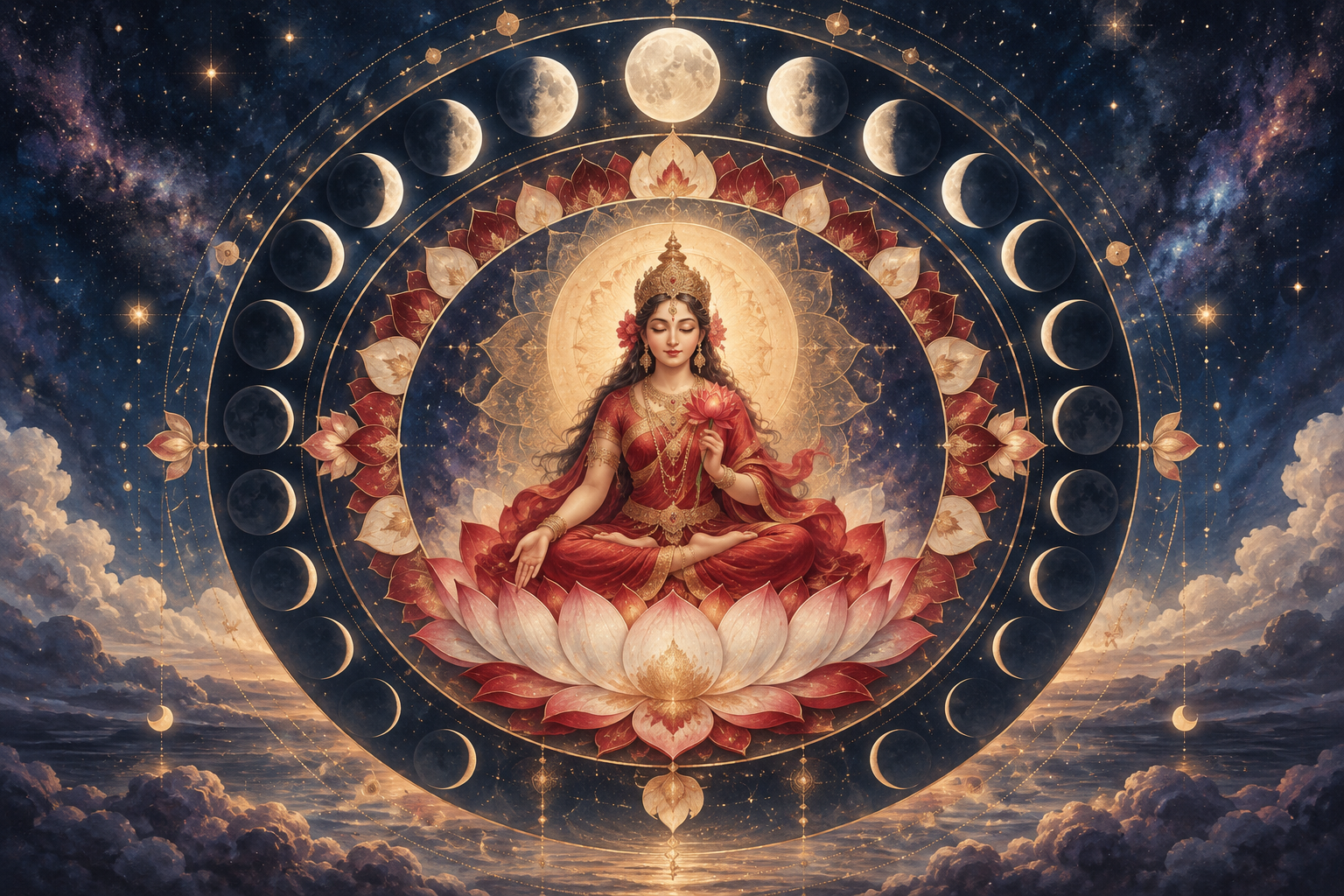
The word Nitya changes the question from “What does this figure look like?” to “How is this divine presence encountered through time?” The Nitya Devis are eternal, ever-present forms associated with tithis, the lunar phases through which a fortnight is ritually reckoned. The cycle comprises fifteen tithis in each waxing or waning half of the lunar month.
A tithi is a lunar date, not simply a numbered box on a solar calendar. Its importance here is theological as well as calendrical. The recurring lunar rhythm gives worshippers a way to approach an ever-present reality through a particular moment. Nitya therefore holds together two ideas that can initially appear opposed: the Goddess is eternal, while the worshipper meets her through changing phases of time.
This is why a purely visual identification remains incomplete. If a temple caption, ritual manual, calendar, or lineage teaching connects a form to a particular tithi, preserve that information with the image. Do not replace the tithi with a fixed Gregorian date, because the lunar observance must be calculated within its calendrical setting.
For a devotee, the practical consequence is simple: iconography and observance should be read together. For a student, cataloguer, or writer, record the name of the form, the associated tithi if it is actually supplied, the ritual tradition, and the visible features separately. That prevents a later interpretation from being mistaken for an observation.
A six-step method for identifying the image responsibly
- Verify the name. Look for a temple label, inscription, published caption, ritual manual, or informed lineage identification. Five faces alone do not establish that every multi-faced goddess is Panchamukhi Nitya Devi.
- Count what is actually visible. Record five faces and twelve arms only when the image supports that count. In sculpture, an arm may be broken; in a photograph, one may be hidden behind another.
- Describe the countenance. Note the dominant expression before interpreting the objects. In this form, the merciful face governs the reading of the Goddess’s abundant power.
- Inventory each hand without guessing. Work methodically from one side to the other. Describe a gesture or object in plain visual terms when you cannot identify it securely.
- Look for the Nitya setting. Check whether a tithi, Srividya practice, mantra, or lineage context is explicitly attached to the image. Do not manufacture these associations from the number of faces or arms.
- Separate observation from interpretation. “Five faces and twelve arms are visible” is an observation. “Each face represents a particular cosmic principle” is an interpretation that needs traditional support.
If you are viewing the murti in a living temple, ask how the local tradition names and worships the form. Temple identity is not always recoverable from a photograph alone. Darshana is also more than classification: careful identification should deepen the encounter, not turn the Devi into a visual puzzle detached from worship.
Key takeaways
- Panchamukhi identifies the five-faced form; Nitya identifies her as an eternal, ever-present manifestation of Devi.
- The five faces concern expanded divine presence, while the twelve arms communicate abundant agency and capacity.
- The merciful countenance is the key to reading the power of the form: capacity is governed by compassion.
- The Nitya framework links divine eternity with the recurring sequence of fifteen lunar tithis in a fortnight.
- Exact meanings for individual faces, hands, objects, colours, or directions should come from the relevant text or lineage, not from guesswork.
The next time you encounter this form, make two columns in your notes: “what is visible” and “what the tradition identifies.” Begin with five faces, twelve arms, the merciful expression, and the Nitya context. Then let a trustworthy temple or lineage explanation supply the finer correspondences. That small habit will make your reading both more accurate and more reverent.
References

Leave a Reply
You must be logged in to post a comment.