
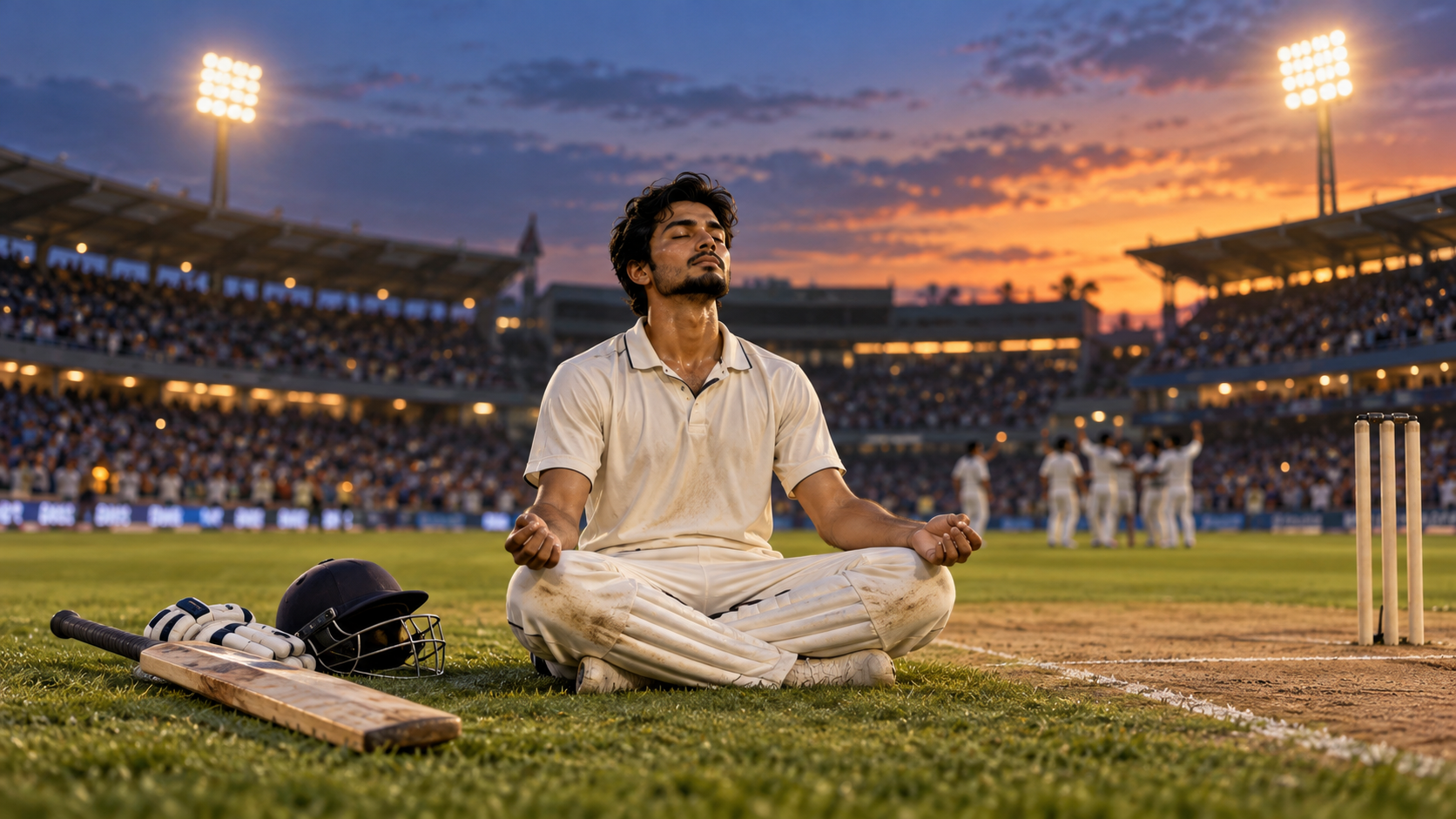
If you saw Abhishek Sharma’s on-field invocation of Shiva and wondered whether to read it as devotion, celebration, performance or politics, begin with what was actually visible. The moment can be honoured without pretending that a short public gesture reveals everything about the person who made it.
After completing a T20 century against New Zealand, Sharma sat in Padmasana and chanted Om Namah Shivaya. That was an explicitly Shaiva act: not generic mindfulness, not an ambiguous hand signal and not merely a pose for a photograph. Its significance lies in the direction it gave to a moment that could easily have centred only on personal achievement.
What Sharma expressed, and what we cannot assume
Om Namah Shivaya is a widely used mantra of reverence to Shiva. The word namah carries the sense of salutation or bowing. Padmasana, the lotus posture, is associated with meditative stillness. By bringing the mantra and posture together, Sharma made his chosen devotional language clear.
The timing matters. An athlete who has just reached a century stands at the centre of noise, attention and acclaim. Sharma answered that outward surge with stillness. The most defensible interpretation is that he redirected the moment from self-display towards remembrance of the divine.
That does not give spectators access to his private spiritual life. We cannot infer his sampradaya, the regularity of his sadhana, the depth of his initiation or the motives behind every choice he makes. Nor do we need those details before accurately identifying the act as Shaiva devotion. What is public should be described faithfully; what remains inward should not be invented.
This distinction protects the gesture from two equally weak reactions. The cynical reaction declares visible devotion false because it is visible. The credulous reaction treats one gesture as proof of complete spiritual attainment. Bhakti does not require either judgement. You can recognise a sincere-looking act of reverence while leaving the final measure of sincerity between the devotee and Shiva.
It is also worth naming the act precisely. Calling it only meditation removes the deity, mantra and tradition that made it intelligible. Calling it merely a Hindu celebration is closer, but still incomplete. Sharma invoked Shiva. Shaiva is therefore the clearest description.
Why stillness after success carries Dharmic meaning
Modern sport encourages an athlete to think in outcomes: runs, medals, rankings, selection and contracts. These outcomes matter, but fixation on them can pull attention away from the action immediately at hand. Dharmic disciplines offer a different order: perform the present duty fully, receive the result without being possessed by it, and return to the next action.
This is the practical force of nishkama karma in the Bhagavad Gita. It does not mean indifference, weak ambition or careless preparation. It means that effort belongs to you while complete command over the result does not. For an athlete, the distinction is concrete: the next delivery can be watched and played; the eventual score cannot be secured by anxiety.
We should not assign that entire philosophy to Sharma unless he states it himself. His gesture nevertheless has a compatible shape. The achievement came first, but the celebration did not end with the isolated self. It opened towards reverence.
He is not alone in drawing a sporting discipline towards a Dharmic centre. Manu Bhaker used the Bhagavad Gita’s teaching on action and results while rebuilding after disappointment; Cheteshwar Pujara drew on its emphasis on presence; and VVS Laxman found direction in Bhakti Yoga. PV Sindhu has also credited relaxation and meditation practices with supporting her mental preparation.
These examples should not be turned into a claim that a mantra mechanically produces a century or that meditation guarantees a medal. Sadhana is not a performance-enhancing superstition. Its sporting value lies in the habits it can cultivate: returning attention to the present task, meeting pressure without panic, recovering after error and keeping success from becoming arrogance.
How to assess public devotion without joining a culture war
A public Hindu gesture often attracts instant speculation. Some viewers want to turn it into proof of a political programme; others want to dismiss it as publicity before they have established any evidence of calculation. You do not have to accept either frame.
Use four questions when a Dharmic expression becomes a public controversy:
- What actually happened? Describe the observable act before adding motives. Here, the relevant facts are the century, Padmasana and the chanting of Om Namah Shivaya.
- What does the symbol mean in its own tradition? A mantra addressed to Shiva should first be read as Shaiva devotion, not stripped into generic wellness or automatically recoded as a partisan slogan.
- Was anyone coerced? Personal expression and compelled observance are different categories. Nothing in the described celebration required teammates or spectators to participate.
- Are you applying an equal civic standard? A plural society should permit peaceful religious expression without demanding that believers hide the distinctive names, forms and practices of their traditions.
This framework lets Hindus defend public dignity without manufacturing an enemy for every devotional act. There is no need to predict hostile reactions, answer insults that have not been made or compare one athlete’s prayer with the most provocative example available from another community. Anticipatory outrage shifts attention away from Shiva and towards the very conflict one claims to resist.
At the same time, public visibility does not turn bhakti into propaganda. Secular public life need not mean a religion-free public square in which only decontextualised wellness practices are acceptable. It can mean that Sharma may invoke Shiva, another person may follow a different path, and neither act becomes coercive merely because other people can see it.
The strongest pro-Dharmic response is therefore neither embarrassment nor exaggeration. Say plainly that the gesture was Shaiva. Explain the mantra accurately. Reject unsupported claims about Sharma’s inner motives. Then refuse invitations to make another community the subject of a moment centred on Shiva.
Turn admiration for the gesture into a durable practice
A viral celebration can make Dharma briefly visible, but its deeper test begins after the camera moves away. If Sharma’s act speaks to you, imitate the discipline behind its form rather than reproducing the pose only when people are watching.
- Choose an authentic anchor. Use a mantra received within your practice, a familiar verse from the Bhagavad Gita, a simple pranam or quiet recollection of your ishta-devata. Do not select a sacred form merely because it photographs well.
- Attach it to effort, not only victory. Remember the divine before training, after an error and after an ordinary session, not just after a milestone. A practice that appears only at the moment of applause can easily become part of the applause.
- Keep the same orientation in success and failure. After success, offer gratitude rather than claiming spiritual favour. After failure, return to disciplined action rather than treating the result as divine rejection.
- Measure conduct, not spectacle. Ask whether the practice helps you return to the next ball, accept correction, restrain anger and work consistently. Those are more meaningful signs of integration than the visibility of a celebration.
- Respect consent in shared spaces. Coaches, schools and teams can make room for voluntary Dharmic practice without testing anyone’s belief or compelling participation.
Parents and coaches should notice one further distinction. Cultural grounding is not the same as adding a decorative yoga session to a timetable. A serious programme would preserve the meaning of mantra, dhyana and pranayama, use teachers who understand the practices, and connect them to ordinary sporting habits such as attention, recovery after mistakes and steadiness under pressure.
Young athletes also need permission to practise without being made into symbols. A player who chants a mantra should not be burdened with representing every Hindu, defending every institution or answering every political dispute. Let the act be meaningful without demanding that the athlete become a spokesman for all of Dharma.
Key takeaways
- Sharma’s use of Padmasana and Om Namah Shivaya after his century was a specifically Shaiva expression, not merely generic mindfulness.
- The gesture redirected a moment of individual acclaim towards reverence, but it does not reveal every detail of Sharma’s beliefs or motives.
- Dharmic mental discipline is best understood as an aid to present action, composure and humility, not as a supernatural guarantee of sporting results.
- Public devotion should be distinguished from coercion. A visible personal practice does not become improper simply because an audience witnesses it.
- If you want to follow the example, build a quiet practice around daily effort, error and recovery rather than copying a celebratory pose after success.
The next time a Hindu athlete expresses devotion, pause before joining either the applause machine or the outrage machine. Name the practice accurately, give the devotee fair interpretive space, and then bring the principle home: do your work, remember what is greater than the scoreboard, and practise when no camera is present.


References

Leave a Reply
You must be logged in to post a comment.