
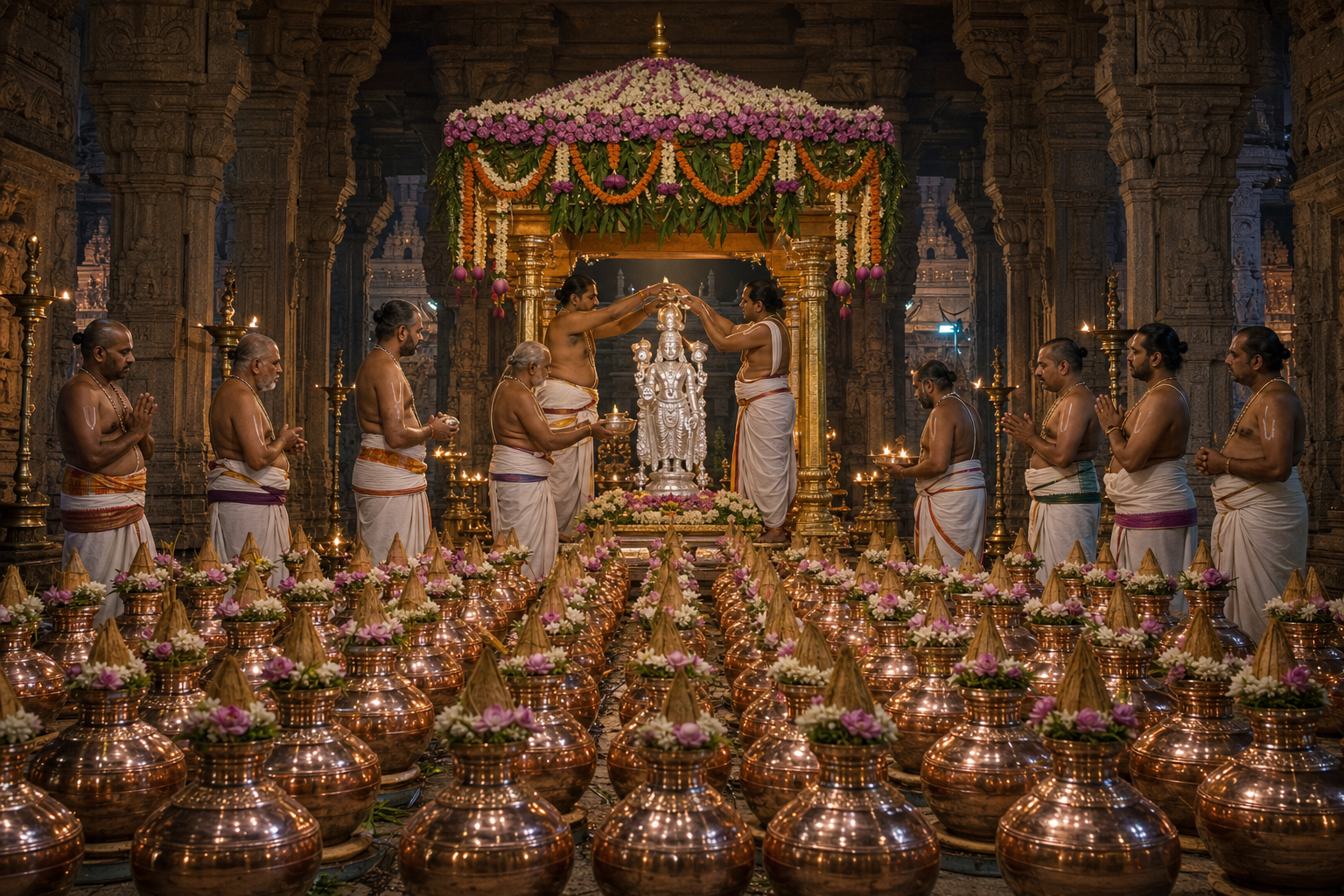
If you encounter Bhoga Srinivasa Murty Sahasra Kalashabhishekam on Tirumala’s calendar, it is easy to read the long name as simply a grand abhishekam involving many vessels. That misses the reason this observance matters.
The annual special rite joins three forms of continuity: Sri Venkateswara’s presence in worship, Queen Samavai Perundevi’s enduring gift, and a carefully ordered Vaikhanasa ceremony. Once you understand those connections, you can follow the worship as seva rather than watching it as spectacle.
Key takeaways
- Bhoga Srinivasa Murty is a compact silver icon associated intimately with the immovable principal deity, or moolavirat, of Sri Venkateswara.
- The annual special observance connected with 24 June 2026 commemorates Queen Samavai Perundevi’s donation of that icon.
- It is distinct from Tirumala’s regular midweek Sahasra Kalashabhishekam for Sri Malayappa Swamy with Sridevi and Bhudevi.
- The ceremony moves from preparation and consecration to ablution, adornment, offering, and the distribution of blessings.
- For a devotee, punctuality, modest attire, silence during recitation, and attention to the ritual sequence matter more than finding the most impressive view.
Start with the deities and the historical gift
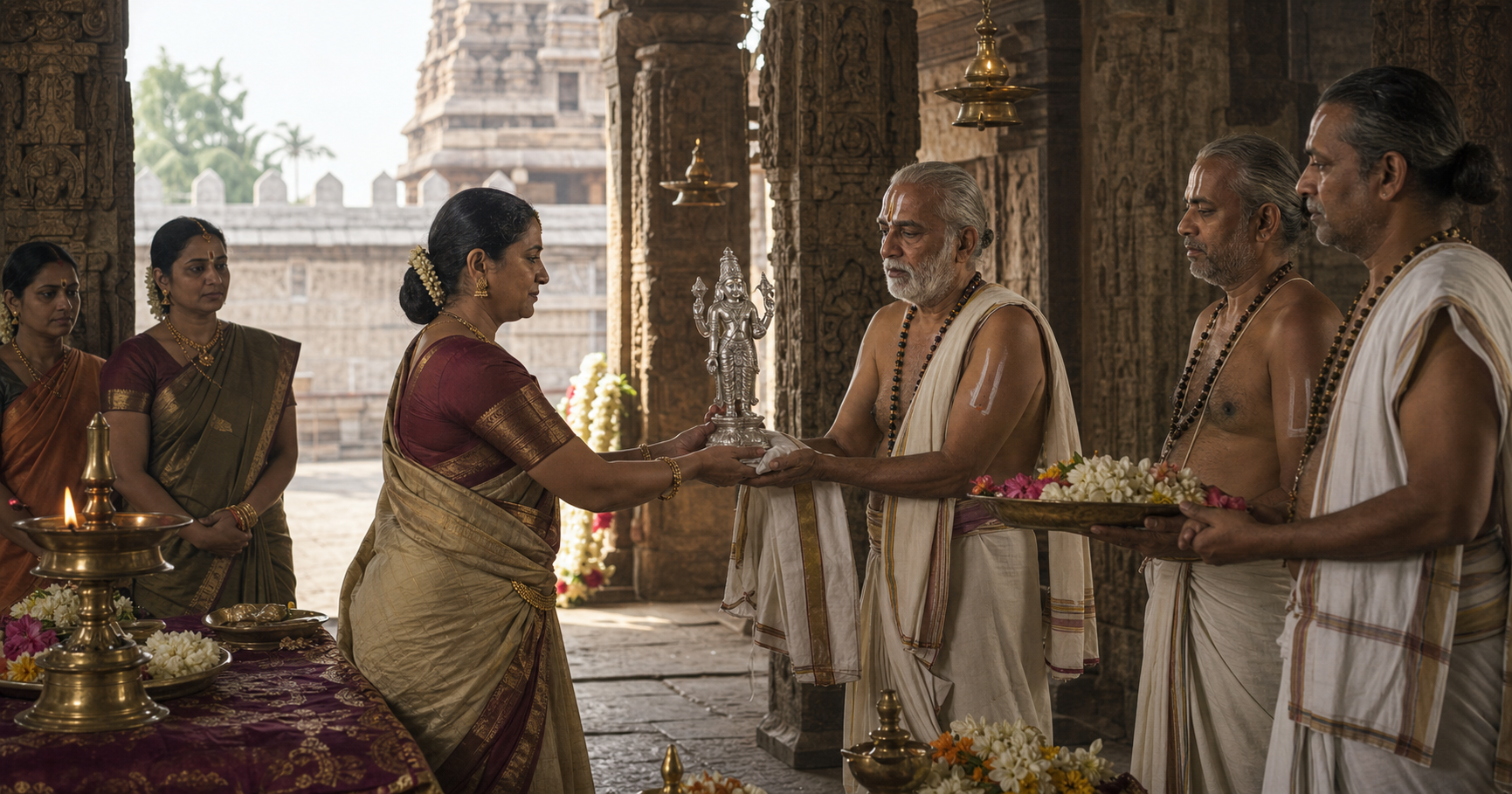
The moolavirat is the immovable principal form of Sri Venkateswara in the sanctum. Bhoga Srinivasa Murty is not another name for that principal form. It is a compact silver icon used in select daily services, especially bhoga and ekanta seva.
The relationship between the two is traditionally expressed through a delicate cord. This sambandha, or ritual connection, signifies more than physical proximity. It conveys an unbroken continuity of service and presence: worship offered through the service icon remains inseparable from Sri Venkateswara at the center of the temple.
That distinction changes how you should see Bhoga Srinivasa Murty. The silver image is neither a museum object nor a convenient replica. Its meaning lies in service. It allows particular forms of intimate daily worship to continue within the temple’s established ritual order while remaining symbolically joined to the moolavirat.
The icon also carries the memory of Queen Samavai Perundevi, whose donation is preserved in temple epigraphy. Her patronage did not end when the gift entered the temple. The donated image remains active in worship, and its annual commemoration turns a historical endowment into living liturgy. When you hear her name during discussion of the festival, remember that the point is not merely to honor a royal donor. It is to recognize how an act of dharmic giving can become a continuing institution of seva.
This is also a useful correction to histories that treat women patrons as peripheral to temple civilization. Samavai Perundevi’s gift occupies a place within daily worship and annual remembrance. The strongest evidence of her legacy is not a ceremonial compliment offered centuries later; it is the continued ritual life of the icon she gave.
The 2026 date, 24 June, belongs to this annual special commemoration. Do not confuse it with the regular midweek Sahasra Kalashabhishekam. The regular observance is performed for the utsava murtis, Sri Malayappa Swamy with Sridevi and Bhudevi. The special annual occasion explicitly brings Queen Samavai Perundevi’s endowment and Bhoga Srinivasa Murty’s sacred legacy into view.
There is another distinction worth keeping clear. A festival bearing Bhoga Srinivasa Murty’s name does not mean that every vessel must be understood as being poured solely over the silver icon. In the ceremonial sequence, streams of sanctified water are poured over the utsava murtis, while the special occasion commemorates the meaning of the Bhoga Srinivasa Murty endowment. The deity being historically honored and the icons serving as the immediate recipients within a rite need not be reduced to the same category.
Follow the ceremony as a sequence, not a spectacle
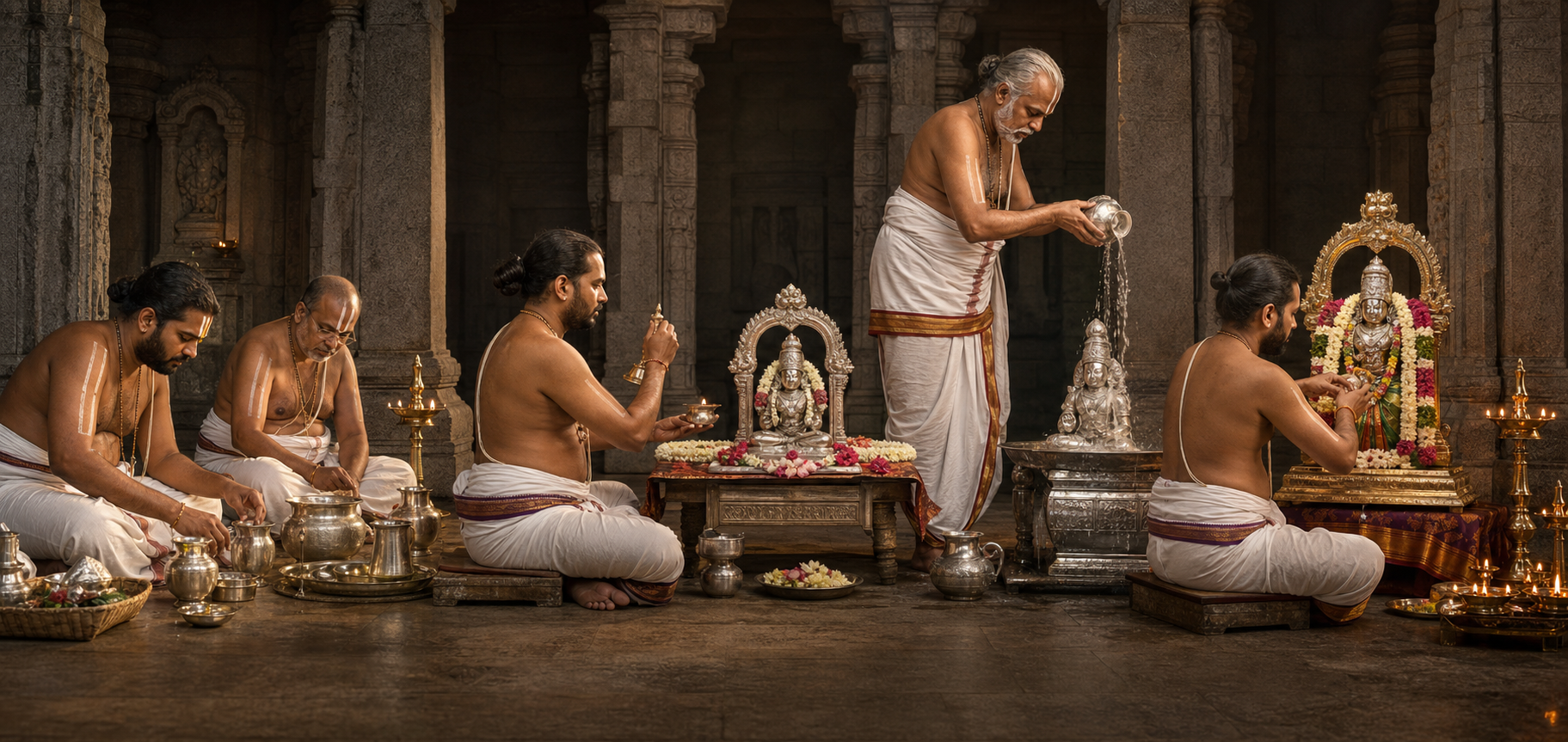
Sahasra Kalashabhishekam follows the Vaikhanasa Agama as practiced at Tirumala. You will understand much more if you follow the change in ritual action from one stage to the next. Each stage prepares the conditions for what follows.
- Ankurarpanam: Preparations customarily begin on the preceding evening with the sowing of seeds. The act invokes purity, auspicious growth, and the successful unfolding of the observance.
- Sankalpa and purification: On the festival morning, the priests undertake sankalpa, the formal statement of sacred intention, together with achamana and other preparatory acts of purification.
- Kalasha-sthapana: The sacred vessels are installed on a consecrated peetha in the mandapa. Their ordered placement matters because these are not yet being treated merely as containers waiting to be emptied.
- Consecration of the water: The vessels customarily hold tirtha prepared with sattvika and fragrant substances such as tulasi, sandal, camphor, and selected herbal infusions. They may be closed with auspicious leaves, often mango leaves, and adorned with cloth and sacred threads. Through mantra, mudra, nyasa, and avahana, the water becomes a bearer of consecratory power.
- Recitation and ablution: Vedic passages including Purusha Sukta, Narayana Sukta, and Sri Sukta accompany the rite, together with the Sri Vaishnava Divya Prabandham. Sanctified water is then poured ceremonially over the utsava murtis amid stotra recitation, nadaswaram, and percussion.
- Completion and worship: The graded pouring culminates in the maha-kalasha, followed by purnahuti and benedictions. The deities are then adorned and worshipped through alankara and archana. Harati and nivedana lead into the bestowal of teertha and satari upon devotees.
The practical way to follow this progression is to notice the verbs: sow, purify, install, invoke, bathe, adorn, offer, and receive. The ceremony has an inner grammar. Sacred water is prepared before it is poured. Ablution is completed before ornamentation. Ornamentation leads into worship and offering. Blessings are then extended to the assembled community.
This prevents a common misreading of abhishekam as a dramatic pouring of water followed by unrelated decoration. The movement from bathing to alankara and nivedana expresses a complete form of service. Purity is not the endpoint. The purified form is adorned, praised, offered sustenance, and approached with reverence.
The word sahasra, meaning a thousand, also carries more than an arithmetic message. Within Indic sacred language, a thousand can signify plenitude and cosmic completeness, as it does in sahasranama traditions that praise the Divine through a thousand names or qualities. You therefore need not spend the ceremony trying to verify its meaning by counting vessels. Attend instead to the abundance of consecrated water, mantra, music, and collective service converging upon a single act of worship.
At the same time, do not turn the number into a vague metaphor that erases the rite’s material discipline. The kalashas are prepared, installed, adorned, invoked, and used according to an ordered procedure. Sahasra communicates fullness precisely because that fullness is embodied through careful ritual work.
How to prepare and participate with attention
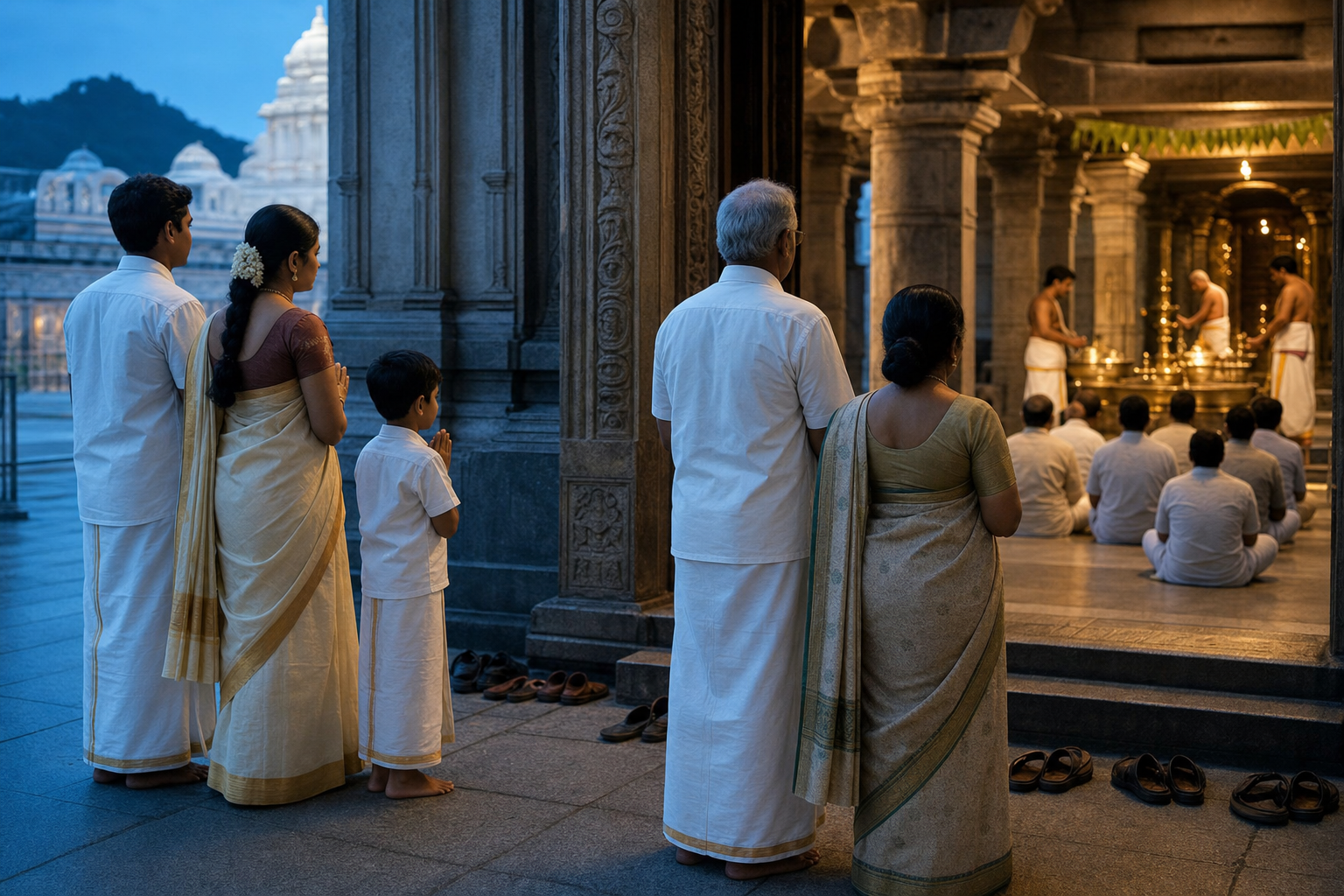
Your preparation should begin by separating devotional understanding from travel logistics. The existence of the observance does not by itself establish admission, ticketing, viewing access, or a travel schedule. Confirm current practical instructions directly with TTD before making plans, especially if participation in the special ceremony is the main purpose of your visit.
- Learn the three principal names beforehand: the moolavirat of Sri Venkateswara, Bhoga Srinivasa Murty, and the utsava murtis Sri Malayappa Swamy with Sridevi and Bhudevi. This will stop the ritual references from blurring together when the ceremony begins.
- Remember why the annual observance is special: it commemorates Queen Samavai Perundevi’s donation and the continuing service of the silver icon. It is not simply the ordinary midweek rite performed on a grander scale.
- Arrive punctually: the preparatory stages establish the sacred intention and status of the vessels. If you attend only for the visible pouring, you miss the process that makes the water ritually significant.
- Wear modest temple-appropriate attire: treat clothing as part of your readiness to enter a disciplined space of worship, not as a secondary concern to be solved at the last moment.
- Keep silence during recitations: Purusha Sukta, Narayana Sukta, Sri Sukta, and the Divya Prabandham are integral parts of the rite. They are not background sound for the visual ceremony.
- Watch for transitions: notice when installation becomes invocation, when many streams yield to the maha-kalasha, and when ablution gives way to alankara, archana, harati, and nivedana.
- Receive the conclusion rather than leaving after the pouring: teertha and satari belong to the ceremony’s extension of blessing to devotees. The rite is not complete, from a participant’s perspective, merely because the abhishekam has ended.
If you are studying the observance rather than attending solely as a pilgrim, organize your notes around three questions: What is being remembered? Which sacred forms perform which ritual roles? How does each stage transform the status of the water, the icons, and the assembled community? Those questions will reveal more than a catalogue of objects or chants.
The most respectful posture is receptive attention. You do not need to understand every mantra in real time to recognize when sacred intention is being declared, divinity is being invoked into the waters, the deities are being bathed, and worship is moving toward its communal conclusion.
A shared dharmic motif without erasing differences
The kalasha and sanctified water belong to a wider dharmic civilizational vocabulary. Jain consecratory practice uses kalasha-based rites, Vajrayana Buddhist abhisheka conveys blessing through sanctified waters, and Sikh Amrit Sanchar prepares sanctified nectar in the bata. These are meaningful family resemblances, but they are not proof that every tradition is performing the same ceremony under a different name.
The sound dharmic approach is to recognize both kinship and integrity. Water, consecration, disciplined preparation, ethical orientation, and service recur across traditions. Yet Jain, Buddhist, Sikh, and Hindu practices retain their own authorities, purposes, ritual agents, and theological meanings. Shared civilizational forms become more illuminating when we resist flattening them into generic spirituality.
Tirumala’s special observance makes the same point within a single temple tradition. A Pallava queen’s act of patronage, a silver service icon, an immovable principal deity, procession-ready utsava murtis, Vaikhanasa discipline, Vedic recitation, Tamil devotional hymns, temple music, ornamentation, and prasadic blessing all retain distinct roles. Their unity does not require their sameness.
If you explain Bhoga Srinivasa Murty Sahasra Kalashabhishekam to someone else, begin with that living relationship. Queen Samavai Perundevi’s gift still serves; the service icon remains joined to Sri Venkateswara; consecrated water moves through an inherited ritual order; and devotees receive the result as blessing. Approach the observance with those connections in mind, and what first looked like an elaborate ablution becomes a precise lesson in memory, seva, and continuity.