-
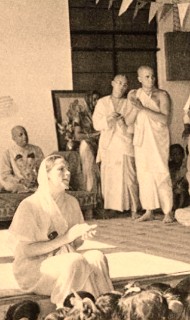
Honoring Senior Devotees: Cultivating Humility, Strength, and Unity in Dharmic Life

Appreciating senior devotees is a disciplined expression of Vaisnava etiquette that advances purification and steadies bhakti. Seen through the lens of the Guru-Shishya Relationship, respect for elders functions as sadhana by transmitting lived virtues through satsanga and seva. Early arrogance often stems from ignorance of history; understanding the sacrifices of senior devotees, including those who…
-
Srila Prabhupada’s 2026 Vyasa-puja: Inspiring Guide to Meaning, Homage Writing, and Dharmic Unity

Srila Prabhupada’s 2026 Vyasa-puja is presented as a rigorous, tradition-grounded celebration that unites devotion, scholarship, and community remembrance. This comprehensive guide explains the theology of honoring the guru as representative of Veda Vyasa, with scriptural anchors in Bhagavad-gita and Srimad-Bhagavatam. It clarifies how the Vyasa-puja book serves as a cultural and spiritual archive, preserving lived…
-
The Thirst That Remains: A Transformative Journey Across Hindu, Buddhist, Jain, and Sikh Wisdom

This long-form reflection reads the “thirst that remains” as a unifying metaphor across Hindu, Buddhist, Jain, and Sikh wisdom, showing how diverse practices meet a common aspiration for freedom and compassion. It maps core goals—moksha, nirvana, kevala-jñāna, and mukti—while explaining shared ethics like ahimsa, satya, dana/dasvandh, and aparigraha. It outlines practical contemplative methods—Aṣṭāṅga Yoga, ānāpānasati…
-
When the Lord Becomes a Son: Kardama Muni and the Descent of Real Knowledge (SB 3.24.30)

Srimad Bhagavatam 3.24.30 captures Kardama Muni’s address to the Lord, who descends to fulfill a sacred promise and inaugurate the dissemination of real knowledge in the heart of family life. The episode anticipates Kapila’s theistic Sankhya, where analytical clarity and bhakti-yoga form a coherent path to liberation. By highlighting divine fidelity—“to fulfill Your word”—the verse…
-
The Silent Power of Association: Satsanga, Desire-Transfer, and Protecting the Bhakti-Latā

Association transfers desires, shapes attention, and quietly sets the course of spiritual life. Drawing on Bhagavad Gita psychology, cross-dharmic teachings on satsanga, kalyāṇa-mitra, sādhu-saṅga, and sangat, and contemporary findings on social contagion and habit science, this essay explains why company is causal, not incidental. It defines practical signatures of uplifting association and clarifies how to…
-
Devotional Leadership as Service: Cultivating Unity, Harmony, and Joy in Community

A recent talk in Stanmore, UK by HH SB Keshava Swami highlighted a rigorous principle of spiritual leadership: authority exists to serve, uplift, and empower. This analysis explains how seva reframes leadership in devotional communities, making success measurable through growth, happiness, and progress toward Krishna. It outlines competencies leaders need—deep listening, clarity of purpose, organizational…
-
Remembering Badrinarayan Swami: A Lasting Legacy of Hope, GBC Service, and Guru–Shishya Grace

This tribute distills a remembrance of Badrinarayan Swami into practical insight on succession and spiritual leadership. It explains why a simple blessing—„Now I can peacefully die“—embodies generational trust and institutional resilience. Readers gain a clear overview of the GBC’s role within ISKCON and how governance aligns with the Guru–Shishya Relationship. The essay unpacks bhakti concepts…
-
A Sacred Farewell: HH Badrinarayan Swami’s Final Day of Bhakti, Stillness, and Grace

This reflection reconstructs HH Badrinarayan Swami’s final day exactly as recorded by Abhaya Nama Das (GKG): attendance at Mangal arti, chanting at the MVT apartment, and a deliberate decision not to go to the Srimad Bhagavatam class. Rather than dramatizing the moment, it situates these ordinary acts within the technical grammar of bhakti-yoga—ritual constancy, japa-focused…
-
Srimad Bhagavatam 7.12.16: Bhakti Discipline and Inner Transformation at ISKCON GEV

This in-depth summary of the Srimad Bhagavatam 7.12.16 class by H.G. Mahamaya Mataji at ISKCON GEV presents a clear, academically grounded pathway to devotional growth. It situates the verse within Canto Seven’s broader ethical and spiritual framework and explains how guru–shishya parampara safeguards scriptural integrity. Readers gain a practical map of sadhana—from śraddhā to prema—supported…
-
When One Verse Moved a Sage to Tears: Rallapalli A. Sarma and Annamacharya’s Revival

This essay examines the life and legacy of Ganakalasindhu Sri Rallapalli Anantakrishna Sarma, focusing on his seminal role in reviving Tallapaka Annamacharya’s Kritis for TTD and his formation within the Guru-Shishya Relationship at Parkala Matha. It recounts a moving episode in which a single Ramayana verse moved his Guru, Sri Krishnabrahmatantra Yatindra, to tears—an emblem…
-
4 Timeless Disciplines to Sustain Bhakti: Humility, Offense-Awareness, Strong Sanga, Clear Path
Long-term perseverance in the Bhakti Tradition flourishes when four stabilizing disciplines are cultivated: humility, freedom from offenses (aparadha), elevating sanga, and a clear path of sādhana. Humility softens ego and increases receptivity to guidance, making chanting and meditation more attentive. Guarding against offenses protects sacred relationships and aligns with universal dharmic values like right speech…
-
Srila Prabhupada’s Compassion in Calcutta: Enduring Leadership Lessons in Vaishnava Care

An early ISKCON incident in Calcutta reveals how Srila Prabhupada prioritized compassionate care over institutional busyness. When severe resource shortages left devotees struggling, he convened an open meeting and reframed priorities toward their welfare. His response to Tamal Krishna Goswami clarified that no plan is legitimate if it disturbs devotees. The episode offers actionable guidance…
-
From Stage to Side: Mastering Humble, Authentic Guidance in Dharmic Guru–Shishya Paths

This reflection examines why spiritual leaders across Hinduism, Buddhism, Jainism, and Sikhism sometimes default to a performative “sage on the stage” stance and how a “guide by the side” approach better aligns with dharmic values. It explains how juniors may surpass seniors due to previous lifetime advancement and sincere practice, and how this can trigger…
-
From sraddha to nishtha: Authentic sadhu sanga that builds unshakable devotion

This article explains why spiritual practice may feel stalled and how the progression from sraddha to nishtha becomes reliable through authentic sadhu sanga. It outlines the interconnected stages—sraddha, sadhu sanga, bhajana-kriya, anartha-nivritti, and nishtha—and shows how proper guidance turns enthusiasm into consistent practice. Readers learn practical markers of genuine association and how small, precise adjustments…
-
From Flight to Fortitude: Prince Uttara’s Mahabharata Lesson on Pride, Guidance, and Courage

Prince Uttara’s story in the Mahabharata reveals how fear can yield to courage when guided by humility and mentorship. Set during the Virata Parva, the episode exposes the brittleness of pride built on bravado and the strength that comes from accepting instruction. Brihannala (Arjuna in disguise) reframes crisis as training, modeling the guru–shishya ethos. The…
-
Baghbazar to Mayapur: Disappearance Day Tribute to Bhaktisiddhanta Sarasvati Goswami

This Disappearance Day reflection honors Srila Bhaktisiddhanta Sarasvati Goswami Prabhupada, who departed in 1937 at Sri Gaudiya Math, Baghbazar, Kolkata, with his samadhi mandir in Sri Mayapur Dham at Sri Chaitanya Math. A rare visit to his private room—ordinarily restricted—enabled documentation of personal belongings and the bed of his final moments, captured in a thoughtful…
-
Inspiration Through Love: Balancing Discipline and Compassion in Dharmic Education

This reflection presents a practical framework for Dharmic education: love as the source of inspiration and discipline as a compassionate structure. It explains how clear boundaries, when rooted in care, foster intrinsic motivation and dignity in the Guru–Shishya relationship. The discussion connects Hindu, Buddhist, Jain, and Sikh values—bhakti, karuṇā, ahiṃsā, and seva—to demonstrate unity in…
-
Compassion in Action: Seva-Centered Community Care Inspired by Sri Caitanya Mahaprabhu

Sri Caitanya Mahaprabhu’s life models an ethic of seva that transforms devotion into daily, compassionate care. Historical episodes from Navadvipa—bowing to devotees, washing and folding cloth, carrying their loads—demonstrate how bhakti becomes tangible service. Applied today, these principles inform counselor or mentor systems that ensure every practitioner is personally supported. Grounded in the Guru–Shishya relationship…