
-
Six Profound Transformations of Life: A Dharmic Guide to the Eternal Self Beyond Change

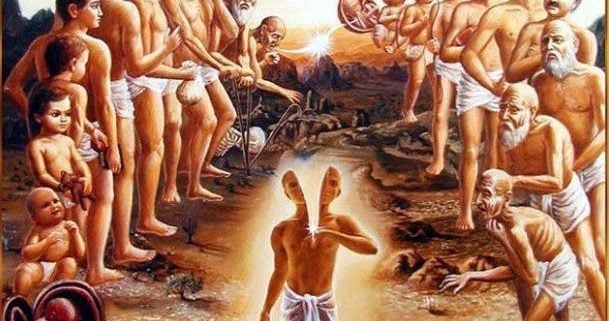
Hindu scriptures teach that embodied life unfolds through six universal transformations—existence, birth, growth, decay, disease, and death—while pointing to the atman beyond change. Seeing these phases clearly reduces fear, strengthens resilience, and fosters compassionate conduct guided by dharma. Parallel insights in Buddhism, Jainism, and Sikhism reinforce impermanence, many-sided truth, and alignment with divine order, cultivating…
-
Beyond the Body: Hindu Philosophy on Consciousness, Out-of-Body States, and Inner Freedom
Hindu philosophy addresses out-of-body experiences through a disciplined framework that distinguishes inner phenomenology from metaphysical claims. Drawing on the Upanishads, Vedanta, and Yoga, it explains how the subtle body (sukshma sharira) and the Pancha Kosha model contextualize non-ordinary states. Yogic methods—pratyahara, dharana, dhyana, pranayama, and mantra—serve as structured tools for exploration, with ethics and guidance…
-
Discover Rebirth in the Bhagavad Gita: A Complete Guide to Epistemology, Ontology, and Ethics
This analysis presents a clear, three-part framework for understanding rebirth in the Bhagavad gītā: epistemology that privileges insight-oriented knowledge, ontology that secures the continuity of the ātman, and ethics that transform insight into equanimity and enlightened action. Readers gain conceptual clarity on how knowledge shapes worldview and why rebirth coherently follows from the soul’s imperishability.…
-
Complete Guide to Panchadasi’s Twelfth Chapter: Discover and Master Atmananda

Panchadasi’s twelfth chapter, attributed to Vidyaranya of the Sringeri Sharada Peetham, guides readers to distinguish the bliss of the Self (Atmananda) from changing mental states. It explains how sat–chit–ananda is recognized through shravana, manana, and nididhyasana, not acquired from external objects. The chapter clarifies the difference between pure consciousness and reflected consciousness, enabling a stable…
-
Discover Yogananda in Panchadasi: The Complete Guide to Bliss of Consciousness in Advaita Vedanta
This article presents a clear, practice-oriented guide to the Yogananda (eleventh) chapter of Vidyaranya’s Panchadasi, a classic of Advaita Vedanta. It explains how the text situates bliss (ānanda) within the nondual identity of Atman and Brahman, and why calming mental activity reveals intrinsic joy. Readers learn the distinctions between sense-based pleasure, the relief that follows…
-
Discover Nātakadīpa: The Complete Guide to Witness Consciousness in Vidyāraṇya’s Panchadaśī

This guide presents the tenth chapter of Panchadaśī—Nātakadīpa—as a clear, practice-ready map of Witness Consciousness (Sākṣī). Readers discover how Vidyāraṇya’s theater metaphor translates nondual philosophy into lived insight: the changeless Self as the steady light, and thoughts and roles as passing scenes. The chapter explains Kūṭastha versus cidābhāsa, examines waking–dream–deep sleep to reveal the invariant…
-
Master Kutasthadipa: The Complete Guide to Panchadasi’s Eighth Chapter and Witness Consciousness
Kutasthadipa, the eighth chapter of Vidyaranya’s Panchadasi, offers a complete and accessible exposition of the eternal Witness (Kutastha) at the core of Advaita Vedanta. It explains how pure consciousness remains unchanged amid the three states—waking, dream, and deep sleep—while mind and body fluctuate. Readers gain practical tools such as neti-neti, sakshi-bhava, and the distinction between…
-
Karma-Siddhanta and its Significance in Sanatana Dharma
The concept of karma is a fundamental aspect of Sanatana Dharma, which includes Hinduism, Buddhism, Jainism, and Sikhism. Each of these religions has its own unique perspective on karma, but they all share some commonalities. In this blog post, we will explore the concept of karma in each of these religions, its significance, and its…
-
Atman in Karmic Religions

atman, (Sanskrit: “self,” “breath”) one of the most basic concepts in Sanatan, the universal self, identical with the eternal core of the personality that after death either transmigrates to a new life or attains release (moksha) from the bonds of existence. As Karmic religions like Hinduism (and its various sects), Jainism, Buddhism & Sikhism arose…