
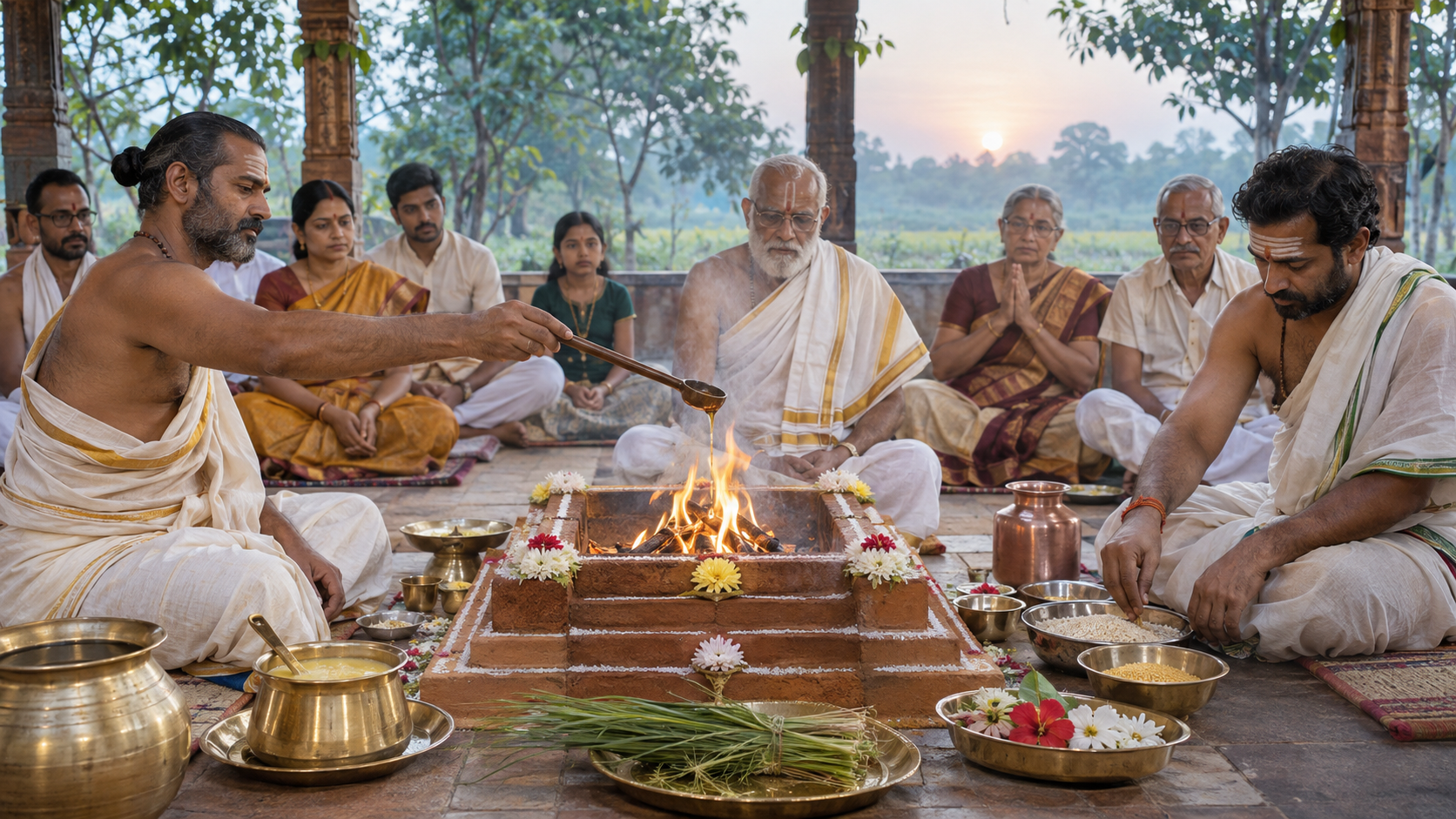
You may have been invited to a homam, asked to sponsor a yajna, or encountered the word yaga and wondered whether these are three different ceremonies. That uncertainty matters when you are choosing an officiant, preparing materials, or deciding how to participate.
The soundest place to begin is not a list of items for the fire. It is the ritual’s grammar: what is being offered, to which devata, through which procedure, and with what act of relinquishment. Once those questions are clear, the vocabulary becomes much easier to navigate.
Read “sacrifice” as an act of relinquishment
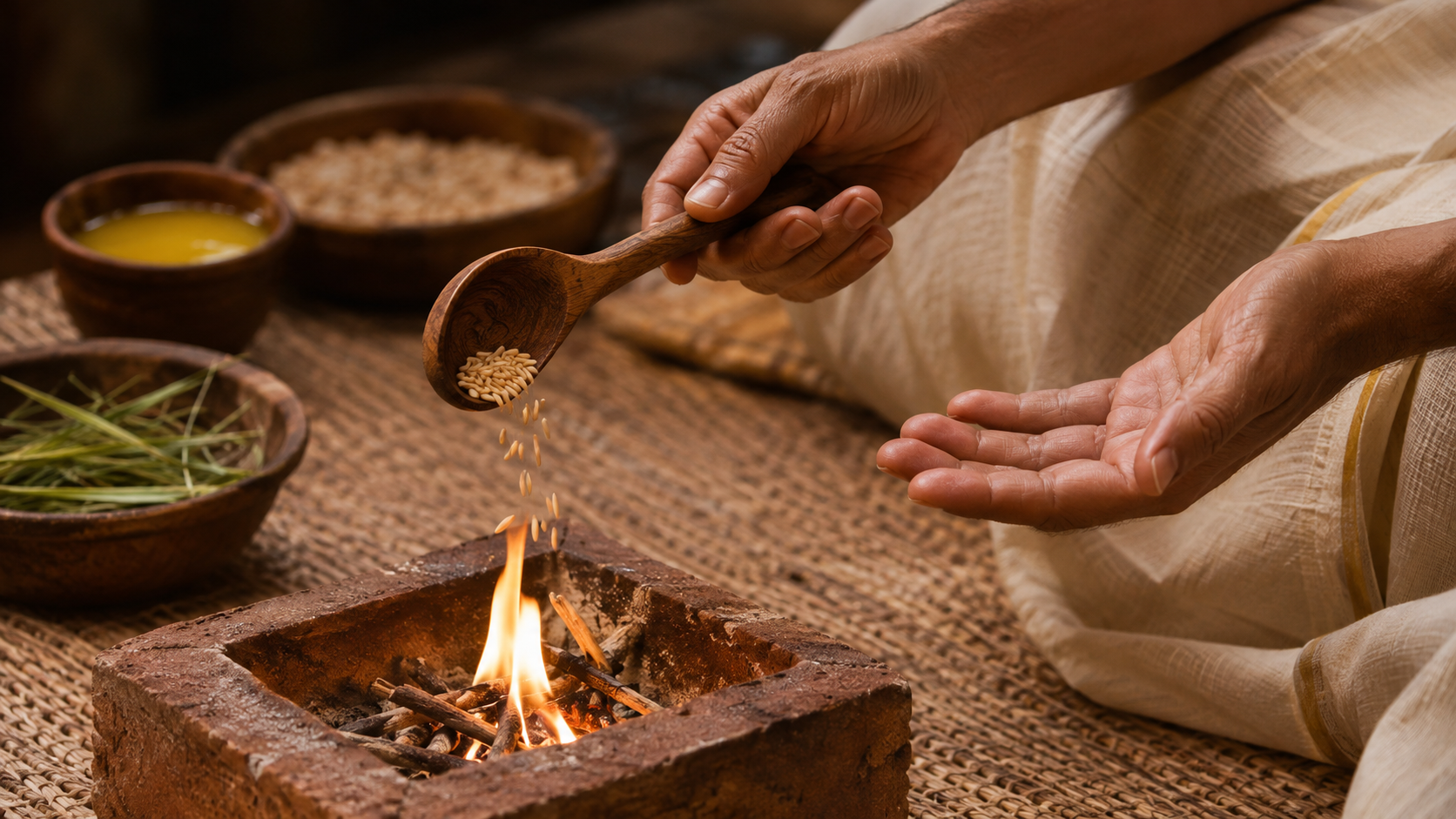
The English word “sacrifice” can make a Vedic fire ritual sound primarily like destruction, loss, or a bargain made to obtain a benefit. That is too narrow. In this setting, the defining action is an offering: a specified material is deliberately given to a devata rather than retained for ordinary personal use.
This is why the Sanskrit idea of tyaga is so helpful. A yajna can be understood as the tyaga, or giving up, of a specified dravya to a devata. The material may be consumed in the fire, but combustion alone does not make the act sacred. The recipient, material, intention, mantras, and prescribed sequence give the offering its ritual identity.
That distinction gives you a practical test. If someone can describe the materials and promise an outcome but cannot clearly name the rite, its devata, its tradition, or the person qualified to conduct it, you do not yet have enough information to proceed. Ask for those details before paying, buying supplies, or advertising the event.
“Specified material” also means that an offering is not improved simply by making it larger, costlier, or more unusual. The correct dravya is the material called for by the particular procedure. More is not automatically more sacred, and personal improvisation is not automatically devotion.
How yajna, yaga and homa relate
Yajna, yaga, and homa belong to the same ritual vocabulary and are connected with the Sanskrit verbal root yaj. Yet the labels do not always function as a rigid three-level classification. Regional languages, family customs, temple usage, and ritual lineages can favor different forms of the words.
| Term | Safest working meaning | What the label alone does not prove |
|---|---|---|
| Yajna or Yagna | Worship through an act of offering or oblation; in the present context, it includes sacred fire offerings. | The spelling difference does not establish a separate tradition or procedure. |
| Yaga | A term with the same basic meaning as yajna: an offering made in worship. | The word alone does not tell you that the rite is larger, longer, or spiritually superior. |
| Homa or Homam | A commonly used name for a ceremony in which offerings are made into consecrated fire. | It does not mean that every homa follows an identical sequence, uses identical materials, or invokes the same devata. |
The practical lesson is simple: do not choose or judge a ceremony by one English transliteration. Ask for its exact ritual name and procedure. A priest may call a particular observance a homa while another community uses yajna or yaga in a related context. That difference in everyday naming does not, by itself, settle what will happen at the fire.
When you need clarity, ask four direct questions: What is the exact rite? Which devata or devatas receive the offerings? Which ritual tradition governs the procedure? What role will the sponsor, family, or assembled community have? Those answers are more useful than debating whether one general term is “correct.”
Devata, dravya and tyaga form the ritual’s inner logic
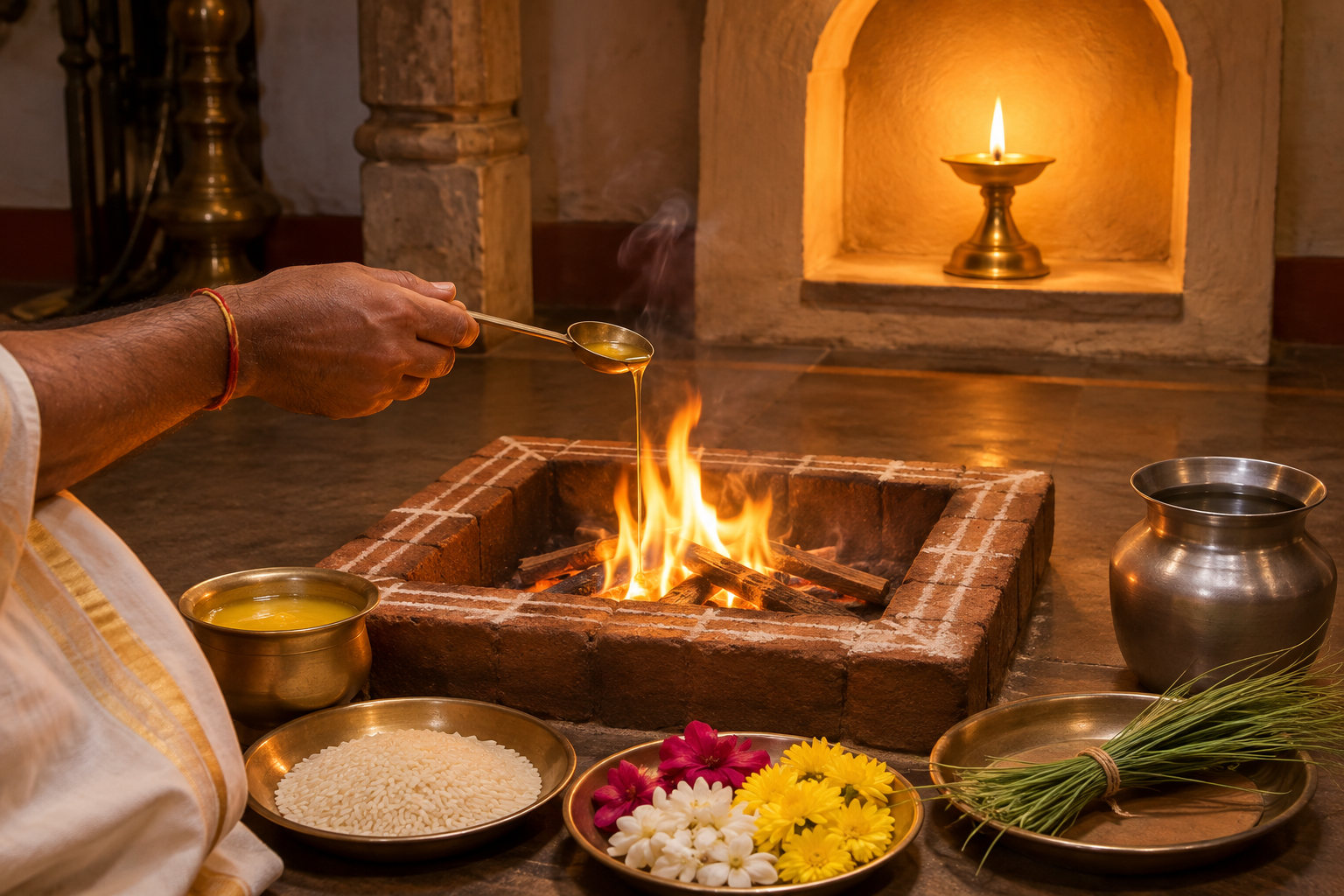
Devata gives the offering its direction
A fire ritual is not merely a general display of reverence around a flame. The devata is the designated sacred recipient or focus of the offering. The name matters because it belongs to the rite’s mantras, intention, and sequence. You should not replace one devata with another according to personal preference while leaving the rest of the procedure unchanged.
If you are sponsoring the ceremony, make sure the officiant explains whom the rite addresses and why that form is appropriate to the stated purpose. You do not need to master every mantra, but you should know the basic devotional direction of the act you are supporting.
Dravya makes the intention concrete
Dravya is not an interchangeable category called “something sacred.” It is the material specified for the offering. The appropriate substances and their preparation can differ from one rite to another, so a generic supply list taken from an unrelated ceremony is not reliable.
Before purchasing anything, obtain the list directly from the person conducting the ritual. Ask who will prepare each item, whether any substitution is permitted, and how remaining materials should be handled. If a participant has an allergy or sensitivity, disclose it before the day of the ceremony rather than silently changing an ingredient.
Tyaga changes your relationship to what is offered
Tyaga is the decisive movement from possession to offering. Once a dravya has been ritually given, it is no longer being treated simply as “mine.” This makes yajna more than the mechanical placement of substances into fire. The outward action trains attention on surrender rather than accumulation.
You do not have to claim that every Hindu school explains this surrender in precisely the same theological language. The action itself is clear enough: offering and retaining exclusive ownership are opposite movements. When you watch a homa, notice that exact moment of release instead of measuring the ceremony by the size of the flames, the volume of chanting, or the amount of smoke.
Procedure joins these elements together. A named devata and an acceptable dravya do not independently create a yajna. The consecrated fire, mantras, order of actions, officiant, sponsor, and assembled participants have defined relationships within the rite. Mantras are not background music, and the fire is not a decorative centerpiece. If you do not know your response or the moment to offer, wait for instruction rather than guessing.
How to attend or arrange a fire ritual responsibly
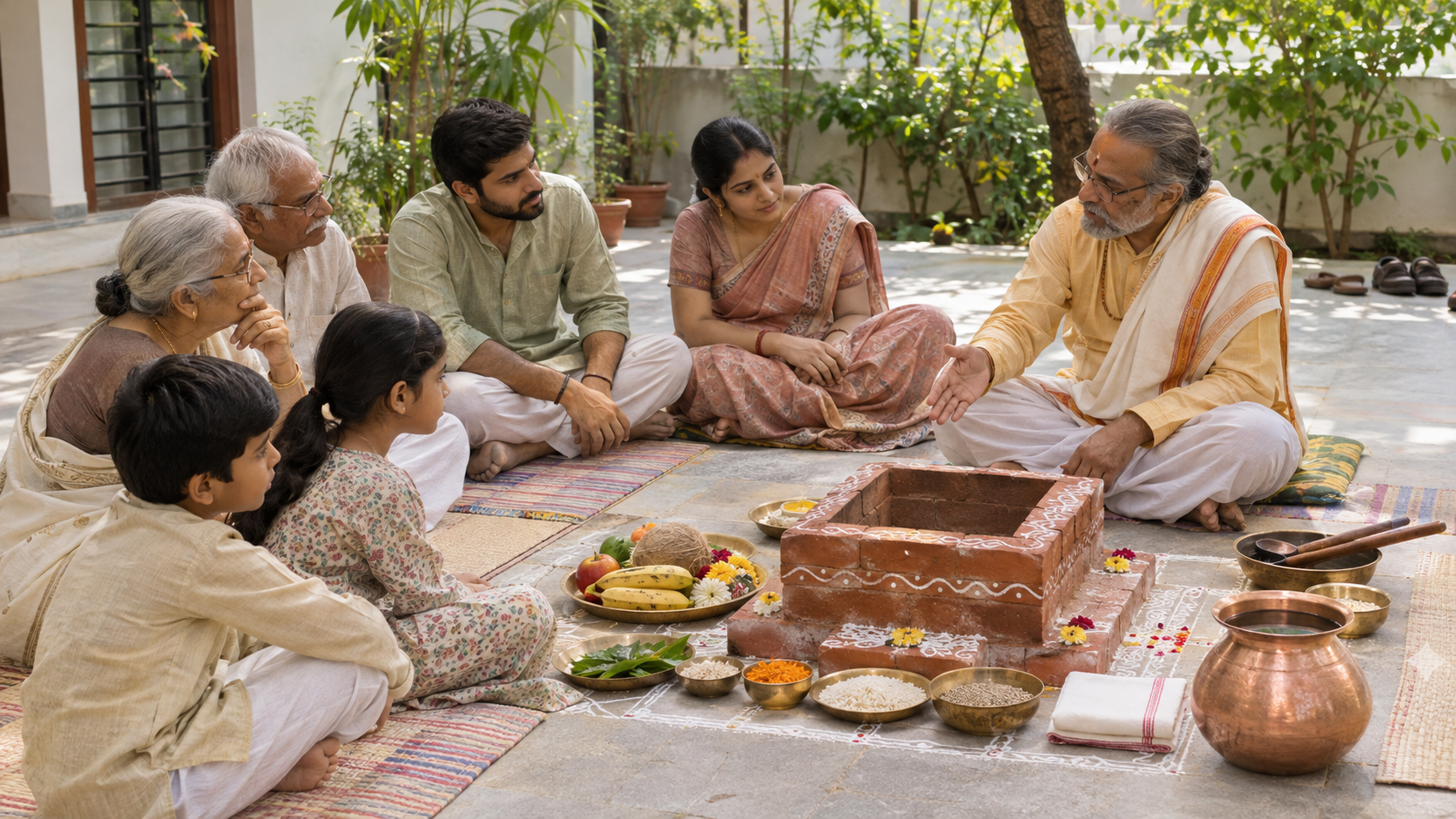
If you have been invited
No single etiquette sheet covers every family, temple, and sampradaya. The host’s instructions should guide you, provided they are safe. These steps will prevent the most common misunderstandings:
- Ask whether guests have a ritual role. Find out whether you will make an offering, repeat a response, remain seated as a witness, or join only at a later point. Do not assume every person present performs the same action.
- Arrive before the rite begins. Entering during a mantra or offering can disrupt a sequence that the officiant cannot simply pause. If you are delayed, wait for the host to show you where to sit.
- Wear clothing suitable for sitting near an open flame. Keep loose sleeves, scarves, long hair, and other combustible material secured. Follow any custom concerning footwear and ritual space that the host explains.
- Do not touch ritual vessels, dravya, or the fire area without an invitation. An object that looks like a spare utensil may already have a defined ritual use.
- Chant or offer only when guided. Respectful listening is better than guessing at a mantra, altering its pronunciation deliberately, or copying an action whose meaning you do not understand.
- Ask before taking photographs or video. Permission to attend is not automatically permission to record a priest, family, altar, or private religious observance.
- Raise practical needs early. If you are bringing children, have limited mobility, or are sensitive to smoke, ask about seating and participation beforehand. Moving farther from smoke or taking a safe alternative role is not a failure of reverence.
If you are arranging or sponsoring the rite
Your first task is to match the intention, tradition, and procedure. Your second is to make the physical setting safe. Treat both as essential.
- State the purpose before choosing a package. Explain the occasion and intention to a qualified priest or acharya. Ask for the precise name of the rite and why it fits, rather than selecting from a menu solely by price or a promised result.
- Confirm the ritual lineage and officiant. Ask which procedure will be followed, which devata will be invoked, and what preparation is expected of the sponsor. A recording, an online transcript, or a translated mantra sheet does not by itself supply ritual competence.
- Request one authoritative preparation list. The officiant should identify the dravya, vessels, seating, and other requirements. Using several generic lists can create conflicting quantities and unsuitable substitutions.
- Define each person’s role. Decide who sponsors the rite, who sits at the fire, who prepares the materials, and how guests will be instructed. If explanations will be given in another language, arrange them before the ceremony rather than interrupting the ritual sequence.
- Make an explicit fire-safety plan. Use an appropriate noncombustible base, adequate clearance and ventilation, clear exits, and a suitable extinguishing method. Follow the venue’s rules and local fire requirements. Never disable alarms or defeat safety systems merely to avoid an interruption. A competent adult should supervise the fire until it is fully out.
- Account for smoke and accessibility. Tell participants in advance that an open flame and smoke will be present. Provide safer seating or an alternative form of participation for anyone who cannot remain near the fire.
- Plan what happens afterward. Ask the officiant how ash, unused dravya, vessels, and other remnants should be treated. Follow the tradition without ignoring environmental rules or leaving hot material unattended.
- Clarify costs before the day. Separate the officiant’s fee or dakshina, the cost of materials, venue expenses, and any voluntary donation. Clear expectations protect the sacred occasion from an avoidable dispute.
Do not conduct a fire ceremony in an unsuitable room merely because the religious intention is sincere. Sacred purpose does not remove the ordinary risks of flame, hot vessels, smoke, or crowded exits. If the venue cannot support the rite safely, change the venue or consult the officiant about an appropriate alternative.
Key takeaways
- Yajna and yaga carry the same basic sense of worship through offering; a spelling or label alone does not define a separate ritual.
- Homa or homam commonly names the fire-offering form, but its devata, materials, mantras, and sequence depend on the particular rite and tradition.
- Devata identifies the sacred recipient, dravya identifies the specified offering, and tyaga identifies the act of giving it up.
- A supply list is not a substitute for understanding the rite or consulting a qualified officiant.
- Respect for sacred fire includes practical fire safety, smoke awareness, clear participant roles, and responsible handling of remnants.
If you are attending, send the host one useful question now: “Will I have a ritual role, and what should I know before I arrive?” If you are arranging the ceremony, have one focused conversation with the officiant before buying anything. Leave that conversation knowing the exact rite, devata, procedure, required dravya, participant roles, and venue requirements.
That preparation lets you approach the fire as more than a spectacle. You can recognize the act at its center: a deliberate offering, rightly directed and genuinely released.
References

Leave a Reply
You must be logged in to post a comment.