
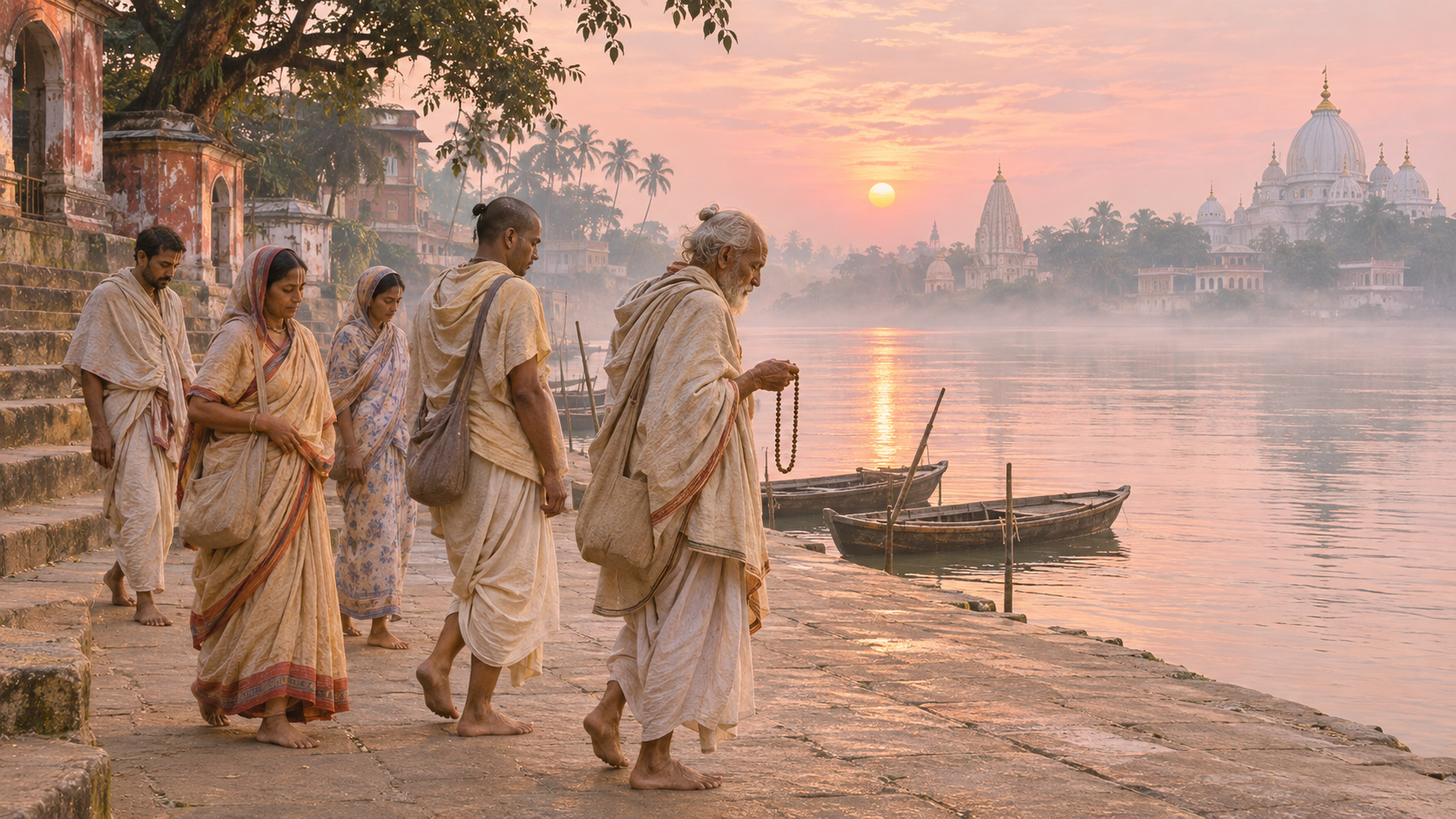
You can visit Mayapur and Navadvipa, see revered places, take photographs and still return with the uneasy sense that you missed the pilgrimage. The usual problem is not a shortage of destinations. It is arriving without a way to receive what those destinations are meant to teach.
Approach the journey as parikrama rather than sightseeing. Let the banks of the Ganga, the birthplace of Sri Caitanya and the samadhis of the acharyas shape distinct parts of your inner journey. A simple intention, attentive conduct and a practice carried home can turn a crowded itinerary into a meaningful encounter with the dhama.
Set your sankalpa before you set your route
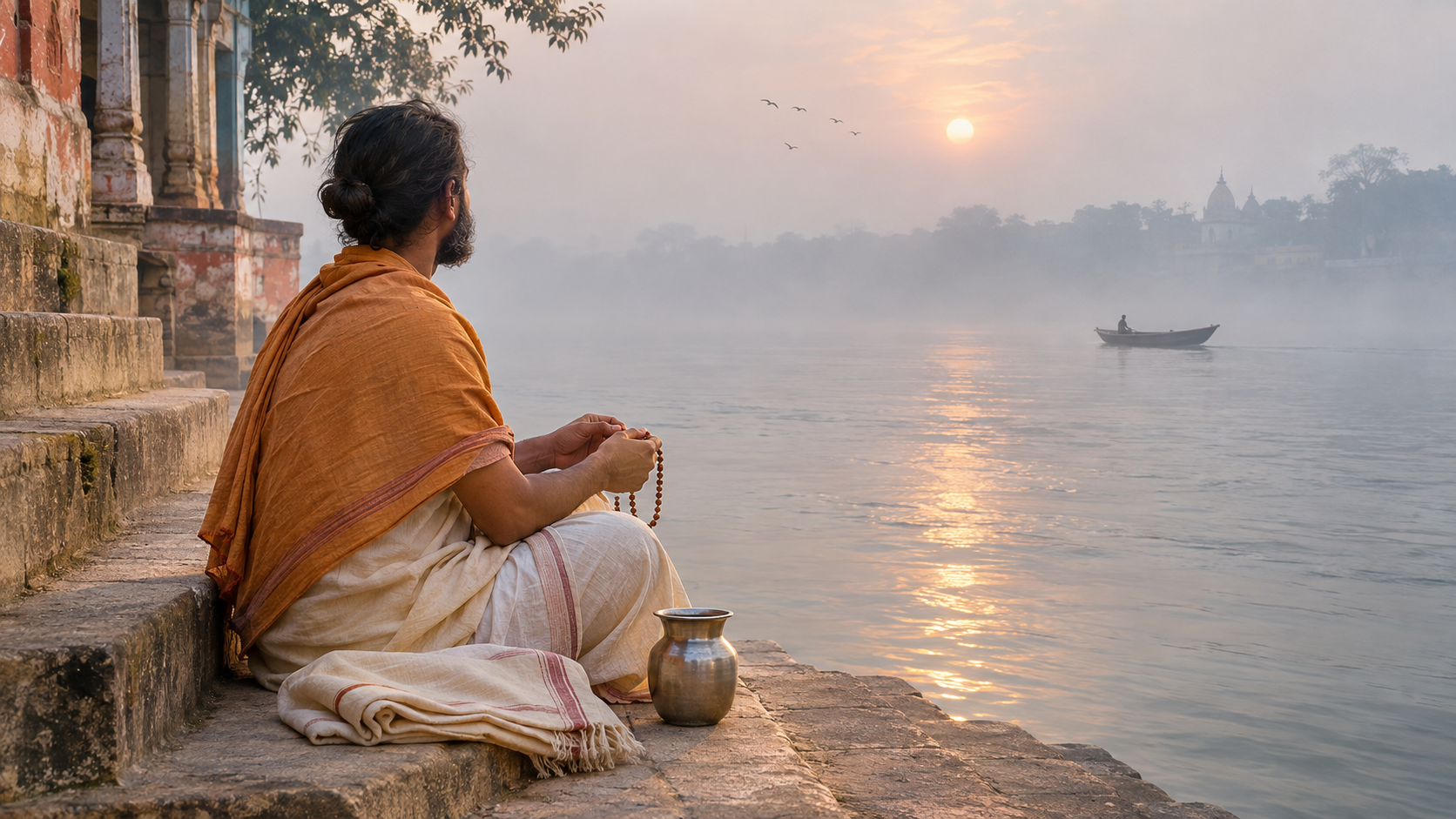
A pilgrimage needs a sankalpa: a clear spiritual intention that guides your attention. Without it, the mind begins collecting places, images and impressions. With it, even a quiet pause can become part of your sadhana.
Complete this sentence before you leave: I am going to Mayapur and Navadvipa in order to… Your answer might be to understand Sri Caitanya’s gift more deeply, chant with greater attention, seek humility, honour the acharyas or renew a neglected practice. Choose the intention that is honest, not the one that sounds most elevated.
Write that sentence where you can see it during the journey. Return to it when the schedule becomes tiring, when crowds test your patience or when the phone starts taking over. Your sankalpa is not a demand for a particular mystical experience. It is a promise about how you will show up.
This matters especially in Navadvipa. In the Gaudiya Vaishnava understanding, the dhama is cherished as the place where Sri Gaurahari offered love of God without making prior qualification the gate. You therefore do not need to manufacture a spiritual mood before you arrive. You do need to become available through hearing, chanting, service and respectful attention.
Let the sacred places form a spiritual sequence
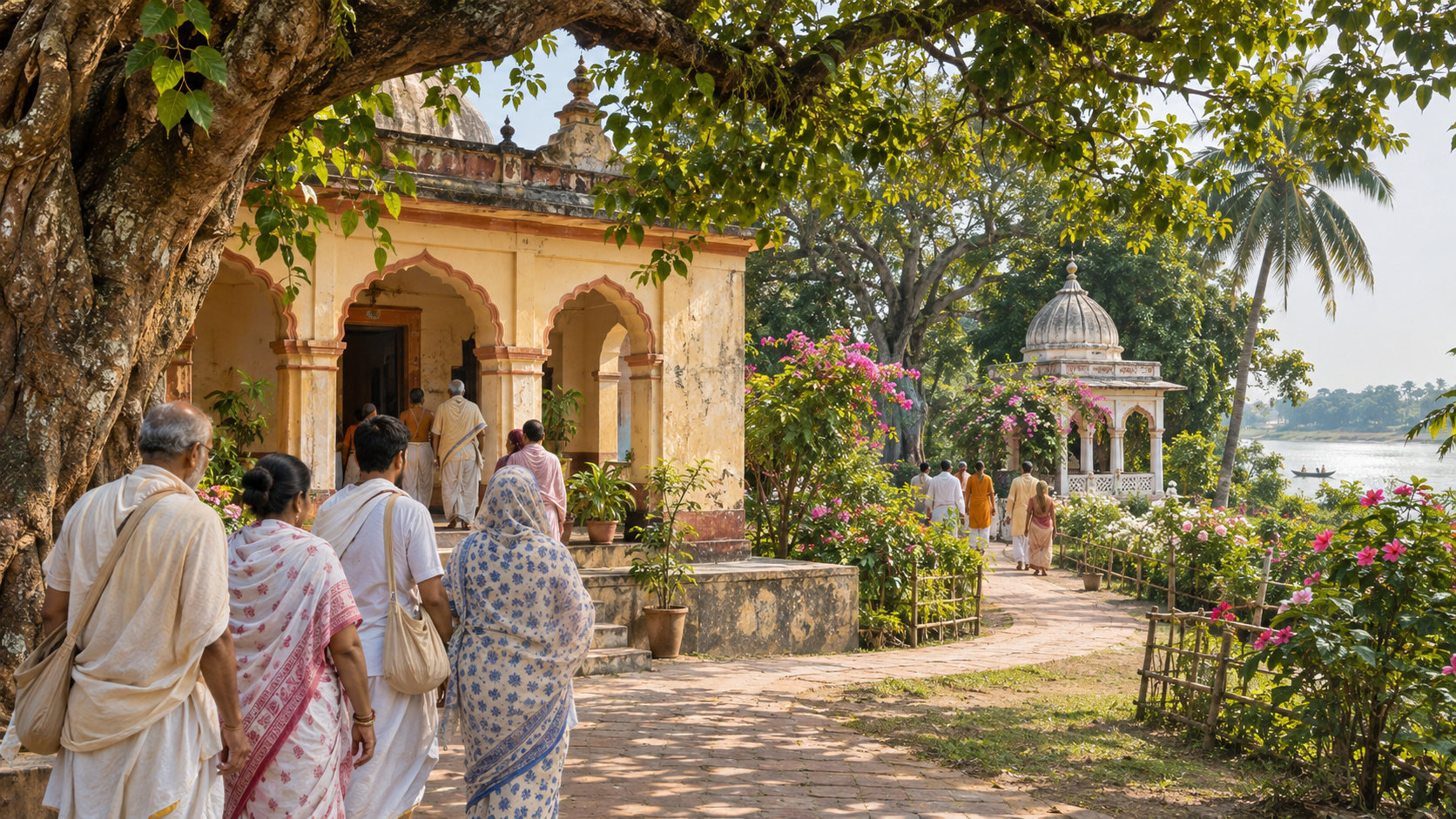
The Ganga bank, Sri Caitanya’s birthplace and the acharya samadhis should not collapse into an undifferentiated series of stops. Each can call forth a different response: receptivity, remembrance and responsibility.
At the Ganga, practise receptivity
Do not hurry to fill your first moments at the riverbank with speech or photography. Stand where access is permitted, settle your breathing and notice what your mind brought with it: expectation, agitation, gratitude, fatigue or distraction. You do not have to suppress any of these. Acknowledge them and turn your attention toward prayer or the holy name.
If a kirtana or devotional programme is taking place, listen before deciding how to participate. The aim is not to perform devotion for observers. It is to become present enough that the sound, the river and the assembled devotees are no longer background scenery.
At Sri Caitanya’s birthplace, remember the gift
At the sacred birthplace, keep the central question close: what does divine generosity ask of its recipient? Sri Caitanya’s mercy is not merely something to admire as a past event. For the pilgrim, it becomes a standard of conduct. If love of God was offered without an entry test based on status or prior attainment, your own response cannot be contempt for a newcomer, impatience with another pilgrim or pride in appearing more religious.
Offer your prayer in plain language. Ask to receive the holy name without vanity and to extend to others some measure of the welcome you seek for yourself. This keeps the theology of mercy connected to visible behaviour.
At the samadhis, accept responsibility
A samadhi is not simply a historical marker. It confronts you with lineage: teachings were preserved, embodied and handed forward through disciplined lives. Approach quietly. Learn whose samadhi you are visiting from a trustworthy local guide, listen to the account being given and resist the urge to reduce the moment to a photograph.
Before leaving, identify a quality associated with genuine discipleship that you need to strengthen: steadiness, service, truthful speech, study, compassion or fidelity to practice. The useful question is not only what the acharyas gave. It is what you will stop neglecting because they gave it.
Walk the parikrama as a practice, not a commute
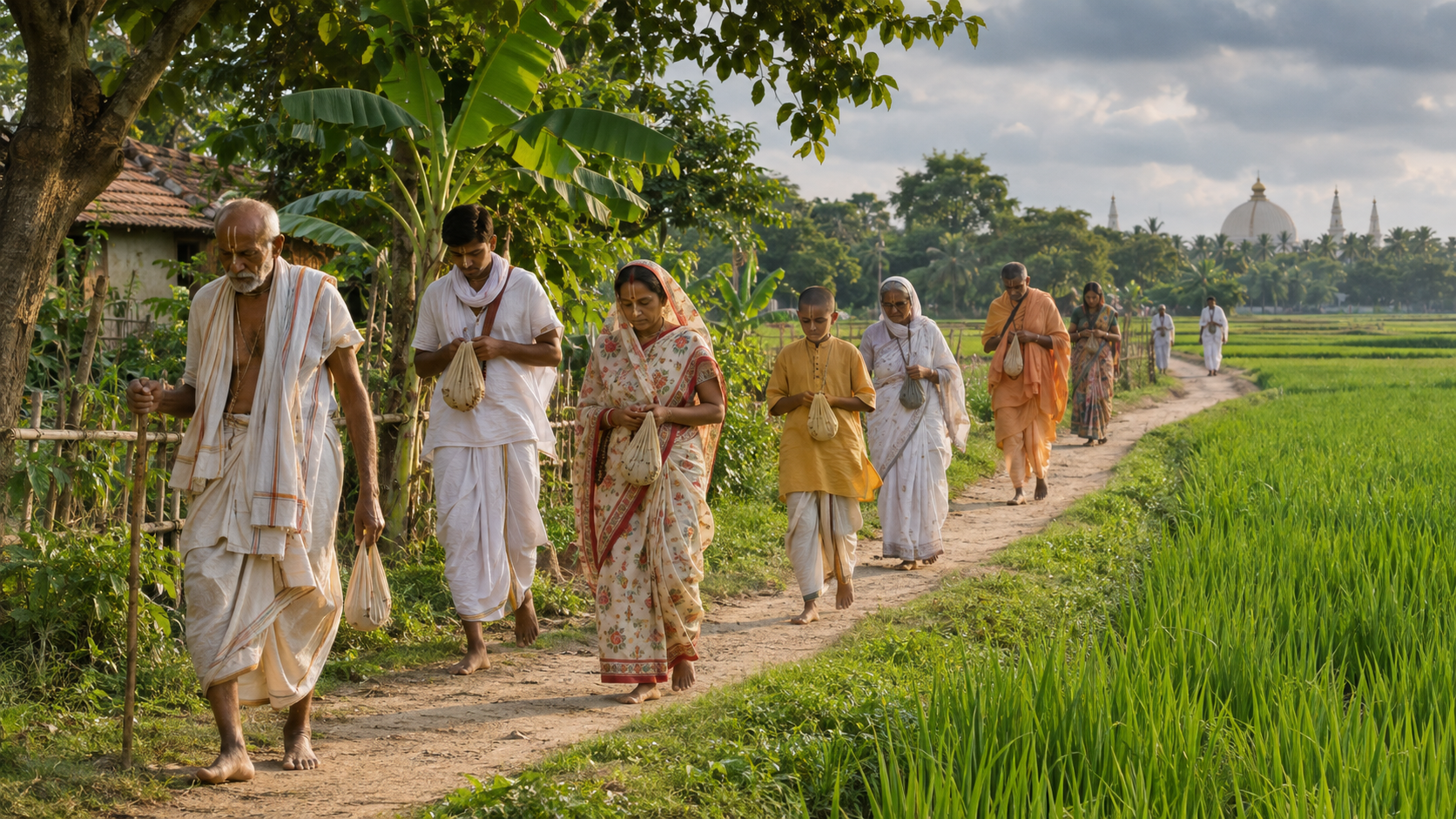
The space between sacred places is part of the pilgrimage. If you mentally switch off between destinations, much of the parikrama becomes transit. Use the walking itself to gather the mind.
- At the beginning, recall your sankalpa and decide what will anchor your attention: nama-japa, kirtana, prayerful silence or careful hearing from the guide.
- As you approach a sacred place, pause before reaching for the phone. Learn why the place matters, then decide whether a photograph will help you remember or merely interrupt the encounter.
- While walking, keep the group’s pace and instructions. Parikrama is shared discipline; repeatedly making others wait for personal photographs or detours turns private preference into a burden for everyone.
- After leaving each principal place, record a brief impression: what you heard, what challenged you and what you want to remember. Do this before the next stop overwrites the experience.
- At the end of the day, return to your original intention. Notice where you were attentive and where you became hurried, irritable or performative. Make the next day’s correction specific.
Current routes, gathering points, access rules and programme timings should be confirmed with your host or parikrama organiser. Ask about the expected walking conditions, footwear arrangements, photography restrictions and riverbank access before departure. If you have mobility limitations or rely on medication, state that early rather than trying to conceal it once the group is moving. Devotional sincerity does not require ignoring physical limits.
Protect the sanctity of the place through ordinary conduct
Many failures of pilgrimage look small: blocking a passage for a photograph, speaking loudly near a samadhi, stepping into a restricted area, treating residents as scenery or arguing when corrected. Small actions matter because reverence becomes credible through conduct.
- Follow local directions concerning shoes, queues, offerings, seating and photography. Customs can differ from place to place.
- Ask before photographing sadhus, residents, worshippers or children. Participation in public devotion is not blanket consent to become someone’s online content.
- Keep conversations low near worship and samadhi areas. If you need to coordinate logistics, move away from the devotional space.
- At the Ganga, obey local access and safety instructions. Do not enter the water merely because you see someone else doing so.
- Make donations through designated or clearly accountable channels. Generosity does not require abandoning judgement.
- Receive correction without turning it into a contest. A pilgrim who cannot be guided has made personal preference more important than the pilgrimage.
The teaching of mercy does not erase etiquette. It changes the spirit in which etiquette is practised. Rules should not become tools for humiliating inexperienced pilgrims, while openness should not become an excuse for carelessness. The mature position holds welcome and discipline together.
Carry the pilgrimage home: key takeaways
- Begin with a written sankalpa so the itinerary serves a spiritual purpose rather than replacing one.
- Approach the Ganga with receptivity, Sri Caitanya’s birthplace with remembrance of mercy and the acharya samadhis with responsibility to the lineage.
- Treat walking, waiting, listening and keeping pace with others as parts of parikrama.
- Let reverence govern your phone, voice, movement, donations and treatment of local people.
- Confirm practical rules with the local organiser instead of assuming that one site’s customs apply everywhere.
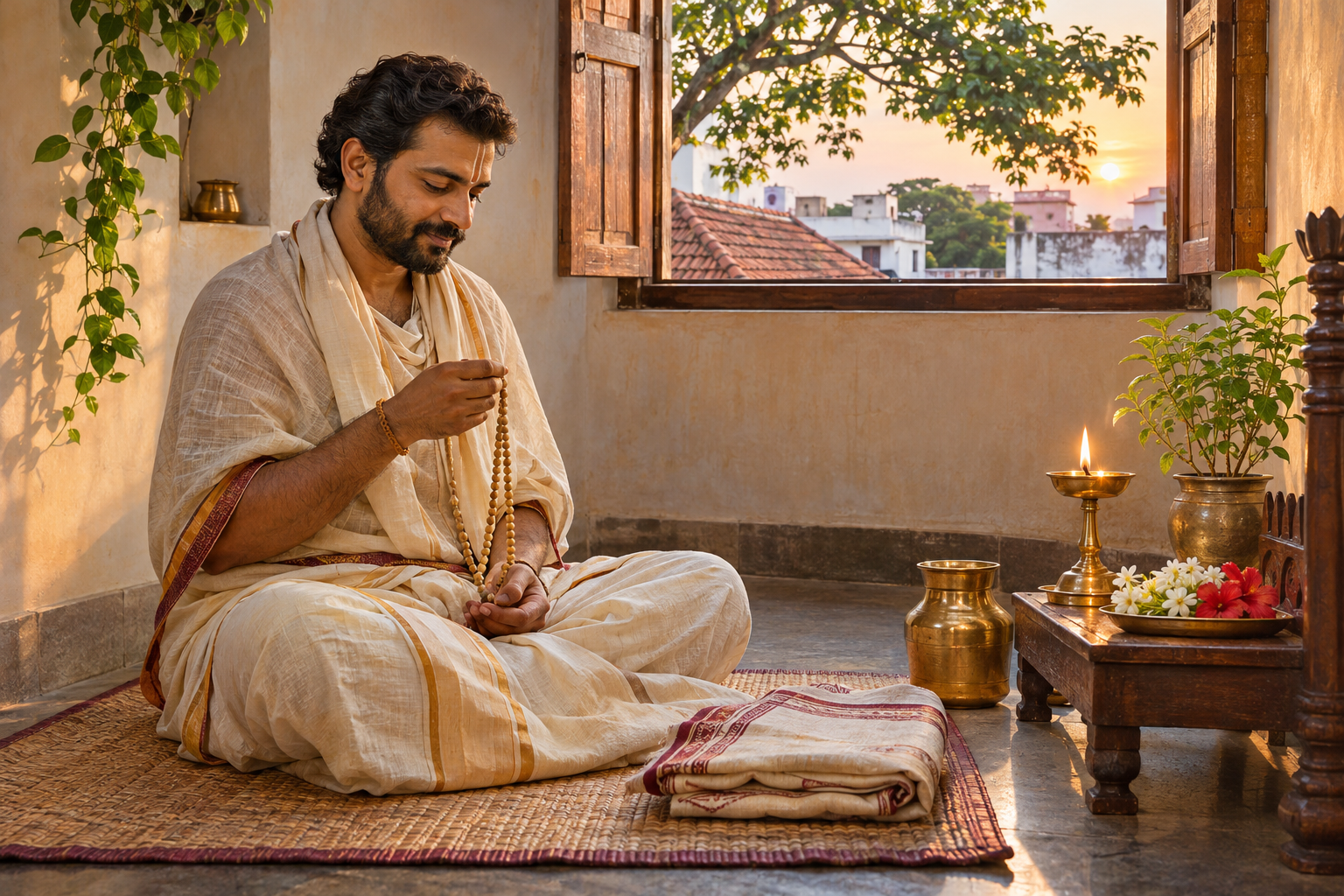
- Choose a sustainable practice to continue at home so the pilgrimage changes your routine, not only your memories.
Before returning home, name the practice that will carry the pilgrimage forward. It might be a regular period of nama-japa, attentive reading about Sri Caitanya, service to devotees, participation in kirtana or the repair of a relationship damaged by pride. Give it a definite place in your routine and begin while the pilgrimage is still vivid.
You do not need to return claiming that every moment was extraordinary. A more trustworthy fruit is quieter: greater steadiness in the holy name, less eagerness to judge another person’s qualification and a stronger willingness to serve. Go to Mayapur and Navadvipa ready to receive mercy, then let your conduct show what you received.
References

Leave a Reply
You must be logged in to post a comment.