
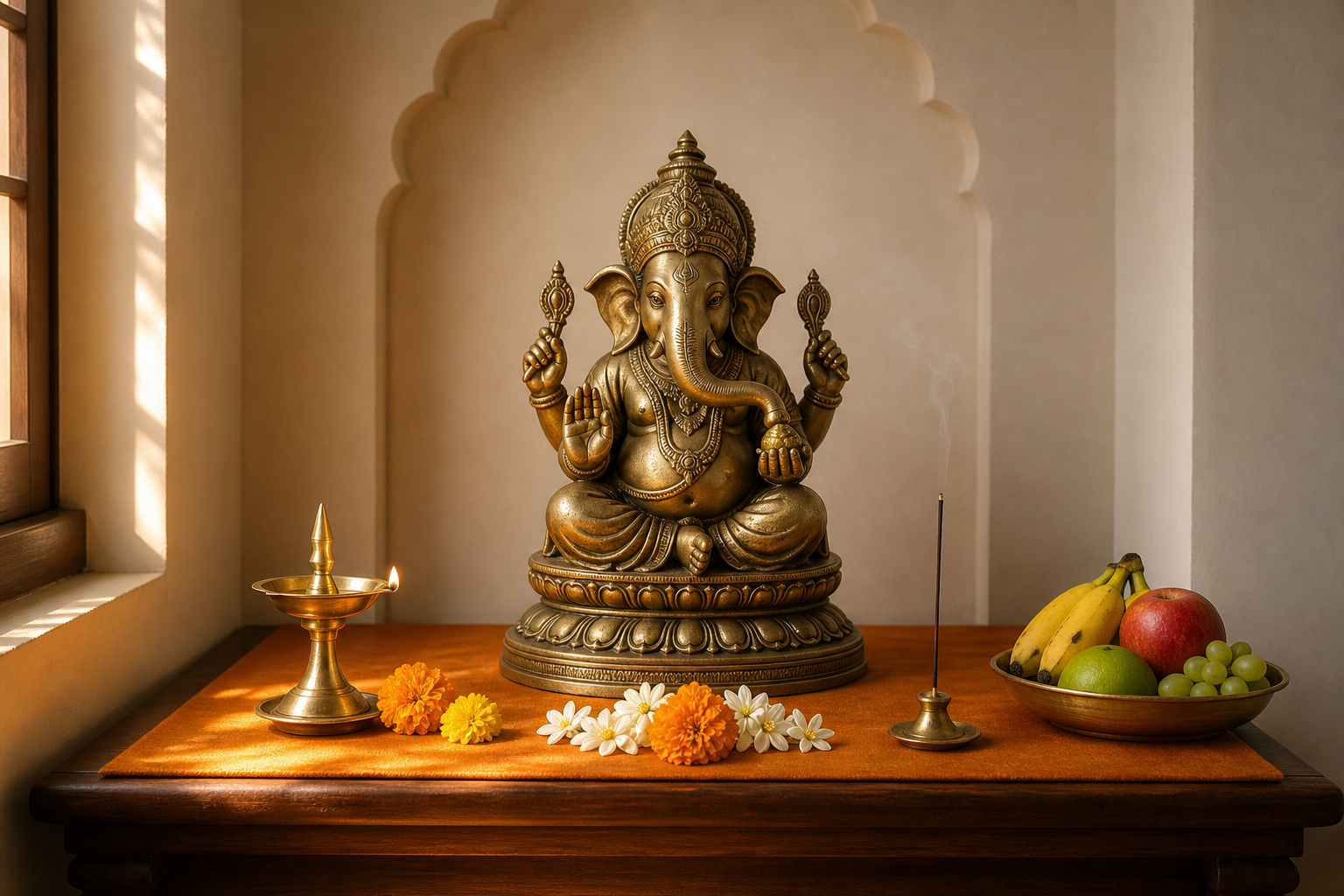
You have found a beautiful Ganesha murti for your home, but the trunk turns to the left and you have heard that its direction matters. The practical question is not whether one form is sacred and another is not. It is which form fits the kind of worship your household can sustain.
For most householders, Vamavarti Ganesha is the reassuring choice: a form traditionally associated with gentle auspiciousness, calm attention and an uncomplicated daily practice. You do not need an elaborate temple routine. You need a respectfully placed murti, a short puja you can repeat, and conduct that carries the worship beyond the altar.
The choice is about the rhythm of your home
Vamavarti is an iconographic description. Vama means left, while varti conveys turning toward. The name therefore identifies Shri Ganesha by the leftward direction of his trunk.
In a traditional yogic interpretation, the left side corresponds to Ida nadi, the lunar channel associated with coolness, inwardness and receptivity. The Vamavarti form consequently expresses a gentle and household-friendly current of grace. Its qualities suit a home where worship must coexist with work, study, meals, caregiving and the inevitable noise of family life.
Dakshinavarti Ganesha, whose trunk turns to the right, is also deeply revered. Its symbolism is commonly related to Pingala nadi, solar heat and outward energy. The distinction is practical rather than hierarchical: the right-trunk form is traditionally approached with more exacting ritual discipline, while the left-trunk form is widely preferred for ordinary domestic worship.
| Question | Vamavarti form | Dakshinavarti form |
|---|---|---|
| Trunk direction | Turns to the left | Turns to the right |
| Yogic association | Ida, lunar and cooling | Pingala, solar and heating |
| Ritual character | Gentle, steady and suited to simple household worship | Traditionally associated with stricter and more consistent observance |
| Practical decision | A natural choice for most family altars | Choose with appropriate guidance and readiness for the prescribed discipline |
Customs can differ among regions, families and sampradayas. If your kula tradition or guru gives a specific instruction, follow that living lineage. Otherwise, you need not be anxious about selecting the Vamavarti form for your home.
Key takeaways
- Vamavarti Ganesha is the left-trunk form traditionally favored for household worship.
- Its lunar and cooling symbolism points toward composure, receptivity and sattvic stability.
- A single primary murti on a clean, raised altar gives daily worship a clear center.
- A short puja performed consistently is more appropriate than an elaborate routine you cannot maintain.
- Offerings such as durva, flowers, fruit or a modest sweet are sufficient when given with care.
- The right-trunk form is not inauspicious; it is traditionally treated as more ritually demanding.
Read the murti before you bring it home
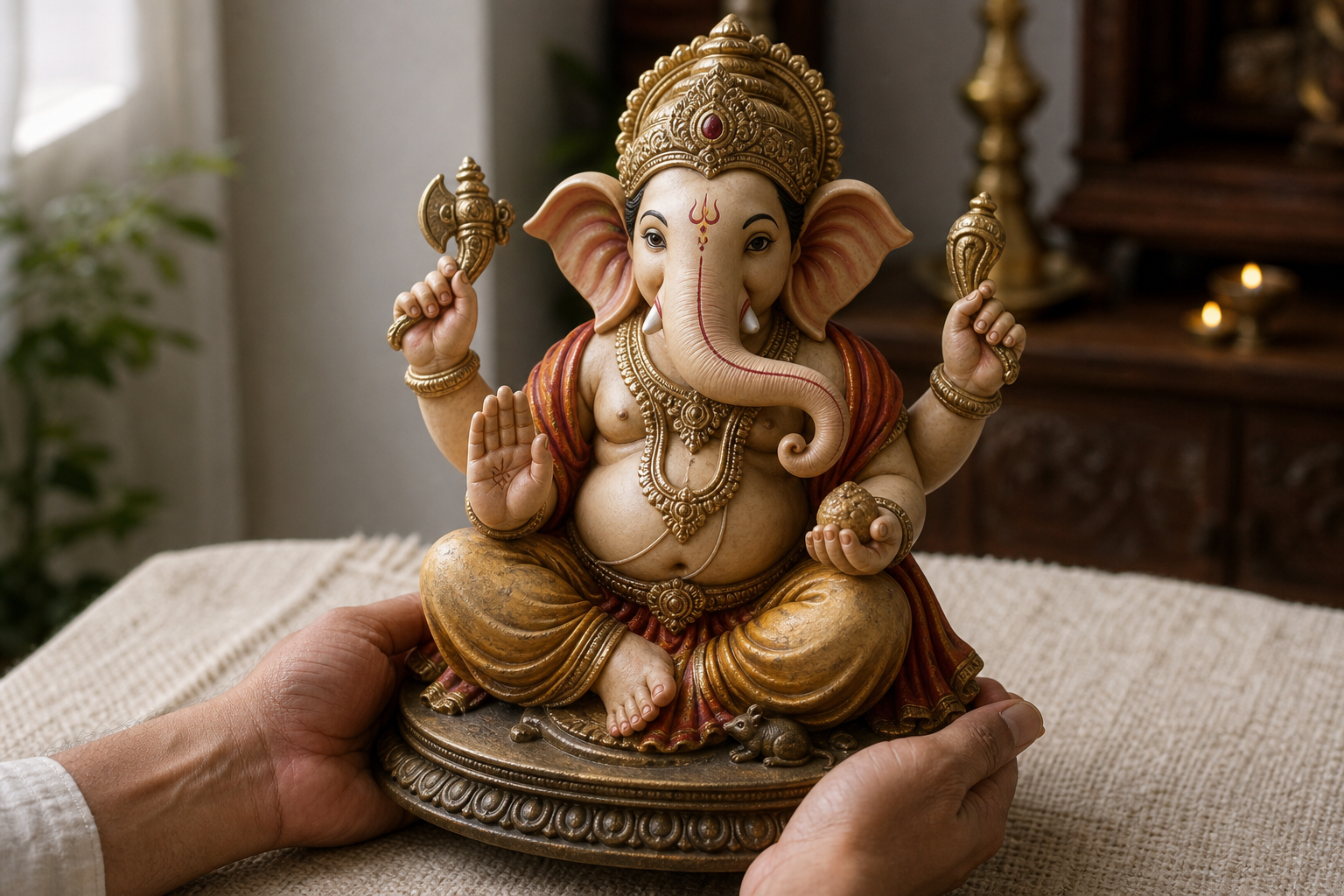
The trunk direction is only one part of the murti’s teaching. Ganesha’s entire form presents a discipline for household life. His large head calls you to think beyond the immediate disturbance. His broad ears ask you to listen before reacting. His small eyes represent concentration. His trunk, capable of delicate and forceful work, represents adaptability without loss of purpose.
The modaka signifies the sweetness that follows sincere sadhana. The mushika, small and restless, evokes desire that has not been destroyed but brought under wise direction. This is a particularly useful household image. A home does not become dharmic by denying every appetite or disagreement. It becomes dharmic when intelligence governs them.
A seated Vamavarti Ganesha in lalitasana, the posture of royal ease, is a fitting choice when you want the altar to communicate composure and accessibility. Before buying or installing the murti, use a simple checklist:
- Choose a form you can identify confidently. If the trunk direction is obscured by ornamentation, ask a knowledgeable seller, priest or family elder rather than guessing.
- Prefer a stable seated posture for the permanent altar. Lalitasana naturally conveys calm presence in a domestic setting.
- Select a manageable size. The murti should fit securely on its pedestal and be easy to clean without precarious lifting.
- Consider how the material will be cared for. Stone, wood and clay are traditionally favored natural materials, while metal murtis are also widely used.
- Inspect the finish before planning abhishekam. Painted clay, unfinished wood or delicate surface treatments may be damaged by liquids. When uncertain, keep the worship dry and ask the maker how the murti should be maintained.
- Establish one primary Ganesha murti. The household custom of giving the altar one principal form protects concentration. The purpose is focused upasana, not fearful counting.
Do not choose solely by decorative appeal and then place the murti wherever an empty shelf happens to exist. Decide first whether this will be your household’s principal worship form. That decision determines the care, location and daily attention it deserves.
Build an altar that is easy to honor every day
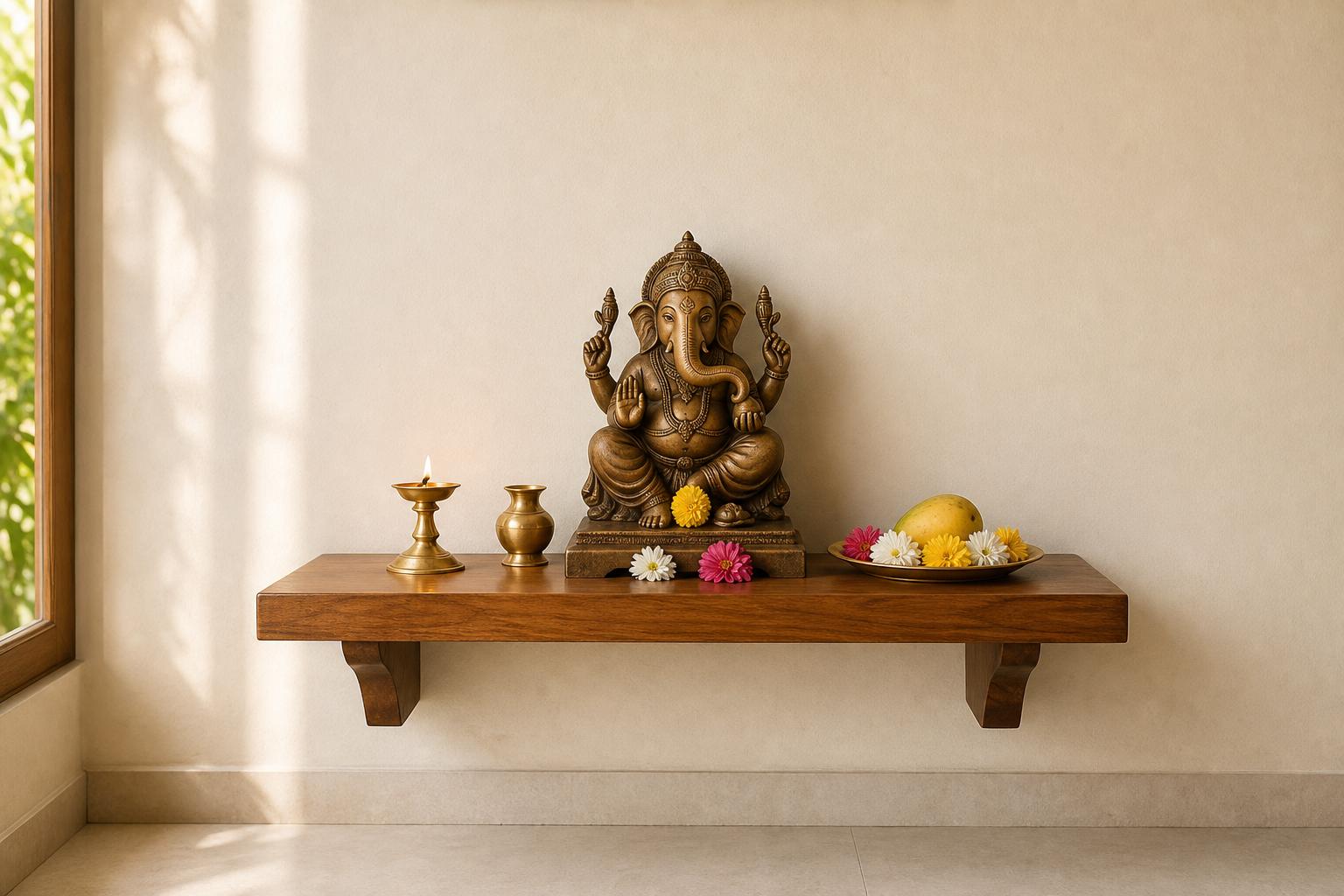
The best altar is not necessarily the grandest one. It is the place you can keep clean, approach without moving clutter, and use without disrupting the rest of the household. Regular care is easier when the shrine has a defined boundary rather than sharing space with bills, keys, storage boxes or unused objects.
Vaastu-minded practice favors the Ishana, or northeast, portion of the home for puja. If your floor plan does not permit that, choose a quiet, ventilated and uncluttered location. A practical limitation in an apartment is not a spiritual failure. Give priority to cleanliness, stability and the household’s ability to worship without disturbance.
- Place the murti on a firm pedestal, shelf or altar rather than directly on the floor.
- Use a clean cloth or dedicated asana beneath it.
- Avoid a wall shared with a bathroom where your home layout gives you a reasonable alternative.
- Arrange the space so you can comfortably face east during puja when possible.
- Leave enough room for a lamp, incense holder, water and offerings without crowding the murti.
- Keep matches, loose fabric and decorations away from the flame. Never leave a lamp or burning incense unattended, especially around children or animals.
Before final placement, sit where you expect to worship. Can you bow without knocking the shelf? Can you reach the lamp safely? Is there somewhere to set naivedya without placing it on the floor? These mundane questions matter because repeated inconvenience gradually turns daily puja into an occasional event.
Once the altar is established, keep its visual field calm. Vamavarti symbolism points toward sattva: luminosity, balance and clarity. An overcrowded shrine can work against the attentive mood the form is meant to cultivate.
Follow a simple puja that you can sustain
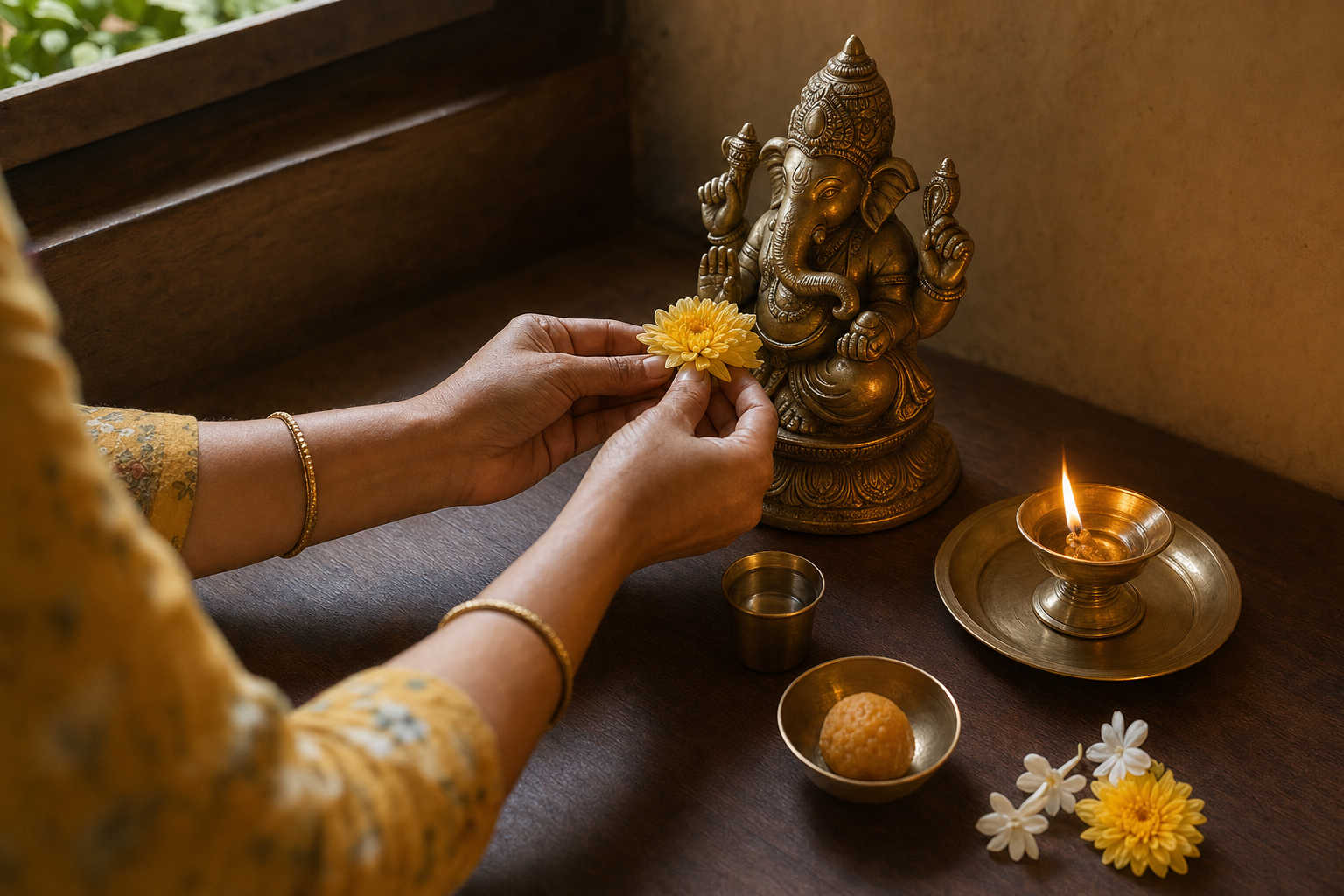
Household puja does not have to reproduce a temple ceremony. Its strength comes from a recognizable sequence that gathers your attention and can be repeated without hurry. If your family has an established vidhi, retain it. If you are beginning, the following structure is sufficient.
- Prepare yourself and the space. Wash your hands, clear the altar and sit quietly. Perform achamana according to your tradition if you have learned it.
- Make a sankalpa. State the purpose of the worship plainly. It can concern study, a new undertaking, family harmony or the removal of a specific inner obstacle such as carelessness or impatience.
- Offer asana and avahana. Mentally offer Shri Ganesha a seat and invite his presence with reverence.
- Perform abhishekam only when appropriate. Pure water with a little rose water can be used on a suitable murti. Panchamrita combines milk, curd, ghee, honey and sugar, but it should be reserved for a material and finish that can receive and be cleaned after it. Skip liquid offerings when there is any risk of damage.
- Offer gandha, akshata and flowers. Apply fragrant paste where appropriate, place clean grains and offer fresh flowers or durva.
- Offer dhoopa and deepa. Present incense and lamp-light with steady attention rather than treating them as background decoration.
- Present naivedya. A modaka, laddu, fruit, coconut, a little jaggery or rock sugar is enough. Elaborateness does not make an inattentive offering superior.
- Recite mantra or stotra. Chant Om Gam Ganapataye Namah 11, 21 or 108 times according to the time you can give without rushing.
- Conclude with arati and pranam. Bow in gratitude, then share the prasada with the household.
If you have learned the Ganesha Atharvashirsha, its recitation can deepen the practice and contemplate Ganesha as an all-pervading reality. For a shorter beginning before study, travel or a new venture, Vakratunda Mahakaya is a familiar choice. Do not collect chants merely to lengthen the ceremony. Choose one that you can pronounce attentively and understand more deeply over time.
Durva and naivedya are lessons in simplicity
Fresh durva grass, often offered as three-bladed sprigs, has a cherished place in Ganesha worship. A popular Puranic account connects it with the cooling of Ganesha after he subdued a fiery asura. The offering therefore fits the lunar, pacifying symbolism of the Vamavarti form. Its deeper household lesson is equally direct: something simple becomes sacred through cleanliness and devoted attention.
Modaka and laddu represent the sweetness of realized knowledge. Banana, pomegranate and coconut carry associations of fertility and wholeness. Choose food that is fresh, modest and suitable for sharing. Naivedya becomes prasada after worship, extending the altar’s blessing into the relationships of the home.
Use sacred days to deepen, not replace, daily practice
Dawn and early evening are natural daily times because they mark transitions in the household rhythm. Pick the one your family can protect. A modest ceremony performed at a dependable time forms a stronger discipline than an ambitious schedule repeatedly abandoned.
Tuesdays and Chaturthi tithis are popular occasions for additional japa, durva or a special sweet. Sankatahara Chaturthi falls on Krishna Paksha Chaturthi and is observed for Ganesha’s help in dissolving difficulties. Bhadrapada Shukla Chaturthi is celebrated as Ganesh Chaturthi. Because a tithi does not correspond permanently to one civil-calendar date, consult the panchanga followed by your family or local temple.
Let special observances enlarge an existing practice. If the daily routine has lapsed, restart with a lamp, one offering and 11 repetitions of the mantra. There is no need to compensate with sudden ritual excess.
Let obstacle removal begin with your own conduct
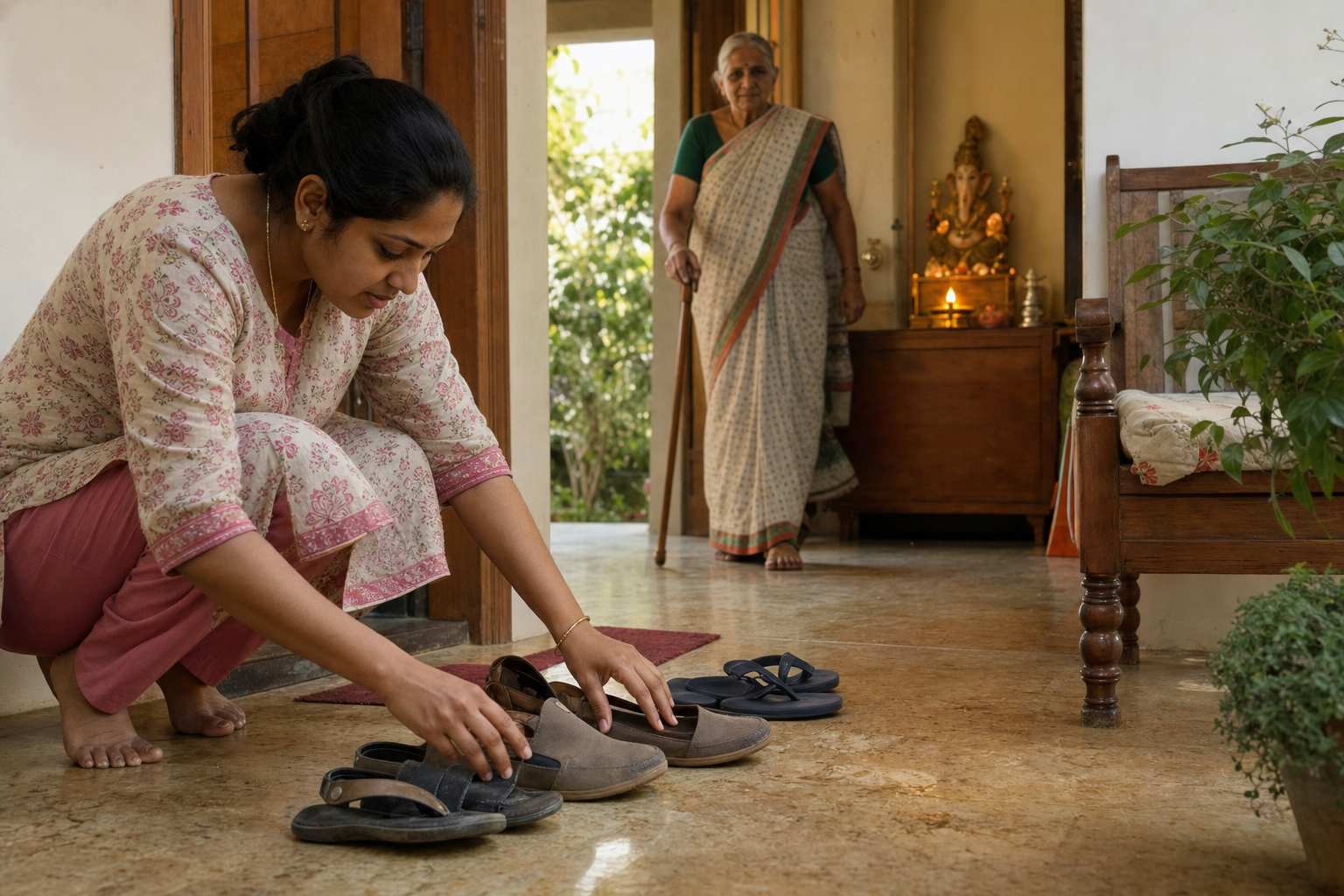
Devotees associate Vamavarti Ganesha with smoother beginnings, calmer family relations, steadier learning and clearer work. These should not be reduced to promises that every external problem will disappear. Ganesha’s grace also reveals the obstacle you are carrying into the problem: scattered attention, impatience, avoidable friction, weak preparation or desire that has seized control of judgement.
This is where the iconography becomes practical. The broad ears ask whether you listened fully. The small eyes ask whether you stayed with the task. The adaptable trunk asks whether you changed your method without abandoning dharma. The mushika asks whether desire is serving intelligence or directing it.
Give each sankalpa a corresponding action. If you pray for success in study, protect a regular period of concentrated work. If you pray for harmony, enter the next difficult conversation prepared to listen before answering. If you pray for an auspicious beginning, complete the neglected preparation that could otherwise become tomorrow’s obstacle. Puja orients effort; it does not excuse you from making it.
You can begin today without waiting for a festival. Clear one stable place, install one Vamavarti murti respectfully, choose a daily time, and make the first offering simple enough to repeat tomorrow. That repeatability is how a sacred image becomes the living center of a household practice.