
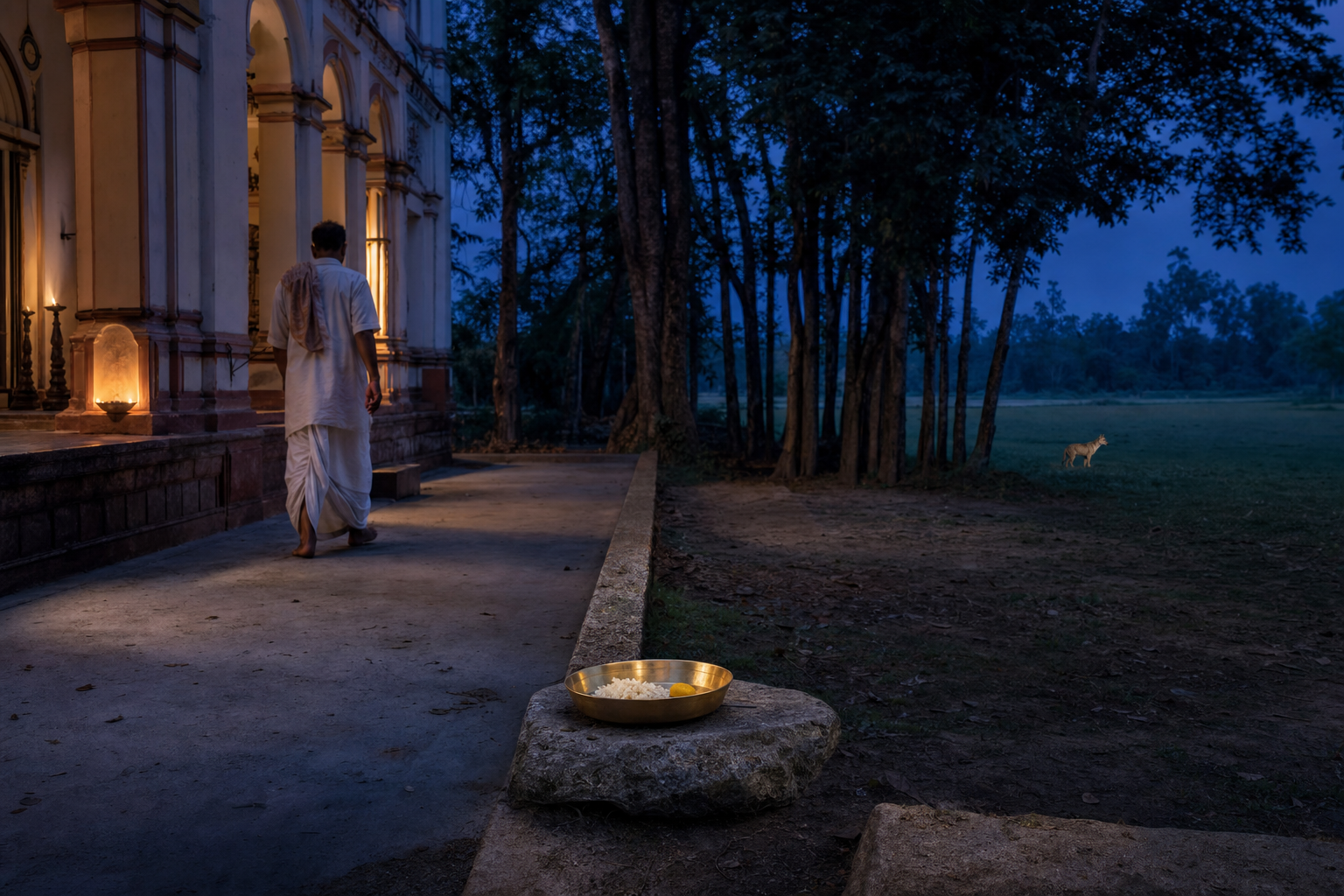
At a Kali temple after evening worship, you may see a portion of consecrated food carried away from the sanctum and placed near a field, grove, or other quiet boundary. If someone tells you it is meant for jackals, the act can look like superstition, discarded food, or an invitation to imitate what you have seen. All three readings miss its ritual logic.
Shiva-bhog, also known locally as Shiber bhog, is a reserved share of prasada offered within Kali’s wider sacred field. Understanding who receives that share, why the boundary matters, and when literal feeding becomes irresponsible will help you approach the custom with both reverence and judgment.
The name tells you where the offering belongs
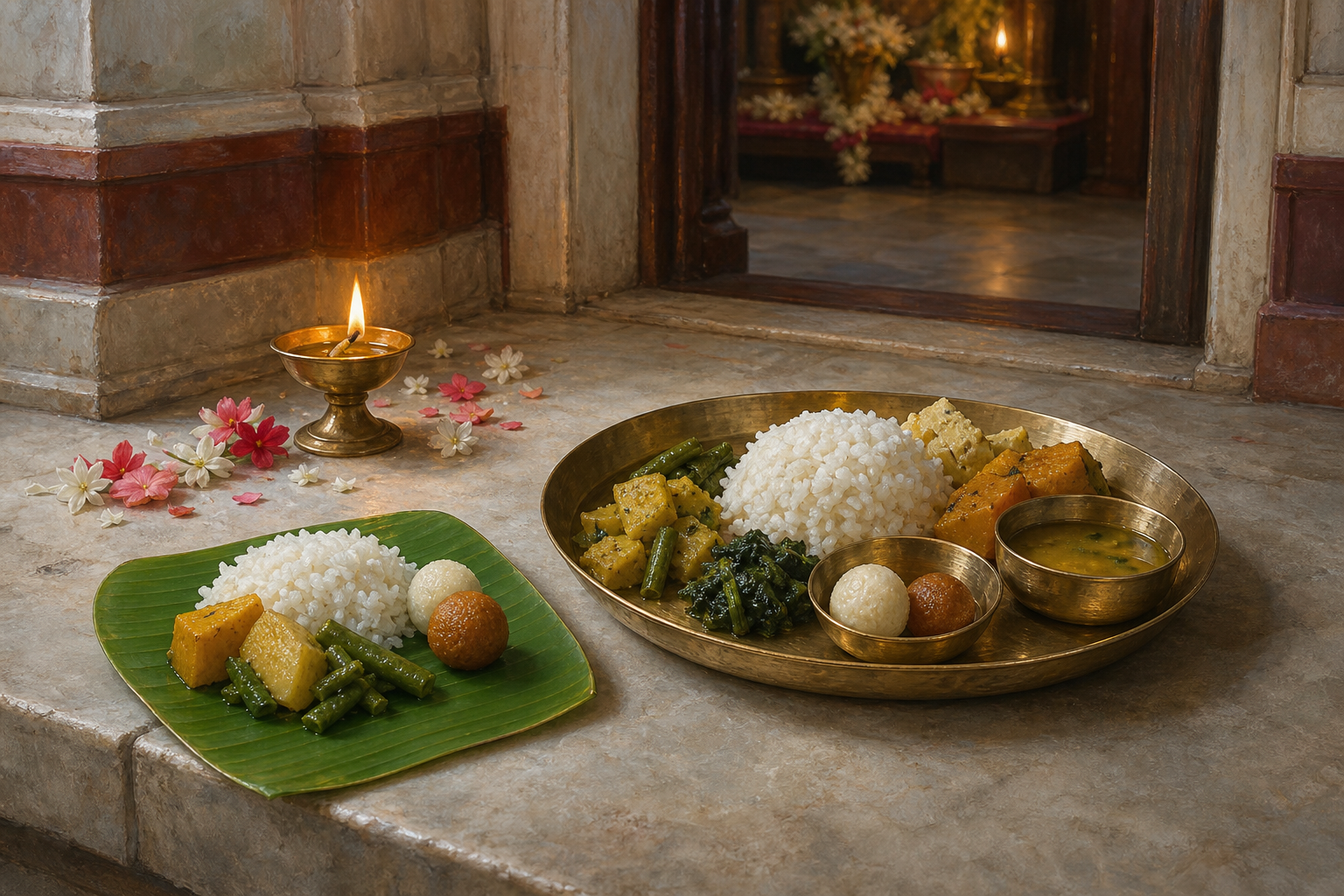
In ordinary temple language, bhoga is food presented to the deity; after the offering, devotees receive consecrated food as prasada. Shiva-bhog is a portion designated as the share for Shiva after the principal offering to the Devi. It is not a replacement for Kali’s worship, and it is not simply unwanted food left outdoors.
The name makes sense within the intimacy of Kali and Shiva. In the fierce sacred landscape, Shiva is encountered through Bhairava, the kṣetrapāla or guardian of the ritual field. Bhairava watches thresholds, while the ganas occupy a divine retinue larger and stranger than the human congregation inside the temple. Jackals may be treated as companions or attendants belonging to that field. Reserving their share acknowledges that worship does not end with the people standing before the image.
This distinction protects the rite from two opposite errors. One is to dismiss it as indiscriminate animal feeding. The other is to claim that every wild jackal is literally Shiva in a way every Shakta community must interpret identically. The custom establishes a ritual relationship among Kali, Shiva-Bhairava, the ganas, the temple boundary, and non-human life. It does not require a single literal theory about the animal.
Shiva-bhog is also commonly a local, ancillary observance rather than a rite found in every formal Agamic schedule. Its details can therefore vary from one temple or region to another. If you encounter it in practice, ask the temple’s ritual custodian three precise questions: What is the local name for the observance? At what point is the portion separated? Is it understood primarily as an offering to Bhairava, to the Mother’s ganas, or to jackals as their representatives? Those answers are more reliable than a generalized ritual copied from elsewhere.
Why the jackal stands at the edge of Kali’s world
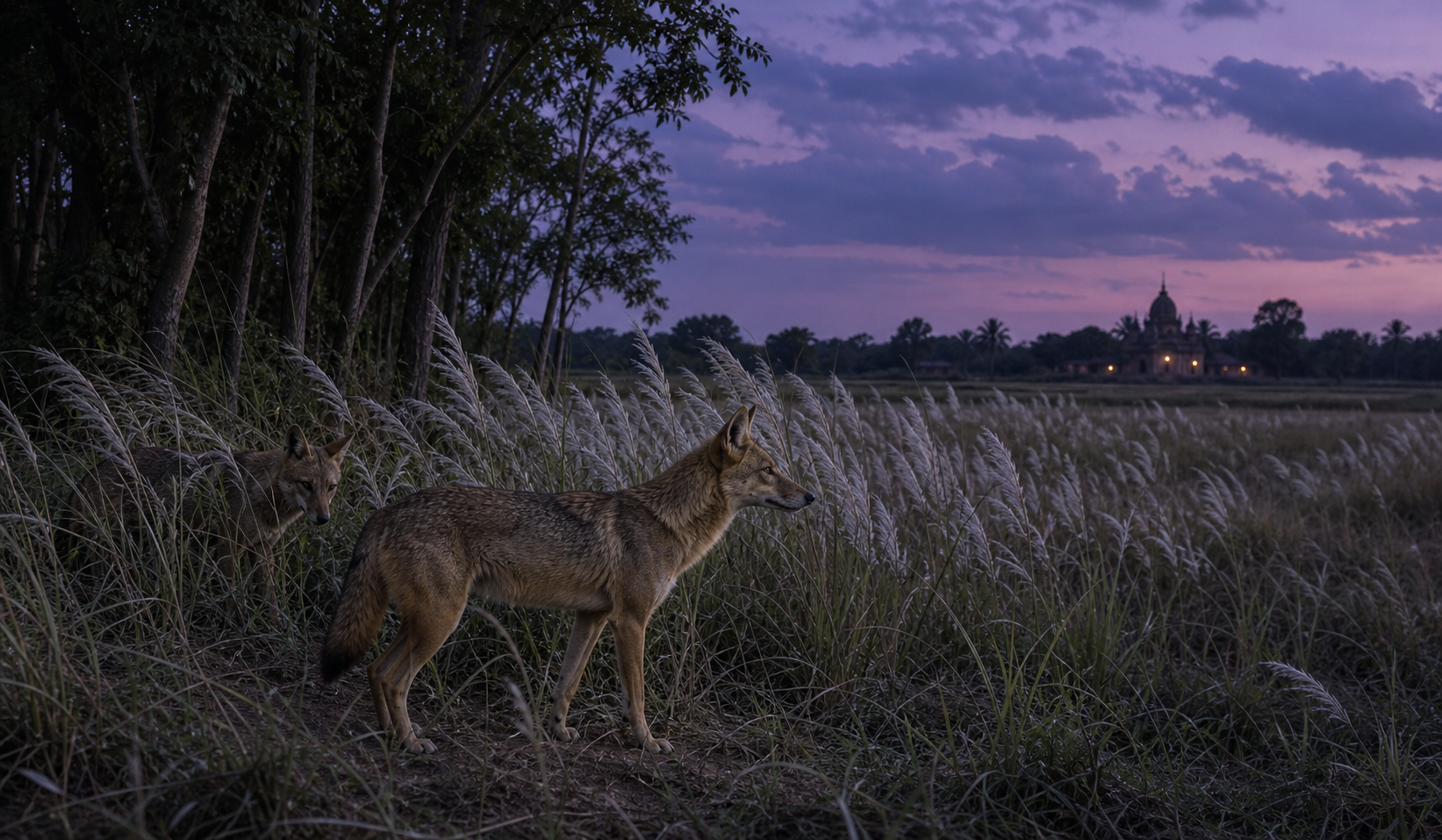
The jackal is not an accidental recipient. Kali and the allied fierce form Chamunda inhabit the śmaśāna, the cremation ground, in Shakta imagination. Their iconography admits beings that ordinary social space pushes out of sight. Jackals appear near the goddesses in cremation-ground and battlefield settings, where they consume what violence, mortality, and time have left behind.
That image should not be reduced to a fascination with horror. The śmaśāna is a place where human claims to permanence fail. The jackal moves between settlement and wilderness, living bodies and the remains of death. As a scavenger, it also participates in ecological recycling. It takes what appears finished and returns it to the movement of life. That makes the animal a fitting companion to a goddess whose spiritual instruction does not evade impermanence.
The association sits within eastern Shakta worlds shaped in part by revered materials such as the Kalika Purana and the wider mantra-tantra corpus. This does not mean that one text supplies a universal instruction manual for every jackal offering. Textual symbolism, temple convention, and rural memory overlap here without becoming identical.
The physical location of the offering carries the same teaching. A forest margin, field edge, grove, crossroads, or outer temple boundary is neither the sanctum nor a spiritually empty zone. It is the kṣetrapāla’s threshold. Moving a consecrated portion there extends the ritual circuit from deity to devotee, from devotee to place, and from human society to beings that live outside its walls.
You can therefore read the jackal as a teacher of liminality without romanticizing wildlife. It exposes a narrow idea of purity in which the sacred belongs only to orderly, familiar, human spaces. Kali’s presence reaches what we fear, reject, or refuse to see. Feeding a creature associated with death’s residue declares that the Mother’s compassion is not a human monopoly.
This ethical movement also resonates beyond Shakta worship. Buddhist karuṇā and mettā, Jain commitments to ahiṁsa and the feeding of living beings, and Sikh seva extended toward ecological care all refuse to make human convenience the sole measure of moral concern. The traditions retain their doctrinal differences, but Shiva-bhog gives a distinctively Shakta form to a widely Dharmic question: does your reverence change how you treat lives that cannot repay you?
The ritual sequence is simple, but it is not a do-it-yourself liturgy
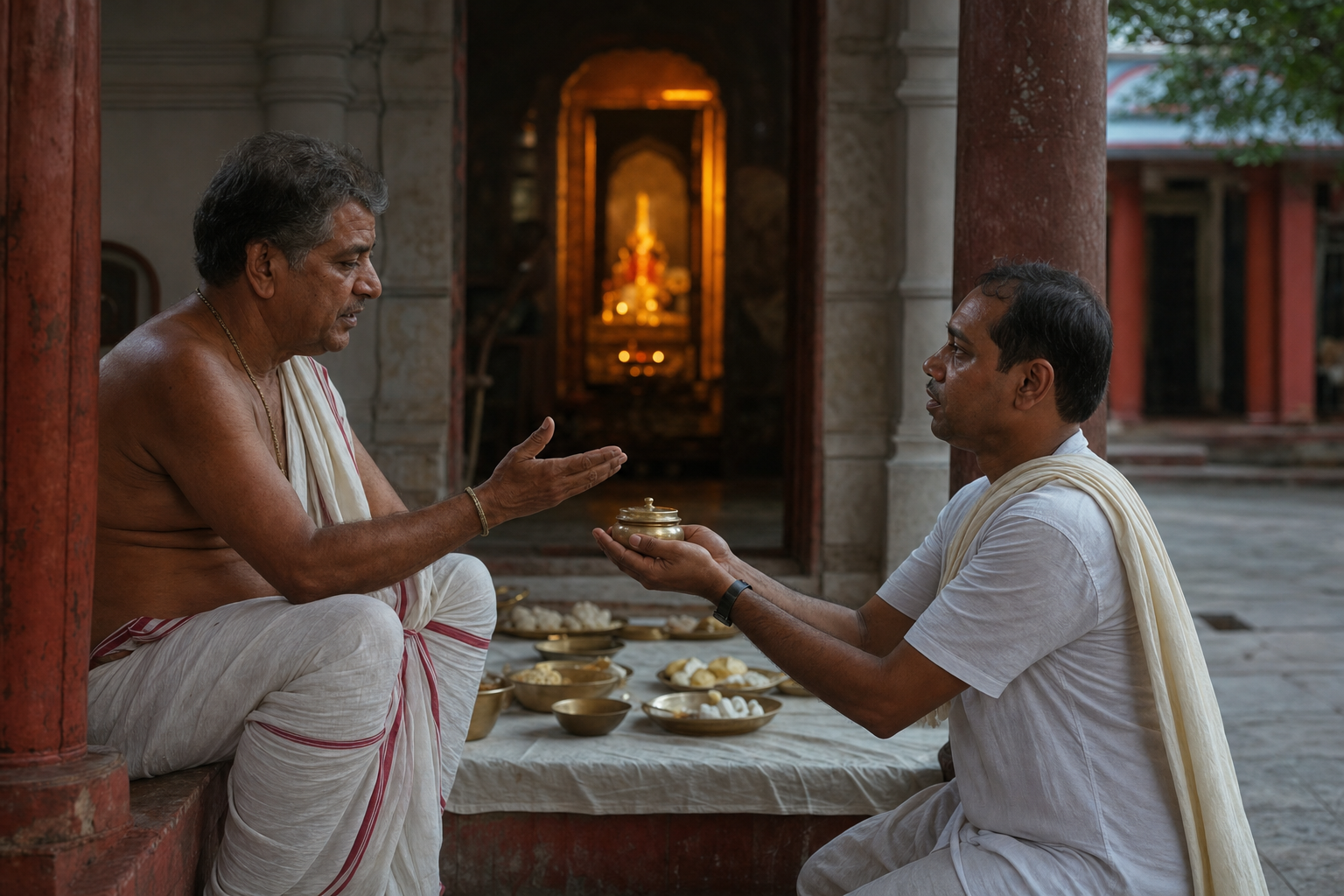
Across local variations, the observance has a recognizable shape. Treat this as a map for understanding what you witness, not as authorization to invent mantras, trespass into wildlife habitat, or reproduce a temple rite without guidance.
- The regular worship of Kali comes first. Bhoga is prepared according to the temple’s convention and offered with its established mantra, lamp, and other upacaras. Many contemporary temples use vegetarian offerings.
- A distinct portion is then set aside as Shiva-bhog. The act of designation matters: this is a consecrated share within the rite, not a disposal method for whatever remains after everyone has eaten.
- An authorized person carries the portion quietly to a suitable threshold associated with Bhairava’s guardianship. Depending on local custom, this may be an outer edge near fields, a grove, or a forest margin.
- The portion is placed with a brief salutation to the kṣetrapāla and the Mother’s ganas. The ritual action ends with the offering; it does not require approaching, chasing, calling, or conditioning a wild animal.
- The location is left clean. Plastic, disposable packaging, and scattered leftovers contradict the same duty of śauca that governs the temple precinct.
The custom is especially visible in parts of Bengal, Assam, and Odisha, including observances associated with Amavasya, Kali Puja, and Bhairava. That regional concentration is a reason to listen carefully to local practice. It is not evidence that every Kali temple should add an identical jackal-feeding rite.
Some rural traditions interpret the first direction of a jackal’s call or the speed with which the offering disappears as a sign concerning protection or auspiciousness. The sound can deepen attention after worship, but it should not be turned into a mechanical forecast. Such omen-reading is better received as a contemplative prompt: examine your conduct, renew your ethical resolve, and remember that the worshipper does not control the world outside the lamp’s circle.
The same restraint applies when no jackal comes. Wildlife behavior is not under ritual command, so absence should not be converted into a verdict that Kali rejected the worship. Baiting an animal, adding more food, or moving the offering toward habitation in order to produce a desired sign reverses the rite’s humility.
Do not confuse this modest practice with every transgressive offering mentioned in historical tantric streams. Certain rites belonged to restricted initiatory settings and cannot be reconstructed responsibly from a name, an image, or a fragment of instruction. Mainstream Kali temples commonly emphasize sattvic bhoga and ahiṁsa-aligned worship. A vegetarian portion reserved for the outer guardians is not evidence that an unrelated esoteric rite is taking place.
Preserve the devotion without training wildlife to seek people
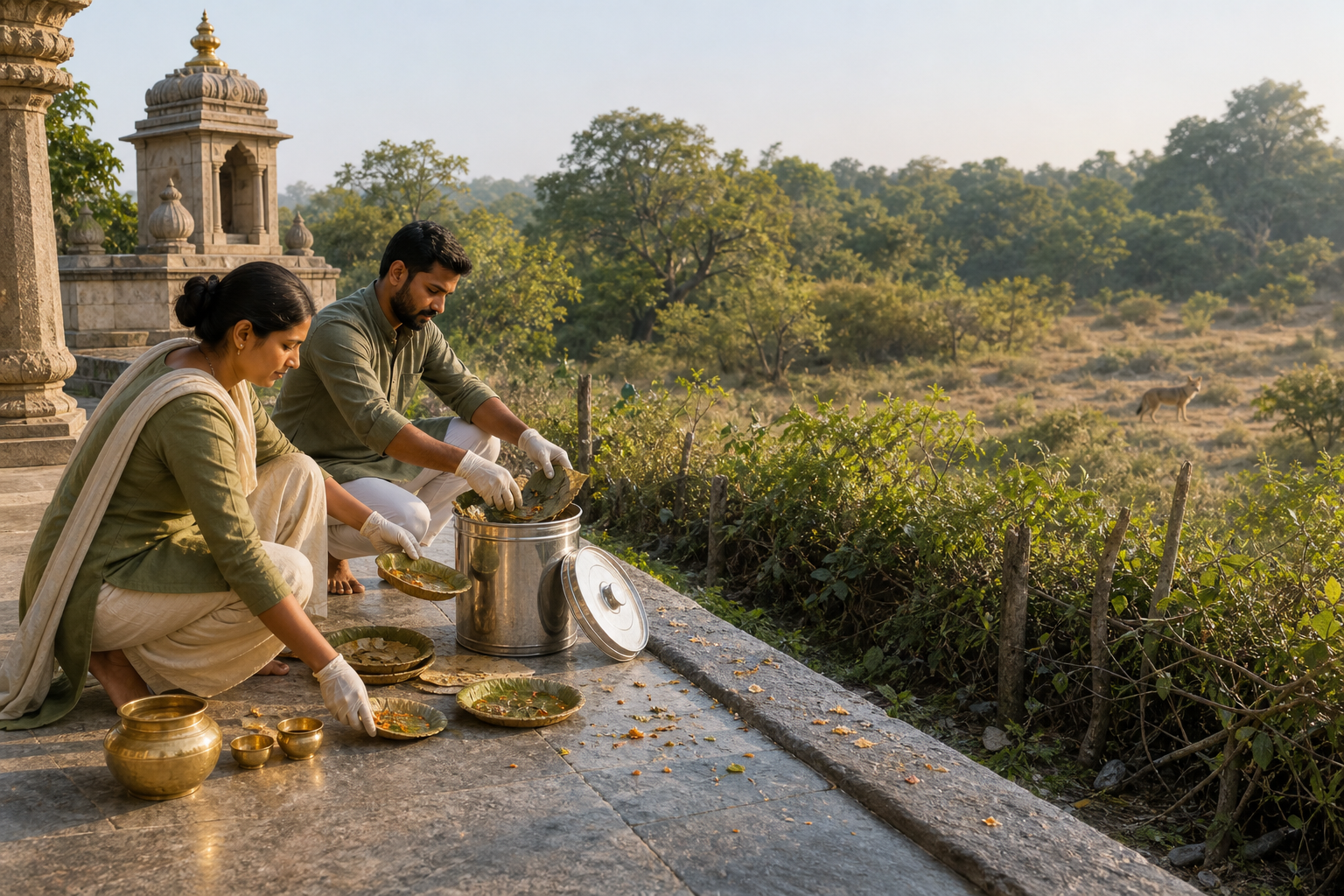
A religious intention does not make harmful wildlife feeding harmless. Repeated access to human food can habituate wild animals, drawing them toward roads, homes, crowds, and further feeding. That creates risks for the animal as well as for public health. The responsible question is therefore not merely, “Is this traditional?” It is, “Can the intention be honored here without making a wild creature less safe?”
Use the following order of decisions if you are helping a temple, household, or community consider Shiva-bhog:
- Establish that the observance belongs to the local tradition. Ask the temple committee, purohit, sevayat, or recognized lineage holder how the share is understood. Do not import a practice simply because it appears in another region.
- Check the wildlife setting before selecting a recipient. If there is no established protocol or appropriate forest-department guidance, do not leave food for wild jackals. Religious intent does not override conservation directions or make a roadside placement safe.
- Choose the least harmful form that preserves the intention. A temple may dedicate the share to community dogs associated with Bhairava within a responsible local feeding arrangement, or direct its value to a vetted animal-welfare initiative. The share can remain deliberate even when it is no longer a bowl placed for a jackal.
- If literal placement is authorized, treat location as a safety decision. Use a genuinely suitable wild margin identified with local guidance. Avoid roads, residential areas, human gathering points, and sensitive habitats. Never try to lure a jackal closer for viewing or ritual drama.
- Separate consecration from nutritional suitability. Prasada status does not change a canid’s physiology. Where feeding is permitted, use plain, lightly cooked food without spices, added salt, sugar, or packaging. Suitability of the food is not, by itself, permission to feed wildlife.
- Complete the rite with śauca. Carry no plastic into the placement area, prevent litter, and follow the temple’s protocol for removing anything that could remain as waste. Dumping human leftovers outdoors and calling it Shiva-bhog empties the gesture of both ritual precision and ecological responsibility.
These adaptations do not have to dilute the rite. Its durable elements are the priority given to the Devi, the deliberate share for Shiva-Bhairava and the ganas, gratitude toward the guardians of place, care for non-human beings, and respect for the boundary. Temple communities can preserve those elements through guided symbolic placement, responsible care for community dogs, or support for animal welfare when feeding jackals would create harm.
A temple committee can make this easier by writing a short local protocol: who may carry the share, whether literal wildlife feeding is permitted, which location is approved, what food is suitable, who is responsible for cleanliness, and which alternative is used when conditions are unsafe. Clear stewardship prevents private enthusiasm from turning a boundary rite into unmanaged feeding.
Key takeaways
- Shiva-bhog is a deliberately reserved share of Kali’s consecrated offering, not discarded food and not a second principal worship.
- Jackals belong to the rite through their association with Kali, Chamunda, Bhairava, the ganas, the cremation ground, and the wild boundary.
- The observance is regionally rooted and often ancillary to formal temple liturgy, so local custodians should guide its form.
- A jackal’s call or the disappearance of food may serve as a contemplative sign, but it should not become deterministic fortune-telling.
- Do not feed wild jackals without an established, conservation-aware protocol. Responsible care for community dogs or a vetted animal-welfare offering can preserve the rite’s compassion.
- Plain food, safe placement, no plastic, and complete cleanliness are ritual obligations as well as ecological ones.
If you encounter Shiva-bhog, begin with one concrete act: ask the temple custodian how that community protects both the sanctity of the offering and the animal receiving it. Where literal feeding is unsafe, preserve the designated share through responsible animal care. Kali’s boundary remains sacred when the lives at that boundary are treated with reverence rather than used to stage a spectacle.