
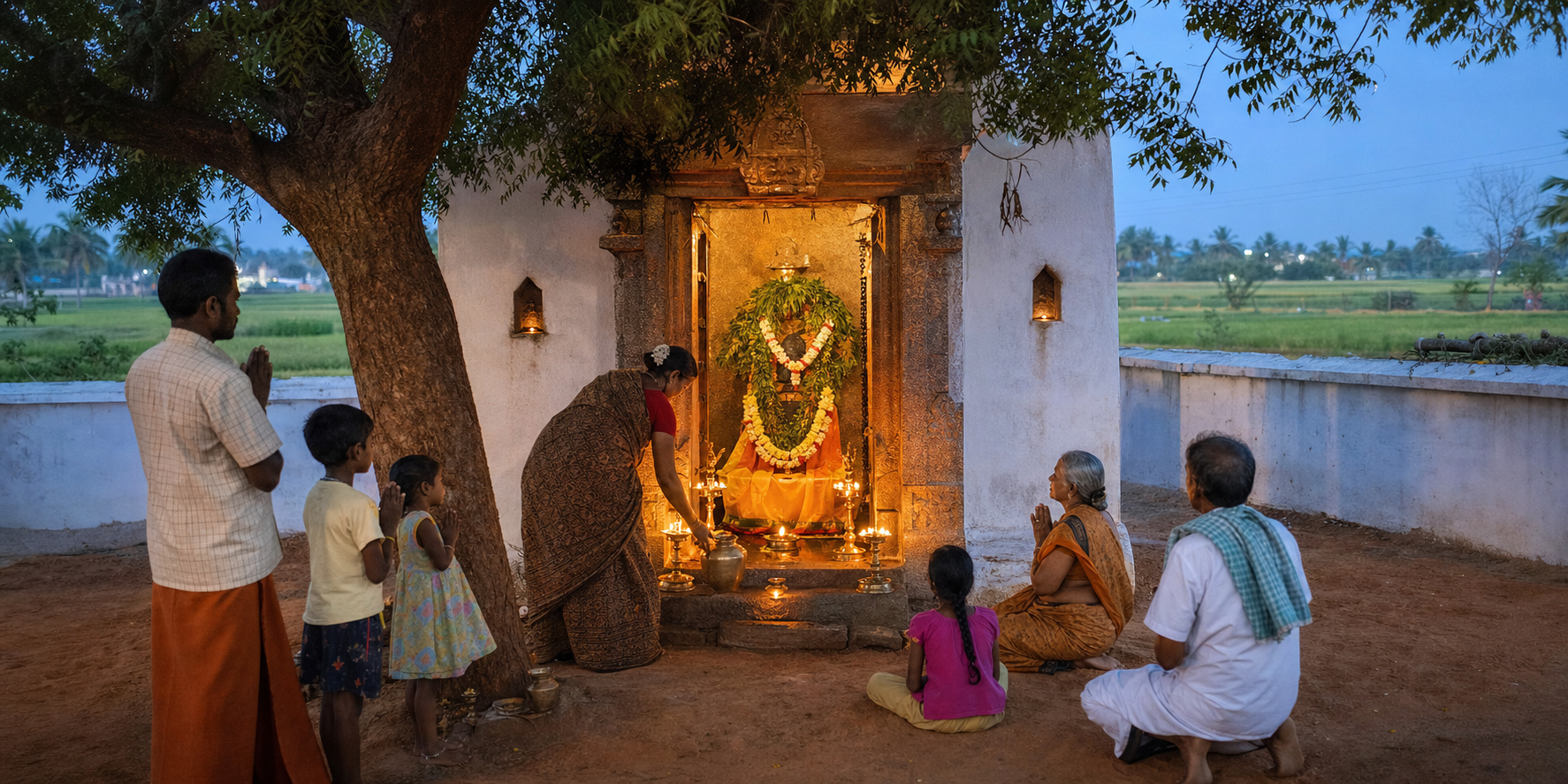
Amman worship is not one uniform practice but a family of South Indian traditions centered on the Divine Mother. In the supplied account, which focuses chiefly on Tamil Nadu, intimate appeals for health, rain and protection coexist with a wider theology of Shakti as the power that sustains creation and confronts disorder.
Understanding this tradition therefore requires more than cataloguing goddess names or rituals. Its deeper significance emerges from the connections among sacred place, bodily vulnerability, ecological balance, collective memory and the many ways a local mother can also be recognized as cosmic Devi.
One Mother across several scales of meaning
The DharmaRenaissance article explains that Amman means “mother,” but presents the title as more than an expression of affection. The goddess is approached as a protective and active presence who receives vows, guards communities, assists devotees in periods of distress and embodies Shakti. This allows worshippers to address immediate concerns without separating them from a larger sacred order.
This movement between the intimate and the cosmic is central to the tradition. A devotee may seek help with illness, childbirth, fear, family harmony or rainfall, while understanding the same goddess as a form of Parvati, Durga, Kali, Lakshmi, Saraswati or Adi Shakti. The local identity is not necessarily displaced by the pan-Hindu one. Instead, each supplies a different scale through which divine power can be understood.
The source consequently resists a rigid division between “folk” and “classical” Hinduism. It reports that worshippers may combine Tamil songs, Sanskrit mantras, village vows, priest-led temple rites and identification of the local deity with Durga or Parvati. From this perspective, layered practice is not inconsistency. It is a religious method that permits theology, inherited custom and local experience to inhabit the same devotional world.
Sacred geography turns vulnerable places into protection
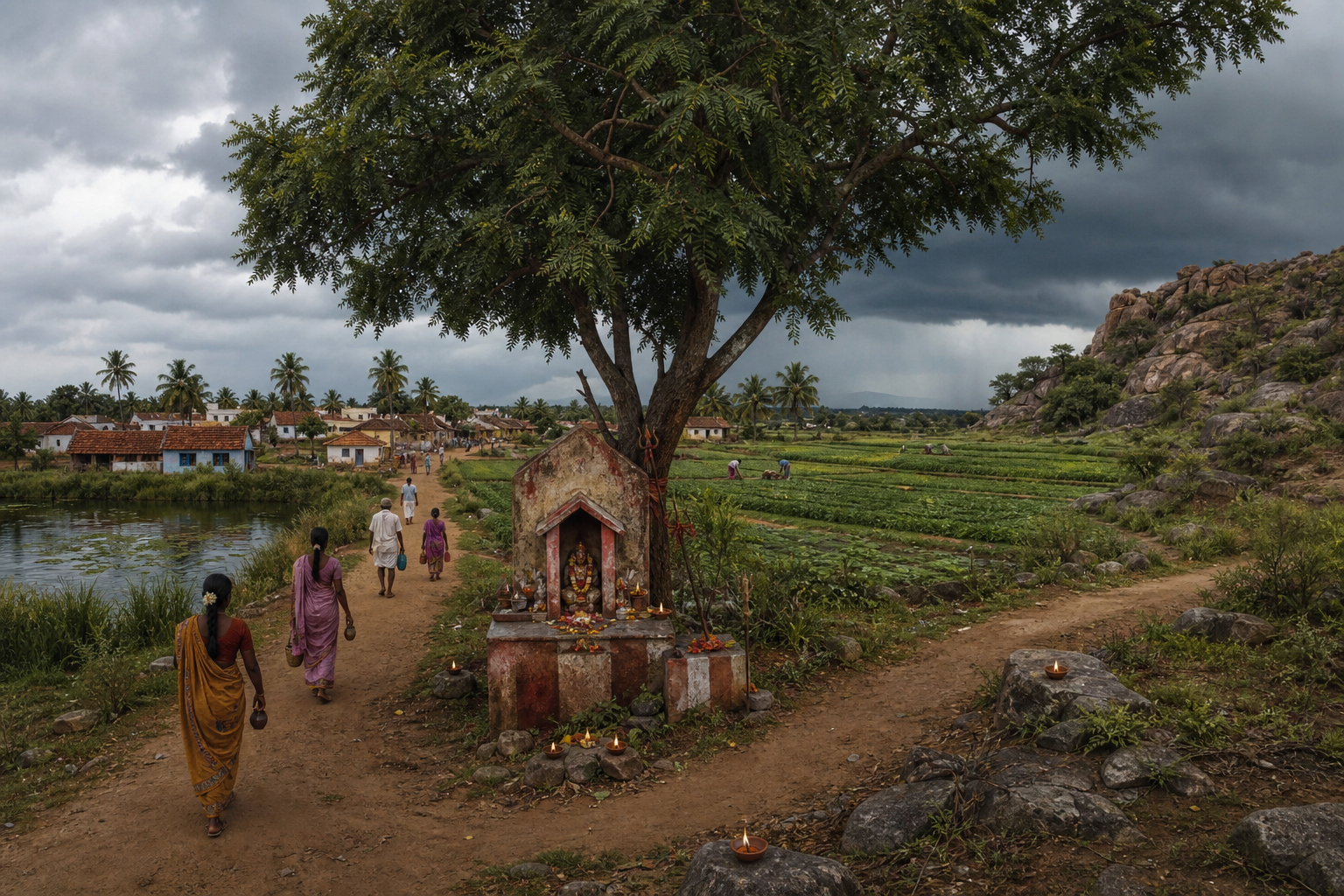
According to the source, many Amman shrines appear to have developed from protective traditions associated with villages, cultivated land, water, fertility, epidemics and communal safety. Sacred presence could be located at a grove, anthill, neem tree, riverbank, cremation ground or settlement boundary. These settings show that religious importance cannot be measured solely by architectural scale.
A modest shrine can carry considerable authority when generations associate it with vows, remembered protection, healing or an annual festival. The community’s memory becomes part of the shrine’s sacred standing. Place, narrative and repeated ritual reinforce one another: the location recalls earlier encounters with the goddess, while each new act of worship renews that relationship.
Ellaiamman makes this spatial logic especially clear. The article describes her as a boundary goddess whose shrine may stand near a village entrance or where settled land meets less controlled space. Her position conveys an important theological idea: protection is needed most at points of exposure and transition. The Mother therefore occupies the edge as guardian rather than remaining confined to a ceremonial center.
Healing rituals use a language of heat and cooling
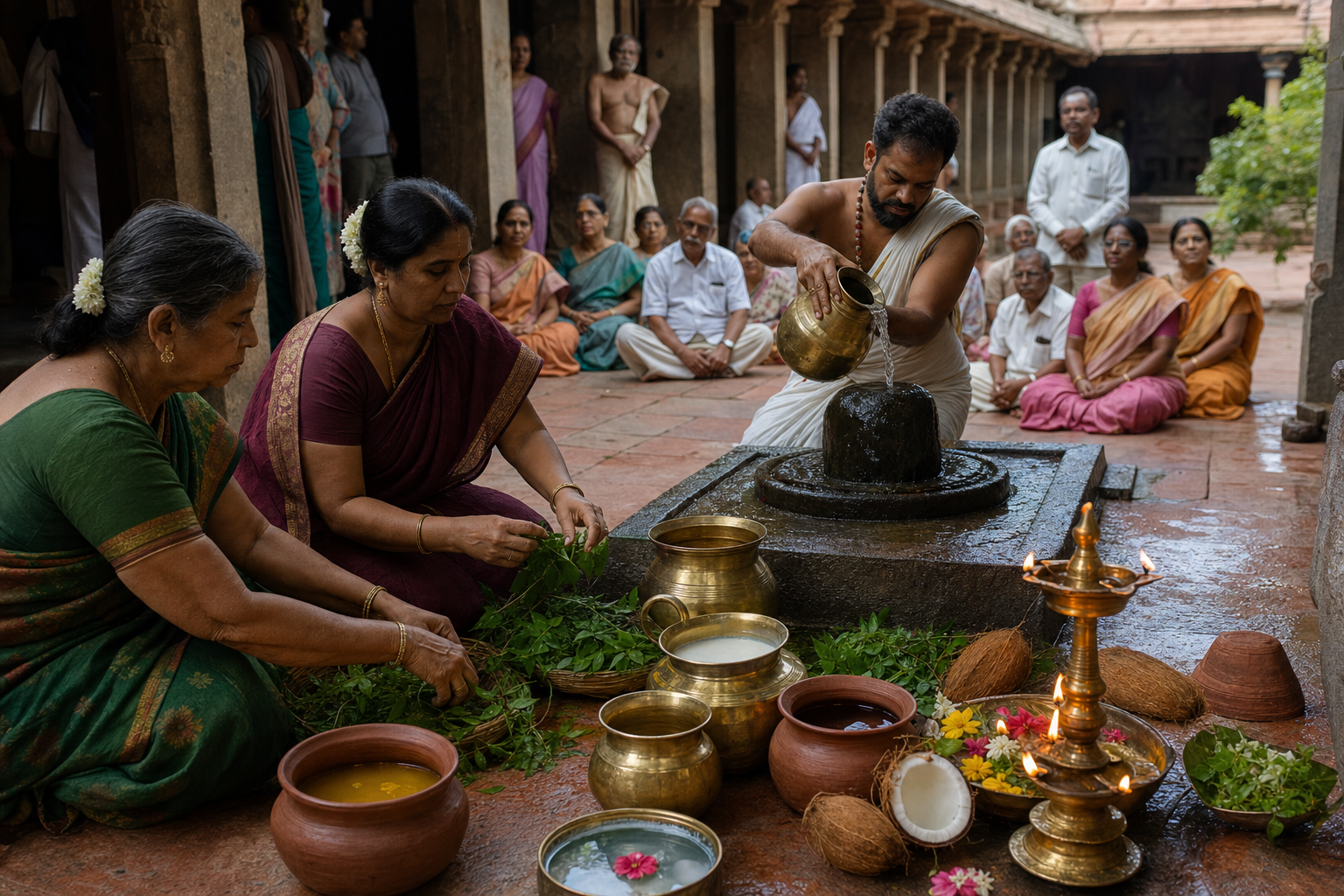
Mariamman worship brings the connections among body, environment and sacred order into focus. The source associates her with rain, heat, fever, smallpox, pox-like illnesses and protection during epidemics. Within the religious framework described, sickness is not treated only as an isolated bodily condition; it can also represent disturbance in the relationships joining person, community, nature and divine power.
The contrast between heat and cooling organizes this ritual response. Heat can signify fever, drought, anger, social tension or the fierce energy of the goddess. Offerings such as turmeric water, neem leaves, sandal paste, curd, tender coconut and pongal express cooling, purification and restored balance. Their meaning is relational: devotees respond to an overheated or unsettled condition by enacting a movement toward composure and harmony.
The article gives neem and turmeric particular prominence. Neem is ritually associated with purification, protection and medicinal strength, while turmeric signifies auspiciousness, fertility and healing. These are reported religious associations, not evidence that ritual observance substitutes for clinical treatment. The cultural importance lies in how familiar plants and substances connect household life, local ecology, the body and Shakti within a shared symbolic vocabulary.
Distinct goddesses reveal a connected religious field
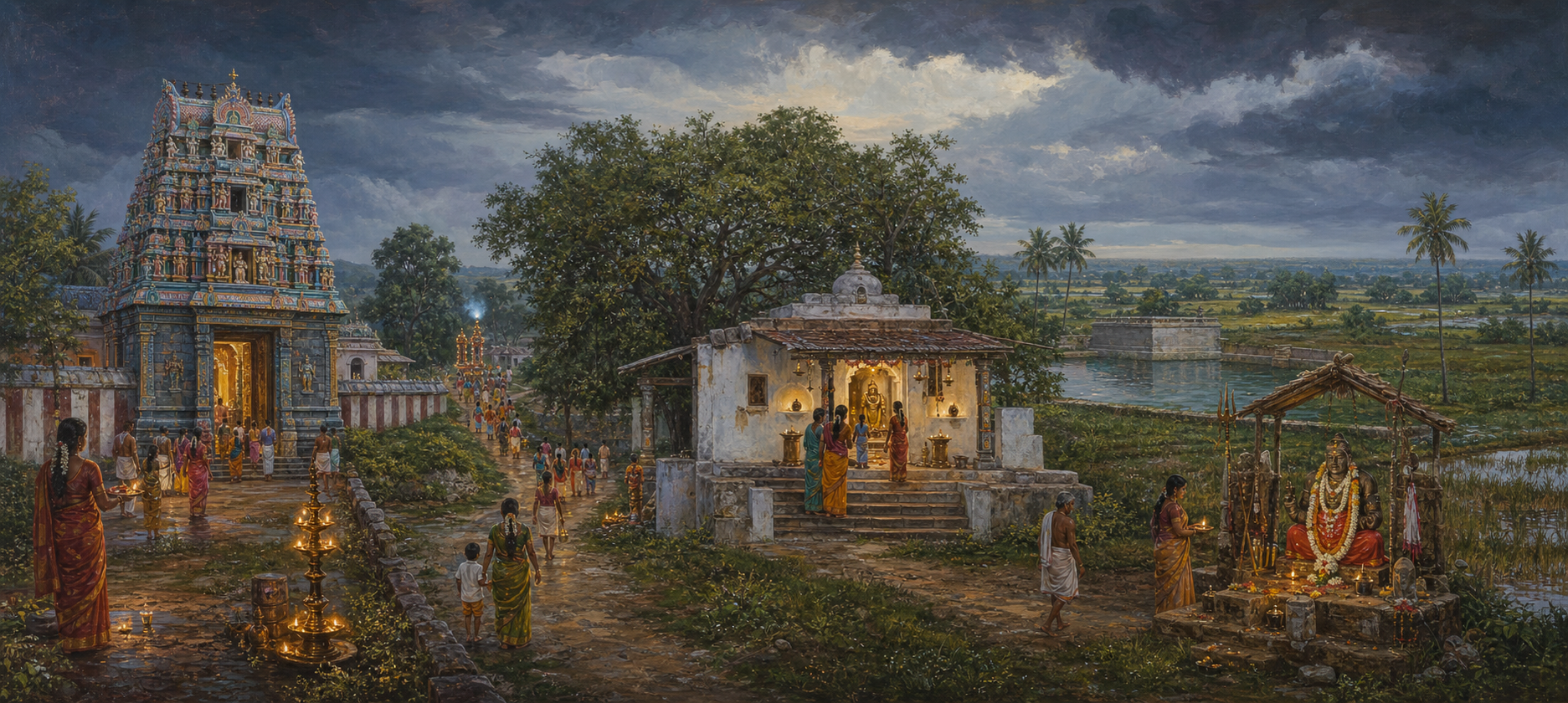
The names attached to Amman worship do not merely label interchangeable figures. In the source, each form brings a particular concern into view while remaining connected to the wider reality of Devi.
| Form described in the source | Religious emphasis | What the emphasis reveals |
|---|---|---|
| Mariamman | Rain, fever, epidemic protection and cooling | Human health is interpreted in relation to environment and sacred balance. |
| Ellaiamman | Settlement boundaries and liminal spaces | Divine guardianship is placed where the community is most exposed. |
| Kaliamman and Angalamman | Fierce confrontation with destructive forces | Maternal compassion can require force when gentleness cannot restore order. |
| Draupadi Amman | Epic memory, suffering, courage, vows and fire-walking | The Mahabharata becomes embodied communal practice rather than remaining only a literary text. |
| Meenakshi Amman | Royal authority, urban temple life, Shaiva theology and classical iconography | A distinctly local goddess can also become the center of a major artistic and theological tradition. |
Annual festivals draw these dimensions together. The article reports that the goddess may be decorated, praised, carried in procession and approached through vows, while streets and households become participants in sacred time. In Draupadi Amman traditions, epic recitation, dramatic performance and fire-walking can make remembered narrative physically and morally present. Festival is thus not an ornament added to belief; it is one of the principal ways belief becomes public, embodied and intergenerational.
This also explains why fierce imagery should not automatically be read as cruelty. As the source interprets Kaliamman and Angalamman, fierceness represents the capacity to resist ego, injustice and destructive disorder. Meenakshi presents another form of strength: sovereign, martial, marital and cosmic at once. Together, these manifestations broaden the meaning of motherhood beyond nurture alone.
Key takeaways
- Amman worship connects practical needs such as protection, health and rainfall with the encompassing theology of Shakti.
- Shrines at trees, roads, boundaries and other local sites show how geography and communal memory can establish sacred authority.
- Cooling offerings belong to a ritual grammar in which bodily distress, ecological conditions and social balance are interpreted together.
- Mariamman, Ellaiamman, Kaliamman, Angalamman, Draupadi Amman and Meenakshi Amman emphasize different functions without forming isolated religious systems.
- Temple rites, village vows, Tamil performance and pan-Hindu goddess theology can coexist within the same devotional life.
Future study will be most illuminating when it records how worshipping communities themselves explain these overlaps, especially where inherited memory, local ecology and formal temple practice meet. Such attention can preserve the tradition’s complexity without reducing living devotion either to folklore alone or to abstract theology.
References
The supplied source packet contained one article. Source-specific claims in this synthesis therefore reflect that account and should not be read as independently corroborated across publications.