
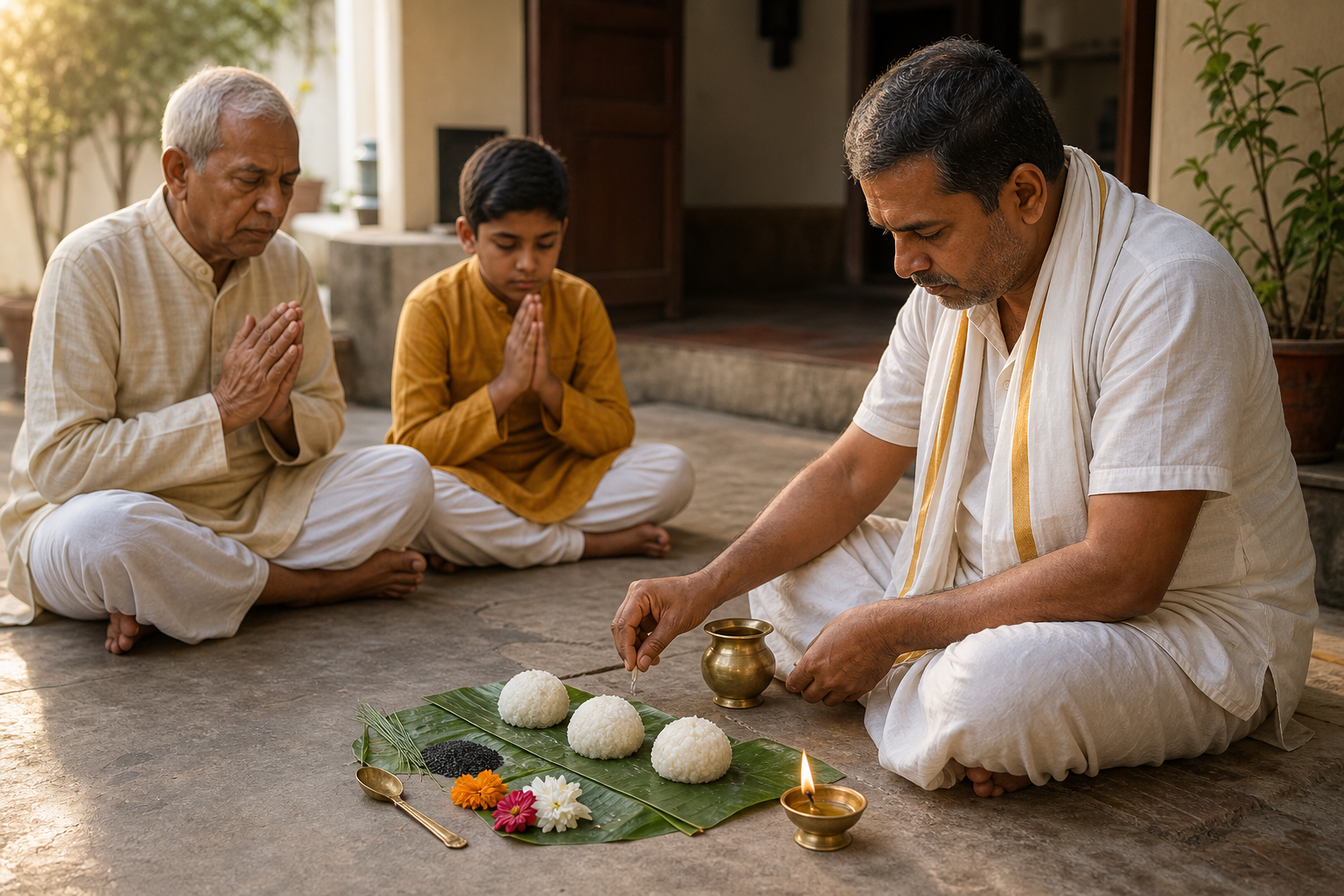
If you have reached Pitru Paksha with several relatives giving you different instructions, do not begin by choosing the most confident voice. First decide what you are trying to observe: a lineage-specific rite for a departed relative, your household’s customary observance during Pitru Paksha, or a personal act of remembrance. These can support one another, but they are not interchangeable.
That distinction gives you a practical way forward even when elders disagree, records are incomplete, or you live far from the place where your family traditionally performed Shraddha. Preserve what is known, obtain guidance for what must be exact, and do not pretend that an improvised observance is a complete ritual when it is not.
Know which observance you are actually choosing
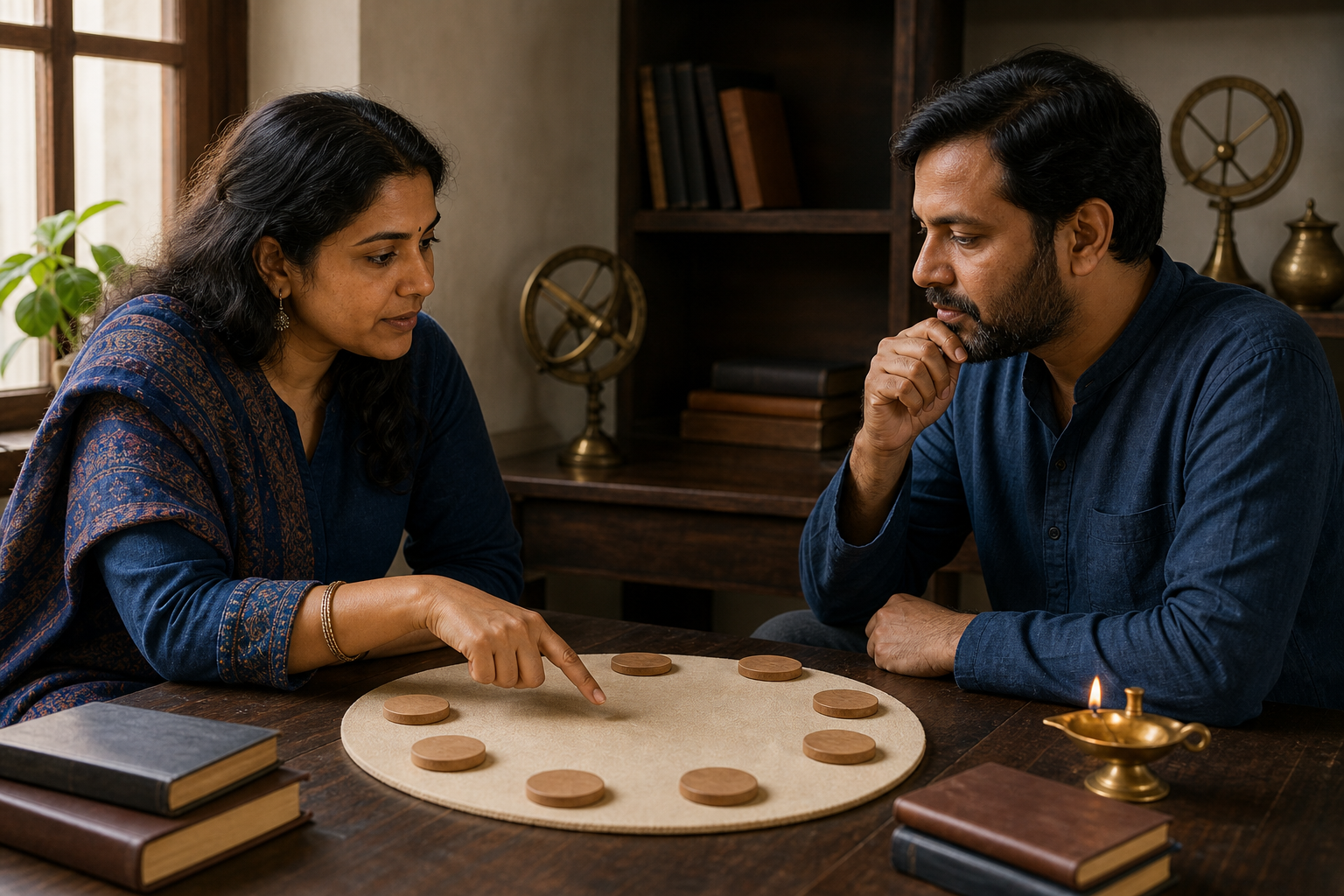
Ancestor veneration is the broadest idea. It includes remembering those from whom you descend, expressing gratitude, preserving their names and stories, and accepting that the living inherit duties as well as benefits from earlier generations.
Shraddha is more specific. It is not merely thinking fondly about someone who has died. It belongs to a ritual and family context, with details that can vary by region, sampradaya, lineage, and household tradition. The person who performs it, the lunar timing, the mantras, the offerings, and the sequence should therefore not be assembled from unrelated internet instructions.
Pitru Paksha is the period set apart for duties toward the departed ancestors. Its concluding Amavasya is known as Mahalaya Amavasya or Pitru Amavasya and is the final day of the fortnight dedicated to Shraddha. It provides a widely recognized focus for ancestral observance, especially when a family is gathering its responsibilities during the Paksha.
The annual fortnight is not the only possible rhythm. Some traditions maintain monthly Shraddha, and Amavasya and the eighth lunar day in the darker half of the month are identified as especially suitable occasions. Treat that as evidence of an ongoing discipline, not as permission to replace your family’s calendar with a generic schedule.
- Choose Shraddha when you intend to perform the prescribed rite according to your family or lineage.
- Choose a Pitru Paksha observance when you are marking the ancestral fortnight but still need to determine the exact family procedure.
- Choose personal remembrance when circumstances prevent the full rite. Keep it sincere, but name it honestly rather than claiming ritual completeness.
- Ask about monthly observance only after establishing whether it belongs to your inherited practice and how it should be performed.
Build the observance from family tradition outward
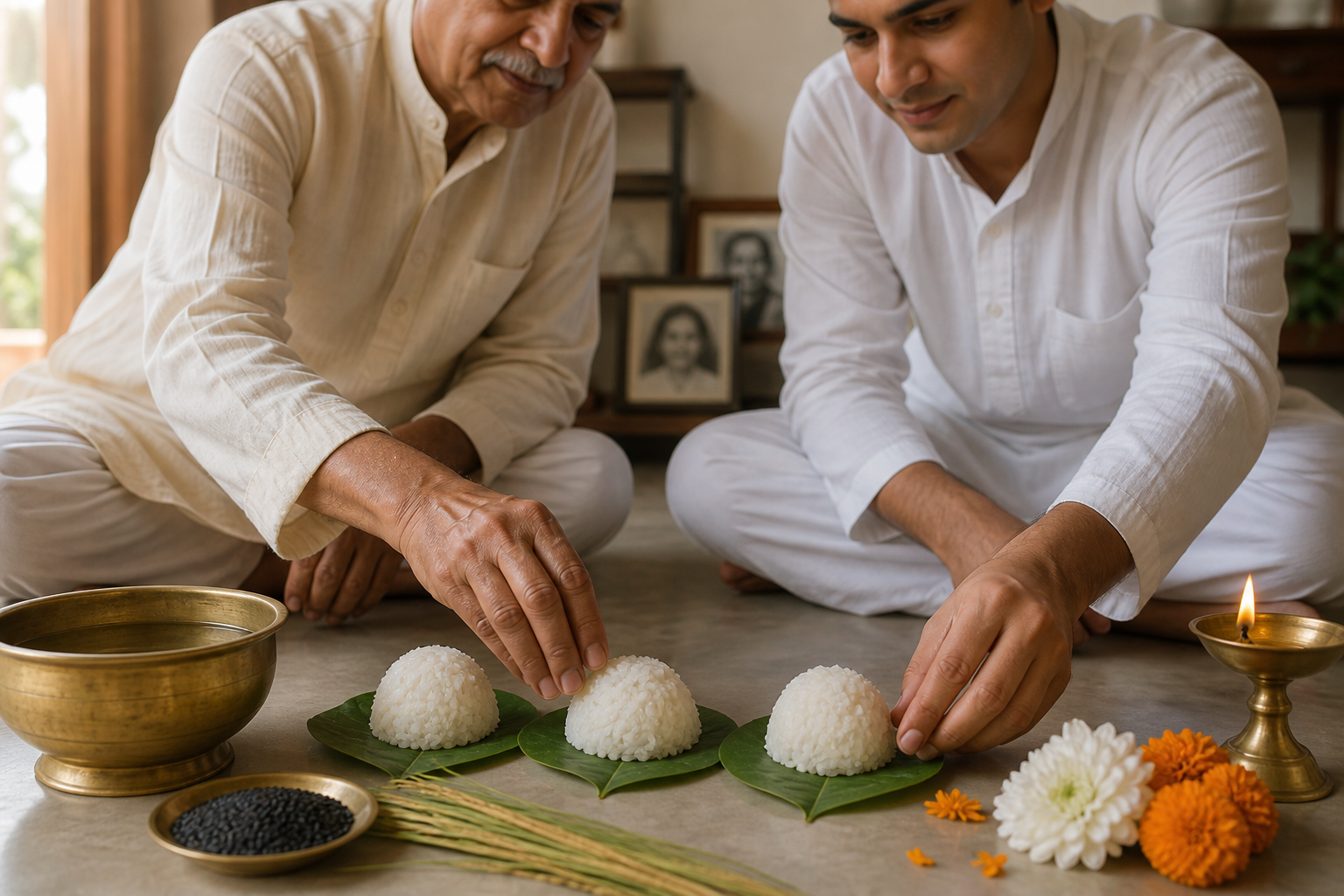
Your first reliable authority is usually the living chain of practice: relatives who have participated, a family priest, the priest connected with the ancestral place, or a teacher who understands your sampradaya. An elder’s memory may be incomplete, but it can still identify which tradition you need to recover.
- Name the purpose. Decide whether this is the regular annual rite for a particular ancestor, an observance during Pitru Paksha, the concluding Amavasya observance, or a monthly practice. Do not ask a priest simply, “What should we do?” without saying which of these you mean.
- Collect what your household knows. Write down the ancestors’ names, their relationships to the expected performer, the family’s place of origin, the sampradaya or community practice if known, and the lunar tithi associated with each death if the family preserved it. Mark uncertain information as uncertain.
- Identify the calendar tradition. A civil date and a lunar tithi are not the same thing. The observance may also appear differently in regional calendars, so confirm the panchanga and location being used before relatives book travel or prepare food.
- Take precise questions to one qualified guide. Ask who should perform the rite, which tithi applies, what preparatory rules are followed, which materials are required, which portions require a priest, what substitutions are accepted when the family is abroad, and how the offerings should be handled afterward.
- Record the answer for the next generation. Keep the confirmed procedure, contact details, calendar convention, names, and unresolved questions together. A short family record prevents the same uncertainty from returning after the elder who currently remembers the practice is gone.
If relatives disagree, separate memory from authority. One person may remember what was cooked, another may remember the date, and a third may remember who performed the rite. Record all three accounts, then ask a guide familiar with that family’s tradition to resolve the ritual question. Volume and seniority alone do not turn a recollection into a complete procedure.
Mahalaya Amavasya can give a family a clear point around which to gather when other information is missing. It should not become a blank cheque for inventing the rest. Confirm whether your household treats that day as its principal Paksha observance, a concluding observance in addition to another tithi, or something else.
Keep the ritual precise when circumstances are imperfect
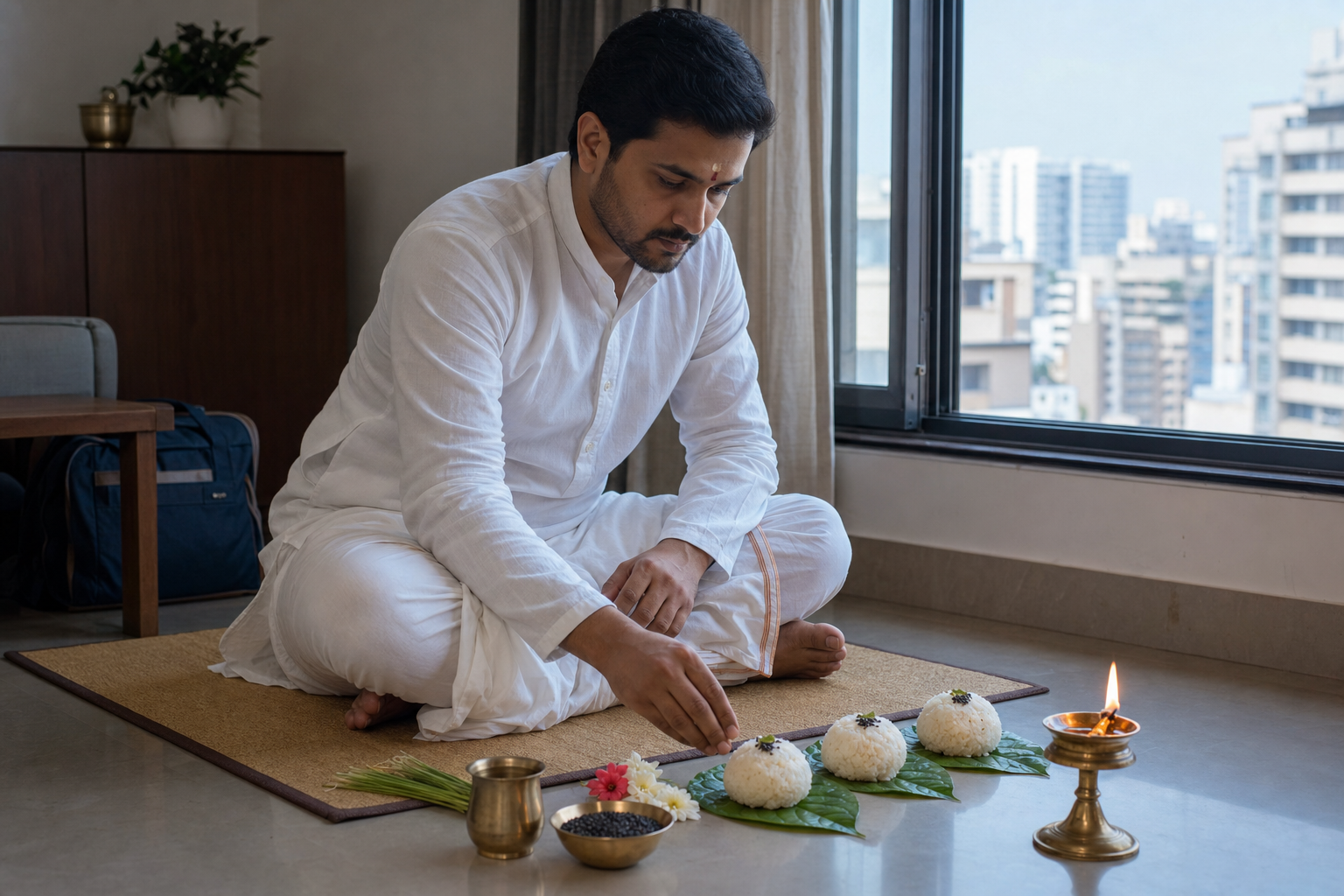
Distance, work schedules, migration, and the loss of knowledgeable elders can make a complete observance difficult. The wrong response is to manufacture certainty. A modest observance whose limits you understand is more honest than combining fragments from several traditions and presenting the result as your ancestral rite.
Use a simple order of priority. Preserve a known family practice. Where a necessary detail is missing, seek instruction from someone competent in that practice. Where the full rite genuinely cannot be performed, mark the day with prayerful remembrance and whatever acts your tradition permits, while acknowledging what remains incomplete. Then ask how the prescribed rite can be resumed on an appropriate occasion.
Before the day, confirm these matters rather than guessing:
- The correct lunar day and the panchanga used for your location.
- The person expected or permitted to perform each part of the observance.
- The names and relationships included in the sankalpa or remembrance.
- The required materials, food rules, mantras, and sequence in your tradition.
- Which actions require an officiating priest and which belong to the household.
- What may be adapted when participants live abroad, cannot travel, or cannot obtain a traditional item.
- What should be done with offerings after the rite.
Do not assume that devotion makes technique irrelevant. Shraddha itself places devotion at the center, but a rite can still have a received form. Intention tells you why you are acting; tradition tells you how that intention is given disciplined expression. You need not choose between the two.
You also do not need to make fear the engine of observance. Do not tell a bereaved relative that continuing sorrow, illness, or family difficulty proves that Shraddha was performed incorrectly. Ritual duty should not be used to blame the vulnerable or to turn grief into a market for escalating remedies. If grief is seriously disrupting a person’s safety or daily functioning, appropriate professional care can accompany religious life; Shraddha should not be burdened with replacing that care.
Let ancestral remembrance change conduct among the living
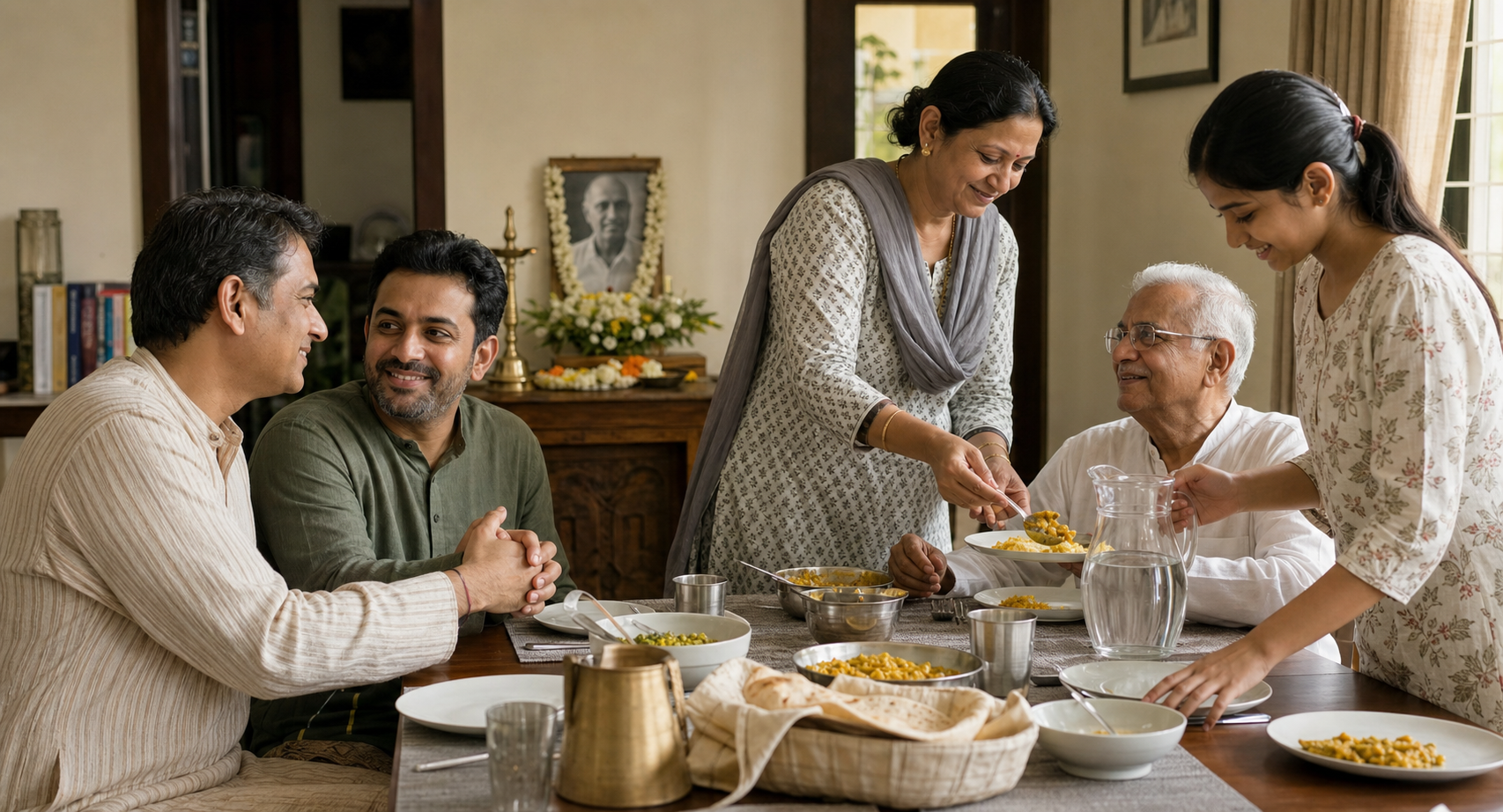
The sacred horizon of Shraddha is larger than a private memorial. A traditional account describes a devoted observance as benefiting or pleasing a vast web that includes human, divine, ancestral, sage, bird, animal, and other forms of life. Whether you are preparing an elaborate rite or a restrained household observance, notice the underlying vision: the departed are remembered within an ordered world of relationships, not as isolated individuals.
That vision gives you a test for sincerity. If the ritual calendar is carefully kept but elderly relatives are neglected, family knowledge is allowed to disappear, food is wasted for display, or siblings use the occasion to compete for status, the household has preserved form while weakening relationship. Correct that failure among the living without claiming that good conduct makes the rite unnecessary.
- Speak the names. Make sure younger family members know whom the household is remembering and how each person belongs in the family line.
- Preserve one concrete memory. Record a language, place, vocation, devotional practice, migration, sacrifice, or family duty associated with each remembered ancestor. Distinguish verified memory from family legend.
- Repair one neglected responsibility. Contact an isolated elder, settle a manageable family obligation, preserve a threatened family record, or assist a dependent relative. Choose something real enough to finish.
- Include children without frightening them. Explain that gratitude reaches backward as well as forward. Give them an age-appropriate role in remembering names, preparing the space, or listening to family history, according to household practice.
- Keep associated giving dignified. If feeding or charity forms part of your tradition, plan it around the recipient’s need and the prescribed observance. Do not turn the act into advertising for the donor.
Ancestor veneration also requires moral clarity. Respect does not require you to declare every ancestral action righteous or to conceal harm. You can honour the life through which your own life arrived, preserve what was worthy, and refuse to transmit what was adharmic. Continuity is not passive repetition; it includes responsible correction.
Key takeaways
- Shraddha is a specific ritual duty; Pitru Paksha is the ancestral fortnight; Mahalaya or Pitru Amavasya is its concluding day; personal remembrance is broader than all three.
- Begin with your family’s inherited practice, then use a priest or teacher familiar with that tradition to resolve missing details.
- Confirm the lunar tithi, regional calendar, location, performer, materials, and sequence before making logistical plans.
- Do not copy a universal recipe from several unrelated traditions. If the full rite is impossible, observe modestly and describe honestly what you have done.
- Monthly observance exists in some traditions, but its timing and procedure should be confirmed rather than assumed.
- Let remembrance produce a visible duty among the living: preserve names, teach children, care for elders, or repair a neglected family obligation.
Before the next observance, create one family note titled “Shraddha Practice.” Put the known names, relationships, tithis, calendar convention, family place, priest or teacher contact, and unresolved questions in it. Confirm one uncertain detail this year. That small act turns an anxious annual search into an inheritance your family can actually carry forward.
References
- Hindu Pad – Importance of Monthly Shraddha Rituals
- Hindu Pad – Mahalaya Amavasya – Pitru Amavasya during Shraddh Paksha
