
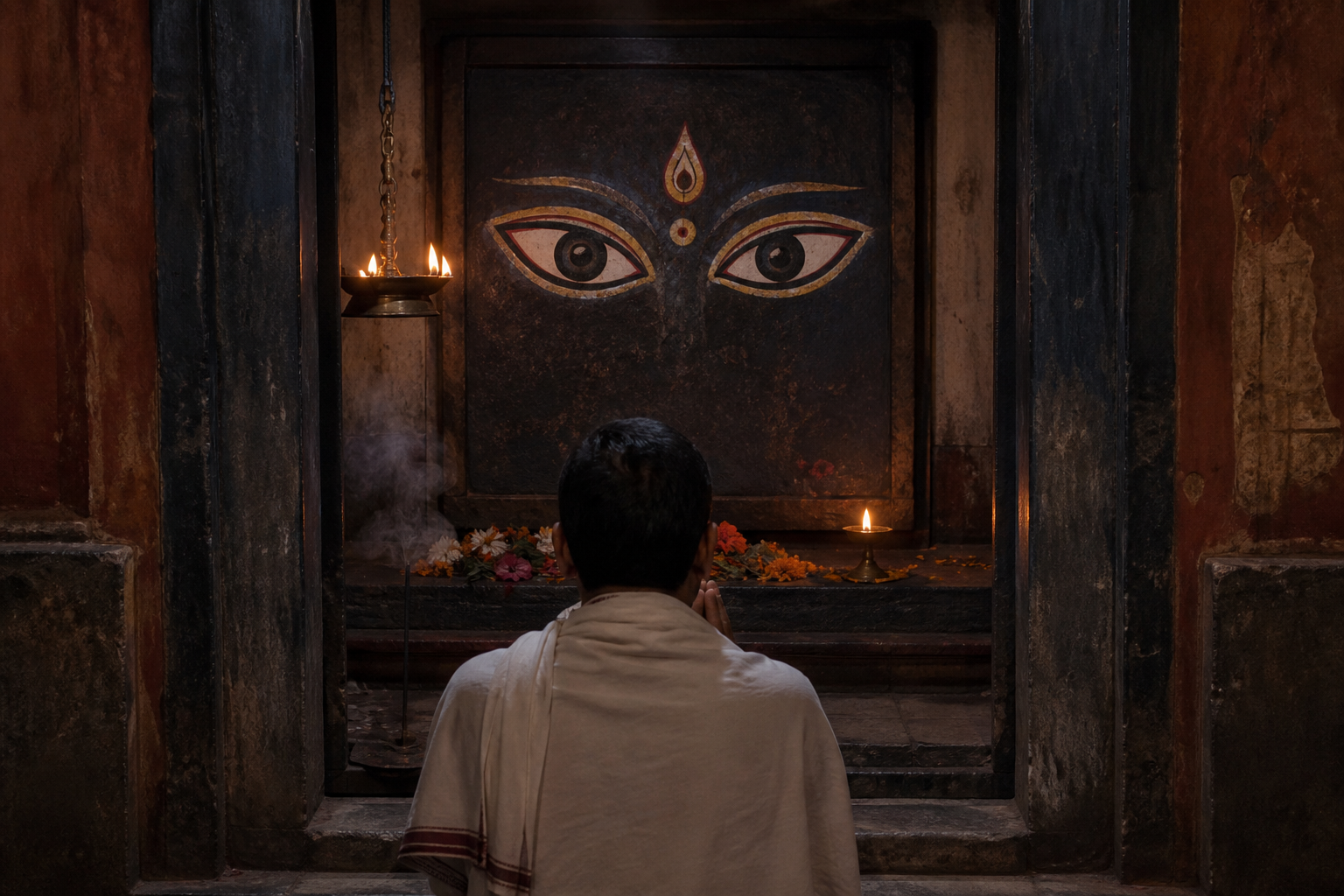
You stop before a pair of painted eyes. There is no sculpted face, no visible body, and perhaps no elaborate temple around them. Are you looking at decoration, a symbol, or the deity?
Artistic completeness cannot answer that question. In Hindu devotional life, the simplest form may become a complete meeting place with the divine. To understand what you are seeing, stop asking what the image lacks and notice the relationship taking place through it.
Darshan begins when seeing becomes reciprocal
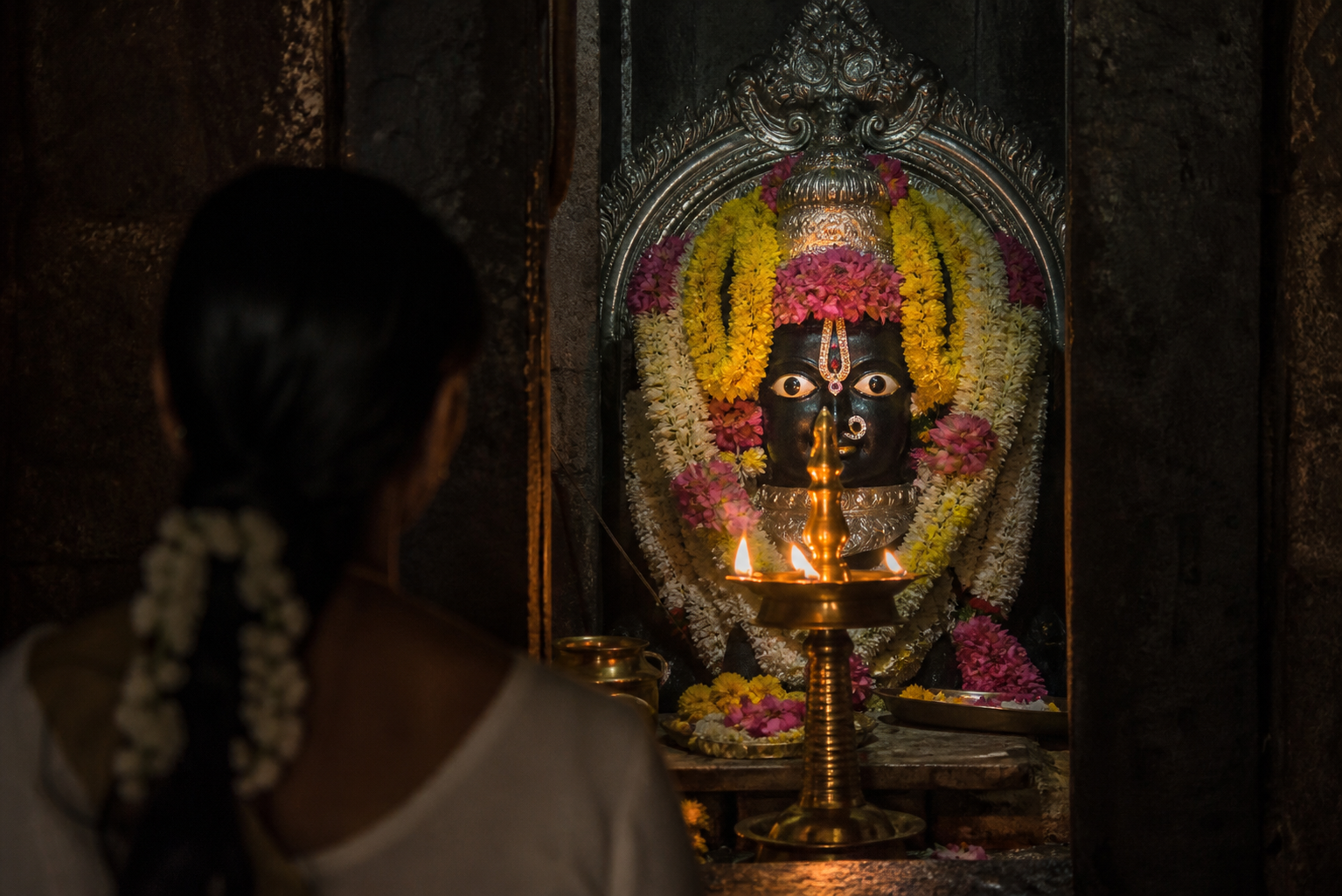
Darshan is often translated as seeing or beholding, but sacred seeing is not merely visual inspection. You approach to see the deity, and you also place yourself before the deity’s gaze. The encounter runs in both directions.
Eyes can carry this reciprocal quality without requiring the rest of a human-like figure. They establish direction, attention, recognition, and address. You know where to stand. You know where to turn your face. You can greet, pray, bow, or remain silent before a presence that appears to be looking back.
This is why divine presence may be encountered through a natural object, an earthen form, or something as visually spare as painted eyes. The material need not reproduce a complete body before it can support a complete devotional relationship.
The useful distinction is between anatomical completeness and relational completeness. Anatomically, two eyes are only a fragment. Relationally, they may be enough for a devotee to recognize someone present, offer attention, and understand prayer as received. The form has done what sacred form needs to do: it has made encounter possible.
Calling such eyes only a reminder can therefore miss the point. A reminder directs your thoughts toward someone absent. A form treated as divine presence is approached as someone present. That difference determines whether a person merely studies the image or enters into darshan.
A visible form does not imprison the formless
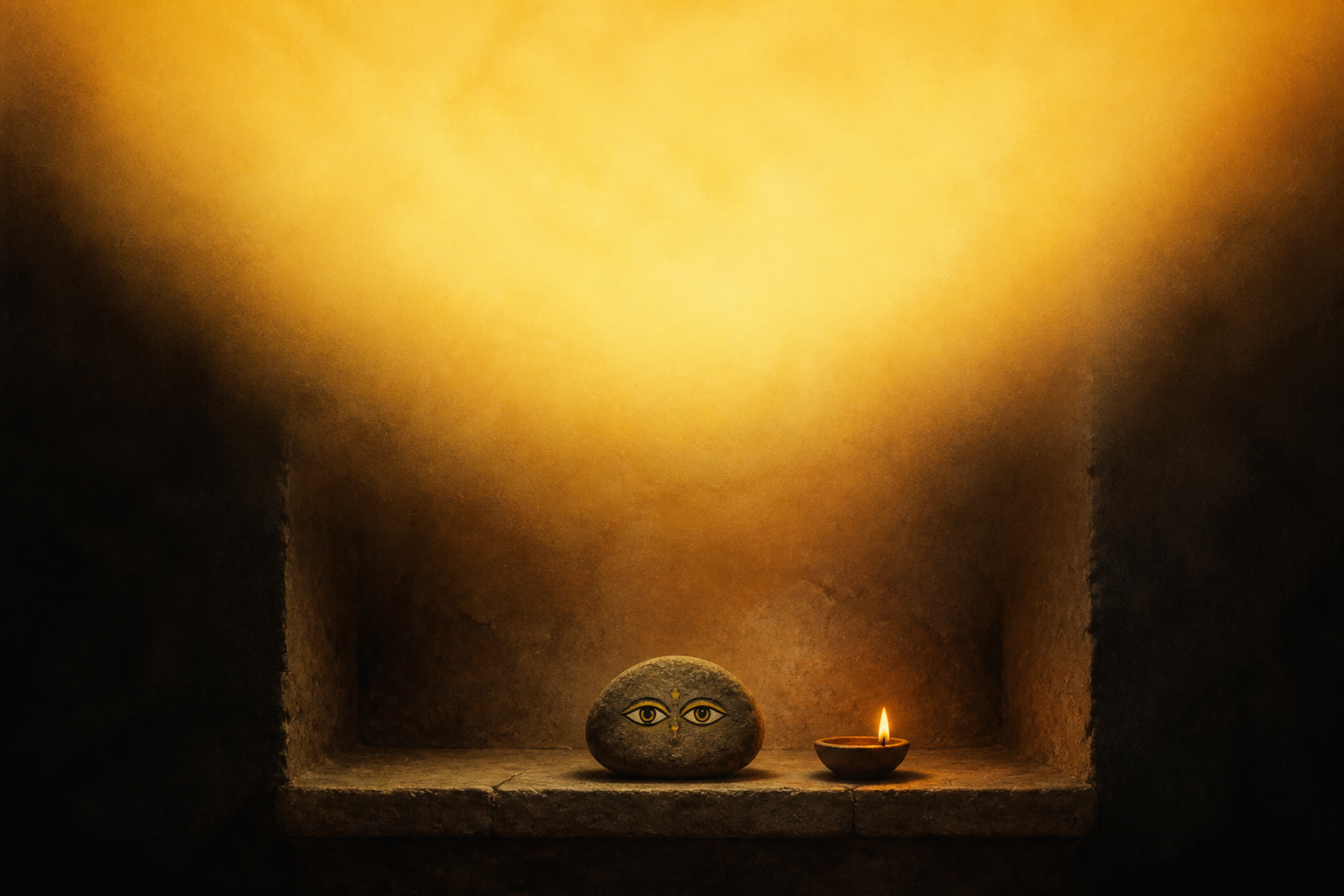
A common objection begins with a reasonable question: if the divine is limitless, how can it be contained in pigment, stone, wood, or earth? The difficulty comes from treating presence and confinement as the same thing.
A finite form gives you a definite place of approach. It does not follow that the divine has been reduced to that place, exhausted by that form, or cut off from every other manifestation. The eyes make presence accessible without pretending to measure its limits.
You also do not have to choose between saying that a wall is materially a wall and recognizing that it is no longer religiously neutral. The first statement concerns its physical substance. The second concerns the presence encountered through it. Devotional practice holds these levels together instead of forcing one to cancel the other.
This helps explain why simplicity does not imply spiritual inferiority. More elaborate sculpture can communicate posture, attributes, stories, and a deity’s distinctive identity. Sacred eyes do something more concentrated: they disclose awareness. Their power lies not in how much anatomy they depict but in how directly they establish the gaze.
There is an equally important limit to this principle. The claim that painted eyes can become a divine form does not mean that every eye motif is automatically a deity. Possibility is not automaticity. You learn how a particular form is understood by noticing the devotional life around it: whether it is named, greeted, tended, prayed before, or treated as a shrine. Those signs do not provide a mechanical formula for producing divinity. They tell you that the community relates to the form as sacred presence rather than casual art.
How to approach sacred eyes without misreading them
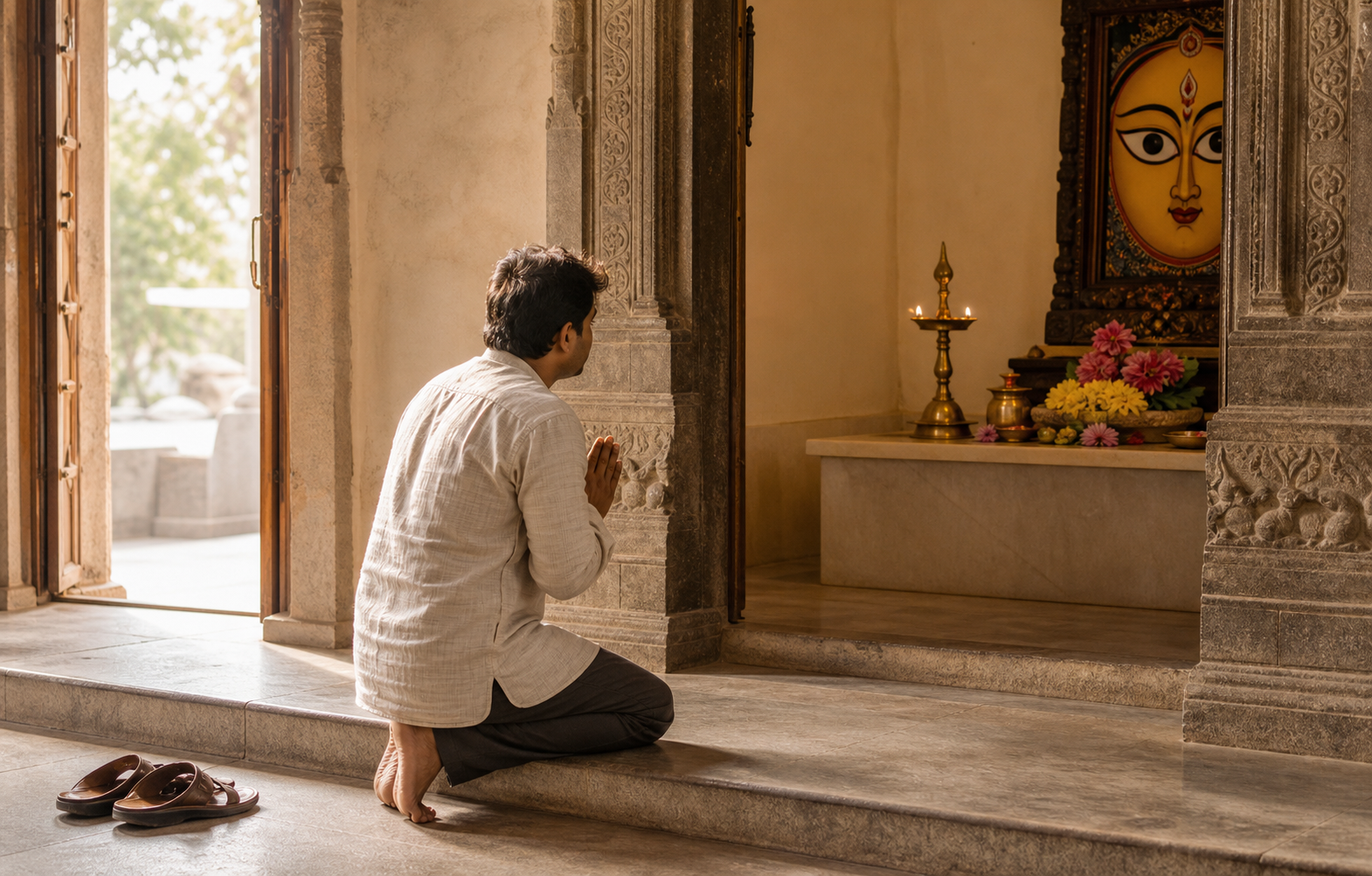
If you encounter sacred eyes in a temple, household, roadside shrine, or community space, you do not need to settle every theological question before behaving respectfully. Use the setting and the conduct of worshippers as your first guide.
- Pause before classifying the image. Do not assume that an apparently simple form is unfinished, decorative, or less sacred than a detailed murti. First observe how the space is being used.
- Look for a living relationship. Lamps, flowers, offerings, cleanliness, gestures of greeting, and people standing in prayer can show that the eyes belong to an active devotional setting. No single sign is decisive, but the pattern matters.
- Ask how to offer respect. If someone responsible for the space is available, ask, “How should I offer respect here?” That question is more useful than immediately asking what the eyes symbolize, because it allows the local tradition to describe the relationship in its own terms.
- Receive the gaze before analyzing the design. Stand quietly for a moment. Let your attention meet the eyes rather than scanning them as an art object. This small change helps you understand why darshan is an encounter and not simply an exercise in decoding imagery.
- Follow local conduct. Watch where people stand, whether they remove footwear, and how they greet the deity. Do not touch, reposition, or photograph a sacred form without permission. Reverence is expressed through restraint as much as through visible action.
- Distinguish home decor from devotional commitment. If you are considering sacred eyes for your own prayer space, do not ask only whether the image is visually sufficient. Ask whether you intend to relate to it consistently and reverently. Family and sampradaya practices differ, so guidance from a knowledgeable elder, teacher, or temple connected to your tradition is more reliable than a universal rule borrowed from elsewhere.
This approach protects you from two opposite errors. You neither declare every pair of eyes divine nor dismiss a form that worshippers receive as the living presence of the deity. You allow relationship, practice, and local understanding to tell you what kind of place you have entered.
Five mistakes that obscure the meaning of the gaze
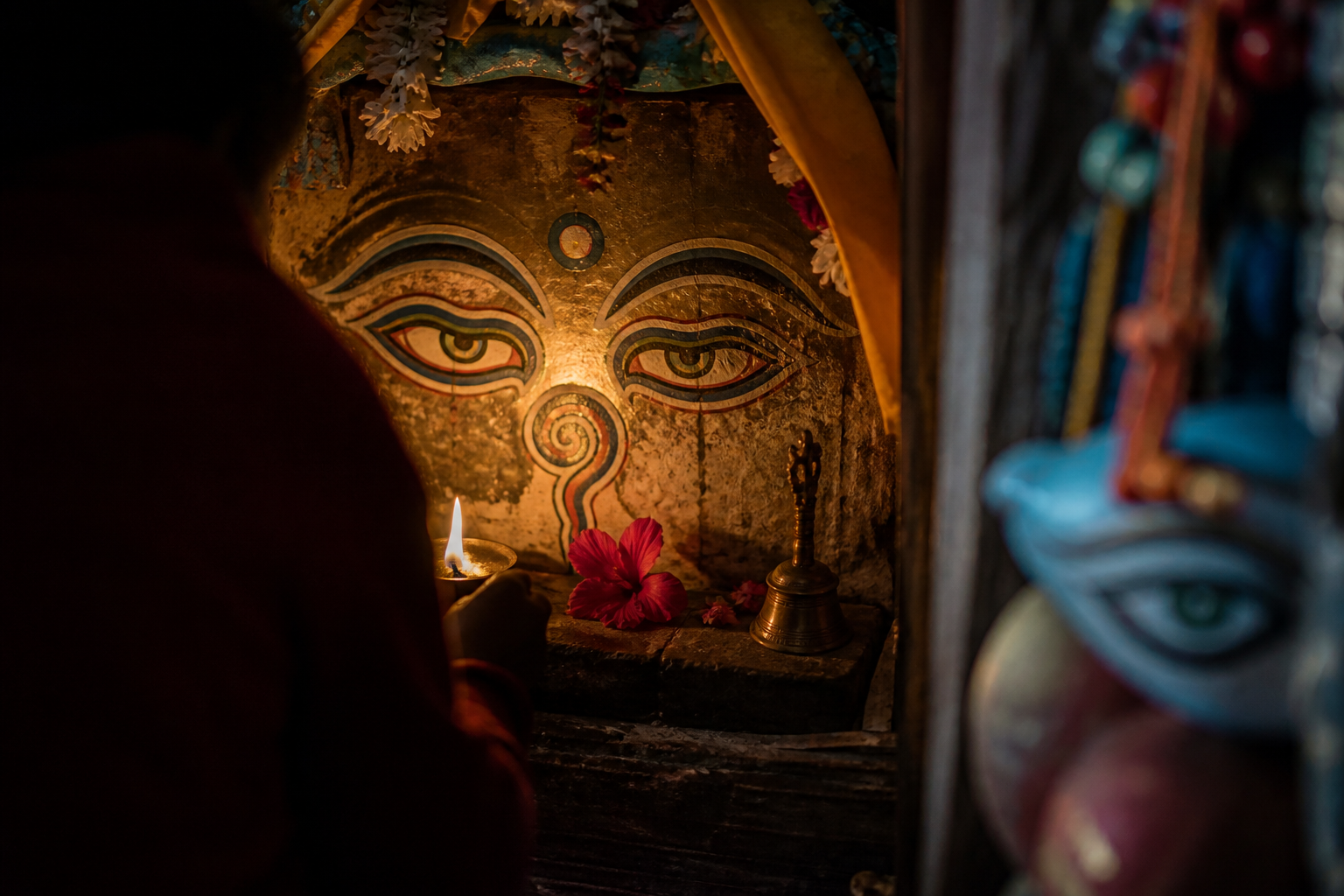
- Looking for the missing body. This assumes that sacred effectiveness depends on visual completeness. The eyes may already provide everything required for recognition and encounter.
- Reducing the form to mere symbolism. Symbols can certainly be sacred, but the word mere turns a living devotional relationship into an intellectual association. A worshipper may not be thinking about an absent deity; the worshipper may be addressing the deity as present.
- Assuming realism produces holiness. Greater artistic detail can communicate more iconographic information, but it does not necessarily create more presence. Craftsmanship and sacred status answer different questions.
- Treating every eye design as a shrine. Eyes on a wall, cloth, vehicle, or commercial object do not all have the same function. Read the setting, ask how the form is treated, and avoid making a religious claim from appearance alone.
- Demanding one explanation from all Hindus. Hindu traditions do not have to describe the relation between deity and form in identical philosophical language. Let a community state its own understanding rather than forcing every shrine into one theory.
These mistakes share one habit: they judge sacred form only by what an outside observer can see. Hindu worship asks you to notice what people do in the presence of the form and whom they understand themselves to be addressing.
Key takeaways
- Painted eyes can function as a complete divine form even when no body is depicted.
- Darshan is reciprocal: you behold the deity while standing before the deity’s gaze.
- A finite form makes the formless approachable without defining the full extent of the divine.
- Not every eye motif is sacred; devotional context and the community’s relationship to the form matter.
- The respectful first question is not “What is missing?” but “How is the divine being encountered here?”
The next time sacred eyes meet you, give the encounter a few unhurried seconds. Notice whether people greet the gaze, care for its place, and speak before it as presence. If you are uncertain, ask how to offer respect and let the local practice answer. When the relationship is whole, a missing body may not be missing at all.
References
