
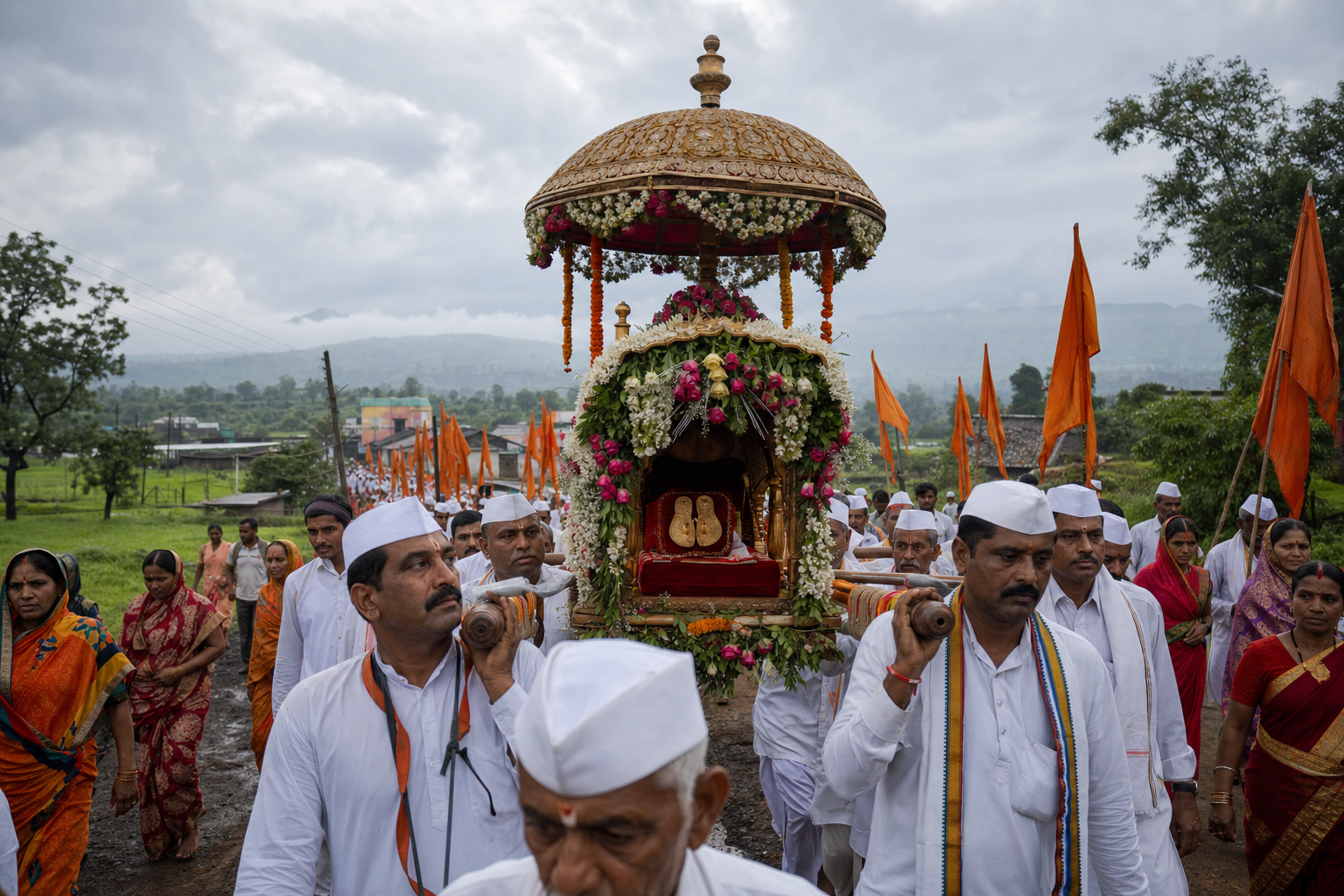
The Sant Nilobaraya Palkhi offers a focused way to understand the larger Ashadhi Wari: a pilgrimage in which remembrance of a saint, worship of Vithoba, community discipline and public service all move together. The supplied DharmaRenaissance report places this procession within the wider stream of Palkhis and Dindis travelling toward Pandharpur.
Its significance therefore extends beyond a route or annual timetable. The procession shows how the Varkari tradition turns roads into devotional spaces, organized groups into communities of mutual care, and practical preparations into support for a shared spiritual purpose.
Sant Nilobaraya’s place within the Ashadhi Wari
The supplied report describes Sant Nilobaraya Maharaj as a revered disciple of Jagadguru Sant Tukaram Maharaj and presents his Palkhi as one part of Maharashtra’s broader Ashadhi Wari. It reports that the journey proceeds from Ahilyanagar, historically known as Ahmednagar, toward Pandharpur, the devotional destination associated with Vithoba, also called Vitthal or Pandurang.
This relationship to Sant Tukaram gives the procession a particular lineage, but not an isolated identity. The same report notes that the Wari is associated especially with Sant Dnyaneshwar Maharaj and Sant Tukaram Maharaj while also encompassing many Palkhis and Dindis connected with other saints. The Nilobaraya procession is best understood as one current within that larger confluence: distinct in the memory it carries, yet oriented toward the same destination and devotional center.
The connection also helps explain why discipleship in this setting is more than biographical succession. The report links the tradition surrounding Tukaram and Nilobaraya with nama-smarana, kirtan, humility, compassion and resistance to spiritual pride. Carrying a saint’s memory forward consequently means carrying an ethical vocabulary into public life.
How a moving shrine becomes an organized community
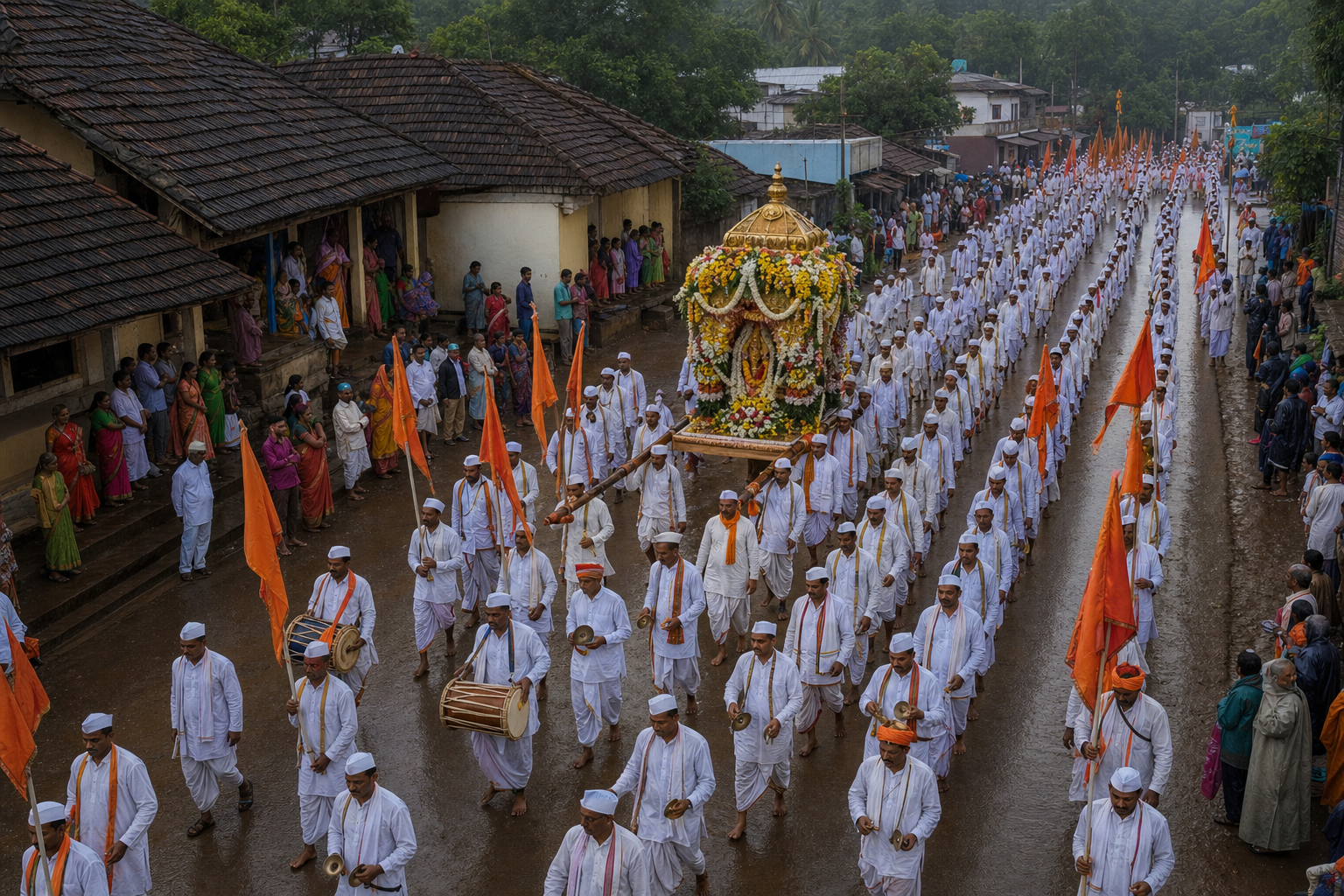
The report explains that a Palkhi ceremonially carries a saint’s paduka or other sacred symbols. Within Varkari devotion, it functions as a moving shrine and signifies that the saint’s remembered presence accompanies the pilgrims. Walking, singing and enduring difficult conditions are therefore not incidental features surrounding worship; they are part of its embodied form.
The Dindi supplies the procession’s working social structure. According to the source, a Dindi is an organized group of Varkaris with its own order, flag, devotional rhythm and service responsibilities. This arrangement gives the individual pilgrim a place within a smaller, disciplined unit, making shared food, mutual care and coordinated movement possible across a much larger gathering.
Key takeaways
- The Sant Nilobaraya Palkhi belongs to a network of saint-associated processions within the Ashadhi Wari.
- The Palkhi represents sacred presence in motion, rather than serving only as a ceremonial object.
- The Dindi system joins devotional practice with group discipline, mutual support and assigned responsibilities.
- A published schedule is a planning framework; participants still need confirmation from organizers and public authorities.
Why devotional movement depends on careful logistics
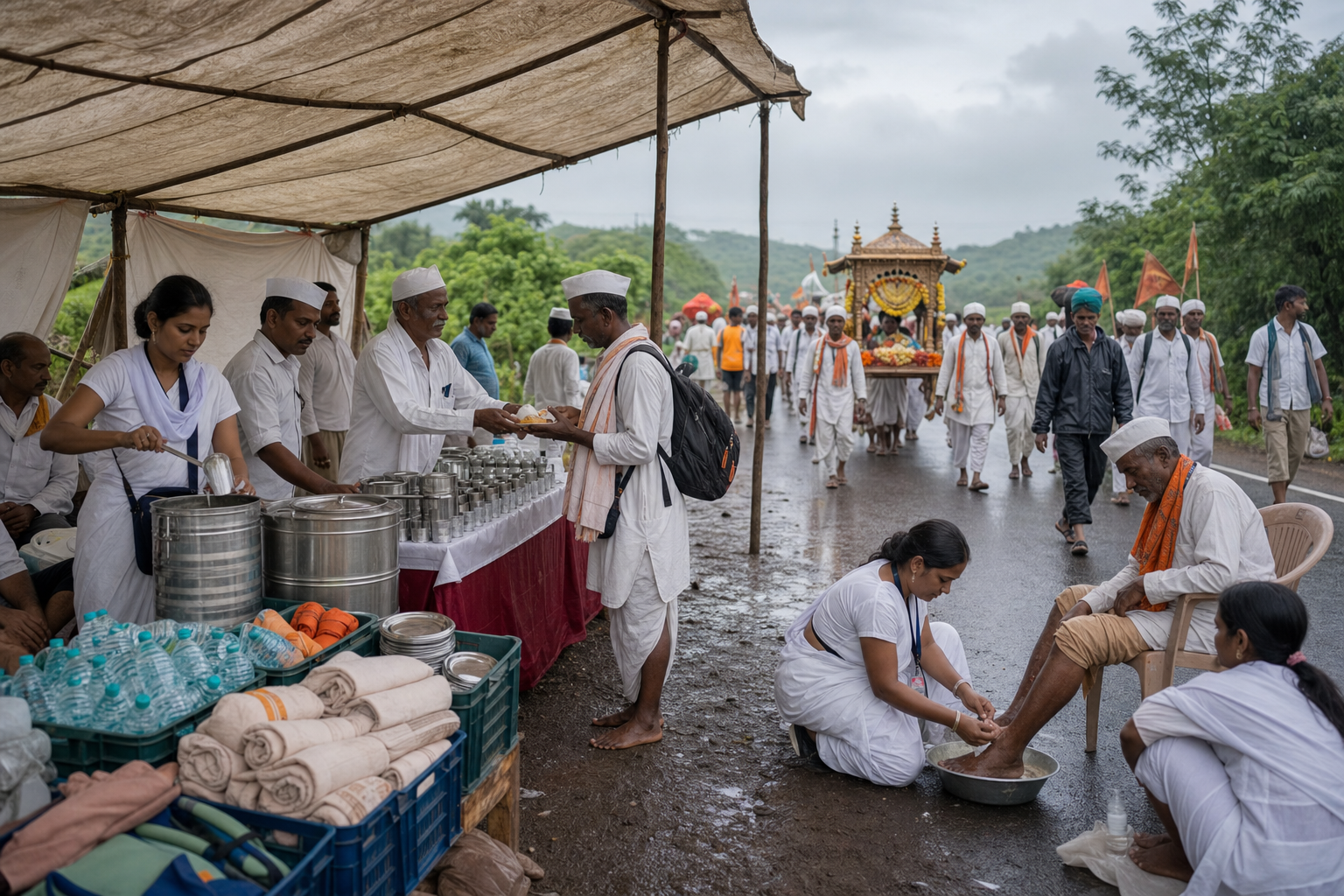
A pilgrimage may be remembered through chants, saffron flags, taal and mridang, but its safe passage depends upon extensive coordination. The supplied report identifies Palkhi trusts, police, health workers, municipal bodies, gram panchayats, transport departments, volunteers, residents and religious leaders among the participants in that supporting system.
It also connects route planning with halts, food arrangements, drinking water, sanitation, medical assistance, traffic management, security, lost-and-found support, waste handling and crowd dispersal. These tasks do not compete with the pilgrimage’s sacred character. They create the conditions in which elderly walkers, organized Dindis, local hosts and other participants can share the route responsibly.
The source treats the announced 2026 schedule as an essential framework but cautions devotees to confirm exact dates, stopping places and local arrangements through official Palkhi organizers or district-administration notices. It notes that daily movement can be affected by official coordination, route permissions, weather and crowd-flow requirements. Because the supplied material does not provide a complete day-by-day itinerary, it should not be used as a substitute for those operational notices.
Seva, memory and the cultural work of the procession
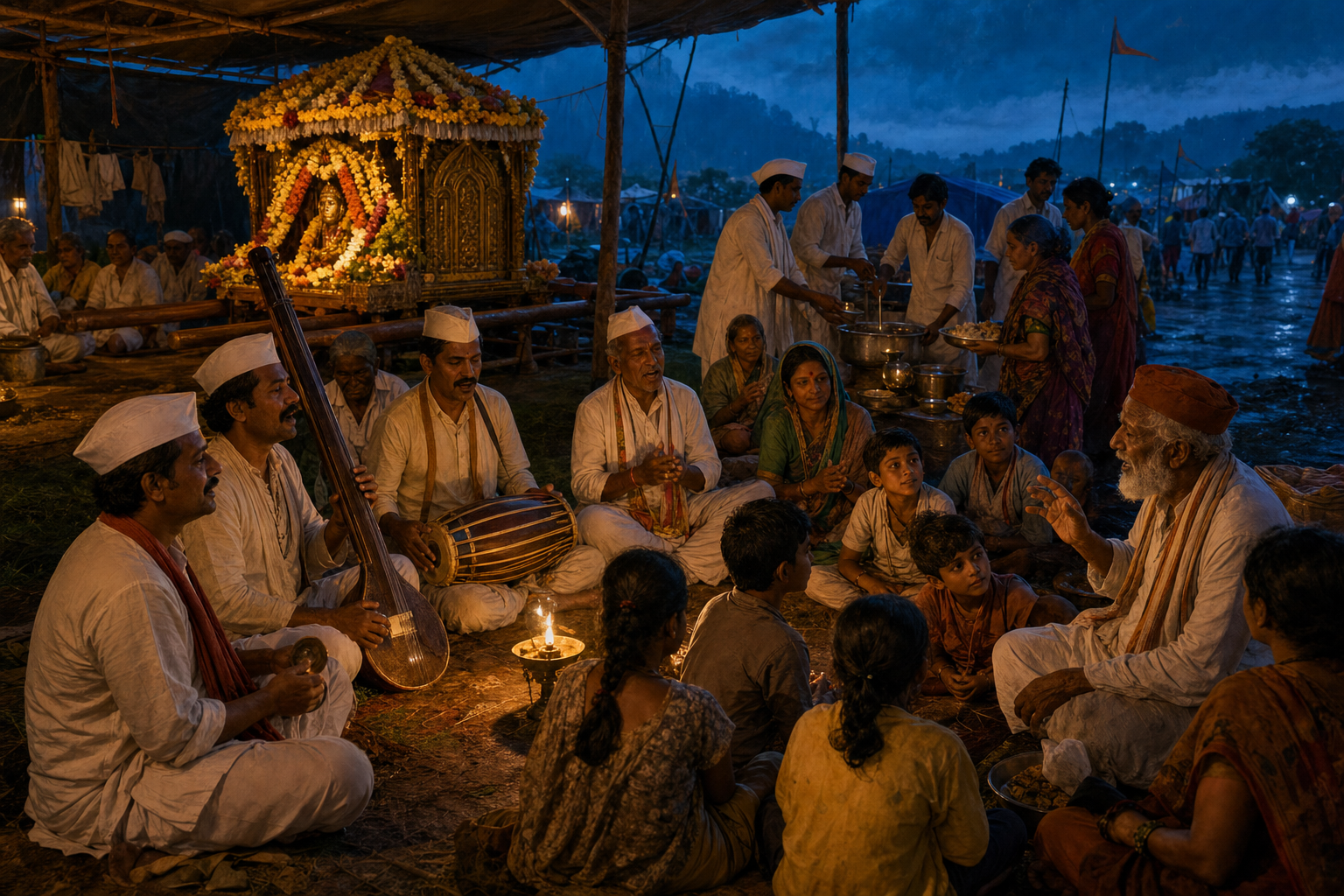
The Wari’s continuity rests not only with those who complete the walk. The report draws attention to households offering food or water, communities hosting halts, children encountering the procession from the roadside and older devotees continuing despite physical difficulty. Together, these forms of participation transmit the tradition between generations without requiring everyone to perform the same role.
Several kinds of inheritance travel along the route at once. Abhangas and collective singing carry devotional teaching; the Palkhi keeps a saint’s memory publicly present; repeated routes connect settlements to a shared religious geography; and food-sharing or voluntary assistance turns seva into observable conduct. The pilgrimage thus preserves culture through recurring practices rather than through commemoration alone.
This also clarifies the social meaning of its bhakti. As presented by the source, devotion is tested through humility, compassion, restraint and service rather than display alone. The procession’s future strength will depend on preserving that relationship between inward remembrance and outward responsibility, while ensuring that verified information and adequate public arrangements reach everyone preparing to participate.