
Ritual precision in Shakta Tantra is not best understood as ceremonial perfectionism. It is the discipline of preserving relationships among sound, body, gesture, visualization, sacred space, materials, time, and intention so that a rite remains intelligible within the tradition that transmits it.
This distinction helps explain which details carry structural meaning, why visual resemblance does not establish ritual identity, and how careful correction can protect continuity without humiliating learners or erasing legitimate regional variation.
Precision means fidelity to a system, not universal sameness
The source article presents Shakta Tantra as a family of traditions centered on Shakti, the dynamic divine power understood through the Goddess, the cosmos, embodiment, speech, perception, and transformative knowledge. It also stresses that this family is internally diverse. Traditions associated with Sri Vidya, Kali, Tara, Tripura Sundari, Kamakhya, Bhadrakali, Chandi, and other forms of Devi can share broad Tantric patterns while differing in mantra, ritual sequence, visualization, eligibility, and theological emphasis.
Precision therefore cannot mean imposing one standardized procedure on every temple, household, region, or initiated community. It means preserving the relationships that make a particular rite coherent within its applicable sampradaya. A practice may be correct in one transmitted setting and inappropriate in another without either tradition being careless.
This also separates variation from arbitrary alteration. A documented regional pronunciation, temple custom, or household observance may belong to a living chain of practice. A change made only because a step appears inconvenient has a different status, especially when the practitioner does not know what that step connects or represents.
Ritual elements operate as an interdependent grammar

The article describes mantra, nyasa, mudra, yantra, visualization, offerings, and disciplined attention as coordinated parts of worship rather than detachable embellishments. Their significance comes partly from their individual forms and partly from their positions within a sequence of preparation, purification, invocation, installation, worship, offering, contemplation, completion, and withdrawal.
Mantra coordinates sound, breath, and awareness
According to the source, a Shakta mantra may include seed syllables, a deity’s name or power, rhythmic organization, prescribed intonation, and lineage-specific recitation. Instruction can also encompass its seer, meter, deity, purpose, visualization, and bodily placements. The relevant unit is therefore not printed wording alone but a coordinated practice of sound, breath, attention, and meaning.
Sanskrit distinctions involving vowel length, aspiration, dental and retroflex consonants, and different sibilants can affect linguistic form or obscure an inherited sonic pattern. Yet the same source cautions against turning phonetic discipline into accent policing. Legitimate regional recitations may differ, while learners benefit from patient correction, competent oral models, and recordings that convey qualities a transliterated page cannot fully preserve, including tempo, pauses, emphasis, and breath.
Nyasa and mudra give the body a ritual order
Nyasa places mantras, letters, deities, or powers on designated parts of the body through touch and concentrated awareness. The article reports that its sequences may correspond to elements, levels of manifestation, sacred letters, divine limbs, or a movement from ordinary identity toward consecrated awareness. Rearranging those placements can consequently disturb the doctrinal journey encoded by the rite, even if every individual gesture remains recognizable.
Mudra illustrates the same dependence on context. A hand form may signify invocation, protection, offering, identification, sealing, or completion according to when and how it is used. A photograph can preserve its outward shape, but not necessarily its accompanying mantra, orientation, timing, or lineage explanation.
Geometry, space, and time establish the field of worship
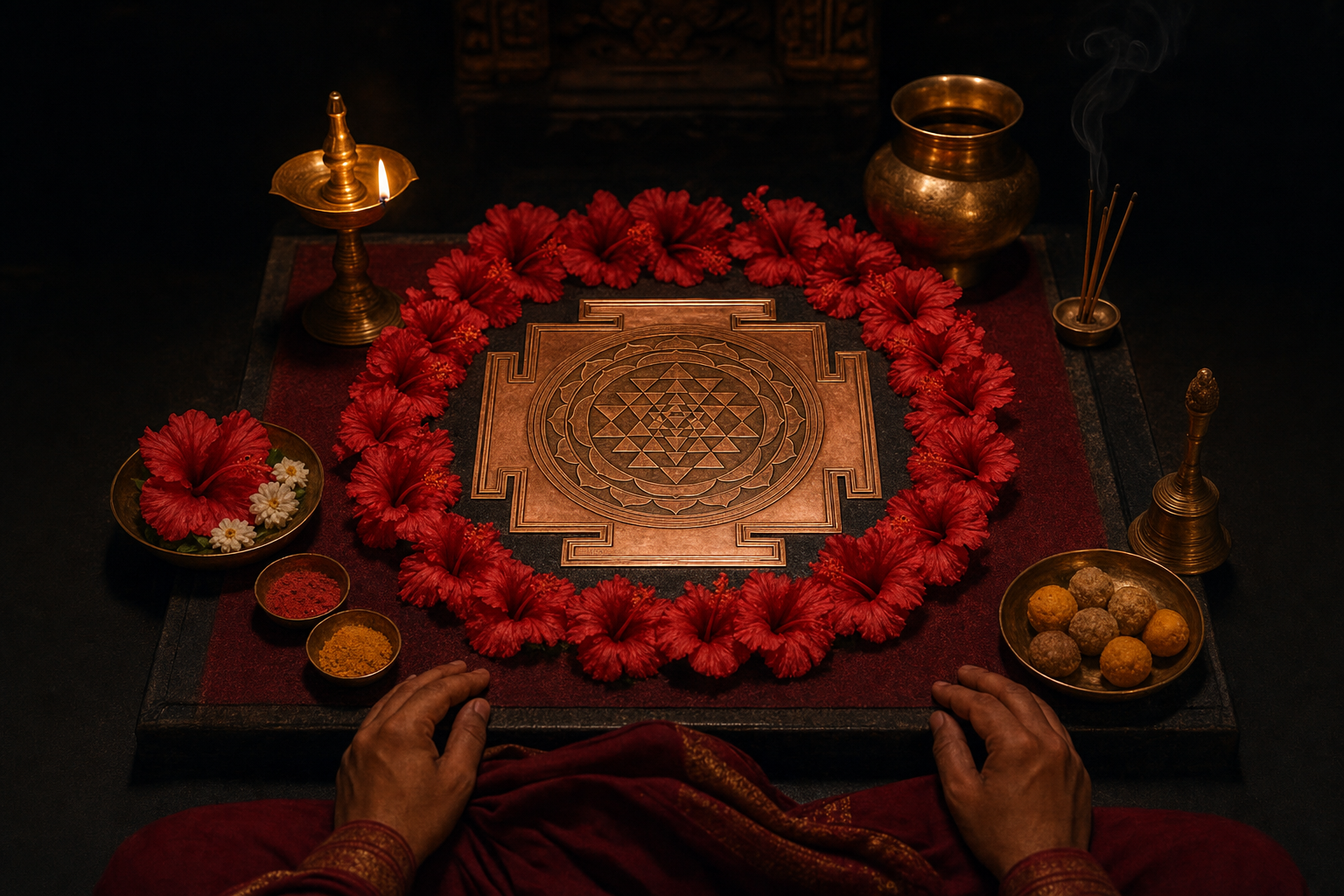
The source treats yantra as theological geometry rather than decoration. Triangles, circles, lotuses, enclosures, directional gates, and a central point can express relationships among divine powers, manifestation, unity, consciousness, and the cosmos. The Sri Chakra is identified as the best-known example, although different Shakta deities have their own yantras and ritual conventions.
Visual similarity alone does not make a commercial reproduction ritually identical to a yantra constructed, installed, and worshipped according to a lineage. Orientation, proportion, inscription, mantra, placement, authorization, intention, and consecration may all contribute to ritual identity. The surrounding arrangement of boundaries, vessels, lamps, water, flowers, incense, offerings, and the practitioner’s seat likewise directs attention through space and the senses.
Time supplies another layer of context. The article associates some observances with lunar days, moon phases, Navratri, seasonal cycles, dawn, dusk, midnight, or temple calendars, while noting that not every practice requires the same calendrical exactness. Household worship and specialized temple or initiatory rites may therefore operate under different standards.
A practical test for proposed adaptations
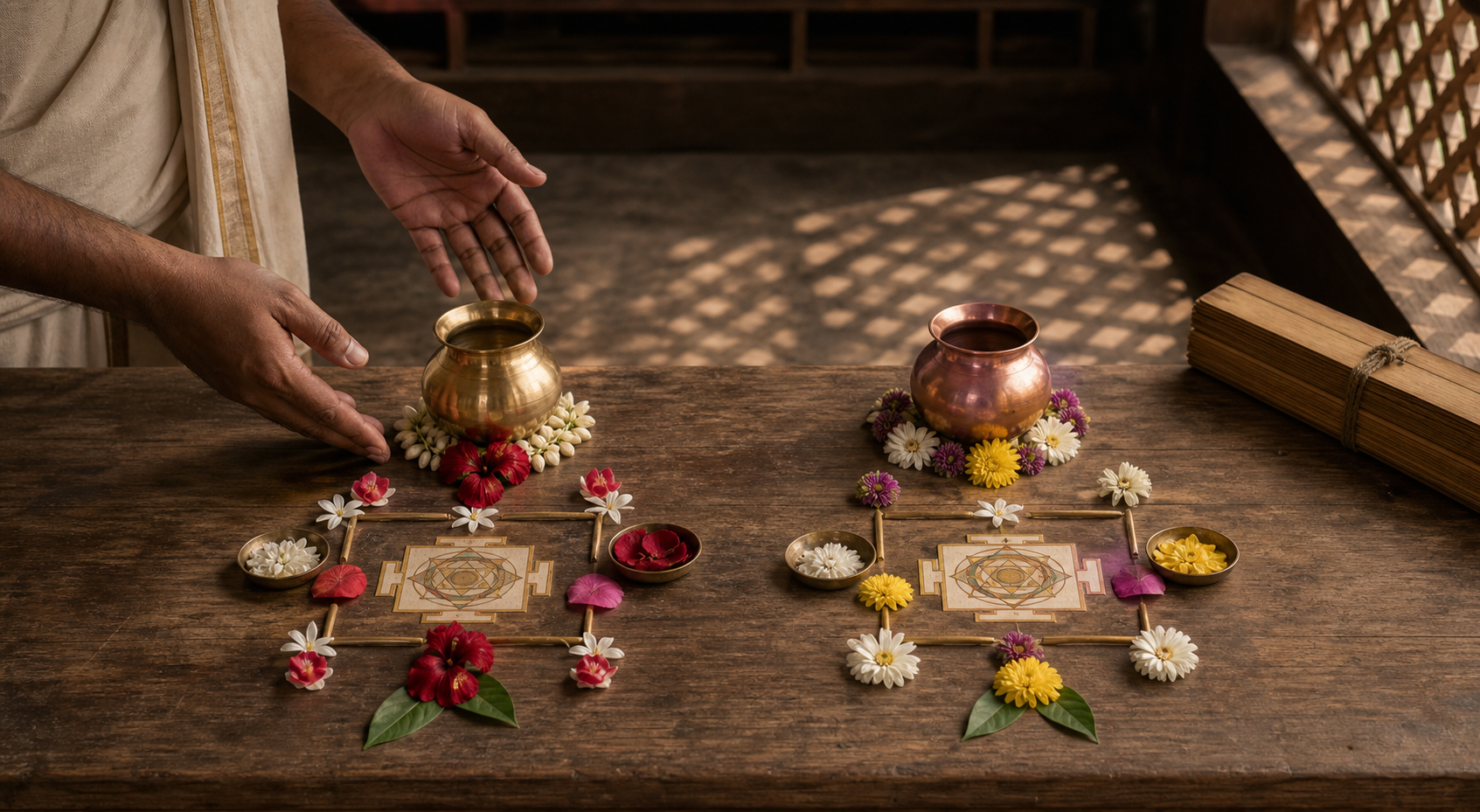
Taken together, the source’s examples support a practical diagnostic for evaluating a proposed change. These questions do not authorize independent revision; they help reveal when apparently minor adjustments require guidance from the tradition responsible for the rite.
- What relationship does the detail preserve? A syllable, placement, gesture, direction, or pause may connect stages of the rite rather than stand alone.
- Which lineage supplies the standard? Generalized online instructions cannot settle a question governed by a particular sampradaya, temple, household custom, or initiation.
- Is the alternative transmitted or improvised? Documented regional variation differs from a substitution made without knowledge of the original function.
- Can the practice be learned adequately from text? Pronunciation, pacing, breath, gesture, and visualization may require oral demonstration and correction.
- Does the rite presume eligibility or initiation? The source describes graded teaching and diksha within the Guru-Shishya Tradition as safeguards against treating every mantra or procedure as immediately interchangeable and suitable for independent use.
This framework also places mistakes in proportion. A learner’s imperfect pronunciation is a reason for instruction, not contempt. At the same time, sincerity alone does not reveal the structural role of an omitted or replaced element. Compassionate teaching and technical care address different parts of the same preservation problem.
Key takeaways
- Ritual precision concerns relationships among elements, not isolated ceremonial details.
- Correctness is lineage-specific; diversity among Shakta traditions is compatible with rigorous transmission.
- Mantra requires more than readable syllables because sound, breath, rhythm, attention, and visualization work together.
- Nyasa, mudra, and yantra carry meaning through sequence, context, orientation, and authorized use.
- Preservation works best through patient teaching, contextual documentation, and clear distinctions between study, public devotion, and initiated practice.
Preservation must transmit context as well as form

Reliable preservation consequently requires more than archiving diagrams or transcribing mantras. Audio can retain pronunciation and pacing; visual records can show movement and spatial orientation; written commentary can explain sequence and theology. None is sufficient by itself when a practice joins all of these dimensions.
The source’s distinction between open study and graded ritual instruction offers a balanced model for public education. Theology, history, symbolism, and artistic form can be discussed respectfully without implying that every specialized practice is suitable for unsupervised performance. Where initiation or lineage authorization applies, acknowledging that boundary is part of describing the tradition accurately.
Scholarly caution is equally important. As the article observes, historical or scientific inquiry cannot independently verify every traditional claim about sacred efficacy. It can document what practitioners say efficacy means and examine how disciplined repetition shapes memory, attention, identity, community, and religious experience. This approach neither dismisses theological claims nor recasts them as laboratory findings.
The durable path forward is a culture of transmission in which teachers explain functions as well as forms, learners receive correction without shame, and documentation remains accountable to the communities whose practices it records.