

If a priest, temple, or family elder has recommended a Pashupatha Homam, do not begin by purchasing a ritual package. Begin by understanding whom the homam honors, what your participation will require, and how the officiant intends to conduct it. That clarity protects both your devotion and your practical interests.
Pashupatha Homam is sacred fire worship dedicated to Pashupatinath, an epithet of Lord Shiva. The name Pashupati means Lord of all creatures and presents Shiva in relation to all beings, not as a separate deity. Devotion and adherence to Vedic ritual are therefore central to the observance.
Key takeaways
- Pashupatha Homam is Shiva-centered fire worship offered to Pashupatinath, the Lord of all creatures.
- The name of the homam does not provide a complete ritual specification. Ask which tradition and procedure the officiant follows.
- Prepare a clear sankalpa, but do not treat the homam as a purchase that guarantees a worldly result.
- During the rite, repeat, offer, move, and receive sacred materials only as the officiant directs.
- Let the meaning of Pashupati continue after the fire ceremony through responsible conduct toward the beings who depend on you.
Decide on your sankalpa before you book

Your first task is to put the intention into plain language. Complete this sentence before speaking to an officiant: “We seek to offer this worship for…” This is not a mantra or a substitute for the formal sankalpa. It is a working statement that helps you explain why you want the homam performed.
Keep that statement honest and proportionate. You may be praying with gratitude, seeking steadiness during difficulty, marking a family observance, or asking for the strength to meet a responsibility. A concrete intention is more useful than a long list of desires because the officiant can tell you whether the proposed rite fits what you are actually asking.
- Identify the person, family, or concern for which the worship is intended.
- Decide whether the primary mood is thanksgiving, repentance, remembrance, protection, or prayer for strength.
- Ask what personal details the officiant needs for the formal sankalpa. If you do not know requested lineage or birth details, say so instead of guessing.
- Tell the officiant whether the relevant family members will be present. Ask how absent participants are handled within that particular procedure.
- Connect the prayer to a duty you can actually perform after the homam. Worship should clarify responsibility, not replace it.
If your concern involves illness, mental distress, debt, litigation, personal safety, or another high-stakes matter, keep using the appropriate medical, psychological, financial, legal, or emergency support. The homam may accompany prayer and disciplined action; it should not be presented as a substitute for professional help.
Verify the rite, the officiant, and the logistics
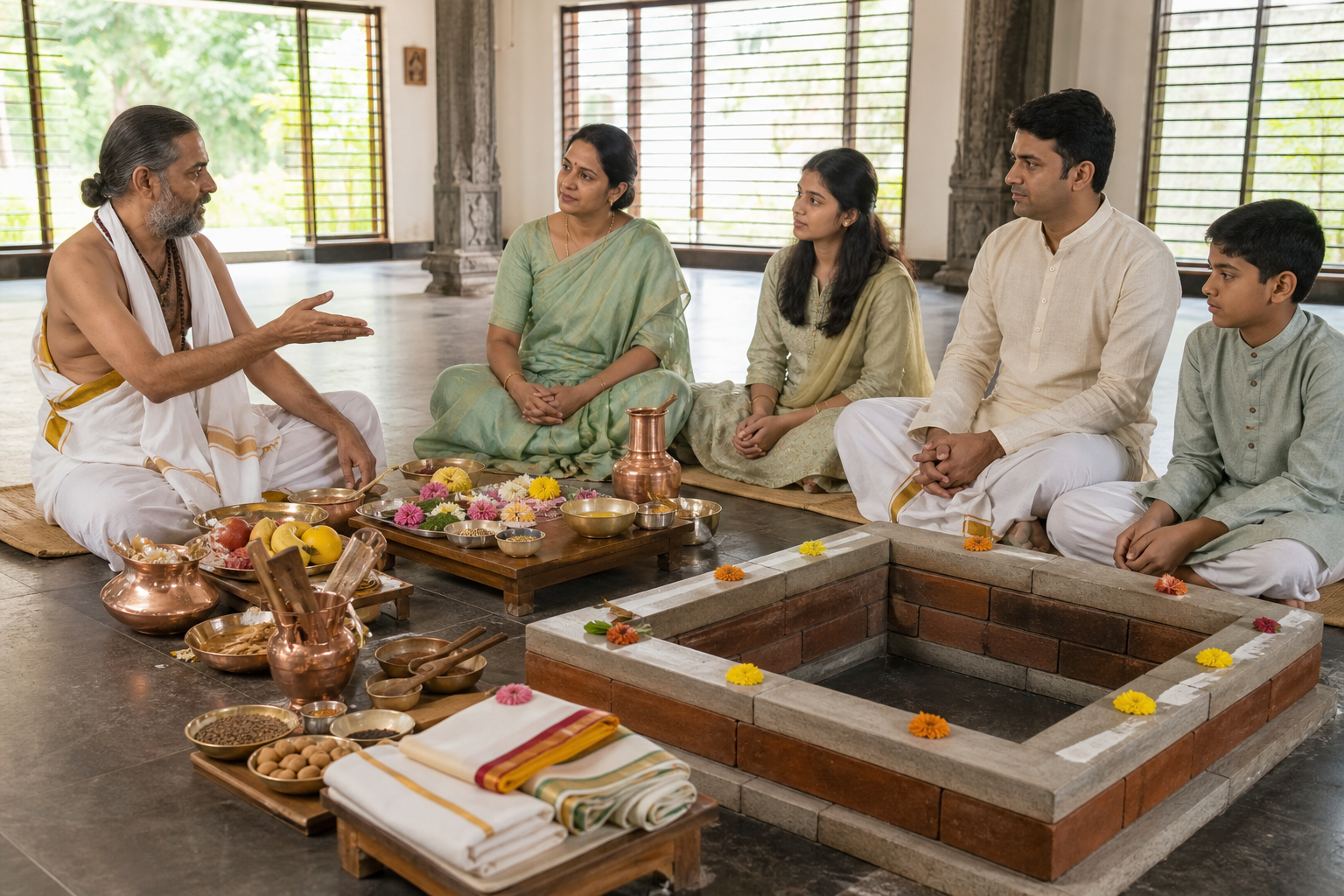
“Pashupatha Homam” identifies the devotional center of the observance, but it does not answer every procedural question. Practical details can differ with sampradaya, lineage, temple custom, region, and the paddhati used by the officiant. Variation is not automatically a problem. Unexplained variation is a reason to ask more questions.
Request a written outline before paying or announcing a date. It need not disclose every mantra, but it should tell you what is being arranged and what is expected of you. Ask the following:
- Which sampradaya or paddhati will govern the homam?
- How is Pashupatinath invoked in this procedure, and which portions are considered central?
- Who will conduct the fire ritual, and what training or temple association does that person have?
- Which preliminary or supporting rites are included, and which proposed additions are optional?
- What will participants be asked to say or do? In which language will instructions be given?
- What materials will the officiant provide, and what must the household or sponsor obtain?
- What preparation is requested concerning food, bathing, dress, medicines, or attendance?
- Where will the sacred fire be established, and who is responsible for venue permission and fire safety?
- What amount covers materials, officiation, venue costs, and dakshina? Which expenses could change?
- How will ash, unused offerings, and other ritual remains be handled afterward?
Clear answers matter more than impressive claims. A trustworthy officiant should be able to explain the broad structure, participant obligations, cost, and safety arrangements without pretending that sacred knowledge is merely a commercial secret.
Pause if someone guarantees a particular worldly result, predicts disaster unless you pay immediately, or repeatedly adds costly rites without explaining why. Fees and dakshina can be entirely legitimate; the warning sign is pressure combined with opacity. A homam is an offering made with devotion, not a contract that compels Shiva to produce a purchased outcome.
Participate with attention, not improvisation
Ask for a participant briefing before the rite begins. You should know where to sit, when to repeat words, when to make an offering, and whom to follow if several family members are present. You do not need to pretend that you know Sanskrit or the ritual sequence. Quietly asking for a cue is better than confidently changing the procedure.
- Arrive at the agreed time in clothing suitable for worship and safe near an open flame. Secure loose fabric and long hair.
- Repeat a mantra only when invited. If pronunciation is difficult, tell the officiant and follow the accommodation given.
- Place offerings into the fire only when instructed. Do not add personal objects, extra substances, or leftover ritual materials on your own initiative.
- Keep phones silent. Ask before photographing or recording, particularly when other worshippers are present.
- Supervise children and keep animals away from the fire, hot vessels, smoke, and ritual materials.
- Ask before assuming that fasting is required. If fasting or smoke exposure could affect a health condition, pregnancy, medication schedule, disability, or recovery, discuss a safe accommodation with the officiant and an appropriate health professional.
- Before leaving, ask how to receive and handle prasada, ash, or other materials distributed under that procedure.
A homam conducted at home still involves an open flame. The location must have a stable, heat-safe arrangement, suitable ventilation, responsible supervision, appropriate fire-safety equipment, and any permission required by the building or local rules. Leave the construction and tending of the ritual fire to competent people. If the proposed room cannot safely accommodate flame, heat, or smoke, use a suitable temple or authorized venue.
Devotion is not measured by remaining beside unsafe heat or smoke. If you become unwell, move away from the fire and seek appropriate help. Tell the officiant beforehand about mobility, hearing, seating, or language needs so that participation can be planned without disrupting the rite.
Let the name Pashupati shape what follows

The most distinctive feature of this homam is not a promised benefit but the divine name at its center. Pashupati directs attention toward Shiva as Lord of all creatures. That gives you a practical test for the sankalpa: does the worship merely express a private demand, or does it also make you more responsible toward life around you?
You need not turn that question into a grand public pledge. Choose a modest practice that you can sustain: more conscientious care for a dependent person or animal, dana to a responsible organization, less participation in avoidable cruelty, steadier Shiva worship, or more faithful performance of a neglected duty. The appropriate act depends on your circumstances, but it should be concrete enough to influence ordinary conduct.
This also prevents a common devotional mistake. When all attention rests on whether an expected event occurs, worship becomes a test administered to the deity. When the homam is understood as an offering, you can still pray intensely while allowing the practice to change your own attention, discipline, and responsibilities.
Before you book the homam, write your intention in plain language and ask the officiant for the full practical outline. Proceed when the ritual basis, participant duties, cost, and fire-safety arrangements are clear and no guaranteed outcome is being sold. If those answers remain vague, pause and approach a priest or temple willing to explain the observance with patience.
References
