Nagaraja is best understood as more than a snake-shaped deity. The supplied DharmaRenaissance Blog article presents the term as a title for sovereign Naga beings whose meanings extend across cosmology, sacred narrative, temple iconography, household devotion, and the protection of land and lineage.
Reading these dimensions together explains why serpent worship cannot be reduced either to fear of snakes or to a simple nature cult. Nagaraja brings apparently contrary ideas into one religious image: danger and refuge, poison and healing, hidden depth and spiritual knowledge, earthly fertility and cosmic continuity.
A sacred title rather than a single fixed identity
The Sanskrit terms behind Nagaraja mean serpent and king. According to the source article, however, the resulting title does not identify only one universally fixed deity. It can be associated with Ananta or Shesha, Vasuki, Takshaka, Karkotaka, and other rulers among the Nagas. This plurality is better read as a feature of the tradition than as a contradiction: different narratives and devotional settings disclose different aspects of serpent sovereignty.
The Nagas themselves occupy a category larger than ordinary animal symbolism. The article connects them with water, fertility, guarded treasure, subterranean realms, and esoteric knowledge. Nagaraja therefore represents command over powers that remain partly concealed from ordinary human perception. The serpent moves along the ground and enters hidden spaces, making it an apt figure for the forces beneath visible life.
Iconography makes that sovereignty visible. The source describes Nagaraja in serpentine form with expanded hoods, as a humanlike figure crowned by cobra hoods, or as a sacred presence forming a many-hooded canopy over another divine figure. These are not merely alternative artistic conventions. The raised hood can communicate authority and vigilance, while the canopy turns a potentially threatening form into an image of shelter.
Why the serpent signifies both danger and protection
Serpent symbolism derives much of its force from refusing a simple moral classification. A serpent can injure, yet a serpent king can guard. Poison can destroy, yet control over poison signifies mastery and healing. The creature belongs to the earth, but its coiled or seemingly unending form can evoke realities beyond an individual lifespan. Nagaraja worship does not erase the danger; it places dangerous power within a relationship of reverence, restraint, and order.
The source article accordingly describes the serpent as a threshold figure: it links land with water, surface with depth, life with death, instinct with awakening, and fear with wisdom. This helps explain why Nagas appear in settings as different as cosmic oceans, royal legends, water sources, cultivated landscapes, ancestral properties, and temple grounds. The shared idea is not that all serpents mean exactly the same thing, but that hidden power must be recognized before it can be integrated.
This symbolic structure also has an ethical implication. Nagaraja represents a domain that human beings do not completely own or control. Reverence for such a being can express an acceptance of limits: the soil contains unseen life, water has its own rhythms, and other species share the landscape. The religious response is therefore not conquest alone, but negotiated coexistence.
Three serpent kings, three dimensions of sacred power
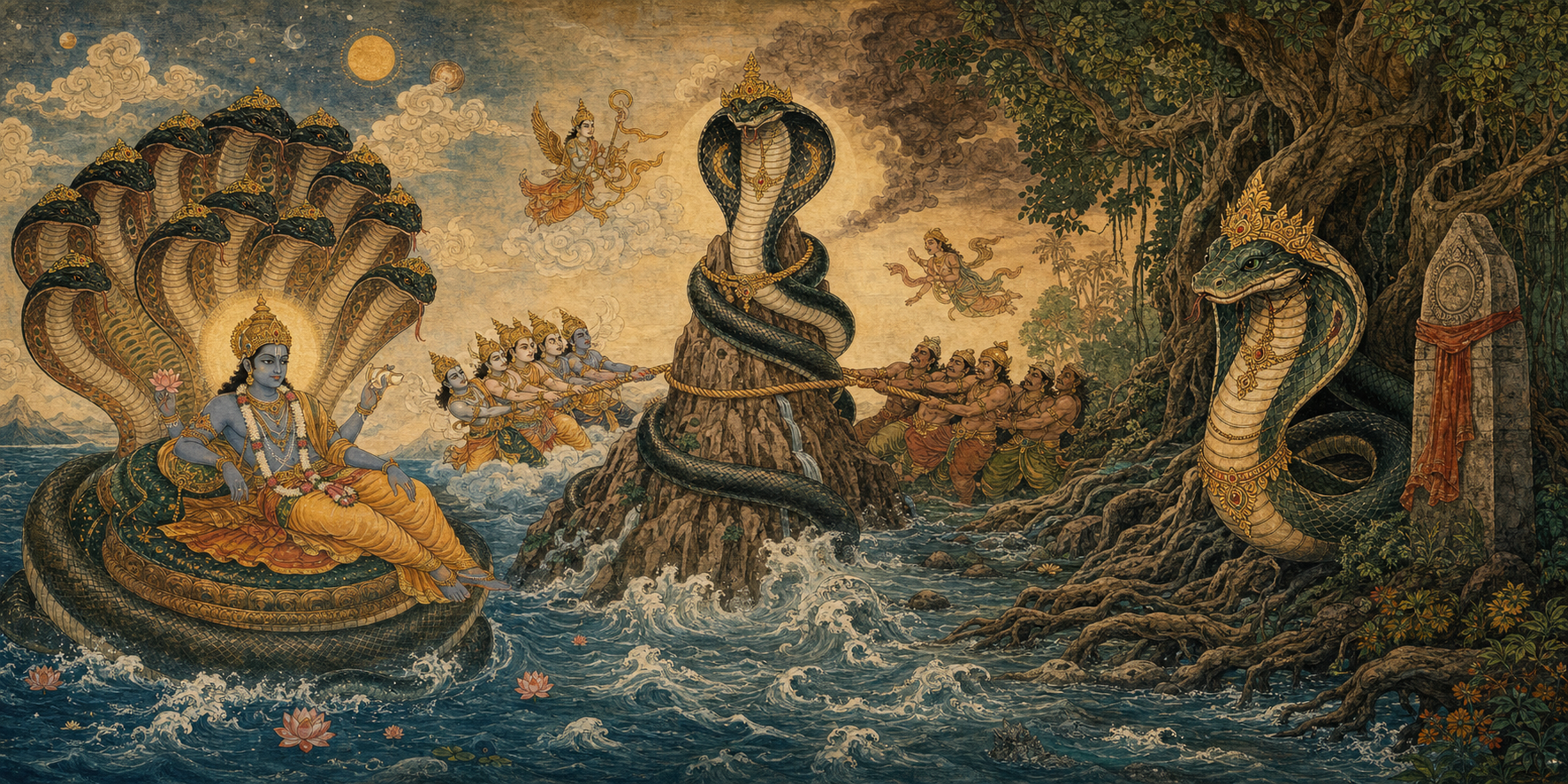
The source article’s accounts of Ananta, Vasuki, and Takshaka reveal three complementary dimensions of Nagaraja symbolism. Ananta, also called Shesha or Adishesha, belongs to the cosmic register. Vishnu reclines upon him in the cosmic ocean, protected by his many hoods. The article relates Ananta to endlessness and Shesha to what remains, interpreting the image as the enduring foundation beneath cycles of creation and dissolution. Serpent power here is stability rather than disruption.
Vasuki expresses transformative tension. In the churning of the ocean of milk, the source reports, devas and asuras use him as the churning rope in their search for amrita. Opposing forces pull against one another; poison appears, but treasures also emerge. Vasuki thus represents the difficult energy through which transformation becomes possible. His association with Shiva, who wears a serpent at his neck, adds another layer: what provokes ordinary fear becomes an ornament when mastered by divine awareness.
Takshaka introduces the moral and political dimension. The source places him within the Mahabharata narrative involving King Parikshit and Janamejaya’s retaliatory serpent sacrifice. Astika’s intervention stops that campaign of destruction. As interpreted by the article, the episode moves beyond a story of humans opposed to snakes and asks where vengeance becomes excessive. Its dharmic center lies in restraint: injury does not justify the eradication of an entire people, lineage, or class of beings.
Together, the three figures prevent a narrow definition of Nagaraja. Serpent sovereignty may uphold the cosmos, generate transformation, or confront human beings with the consequences of unrestrained retaliation. Sacred power is neither automatically gentle nor inherently evil; its meaning depends on its place within cosmic and moral order.
How cosmic symbolism becomes regional worship
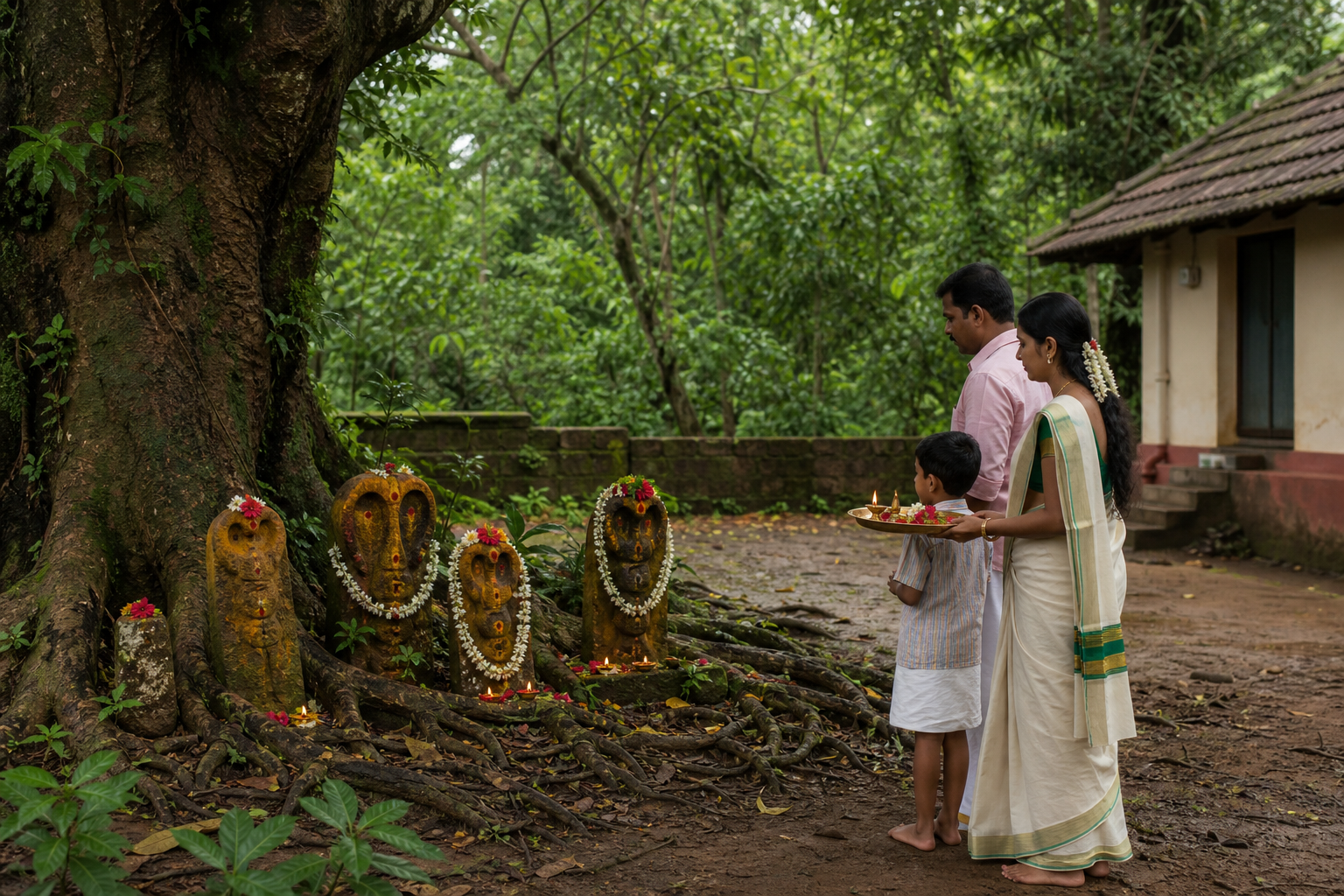
South Indian traditions translate these large theological themes into relationships with particular places and communities. In Kerala, the source highlights sarpa kavu, serpent groves maintained near homes, temples, and ancestral lands. These sites join ritual reverence to the preservation of vegetation, moisture, and small forms of life. Their significance is therefore simultaneously devotional, familial, and ecological: restraint on the use of sacred land can also protect habitat.
The article identifies Mannarasala Sree Nagaraja Temple as a prominent center of this devotional world. It reports that worshippers approach the temple for concerns including fertility, family welfare, protection, and relief from afflictions understood through ancestral traditions. The many serpent images associated with the site express a cumulative relationship formed through vows, offerings, inherited memory, and repeated worship rather than through theology alone.
In Tamil Nadu, according to the source, serpent stones may be placed under sacred trees, near temples, or in village shrines. Some depict intertwined serpents or hooded Nagas and may appear within devotional settings associated with Shiva, Vishnu, Devi, or Subrahmanya. Reported observances include offerings of turmeric, milk, flowers, and lamps, as well as circumambulation. The practices vary locally, but their recurring concerns include fertility, continuity of lineage, protection, and the removal of obstacles.
Coastal Karnataka provides another ritual expression through Nagaradhane and Nagamandala traditions. The article also emphasizes Kukke Subramanya, where Subrahmanya is worshipped in close association with serpent power. It reports that devotees undertake rites such as Sarpa Samskara and Ashlesha Bali within frameworks of karma, ancestral responsibility, and spiritual correction. The association does not make Subrahmanya merely a serpent deity; instead, it situates Naga reverence within a wider devotional identity connected with wisdom, valor, and divine command.
Festivals such as Nag Panchami and Nagula Chavithi carry the relationship beyond specialized shrines. As described by the source, prayer, fasting, offerings, and restraint can express gratitude toward Nagas and a desire for protection from snake-related harm. At a deeper level, these observances ritualize the same principle visible in sacred groves and epic narratives: power should be approached with humility, and coexistence requires limits on human action.
Key takeaways
- Nagaraja is a royal title shared by several Naga figures, not the exclusive name of one uniformly defined deity.
- The serpent’s sacred meaning depends on its dual capacity to threaten and protect, conceal and reveal, poison and heal.
- Ananta, Vasuki, and Takshaka respectively illuminate cosmic continuity, transformative tension, and ethical restraint.
- Regional worship turns symbolism into lived obligations involving family continuity, ancestral memory, water, land, and other forms of life.
The continuing significance of Nagaraja will depend on preserving this layered vision. Textual interpretation, regional practice, and care for serpent-associated landscapes can remain mutually illuminating without forcing every tradition into a single explanation.