
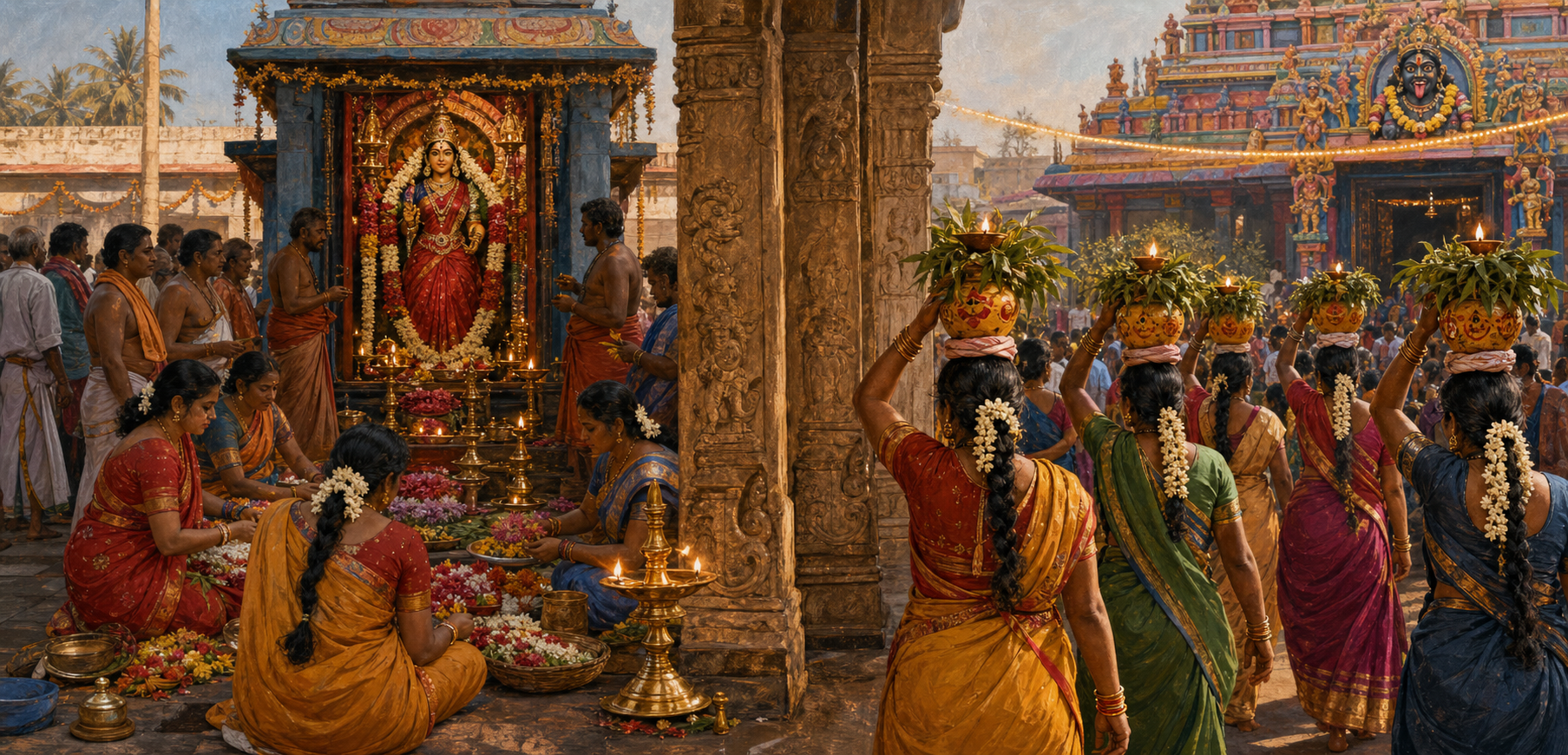
Two South Indian traditions illuminate a shared religious question: how does divine feminine power become present in the life of a community? One source approaches Draupadi as Amman in Tamil devotional culture; the other describes Mahakali worship through Telangana’s Bonalu festival. Together, they show that Shakti is encountered through locally meaningful combinations of story, image, offering, movement, memory and public assembly.
The comparison also guards against a common misunderstanding. South Indian goddess worship is neither a single standardized system nor a collection of unrelated local customs. Its coherence emerges through recurring relationships—mother and devotee, protector and community, vow and fulfilment—while each temple and region gives those relationships a distinctive form.
Key takeaways
- Shakti is presented as a relationship with a particular goddess, community and place rather than only as an abstract theological principle.
- Icons, food, fire, pots, clothing, ornaments and processions communicate sacred meaning through material and embodied forms.
- Draupadi Amman worship turns remembered injustice into an affirmation of dignity, while Bonalu turns memories of danger and recovery into communal gratitude and protection.
- Local variation does not undermine a wider tradition: epic queens, forms of Mahakali and neighborhood goddesses can all participate in a shared sacred vocabulary.
One sacred feminine, expressed through different identities
The Draupadi Amman article begins with a conjunction of identities. Draupadi belongs to the narrative world of the Mahabharata, but the title Amman, meaning mother, places her within an immediate devotional relationship. She is consequently approached as epic heroine, queen, witness to adharma, maternal protector and guardian deity. The source treats this layering as essential rather than contradictory.
The Bonalu guide presents another kind of plurality. Mahakali stands at the center of the Ujjaini Mahankali celebration in Secunderabad, while the report situates her alongside Yellamma, Pochamma, Maisamma, Muthyalamma, Peddamma and other locally worshipped goddess forms across Telangana. The article argues that these distinctions deepen a common sacred culture instead of fragmenting it.
Read together, the sources suggest that Shakti tradition works through recognizable affinities without requiring uniform names or iconography. Protective power, maternal accessibility, fierce moral agency and the capacity to bless a community recur across the two accounts. Yet Draupadi’s authority remains inseparable from epic memory, just as Ujjaini Mahankali’s public presence remains embedded in Telangana’s ritual vocabulary and Secunderabad’s civic landscape.
Images, offerings and bodies make theology tangible
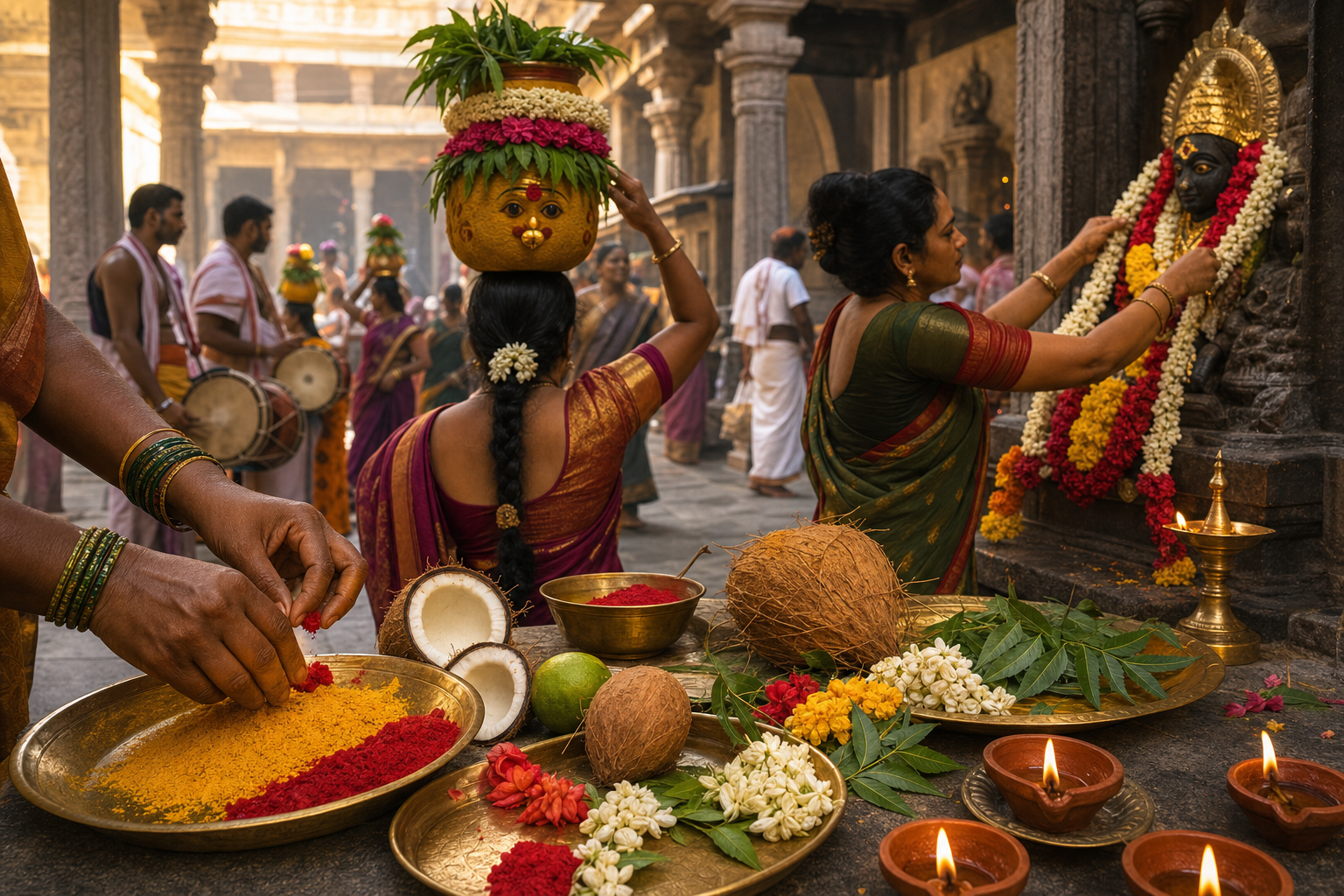
The Draupadi source reads the goddess’s consecrated image as more than a representation. Common features—including an upright regal posture, steady gaze, crown, bright clothing and abundant jewelry—are interpreted as signs of sovereignty, attention, auspicious power and the ability to protect. The article is careful to note variation among temples: some forms may emphasize weapons and guardianship, while others foreground queenly dignity or maternal presence.
Draupadi’s reported birth from sacrificial fire supplies another layer of meaning. The source connects that origin with Theemithi, in which devotees cross embers in fulfilment of vows and as an act of faith, purification and surrender. In this interpretation, fire is not a theatrical effect. The devotee’s body becomes a site where trust, fear, endurance and relationship with the goddess are enacted.
Bonalu gives material form to devotion through a different sequence. According to the guide, a Bonam consists of rice cooked with milk and jaggery and carried in a decorated brass or earthen pot. Turmeric, vermilion, neem leaves and a lamp turn prepared food into an offering to the Mother Goddess. The report emphasizes the foundational role of women who prepare the offering and bear it through the crowds: domestic labor, bodily discipline and public worship meet in one act.
The festival also moves sacred presence beyond the shrine. The guide describes the Ghatam as a decorated copper pot representing the goddess and carried in procession through the community. Pothuraju, regarded in the tradition as Mahakali’s brother or guardian, advances with vigorous dance as a figure of protection and obstacle-clearing. Rangam, held after the principal offering day, is described as an oracle rite through which the goddess’s message is received and communicated.
The contrast is instructive. Draupadi Amman’s icon offers a stable focus for seeing dignity and watchful authority, while the Ghatam makes divine presence mobile. The fire-walk places a vow under the feet of the devotee; the Bonam places nourishment above the devotee’s head. Neither tradition separates belief neatly from matter. Sacred meaning is carried, adorned, tasted, heard, watched and physically endured.
Moral injury and collective danger become sacred memory
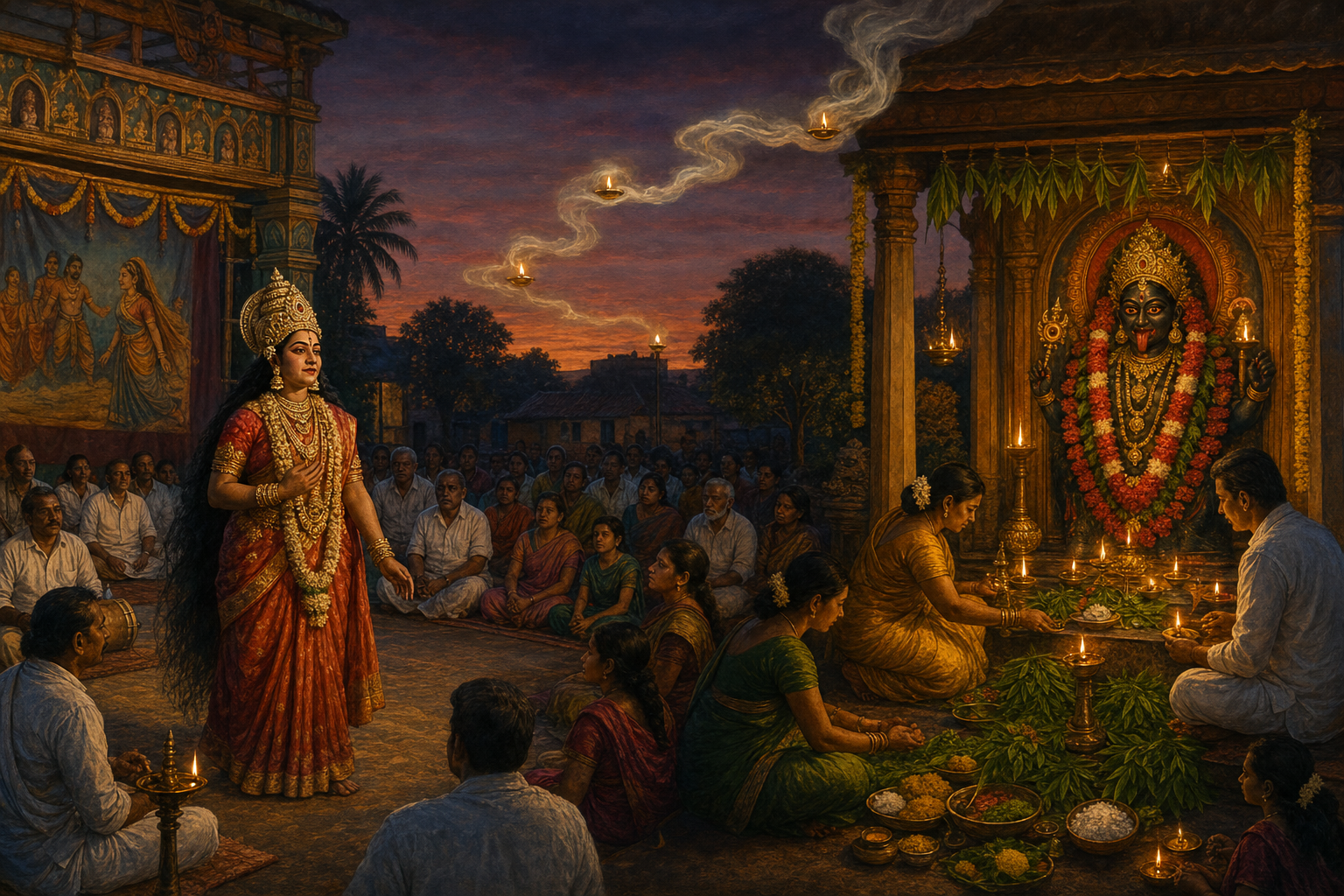
The two sources organize memory around different crises. In the Draupadi account, the attempted disrobing in the Kuru court reveals a collapse of dharma: powerful elders remain silent while a woman’s dignity is attacked. The article interprets Draupadi’s questions, resolve and association with unbound hair as forms of moral memory. Her worship does not erase injury; it makes the refusal to normalize injustice part of her sacred identity.
The Bonalu account centers a communal danger rather than an epic outrage. It reports a popular history linking the Ujjaini Mahankali temple with an early nineteenth-century epidemic in the Hyderabad-Secunderabad region. According to that tradition, people connected with the military establishment prayed to Mahakali at Ujjain and later installed the deity in Secunderabad in fulfilment of a vow. The source also notes, with appropriate uncertainty, discussions of possible older epigraphic references that could place Bonalu within a longer continuum of regional goddess worship.
These memories perform related work without being interchangeable. Draupadi Amman carries the demand that violated dignity be witnessed and answered. Mahakali receives gratitude for protection and survival. One account begins with adharma exposed in an assembly; the other with danger faced by a population. In both, a past crisis becomes a continuing ethical bond: remembrance generates vows, offerings and obligations among the living.
Festivals create communities, not merely audiences
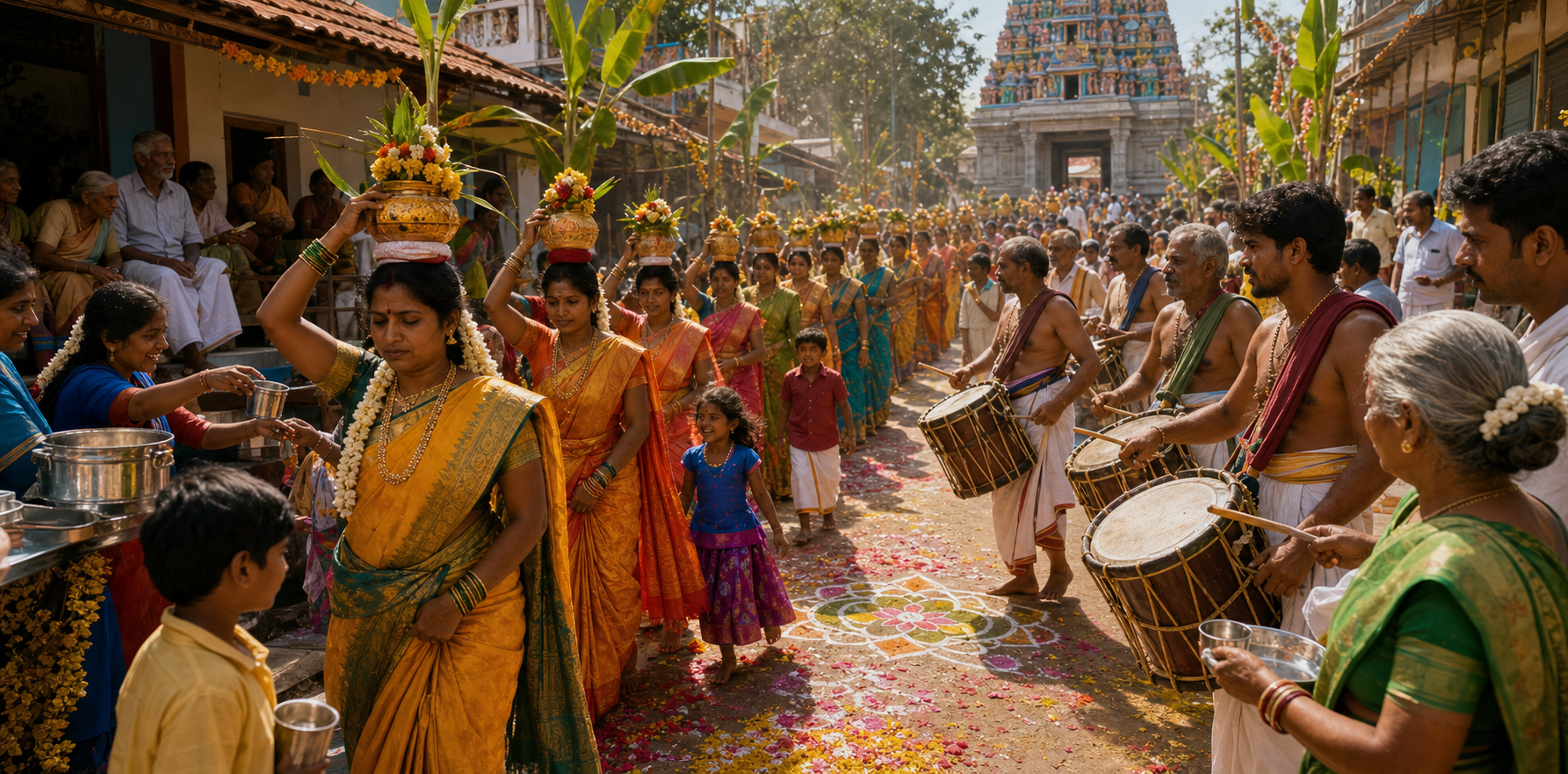
Both reports describe goddess worship as a way communities organize themselves. The Draupadi article points to temples, storytelling, processions, vows and festivals around which religious calendars take shape. The Bonalu guide presents an especially visible civic-religious network: temple lanes, neighborhoods, markets, families, musicians, volunteers, administrators and public-safety arrangements all become involved in the jathara.
This public character also complicates simple distinctions between household and temple authority. Draupadi’s identity joins royal status and maternal proximity, while Bonalu brings food prepared through household labor into a major public procession. The guide’s emphasis on women carrying Bonam pots is therefore not incidental color; it identifies women as central ritual agents. The Draupadi account, from another angle, locates feminine authority in a goddess who sees injustice, questions failed power and embodies moral steadiness.
The sources also converge in resisting spectacle. The Draupadi article asks readers to understand fire-walking within the discipline of vow and devotion. The Bonalu guide similarly frames online darshan as mediated participation for distant devotees, elders and diaspora families, not as entertainment or a full replacement for embodied attendance. Both positions call for ritual literacy: visible intensity should be interpreted through the meanings participants give it.
As these traditions continue through temples, streets and digital channels, responsible preservation will depend on attending to local names, ritual roles and community interpretations. The most useful future accounts will neither flatten every goddess into a generic symbol nor isolate each form from the wider language of Shakti that makes comparison possible.
References
- DharmaRenaissance Blog — Draupadi Amman’s Sacred Power: Iconography, Fire Rituals, and Living Shakti
- DharmaRenaissance Blog — Ujjaini Mahankali Bonalu 2026: Sacred Secunderabad Jathara, Rangam and Online Darshan Guide