
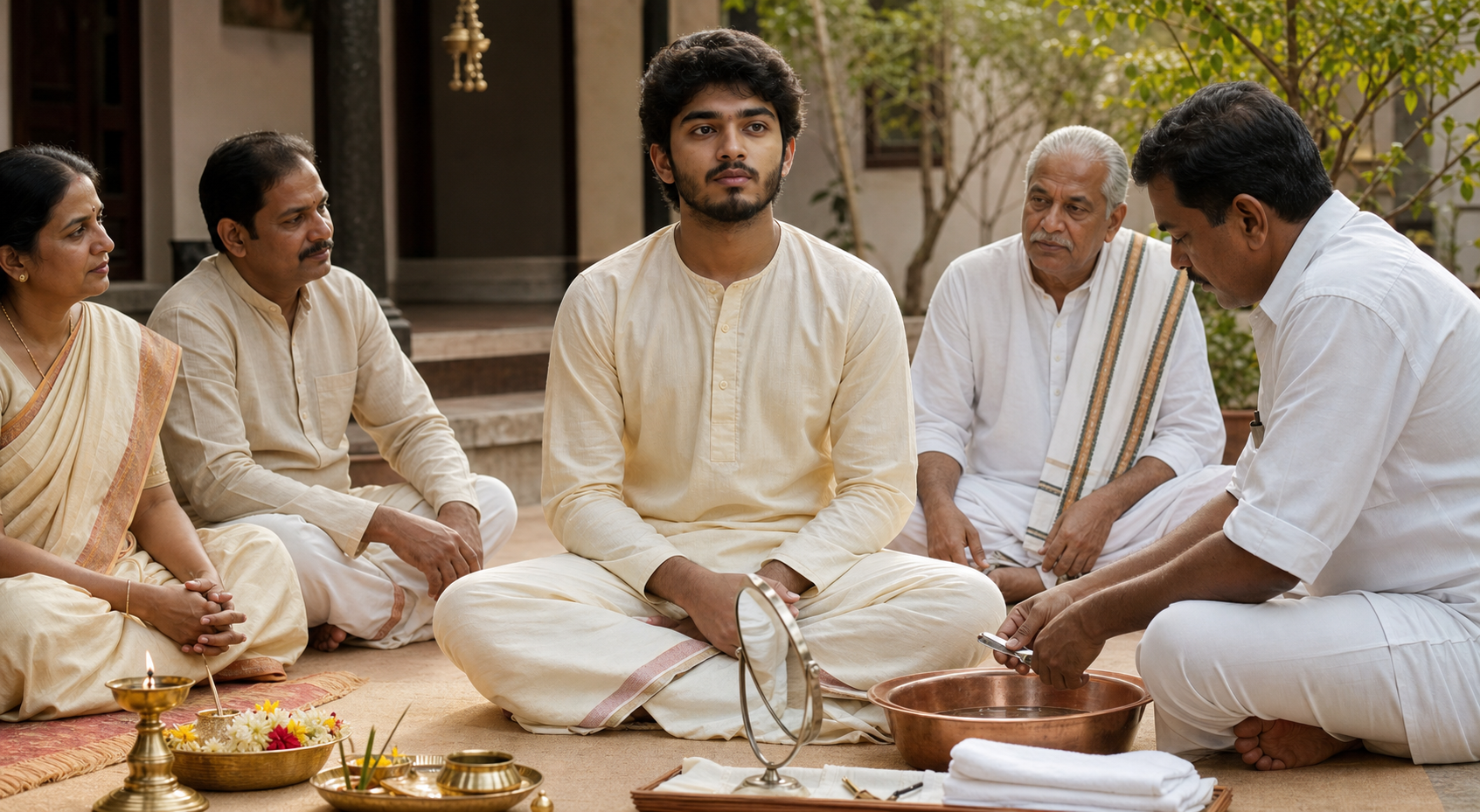
Your son’s facial hair has appeared, and someone in the family has said that his first shave should be a samskara. Before you book a barber or choose a date, you need to settle a more important question: what does Keshanta mean in your lineage?
There is no single procedure followed by every Hindu family. Some traditions shave only the beard and moustache. Others include the head or limited body hair, and families that maintain a sikha preserve it. A sound observance therefore begins with family memory, the young person’s informed participation, and guidance appropriate to your sampradaya. The aim is not ritual uniformity. It is to turn a bodily sign of adolescence into a conscious step toward cleanliness, restraint, study, and responsibility.
First determine which rite your family is observing
Keshanta is the formal first shaving associated with adolescent maturation. It is not another name for Chudakarana, the tonsure usually performed in infancy or early childhood. Chudakarana concerns the child’s hair and often establishes or honors the sikha. Keshanta ordinarily concerns the facial hair that emerges later, although some ritual traditions prescribe a wider shaving.
This distinction prevents a common planning mistake. If your son already underwent Chudakarana, that does not mean Keshanta has also been completed. Conversely, a reference to head shaving during Keshanta does not turn the adolescent rite into Chudakarana. The person’s life stage and the purpose of the ceremony identify the samskara more reliably than the amount of hair removed.
Many traditional prescriptions connect Keshanta with the sixteenth year or the appearance of facial hair. Treat these as lineage-sensitive markers rather than a universal appointment date. Regional usage, the student’s progress, family practice, and the availability of a teacher may all affect the timing. If the young man is much older and the rite was missed, ask your acharya or purohit how your tradition handles a delayed observance instead of inventing a correction.
Keshanta also makes more sense when placed beside two neighboring samskaras. Upanayana begins formal brahmacharya and disciplined study. Keshanta acknowledges maturation within that disciplined life or near its culmination. Samavartana marks the ceremonial completion of formal studentship and the status of a snataka. Not every household performs all three separately, but you should establish which transition the family intends to recognize.
- Ask whether Keshanta has been performed in either parent’s family and what the last two generations actually did.
- Confirm whether the intended shaving covers only the beard and moustache or also the head or specified body hair.
- Record explicitly whether a sikha must be preserved.
- Ask whether the rite is independent or connected to Upanayana, the completion of a stage of study, or Samavartana.
- If the term godana is used, ask what the officiant means by it. In samskara usage it often functions as a conventional name for Keshanta, so context is more useful than a casual etymological guess.
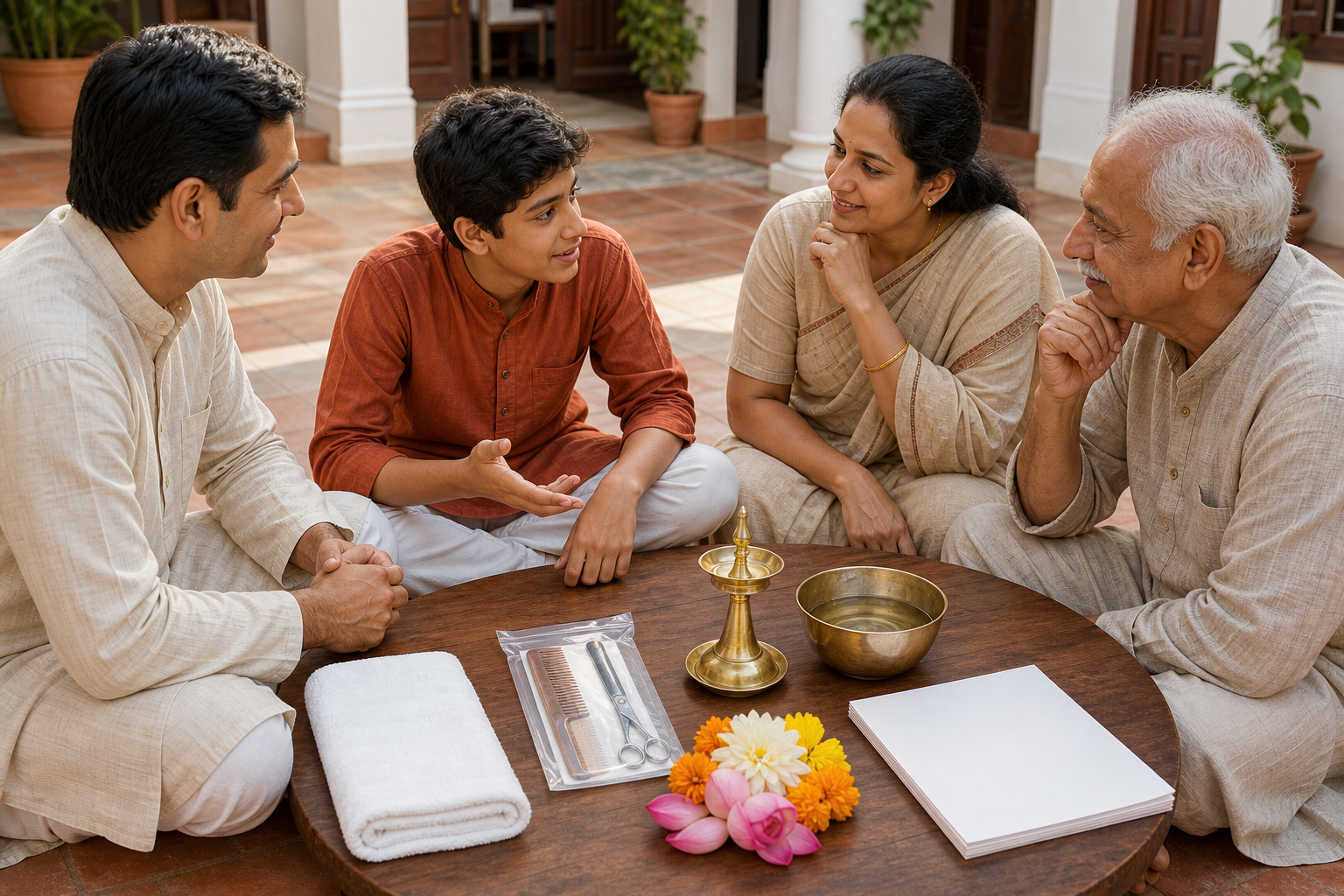
Write down the answers before making arrangements. A short written plan prevents the barber, priest, elders, and young person from arriving with four different ideas of what is about to happen.
Plan for dignity before planning the ritual details
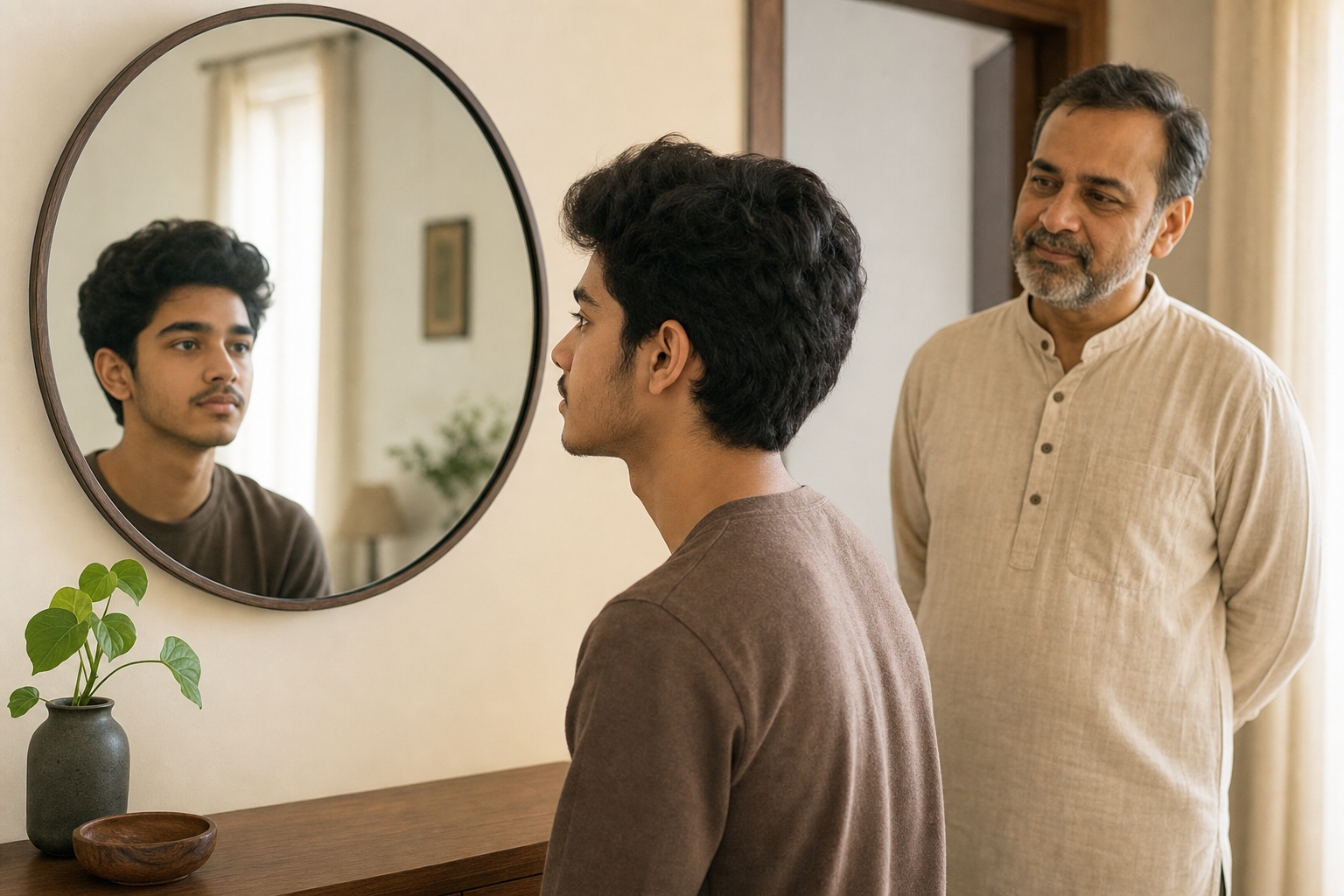
Keshanta concerns the young person’s body. His informed consent, privacy, and understanding are therefore part of a dignified observance, not modern obstacles to it. Tell him beforehand what will be shaved, who will be present, what prayers or offerings are expected, and what he will be asked to do. Do not surprise him in front of relatives.
This matters especially where a family custom includes the head, armpits, or another area beyond the face. No one should broaden the shave merely because a wider prescription exists somewhere. Follow the lineage you have identified, preserve modesty, and arrange a private space for any part that should not be public. If the young person objects to the proposed scope, pause and resolve the issue before the ceremony. Public embarrassment teaches the opposite of self-mastery.
Once the scope is clear, prepare in this order:
- Choose the ritual guide. Ask a family acharya, purohit, guru, or knowledgeable elder to confirm the procedure followed by your community. General instructions can help you ask questions, but they cannot identify your Grihya tradition for you.
- Select the day. Use the household’s calendar practice and the officiant’s guidance. If you live in the diaspora, coordinate with school and work schedules early enough that the ceremony is not rushed between unrelated obligations.
- Confirm every participant’s role. Decide who conducts the sankalpa, who shaves, which elder or teacher guides the young person, and who receives dakshina. If a professional barber will participate in a sacred setting, explain the expected sequence in advance.
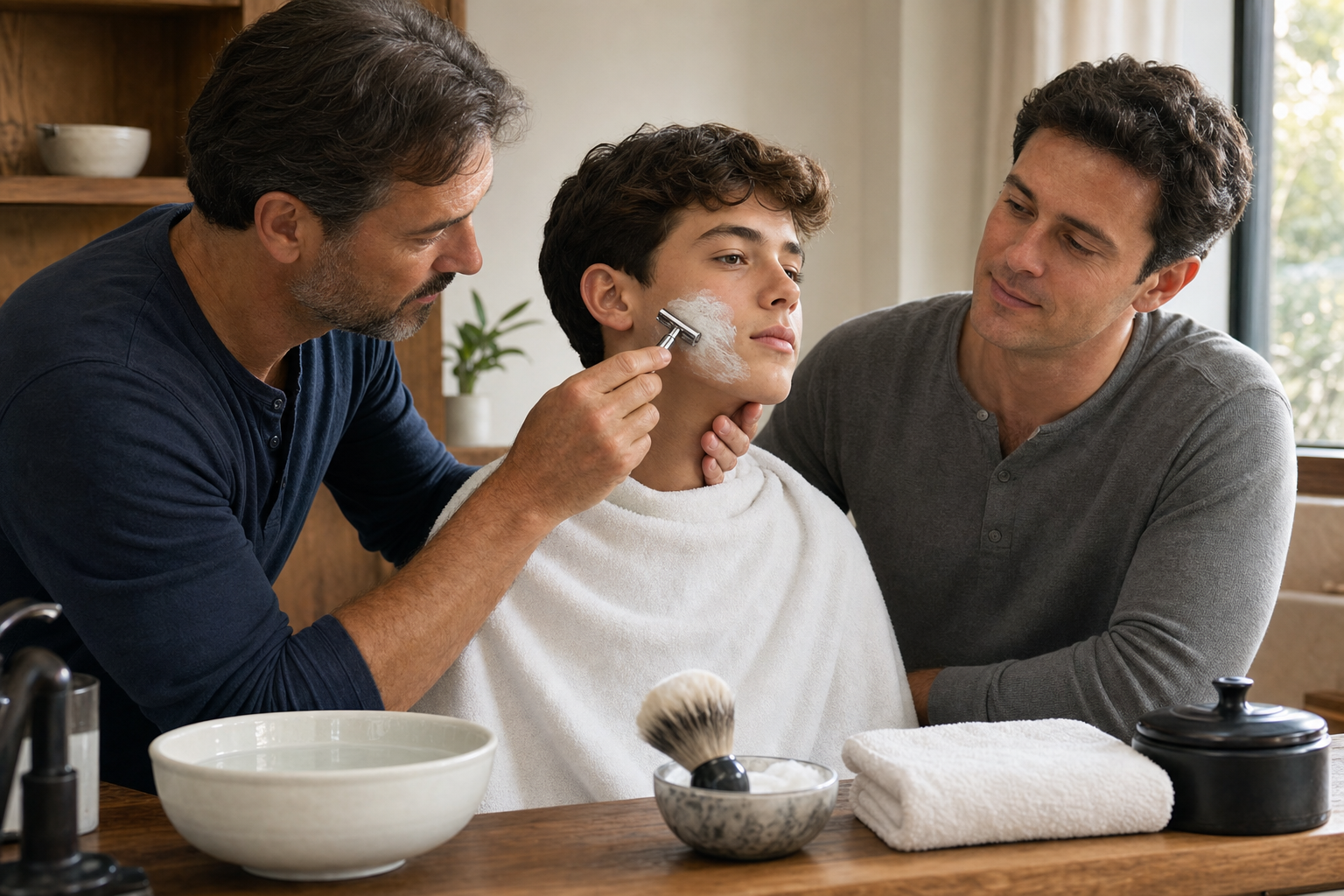
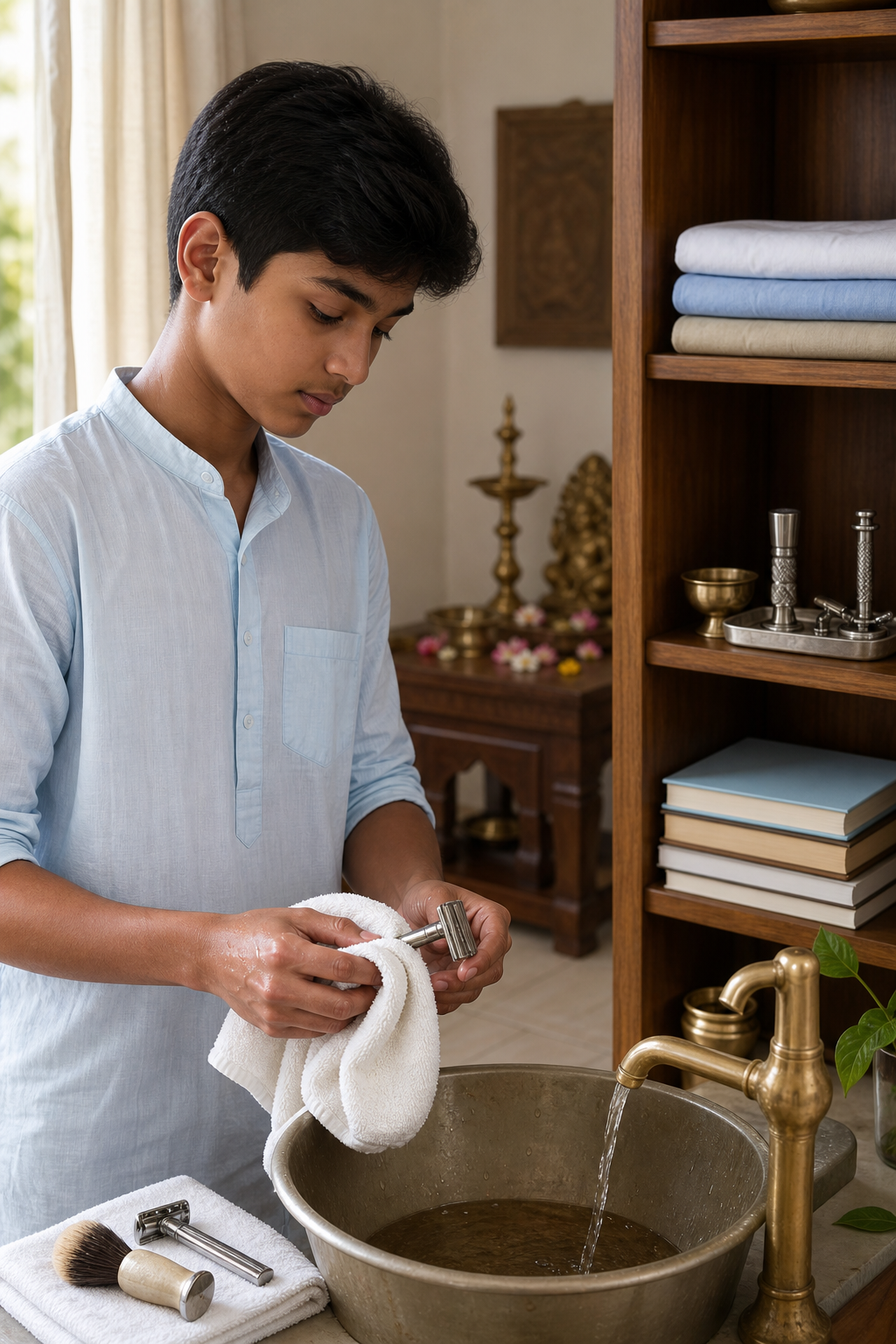
- Prepare hygienic equipment. Use a clean blade and properly cleaned reusable tools. Provide individual towels and suitable grooming supplies. Ritual purification does not replace practical cleanliness.
- Protect the sikha and other retained hair. Show the barber exactly what must remain. A verbal instruction given after shaving begins is too late.
- Decide how the removed hair will be handled. Some lineages consign it to water or fire. Where that would create an environmental or practical problem, ask whether a small symbolic portion may be offered while the remainder is collected responsibly or composted where appropriate.
- Arrange dakshina and hospitality. Prepare the barber’s gift or payment and any charity, gifts to Brahmanas, or hospitality for guests before the rite begins.
If there is an active skin problem, an unusual bleeding concern, or another condition that makes shaving unsafe, do not let the ceremonial date overrule health. Defer the shave and seek appropriate professional advice. The purpose of a samskara is refinement, not avoidable injury.
Use a simple sequence, then let your lineage supply the particulars
The exact mantras, order of cutting, deities invoked, and offerings differ. That is why an online formula should not be presented as the universal Vedic Keshanta. A broadly recognizable structure can still help your family understand the day and prepare intelligently:
- Snana: The young person bathes and arrives in clean clothing. This begins the passage from ordinary grooming to deliberate purification.
- Sankalpa: The intention is formally stated. The name, purpose, and other details should follow the officiant’s customary form.
- Invocation: Ganesha and the protective or lineage deities may be invoked according to family practice.
- Preparation of the implements: The shaving tools are cleaned and ritually presented or blessed as the tradition directs.
- The first shaving: The barber or designated person removes the agreed hair in the customary order under the guidance of the elder, guru, or officiant. The sikha is preserved where required.
- Disposition of the hair: The hair is collected rather than scattered. It is then offered or handled in the manner settled during preparation.
- Dakshina and giving: The barber is honored, and the family may give gifts, charity, or hospitality to Brahmanas and guests according to its custom and capacity.
- Blessing and commitment: Elders acknowledge that the young person is taking greater responsibility for his study, speech, conduct, and bodily discipline.
Do not rush the sankalpa and blessing while treating the shave as the main event. Hair grows back. The lasting part is the young person’s consent to manage himself with greater steadiness. Keshanta gives that inward change an outward form through sauca, cleanliness; samyama, restraint; and tapas, disciplined effort.
You can make that meaning concrete without pretending a modern addition is an ancient injunction. Before the ceremony, ask the young person to choose one daily responsibility that will begin with Keshanta: caring for his own grooming implements, keeping an agreed period for study, or observing a definite discipline in speech. Let him state it in his own words after the inherited ritual is complete. This is a family teaching practice, not a substitute for the traditional sankalpa.
Keep the commitment narrow enough to be observable. “I will become disciplined” cannot guide action. “I will clean and put away my shaving tools after every use” can. The family should support the chosen discipline quietly rather than turning the samskara into an excuse for constant surveillance.
Adapt carefully without erasing the differences between traditions
Traditional Keshanta prescriptions largely address male students, but a household still has to make thoughtful decisions about daughters, inter-tradition families, missed samskaras, and customs that are no longer remembered. The answer is not to claim that every adaptation is textually identical. State plainly what is inherited and what the family is adding.
If you want to recognize a daughter’s maturation, you can preserve the educational core through a family observance centered on study, self-management, blessings, and a personal commitment. There is no need to reproduce a hair-focused procedure merely to make two ceremonies look symmetrical. Call the observance what it is rather than presenting a newly designed rite as an unchanged classical Keshanta.
Inter-tradition households need particular care. Sikh reverence for unshorn kesh is not a minor preference to be set aside for a Hindu shaving custom. Where that commitment governs the young person’s life, choose a non-cutting marker of maturity. Buddhist monastic shaving, Jain kesh-lonchana, Sikh keeping of unshorn hair, and Hindu Keshanta all place the body within a discipline, but they do so through different vows and different signs. Dharmic kinship becomes more credible when those differences are honored rather than flattened.
A Hindu family with no remembered Keshanta custom is not obliged to manufacture false certainty. You can consult a trusted teacher, recover a practice connected to your regional or sampradaya tradition, or mark the transition through a modest family sankalpa without claiming a textual pedigree you cannot establish. Dharma is not strengthened by ceremonial overstatement.
The same principle applies when resources are limited. A large gathering, elaborate decoration, and expensive gifts are not what make the rite serious. Give attention to a clean setting, a clear sankalpa, the correct treatment of the hair and sikha, appropriate dakshina, and the young person’s new responsibility. Capacity, place, and time can shape the form without emptying the observance of purpose.
Key takeaways for a family preparing Keshanta
- Keshanta is an adolescent first-shaving samskara; Chudakarana is the earlier childhood tonsure. Do not merge them merely because both involve hair.
- The sixteenth year and the appearance of facial hair are traditional timing markers, not a universal deadline for every Hindu family.
- Confirm the exact shaving area, preservation of the sikha, ritual guide, date, hair disposition, and dakshina before the ceremony.
- Explain the full procedure to the young person and obtain his willing participation. Privacy is essential if the custom extends beyond facial hair.
- Use clean equipment and responsible hair disposal. A sacred intention does not cancel hygiene, safety, or ecological care.
- Connect the visible shave to one specific responsibility in study, speech, conduct, or personal care so that the samskara begins a practice rather than ending with photographs.
- When family or Dharmic commitments require unshorn hair, preserve the ethical purpose through a non-cutting observance instead of forcing formal uniformity.
Your next step is a short family meeting, not a shopping list. Bring the young person, an elder who knows the family custom, and the person who will guide the ritual into the same conversation. Settle what will happen and why. Once he can explain the meaning in his own words, the first shave is ready to become more than grooming: it becomes his first public act of managing himself.
References
